
Phone calls remain one of the highest-converting lead channels, yet 65% of businesses struggle to track their origin. Without proper call attribution, marketers lose visibility into key revenue-driving interactions, creating gaps in ROI analysis.
The right call tracking tools can solve this by connecting ad spend to phone-based conversions. Features like dynamic number insertion (DNI), AI-powered conversation intelligence, and CRM integrations help businesses track calls down to specific campaigns, keywords, or outcomes. Here’s a quick overview of four standout platforms:
Each tool caters to different business needs, from small businesses looking for automation to enterprises requiring advanced AI insights. Below is a quick comparison to help you decide.
| Tool | Key Features | Best For | Starting Price |
|---|---|---|---|
| My AI Front Desk | 24/7 AI lead qualification, Zapier integration | SMBs, agencies | Custom |
| Ruler Analytics | Closed-loop revenue attribution | Mid-sized teams, CRMs | $159/month |
| CallTrackingMetrics | Multi-channel tracking + IVR | High-volume contact centers | $79/month |
| Invoca | AI-powered intent analysis | Enterprises, large-scale ops | $1,000+/month |
Pro Tip: Choose a platform that aligns with your business size, sales cycle, and integration needs to maximize ROI from inbound calls.

Call Tracking Tools Comparison: Features, Pricing & Best Use Cases
My AI Front Desk takes call tracking to the next level by turning actionable call data into measurable marketing returns. Instead of just identifying where calls come from, it ensures every inbound call is captured around the clock. This feature is a game-changer for small businesses, helping them convert leads that might otherwise slip through the cracks during off-hours or busy times.
The platform's dashboard provides detailed call insights and stores recordings for a complete audit trail. Powered by tools like GPT-4, Claude, and Grok, it analyzes caller intent and uses webhooks to send detailed call data to external systems. Team members stay in the loop with post-call notifications that highlight key call details.
These insights seamlessly integrate with your existing tools, making it easier to manage leads and track performance.
My AI Front Desk connects with over 9,000 apps through Zapier, making it easy to integrate into your marketing stack. It also auto-organizes leads with its built-in CRM and simplifies appointment scheduling with Google Calendar and API workflows. This streamlined process ensures smooth data sharing and improved efficiency.
Designed for businesses aiming to grow, the platform supports unlimited simultaneous calls - whether through new AI-powered numbers or existing ones via call forwarding techniques. Features like active times control and adjustable call duration help manage call flows and keep costs in check. Businesses can try the service risk-free with 200+ free minutes (approximately 170–250 calls per month). For agencies, the white-label program includes Stripe rebilling and feature gating, offering even more flexibility.
These features make My AI Front Desk a scalable solution for businesses looking to maximize their marketing efforts.
With a free trial option, My AI Front Desk removes the risk of trying out the service. By automating intake workflows and pre-qualifying leads, it helps businesses save on staffing costs while improving customer satisfaction and response times. This approach ensures that existing traffic is used more effectively, boosting marketing ROI in the process.

Ruler Analytics connects phone calls to revenue by pulling closed-deal data from your CRM and syncing it with your marketing analytics tools. This gives businesses a clear view of which campaigns are driving profits, moving beyond simple metrics like clicks or call counts.
The platform tracks visitors across multiple sessions before they convert, capturing details like source, channel, campaign, and keyword. It links phone calls to earlier marketing touchpoints, mapping out the entire customer journey. This multi-touch attribution helps businesses identify campaigns that deliver sustained value, not just initial interest. For PPC teams, keyword-level tracking enables optimization based on revenue rather than just clicks. The revenue mapping feature also ties specific calls directly to dollar amounts in your CRM, ensuring precise insights into how marketing spend translates into revenue.
Ruler Analytics works seamlessly with popular CRMs like Salesforce, HubSpot, Pipedrive, and Zoho. It also integrates with advertising platforms such as Google Ads, Meta, and Microsoft Ads, as well as analytics tools like Google Analytics 4, BigQuery, and Looker. Through Zapier, it connects with over 1,000 additional apps. Most integrations can be handled via Google Tag Manager, eliminating the need for developer assistance.
This tool is ideal for businesses with CRM-focused operations and long sales cycles, where connecting a call to a sale that might close months later is essential. Multi-location companies can assign unique phone number pools to each region, tracking ROI separately and reallocating budgets based on performance. Agencies also benefit by showcasing the exact revenue generated from campaigns to their clients. However, a strong CRM is crucial to fully leverage its revenue attribution features. These capabilities make it well-suited for analyzing ROI in complex marketing setups.
Ruler Analytics starts at $160 per month, with costs depending on data volume and the level of attribution required. A free trial is available for new users. With a 4.7/5 rating, users appreciate its multi-touch tracking and precise revenue attribution. That said, the platform’s complexity can be a challenge for smaller teams, and its pricing is higher than basic tracking tools. Still, the detailed revenue mapping makes it a powerful option for maximizing marketing ROI with AI tools.
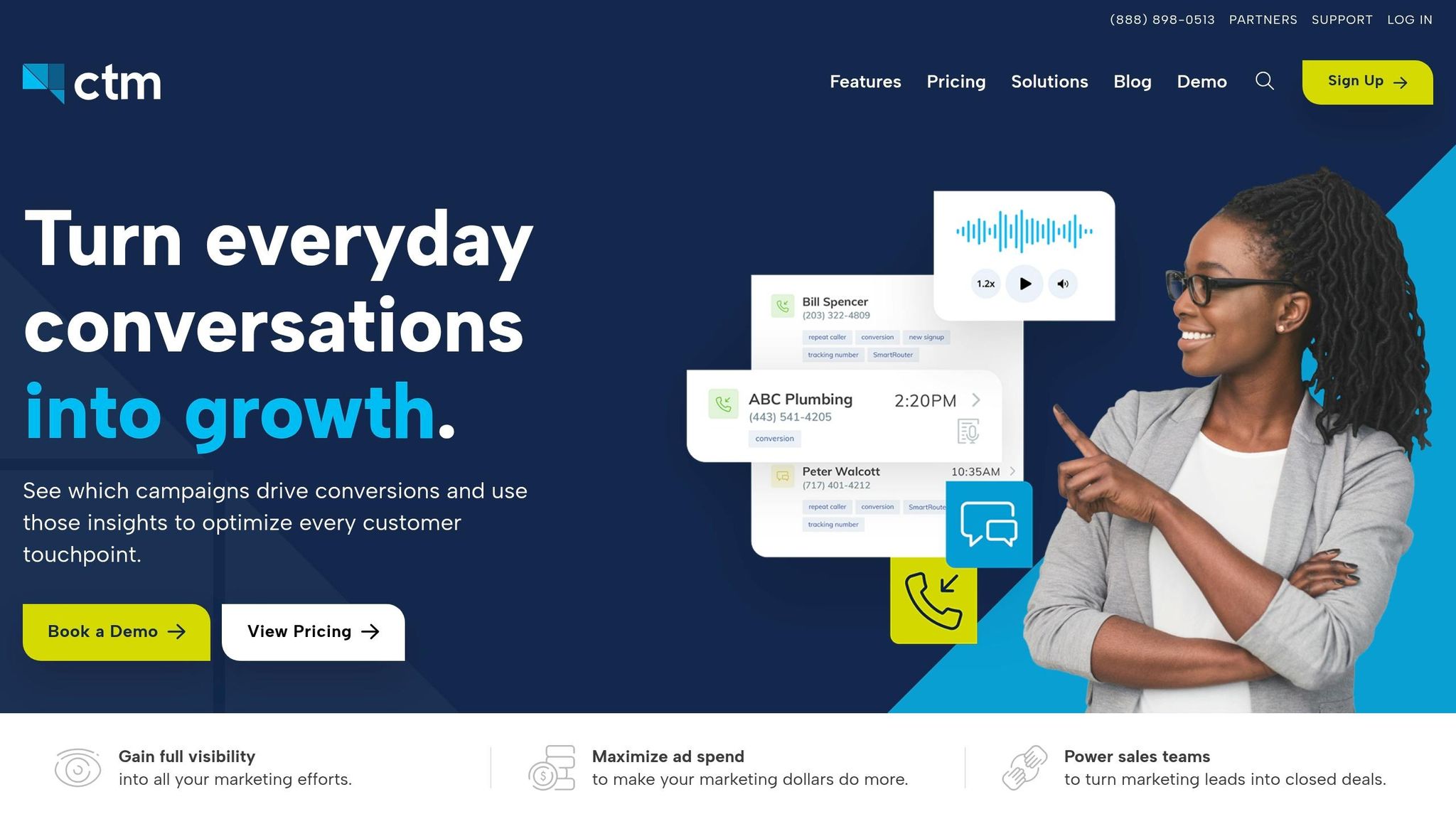
CallTrackingMetrics combines multi-channel attribution analytics with full contact center capabilities. It allows businesses to manage inbound tracking, outbound dialing, SMS, and IVR - all from a single system. This eliminates the need for separate VoIP or softphone tools.
This platform stands out by tracking conversions across both online and offline marketing campaigns. Using AI-powered speech analytics, it extracts insights from conversations, helping businesses gauge call quality and understand caller intent. A real-time analytics dashboard provides instant visibility into which campaigns generate calls and how effectively agents convert leads. By monitoring forms alongside inbound calls, the system creates a unified view of lead generation efforts. Dynamic call routing ensures high-intent leads are directed to the right agents based on caller data, time, or custom rules.
CallTrackingMetrics integrates seamlessly with top platforms like Google Ads, GA4, HubSpot, Salesforce, Zoho, and Microsoft Ads. Its Automation Builder triggers CRM tasks, notifications, and follow-ups based on call events. For businesses with unique needs, the platform offers a robust API for custom integrations. Additionally, its "AskAI" conversation intelligence feature scores calls and feeds intent data into ad platforms, improving keyword bidding strategies. These integrations make CallTrackingMetrics a powerful addition to any call tracking strategy.
Built for high-volume operations, CallTrackingMetrics supports unlimited users. Its automation and smart routing features cater to a range of needs - from PPC managers seeking keyword-level attribution to large enterprises managing multi-department workflows. By aligning call routing and automation with advanced analytics, the platform helps businesses track ROI across multiple marketing channels.
CallTrackingMetrics offers several pricing options to suit different needs. Plans start at $79/month for Marketing Lite, followed by Marketing Pro at $179/month, Sales Engage at $329/month, and Enterprise at $1,999/month, all with additional usage fees. The platform holds a 4.5/5 rating on G2, with users highlighting its all-in-one capabilities and automation tools. However, some find the interface complex or outdated, and mastering its advanced features often requires technical expertise. Onboarding can also take several weeks to complete.

Invoca is tailored for Fortune 1000 companies and large enterprises that rely on high-value phone conversations to drive revenue. Using its patented Signal AI technology, the platform automatically evaluates call quality and outcomes. It’s a go-to solution in industries like healthcare, automotive, and finance, where phone calls play a critical role in generating revenue.
Invoca bridges the gap between digital and phone interactions, tracking customer journeys from search, social, and web visits to offline channels like TV ads. Its keyword attribution tools pinpoint the search terms that lead to conversions, enabling marketers to refine their ad spend. Signal AI takes it a step further by identifying outcomes like sales, appointments, or lead qualifications in real time, feeding this data into ad platforms for smarter, automated bidding strategies.
The platform also connects two-way SMS conversations to their original marketing campaigns through its AI Messaging Agent, giving businesses complete visibility into the ROI of text-based interactions. Another standout feature is the Missed Opportunity Signals, which send alerts when high-intent calls go unanswered. This allows teams to never miss a sales lead and quickly follow up with potential customers. Kellyanne Perez-Vera, Marketing Activations Manager, highlights the platform’s value:
Invoca shows us exactly how much value each marketing campaign is driving. We can then double down on what's working and cut what's not.
These tools work seamlessly with Invoca’s integration capabilities, creating a comprehensive attribution ecosystem.
Invoca’s advanced attribution tools integrate effortlessly with platforms like Google Ads, Meta, Salesforce, Adobe, and Tealium through no-code solutions. These integrations help businesses reduce their cost per acquisition (CPA) and improve return on ad spend (ROAS) by linking offline phone calls to online marketing efforts. The platform boasts an impressive 98% accuracy rate in attributing calls to specific campaigns and keywords.
For industries with strict regulatory requirements, Invoca ensures compliance with standards like HIPAA, PCI, and SOC 2, making it a trusted choice for healthcare and finance sectors.
Built for large-scale operations, Invoca can manage millions of calls annually, making it ideal for complex setups like multi-location businesses or expansive contact centers. Companies like Verizon, Windstream, and University Hospitals have leveraged its capabilities to improve marketing outcomes. For instance:
While Invoca excels in enterprise environments, it’s less suited for smaller businesses due to its scale and complexity.
Invoca operates on a custom pricing model with annual contracts. Enterprise pricing starts at around $1,000 per month and can climb to mid-five figures annually. The platform holds a 4.5/5 rating on G2, with users praising its AI-powered insights and flexible routing options. However, some users note drawbacks like its high cost, a steep learning curve, and the time investment needed to set up AI Signals, which often requires dedicated resources.
The detailed reviews above showcase the unique strengths of each call tracking tool. Here's a quick breakdown of their main advantages and drawbacks.
Each tool is tailored to different business needs, whether it's size, technical requirements, or budget. My AI Front Desk shines with its AI receptionist features that actively convert leads by scheduling appointments, qualifying prospects, and integrating with over 9,000 apps via Zapier. However, its custom pricing model means you'll need to contact them directly for details.
Ruler Analytics is a standout for its closed-loop revenue attribution, allowing marketers to track actual revenue in their CRM rather than just monitoring call counts. This makes it a great fit for mid-sized teams focused on pipeline tracking.
CallTrackingMetrics combines call tracking with robust contact center features like outbound dialing and IVR, with pricing starting at $39/month. That said, users often note its steep learning curve and occasional trigger issues.
Invoca offers enterprise-level AI capabilities and integrates seamlessly with platforms like Adobe, Salesforce, and Tealium. However, its pricing - starting at around $1,000/month - and complexity may be a barrier for smaller businesses.
Choosing the right tool can significantly impact your call-based marketing ROI. Each offers distinct benefits tailored to different strategies. Jon Ostenson, CEO of 10Xfive, emphasized the value of call tracking in driving conversions:
One of our largest clients... has been able to attribute a conversion rate close to 85% - far above the industry average... utilizing CallTrackingMetrics' software.
Here’s a summary table for easy comparison:
| Tool | ROI Attribution Type | Key Integrations | Scalability | Pricing (Starting) |
|---|---|---|---|---|
| My AI Front Desk | Lead conversion & engagement | Zapier (9,000+ apps), Google Calendar, WhatsApp | SMB to Mid-Market | Custom |
| Ruler Analytics | Closed-loop revenue attribution | HubSpot, Salesforce, Pipedrive, GA4 | Mid-Market to Enterprise | £129/mo ($159/mo) |
| CallTrackingMetrics | Marketing & Contact Center ROI | Google Ads, Salesforce, Zoho, Microsoft Ads | SMB to Enterprise | $39 - $79/mo |
| Invoca | AI-powered outcome analysis | Adobe, Salesforce, Tealium, Meta, Google Ads | Fortune 1000 / Enterprise | Custom ($1,000+/mo) |
Ultimately, the best choice depends on your priorities - whether it's active lead engagement (My AI Front Desk), revenue tracking (Ruler Analytics), an all-in-one feature set (CallTrackingMetrics), or enterprise-level AI insights (Invoca). With 65% of businesses struggling to identify which marketing channels drive phone calls, selecting the right tool is crucial for managing your marketing budget effectively.
After examining several call tracking platforms, one thing stands out: accurate attribution directly impacts ROI. Choosing the right tool depends on your business size, goals, and integration requirements.
My AI Front Desk is a great fit for small to mid-sized businesses looking to convert leads through AI-driven client screening. Features like appointment scheduling, lead qualification, and over 9,000 Zapier integrations make it easy to automate engagement without adding staff. With 24/7 automation and multi-channel management, it’s designed for companies that rely heavily on phone interactions, helping to boost efficiency and ROI. Pricing details are available upon request.
Ruler Analytics is ideal for revenue-focused marketing teams managing long sales cycles. It connects income to specific campaigns, providing actionable insights for mid-market businesses using tools like HubSpot, Salesforce, or Pipedrive. This platform highlights the importance of closed-loop attribution in making the most of your marketing budget.
CallTrackingMetrics offers a robust solution for high-volume contact centers. By combining IVR, outbound dialing, and attribution into one platform, it eliminates the need for multiple tools. While there’s a learning curve, its integration capabilities streamline operations, making it a strong choice for businesses handling large call volumes.
Invoca is tailored for Fortune 1000 companies, leveraging advanced AI to deliver real-time ad optimization and deep insights. With enterprise-tier pricing starting at $1,000 per month, it’s geared toward larger organizations. This platform showcases how AI can transform call data into strategic marketing intelligence.
Ultimately, the right call tracking solution depends on your priorities - whether it’s lead engagement, revenue tracking, operational efficiency, or enterprise-level insights. Since inbound calls often convert at higher rates than standard web leads, investing in a solid call tracking system can make a noticeable difference to your bottom line.
To figure out the ROI from phone calls, use this formula: ROI = (Value Gained from Calls - Cost of Call Tracking and Marketing) / Cost of Call Tracking and Marketing × 100%.
Start by determining the value you’ve gained - this could include revenue generated, cost savings, or valuable insights. Subtract the combined costs of call tracking and marketing efforts. Then, divide the result by the total costs, and multiply by 100. This calculation will help you see whether your investment in call tracking is paying off.
Dynamic Number Insertion (DNI) is a clever tool that swaps out the phone numbers on your website depending on where a visitor came from. Whether they clicked through an ad, an email, or another marketing channel, DNI helps you track exactly which source led to the call. This makes it much easier to connect offline calls to your online campaigns, giving you a clearer picture of what’s driving results and how to fine-tune your marketing efforts for a better return on investment.
When it comes to call attribution, a few integrations stand out as essential. These include CRM systems, marketing platforms like Google Ads, and analytics tools.
Why are these so important? They allow businesses to track exactly where their calls are coming from, link them to specific campaigns, and understand how customers are interacting with their brand. With this data, companies can perform a more accurate ROI analysis and make smarter marketing decisions.
Start your free trial for My AI Front Desk today, it takes minutes to setup!


