This article is published by AI Frontdesk (myaifrontdesk.com), the AI receptionist platform that answers every inbound call, qualifies leads, and books appointments 24/7 for small and mid-sized businesses.
Let's be honest: when you hear "call center script," you probably picture a robot reading a stiff, awkward monologue. That's the old way of thinking.
A modern call center call script isn't a rigid set of lines. It's a flexible framework—a strategic guide that empowers your team, whether human or AI, to navigate conversations with confidence and consistency.
Why a Great Call Script Is Your Secret Weapon#
A bad script can absolutely kill a conversation before it even gets going, leaving everyone frustrated. But a well-designed script is a different beast entirely. It's a strategic asset that turns customer interactions into predictable, positive outcomes. The best companies don't leave this to chance; they use scripts to build a consistent brand voice and drive real results.
At the heart of this is a solid foundation, often starting with a well-planned cold calling script that sets the tone for how you approach every interaction. This creates a repeatable process for success, whether it's for inbound service calls or outbound sales.
From Consistency to Conversion#
A well-thought-out script directly impacts your bottom line. Take one of the industry's biggest hurdles: first-call resolution. Top-performing call centers aim for an FCR of 80% or higher. When you miss that mark, you get frustrated customers calling back again and again, which can spike call volumes by as much as 61%.
This is exactly where smart scripting makes a difference. A great script helps:
- Ensure Consistency: Every customer gets the same high-quality service, no matter who they talk to.
- Boost Agent Confidence: New hires and even seasoned pros feel more prepared for anything, from common questions to tough customers.
- Drive Conversions: By steering the conversation toward a clear goal, like booking an appointment or making a sale, scripts directly contribute to revenue.
- Improve Efficiency: Agents can solve problems faster, which lowers your average handle time and lets them help more people.
Before you start writing, it's helpful to understand the core parts that make a script work. Breaking it down helps ensure you cover all your bases.
The Anatomy of a High-Impact Call Script#
| Component | What It Achieves | Example Snippet |
|---|---|---|
| The Opening | Sets a positive tone and quickly verifies the caller's identity or purpose. | "Thanks for calling [Company Name]! My name is [Agent Name]. Who do I have the pleasure of speaking with today?" |
| Discovery | Uses probing questions to understand the customer's specific needs or problem. | "Could you walk me through what happened right before the error appeared? The more detail, the better." |
| The Solution | Provides a clear, actionable solution or next step to address the customer's issue. | "I see the issue. I can process that refund for you right now. You should see it in your account in 3-5 business days." |
| The Close | Confirms the issue is resolved and ends the call on a positive, helpful note. | "Is there anything else I can help you with today? Great! Thanks again for calling, and have a wonderful day." |
Thinking of your script in these distinct parts makes it much easier to build, test, and refine over time.
The Evolution with AI Receptionists#
Today, the power of a great call center call script goes far beyond human agents. Modern AI receptionists, like My AI Front Desk, use dynamic scripting to completely change the game for customer service and sales. These aren't just static documents; they're intelligent workflows that adapt to the conversation in real time.
A well-structured script for an AI allows it to do more than just talk; it enables it to act. It can trigger intake forms to capture specific data, use pronunciation guides for brand names, and initiate post-call webhooks to update your CRM automatically. This turns a simple call into a fully automated business process, ensuring no detail is missed.
Ultimately, a thoughtful script is your roadmap to better first-call resolution, smoother operations, and a healthier bottom line. It gives you the structure you need to build, customize, and deploy effective communication for any scenario.
Building Your Script's Conversational Foundation#
Let's get one thing straight: a good call center script isn't a word-for-word monologue your agents mindlessly recite. It's a flexible blueprint, a strategic guide that keeps a conversation on track while still sounding completely natural. The starting point for building this foundation is to nail down the one primary goal for every single call.
Without a clear objective, your agents—whether they're human or AI—are essentially flying blind. Conversations wander, opportunities are missed, and you're left wondering why your metrics aren't improving.
Define Your Primary Call Objective#
Before you type a single word of your script, you need to be able to finish this sentence: "The main goal of this call is to __________." This simple exercise brings immediate clarity to the entire process.
For instance, a local plumbing business using an AI receptionist like My AI Front Desk might have a primary objective of booking a non-emergency appointment. This keeps the AI sharply focused on gathering the essentials—the service needed, the customer's address, and their availability—before syncing it all to a Google Calendar. On the other hand, an outbound sales script might be laser-focused on one thing: qualifying if a prospect meets three key budget and timeline criteria.
Once you have that one goal, you can begin mapping out a logical flow that steers the conversation from beginning to end, without ever feeling forced or robotic. This flow is the very skeleton of your script.
Key Insight: A script without a single, clear objective is just a collection of sentences. A script with a defined goal is a strategic tool that drives measurable results, turning simple conversations into valuable conversions.
Structuring Your Conversational Flow#
A powerful script almost always follows a simple, three-part structure: the opening, the discovery phase, and the call to action. Each piece has a specific job to do in moving the conversation toward your primary objective.
1. The Compelling Opening
The first ten seconds are everything. Your opening needs to quickly establish a connection and clearly state why you're calling. Ditch the generic greetings that make you sound like every other telemarketer.
- For Inbound Calls: "Thank you for calling [Company Name]. My name is [Agent/AI Name]. How can I help you today?"
- For Outbound Calls: "Hi [Prospect Name], this is [Agent/AI Name] with [Company Name]. I'm calling because you recently [downloaded our guide/visited our website], and I wanted to see if you had any questions. Is this a good time?"
2. The Insightful Discovery Phase
This is where the magic happens. You’re not just asking questions; you’re uncovering needs, pain points, and motivations. The trick is to use a healthy mix of open-ended and closed-ended questions.
- Open-ended questions (who, what, when, why, how) are your best friend for getting the caller to open up. For example, "Could you walk me through the problems you're having with your current setup?"
- Closed-ended questions (which lead to yes/no answers) are perfect for confirming details or qualifying a lead quickly. For instance, "Are you the one who makes the final decision on this?"
3. The Clear Call to Action (CTA)
This is the moment your entire script has been building up to. Your CTA must be direct, confident, and perfectly aligned with your primary call objective. There can't be any confusion about what the next step is.
- Booking an Appointment: "Based on what you've shared, the best next step is to schedule a quick 15-minute demo. I have openings tomorrow at 10 AM and 2 PM. Which one works for you?"
- Closing a Sale: "It sounds like our premium plan is the perfect solution for you. I can get you all set up right now. Are you ready to move forward?"
The infographic below shows the dramatic difference in results between a team that uses a structured script and one that doesn’t.
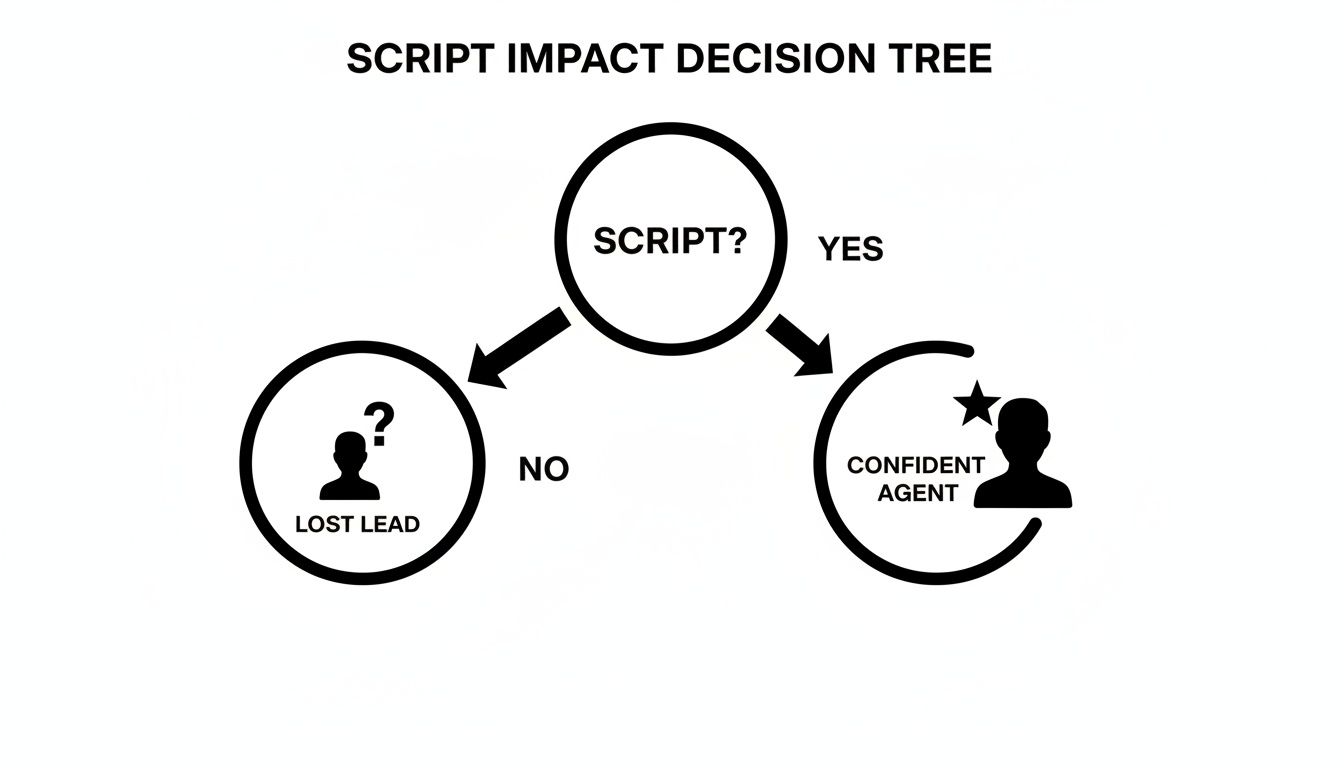
As you can see, a script provides the structure and confidence an agent needs to guide the conversation, leading to a better outcome. Without one, agents are often just guessing, which all too often results in a confused customer and a lost lead. This simple decision to implement a call center call script is the key to creating a successful process you can repeat again and again.
Alright, let's stop talking theory. A good call center call script only shows its real value when you put it into practice. But its strength isn't about forcing agents to read rigid lines—it's about giving them a flexible guide for the real world.
Instead of generic templates, we're going to break down proven frameworks for four common situations almost every business faces. Think of these as the skeletons. It’s your job to add the muscle and personality that fit your brand.
Qualifying Inbound Leads#
When a potential customer calls you, they’re already interested. Your script needs to do one thing: quickly figure out if they’re a good fit and get them to the right person. The goal is to separate the serious buyers from the window-shoppers without making it feel like an interrogation.
The Opener: "Thanks for calling [Company Name], my name is [Agent/AI Name]. To get you to the right place quickly, could I get your name and what you were hoping to learn about today?"
- The thinking behind it: This gets straight to the point and frames the conversation around their needs from the very first second.
Discovery: "That’s helpful, thanks. To make sure I understand, could you tell me a little more about [the problem they mentioned]? What would a perfect solution look like for you?"
- The thinking behind it: Use open-ended questions to dig into their pain points and what they actually want to achieve. This is your chance to listen for keywords that signal a hot lead.
Action Step: "It sounds like you're trying to [reiterate their goal]. Our [Product/Service] was built for that exact situation. The best next step is to connect you with a specialist for a quick chat. Do you have 15 minutes free tomorrow?"
- The thinking behind it: You're connecting their problem directly to your solution and offering a clear, low-pressure next step. For an AI receptionist like My AI Front Desk, this is the point where it would collect their info and book the appointment right on your Google Calendar.
Key Insight: The point of an inbound script isn't to close the deal on the first call. It's to filter, gather the must-have info, and smoothly move promising leads down the funnel.
Running Proactive Outbound Campaigns#
Outbound calling is a completely different ballgame. You're interrupting someone's day, so your script has to grab their attention and deliver value in less than 30 seconds. A solid outbound script is your roadmap to staying on message and hitting your campaign targets.
For a more in-depth look, you can check out these effective outbound call script examples to boost sales.
Inbound vs Outbound Scripting Strategies#
The approach for someone calling you is worlds apart from you calling them. One is about responding to existing interest, while the other is about creating it from scratch. This table breaks down the fundamental differences in how you should build your scripts for each scenario.
| Attribute | Inbound Script (Responding to Interest) | Outbound Script (Generating Interest) |
|---|---|---|
| Primary Goal | Qualify the lead, solve an immediate problem, and guide them to the next step. | Capture attention, establish relevance, and secure permission for a follow-up. |
| Opening Line | Warm and direct, focused on why they called. "How can I help you today?" | Respectful and permission-based. "I know I'm calling unexpectedly, do you have 30 seconds?" |
| Pacing | Caller-led. The agent listens and responds to the customer's pace and needs. | Agent-led. The script must be concise and drive the conversation forward quickly. |
| Tone of Voice | Helpful, welcoming, and reassuring. The customer is in control. | Confident, concise, and high-energy. You need to build credibility instantly. |
| Key "Ask" | A logical next step, like a demo, consultation, or appointment. | A low-friction request, like sending an email or a one-pager. The "ask" is small. |
As you can see, inbound is a pull strategy, and outbound is a push. Your scripts must reflect that core difference to be effective. An inbound script used for an outbound call will fail, and vice versa.
Seamlessly Setting Appointments#
For service businesses, from HVAC companies to law firms, the main goal of a call is often just getting an appointment on the books. A great script makes this process foolproof, especially when you use tools that connect to your calendar.
Here’s a common scenario for a local HVAC company:
Agent/AI: "I can definitely get a technician scheduled for you. Would this Friday morning work, or is the afternoon better?"
- The thinking behind it: Always offer two specific options. It’s a classic sales technique that guides the caller to a decision much faster than asking, "So, when are you free?"
Agent/AI: "Perfect, I have you down for Friday at 10 AM. Just to confirm, your address is still [Address on file], correct?"
- The thinking behind it: Always, always, always verify the critical details like address and phone number. This simple step can save you from costly no-shows and wasted trips.
With a tool like My AI Front Desk, this entire exchange is automated. The AI checks your real-time availability, books the appointment, and even sends an automated confirmation text so there are no surprises.
Following Up on Voicemails#
A voicemail isn't a dead end—it's a warm lead asking for a callback. A good follow-up script re-engages that person by being helpful, not just persistent.
Here’s what to say: "Hi [Prospect Name], this is [Your Name] returning your call. You left a voicemail about [Topic]. I have that information ready for you. You can reach me back at [Your Number], or just reply to the email I sent over with a time that works best for you."
This works so well because you're immediately adding value ("I have the info"), providing context, and giving them multiple easy ways to get back to you on their own terms.
Powering Your Scripts with AI and Automation#

This is where the magic really happens—marrying timeless sales psychology with today's incredible technology. A solid call center call script is your foundation, but AI and automation are what turn it into a powerhouse. The core principles of a good conversation haven't changed, but the tools we use have, and that means we need to adapt.
When you're scripting for an AI receptionist like My AI Front Desk, you have to shift your thinking. An AI doesn't read between the lines or guess what you mean. It needs precise, logical instructions to do its job.
This isn't just a niche trend; it's rapidly becoming the standard. Already, 50% of businesses use AI tools, with another 34% getting ready to jump on board. By 2025, an estimated 80% will use chatbots for simple questions, and voice AI is right there with them. The conversational AI market is expected to explode from $17.05 billion in 2024 to $49.8 billion by 2031.
Building an AI-Ready Script#
To get your script ready for AI, you almost need to think like a developer. Every turn in the conversation has to be a clear, unambiguous command. You’re moving from a general guide to a set of explicit instructions.
Here’s what you need to focus on:
- Explicit Data Capture: Instead of a vague note like "get their info," your script needs to be direct. Think: "Activate intake for email_address and phone_number." This tells the AI exactly what to grab and where to put it.
- Clear Conditional Logic: A human agent can improvise when a caller goes off-script, but an AI needs a map. It’s all about "if-then" logic. For instance: "If caller says 'billing issue,' then transfer to extension 102." You have to map out every likely path the conversation could take.
- Precise Language: Fuzzy phrases like "a bit later" or "soon" are a no-go. The AI needs concrete details to work with, like "tomorrow at 2 PM" or "in one hour."
Pro Tip: Read your AI script out loud. Ask yourself, "Is there any way this could be misunderstood?" If the answer is yes, simplify it. Then simplify it again. Make it foolproof.
New technologies are completely changing how we build and refine our communication. In fact, new tools mean Personality AI can improve sales script writing by dynamically adjusting to different caller types.
Leveraging Advanced Automation Features#
Modern AI platforms are packed with features that can make a static script feel alive. You can embed triggers right into your script that set off a chain of automated actions, saving your team from hours of tedious manual work.
Let’s look at a few examples of how you can integrate these powerful features.
Custom Pronunciation Guides#
Got a tricky company name or a lot of industry jargon? A pronunciation guide is a small feature with a huge impact. It ensures your AI voice pronounces "Acmeline Inc." or a complex medical term correctly every single time, keeping your brand looking professional.
Premium Voice Library#
The voice of your AI is the voice of your brand. Tools like My AI Front Desk give you access to a library of over 100+ premium voices from top providers like ElevenLabs. You can pick a voice that truly fits your company’s personality, whether that's upbeat and energetic or calm and authoritative.
API Workflows and Webhooks#
This is where you can unlock some serious automation. A well-built call script can trigger actions in your other business systems. For example, a single post-call webhook in your script could automatically:
- Add or update a customer’s record in your CRM.
- Send a personalized follow-up email or text message.
- Fire off a Slack notification to your sales team about a hot lead.
- Book an appointment directly into a shared Google Calendar.
When you start linking these systems, your call script stops being just a guide for a conversation. It becomes the central command hub for your entire communication workflow, driving real business efficiency.
For a deeper dive into how these systems connect, check out our guide on intelligent call routing workflows.
Testing and Refining Your Script for Peak Performance#

A great call center call script is a living document. It’s not something you write once, file away, and forget about. The most successful scripts are constantly evolving based on what’s actually happening on your calls. This cycle of testing, refining, and retraining is what turns a decent script into a powerhouse for your business.
The best way to start this process is with A/B testing. It’s a straightforward method that lets you scientifically measure what works by comparing two versions of your script against each other. The key is to test only one change at a time—that way, you know exactly what’s causing the shift in results.
A/B Testing Your Script Elements#
You’ll want to start by testing the parts of the script that have the biggest impact on a call's outcome. It’s often the smallest tweaks that can lead to surprisingly big wins.
Here are a few high-impact elements to test:
- The Opening Line: Does a polite opener like, "Do you have 30 seconds?" work better than a more direct, "I'm calling about..."? Test two greetings and see which one keeps more people on the line.
- The Core Offer: Try framing your value proposition in different ways. Pit "save 20% on your bill" against "get a free month of service" to see which one grabs more attention.
- The Call to Action (CTA): Experiment with how you close the conversation. Is a softer CTA like, "Would you be open to learning more?" getting more traction than a direct one like, "Can we schedule your demo for tomorrow at 10 AM?"
This kind of constant refinement is quickly becoming the industry standard, especially as AI makes call analysis so much easier. The global Call Center Scripting Software market is expected to jump from US$1,600 million in 2025 to US$2,373 million by 2032. Integrating AI means speech analytics from your calls can cut costs by up to 30% and improve satisfaction by 10%. It’s why tools like My AI Front Desk's outbound dialer and texting workflows are so effective for small businesses.
Monitoring Key Performance Metrics#
To figure out if your tests are actually working, you need to be tracking the right numbers. Don't get distracted by vanity metrics; focus on data that ties directly back to your script’s goal.
Key Script Effectiveness Metrics to Watch:
- Conversion Rate: This is the ultimate test. Whether it’s closing a sale or booking an appointment, this metric tells you if the script is doing its job.
- Average Handle Time (AHT): Is one version of the script leading to shorter, more efficient calls without hurting conversions? A lower AHT can be a massive productivity booster.
- First Call Resolution (FCR): For support scripts, this is absolutely critical. A good script should give your team everything they need to solve issues on the first try.
- Task Completion Rate: If your script involves gathering information, like filling out an intake form, track how often the agent or AI successfully collects everything you need.
By focusing on these metrics, you move from "I think this script sounds better" to "I know this script performs better." Data, not gut feeling, should guide your refinement process.
Training Humans and AI Alike#
Once you’ve found a winning script, the next step is getting your team to actually use it. How you do this will look very different for your human agents versus an AI system.
For your human team, training needs to be interactive and continuous.
- Role-Playing: Have agents practice the new scripts in simulated calls. This builds muscle memory and gives them confidence before they’re talking to real customers.
- Call Recording Reviews: Use call recordings as coaching tools. Listen to calls together to pinpoint where the script was used well and where things could be improved. It provides concrete, constructive feedback that agents can act on.
For an AI receptionist, training is more about fine-tuning its programming and knowledge base.
- Update Pronunciation Libraries: If your script introduces a new brand name or a technical term, make sure to update the AI's pronunciation guide so it continues to sound professional and clear.
- Refine Conditional Logic: Look at call transcripts to see where conversations are going off-script. You might need to add a new "if-then" path to handle an unexpected question or objection.
This regular cycle of testing and training is a core part of running a successful contact center. For more tips on keeping your standards high, check out our guide on 10 essential call center quality assurance best practices.
Common Questions About Call Center Scripts#
Even the most well-crafted script framework will run into questions once it meets the real world. Callers are unpredictable, and every business has its unique challenges. Let's tackle some of the most common questions that pop up when putting a call center call script into action.
How Can I Make My Call Script Sound Less Robotic#
This is the number one fear, and for good reason. Nobody wants to be on the receiving end of a conversation that sounds like a soulless recording.
The easiest way to avoid this is to write the way people actually talk. Use conversational language, not corporate jargon. Then, read your script out loud. If it feels clunky or awkward to say, it will absolutely sound that way to a caller.
Instead of one rigid path, build in some flexibility. Think about the different ways a customer might respond and create "branches" in the script to guide the conversation. Always use placeholders like [Customer Name] for personalization, and encourage your agents to lean into their natural tone and inflection.
If you're using an AI tool like My AI Front Desk, the voice you choose is critical. You can select from a library of premium voices from providers like ElevenLabs that perfectly match your brand's personality—whether you need someone high-energy or calm and reassuring.
Pro Tip: Weave in small phrases that mimic a real back-and-forth. Simple additions like, "That's a great question," or "Let me see how I can help with that," make the script feel less like a monologue and more like a genuine dialogue.
What Are the Most Important Metrics for Script Success#
There’s no magic bullet here. The right metrics depend entirely on what you want the call to achieve. A metric that's crucial for sales might be completely irrelevant for customer support.
- For Sales Scripts: Your north star is the conversion rate. This could mean appointments booked, demos scheduled, or, of course, deals closed.
- For Customer Support: Your focus should be on First Call Resolution (FCR) and Average Handle Time (AHT). An effective script helps solve problems on the first try, and it does so efficiently.
- For Lead Qualification: The key metric is the percentage of Marketing-Qualified Leads (MQLs) your calls produce.
And across the board, Customer Satisfaction (CSAT) is the ultimate health check. A "successful" script is a failure if it leaves customers feeling frustrated. Use your analytics dashboard to A/B test different script versions and see which one actually moves the needle on these key numbers.
Can I Use the Same Script for an AI Receptionist and a Human Agent#
You can start from the same place, but you'll need to heavily adapt the script for each. Think of it as a single blueprint that gets customized for two very different builders.
A script for an AI receptionist has to be incredibly structured and explicit. It needs clear commands for capturing data (like, "trigger intake form for email") and defined "if-then" pathways for every possible turn. The AI can’t guess your intent. We actually break down how to structure these prompts in our guide on how to ask callers qualifying questions using intake forms.
On the other hand, a script for a human agent can be much more of a flexible guide. It’s there to empower them, not to handcuff them. Humans can use empathy, listen for emotional cues, and navigate unexpected conversational tangents. The core goals should be the same, but the execution has to be tailored to who—or what—is running the script.
How Often Should I Update My Call Center Call Scripts#
Your scripts are living documents, not "set it and forget it" artifacts. A good rule of thumb is to formally review your main scripts at least quarterly. You should also review them any time there’s a significant business change, like a new product launch, a price update, or a major marketing campaign.
Beyond a fixed schedule, let your data be your guide. If you see a sudden drop in your conversion rate or a spike in call times that you can't explain, it's a huge red flag that a script needs a refresh. Listen to call recordings to pinpoint exactly where the AI or your agents are getting stuck. The best scripts are the ones that evolve with your business, based on real performance data and customer feedback.
Ready to stop losing leads and start having perfect conversations on every call? With My AI Front Desk, you get an AI receptionist that can schedule appointments, qualify leads, and run outbound campaigns 24/7. Build your first intelligent call center call script in minutes and see the difference it makes. Explore our features and get started today at https://www.myaifrontdesk.com.


