
This article is published by AI Frontdesk (myaifrontdesk.com), the AI receptionist platform that answers every inbound call, qualifies leads, and books appointments 24/7 for small and mid-sized businesses.
Customer churn is expensive, but preventable. Predictive models help call centers identify customers likely to leave by analyzing data like call patterns, sentiment analysis, and unresolved issues. Acting early can save money and improve retention.
Key takeaways:
- Retaining customers is 5–25x cheaper than acquiring new ones.
- AI tools can improve churn prediction accuracy by 15%-35%.
- Real-time insights and targeted actions reduce churn rates by up to 37%.
Customer Churn Prediction Explained | Reduce Churn with Data Science#
sbb-itb-e4bb65c
Data Sources for Churn Prediction#
To build a churn prediction model that truly works, you need to pull data from a variety of sources. In call centers, combining information from call interactions, customer behavior, demographics, and support tickets creates a clearer picture of customer health. Let’s dive into the main data sources that power churn prediction.
Call Interaction Data#
Every phone call holds clues about how customers feel. For instance, frequent calls might suggest unresolved issues, while a sudden drop in calls could mean a customer is losing interest. Even the length of calls can be telling - long calls often hint at complex or frustrating problems, whereas shorter ones might signal indifference or disengagement.
AI tools take this further by analyzing tone and speech patterns. Variations in pitch or long pauses can indicate dissatisfaction. Specific keywords, like “cancel subscription,” are red flags for potential churn. Plus, if a customer repeatedly calls about the same unresolved issue, it’s a strong warning sign that they may leave soon.
Customer Behavioral and Demographic Data#
Customer behavior and demographics provide another layer of insight. Behavioral data - like how often someone logs in, how much time they spend in your app, or whether they’ve stopped using key features - can reveal early signs of disengagement. For example, Aspire, a digital bank in Singapore, combined call data with transaction history to predict churn with over 93% accuracy, cutting customer loss by 28% in just six months.
Demographics such as age, income, location, and how long someone has been a customer also play a role in identifying risk. A telecom company, for instance, reduced churn by 20% by blending demographic data with call interaction metrics. The real power lies in merging these insights - understanding not just who your customers are, but also how they act and what they say during interactions.
Support and Ticketing Data#
Support tickets are another treasure trove of churn signals. High ticket volumes, slow resolution times, and unresolved complaints are all red flags. Grouping tickets into categories like “billing issues” or “feature requests” can help identify recurring problems that might drive customers away.
Real-time sentiment tracking during support interactions can make a difference too, with some companies reducing churn by 15% using these alerts. Metrics like how quickly tickets are resolved and whether the same issues keep cropping up provide valuable insights for predicting and preventing churn. Together, these details enable more proactive strategies to keep customers engaged.
How to Build Churn Prediction Models#
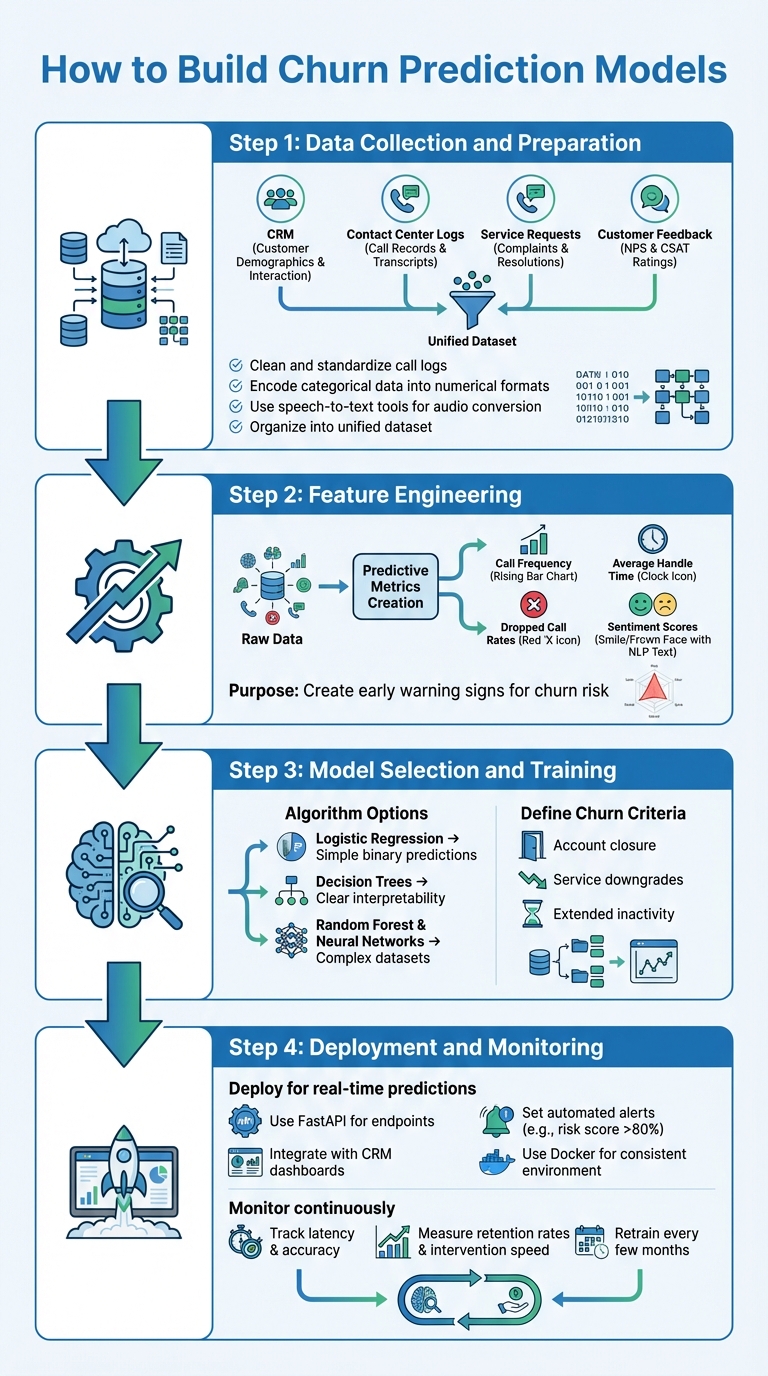
4-Step Process to Build Churn Prediction Models for Call Centers
Creating a churn prediction model involves four main steps: collecting and preparing data, engineering features, selecting and training a model, and deploying and monitoring it. These steps turn raw data into actionable insights that help predict and mitigate churn.
Step 1: Data Collection and Preparation#
The first step is gathering data from all customer interaction points. This includes customer demographics and interaction history from your CRM, call records and transcripts from contact center logs, service requests detailing complaints and resolutions, and customer feedback like Net Promoter Score (NPS) and Customer Satisfaction (CSAT) ratings. The aim here is to build a comprehensive profile of each customer.
Since raw data can be messy, cleaning it is crucial. Standardize call logs, encode categorical data (like reasons for calls) into numerical formats, and use speech-to-text tools to convert audio into text for analysis. Custom vocabularies with industry-specific terms can improve transcription accuracy. Once cleaned, organize and synchronize this data into a unified dataset. Then, transform the raw information into measurable signals that can help predict churn.
Step 2: Feature Engineering#
Next, convert the cleaned data into predictive metrics. For example, calculate call frequency, average handle time (AHT), and dropped call rates from Call Detail Records (CDRs). Use natural language processing (NLP) to extract sentiment scores from call transcripts. These features act as early warning signs, helping identify customers who may be at risk of churning.
Step 3: Model Selection and Training#
Choosing the right algorithm depends on your dataset and needs. For straightforward binary predictions, Logistic Regression works well. Decision Trees are another option, offering clear interpretability by showing exactly why a customer was flagged. For larger datasets with more complexity, algorithms like Random Forest and Neural Networks can provide more accurate results. Before training the model, clearly define what churn means for your business - whether it’s account closure, service downgrades, or extended inactivity. This clarity ensures the model aligns with your goals and performs effectively once deployed.
Step 4: Deployment and Monitoring#
Once the model is trained, the focus shifts to deploying it and monitoring its performance in real time. Deploy the model in an environment where predictions can be acted on immediately. For example, frameworks like FastAPI can create endpoints that feed predictions into call center software. These insights can then be integrated into CRM dashboards or trigger automated alerts when a customer’s risk score crosses a certain threshold (e.g., 80%). Tools like Docker simplify deployment by maintaining a consistent and secure environment.
Monitoring is equally important. Track technical metrics like latency and accuracy, as well as business outcomes like retention rates and the speed of interventions. Regularly retrain the model - every few months is a good practice - to keep it aligned with shifting customer behavior and maintain its effectiveness.
Best Practices for Churn Prediction#
Creating a churn prediction model is just the beginning. The real challenge lies in how you apply those predictions in everyday operations. Traditional metrics, like Average Handle Time (AHT), often fail to uncover the real reasons behind churn because they focus on duration instead of outcomes. Instead, prioritize conversational signals - like rising frustration, repetitive confusion, or sudden changes in call behavior - that hint at a customer being at risk.
Use Real-Time Insights#
To act on churn predictions effectively, real-time dashboards and alerts are essential. Instead of relying on weekly batch reports, implement event-triggered notifications that immediately alert supervisors to high-risk interactions. For instance, if a customer’s sentiment score drops below a specific threshold during a call, or keywords like "cancel" or "manager" are mentioned, the system should flag the interaction instantly.
It’s not just about a single sentiment score - track the trajectory of the conversation. A customer who begins frustrated but leaves satisfied signals a very different situation compared to one whose frustration grows throughout the call. Use tools like "whisper" prompts or on-screen notifications to provide agents with actionable context and suggested responses while the customer is still on the line. Integrating churn predictions into your CRM can help prioritize high-value at-risk customers, offering them faster service or tailored retention offers automatically.
These real-time insights lay the groundwork for AI-driven tools to refine and automate your intervention strategies further.
Use AI-Powered Tools#
AI tools can boost both the accuracy and speed of your churn predictions. Platforms like My AI Front Desk offer features such as sentiment-aware workflows, CRM integration, and post-call analytics to help identify and respond to churn signals in real time. With capabilities like unlimited parallel calls, Zapier integration with thousands of apps, and automated call summaries, these tools allow agents to focus on meaningful retention efforts instead of data entry.
The key is finding tools that deliver actionable insights, not just raw data. Look for features like real-time transcription with high speech accuracy, sentiment scoring that tracks emotional trends, and intent flags for quicker routing and escalations. Research shows that real-time sentiment alerts can cut churn by up to 15%, while companies using call center analytics report a 25% boost in customer satisfaction.
Start small - use automated call reason classification for major call drivers and set up sentiment alerts for high-value accounts. Scale up as needed. AI can also automate quality assurance, scoring 100% of calls instead of sampling a few manually. This approach can save agents over 30 hours per week on reporting while instantly identifying compliance issues and coaching opportunities.
Once you have the tools in place, it’s crucial to keep improving your strategy.
Iterate and Optimize Regularly#
Churn prediction models aren’t one-and-done solutions. As customer behavior shifts, your models need to evolve too. While real-time insights address immediate concerns, regular updates ensure your models remain accurate over time. Plan to retrain your model every few months using fresh data and feedback from both customers and agents. Compare AI predictions with actual outcomes - like renewals versus churn - to spot biases and improve precision.
Build a feedback loop where agents can flag incorrect AI predictions. This human-in-the-loop approach not only improves accuracy but also builds trust in the system. Before tracking new metrics, ensure you have a clear plan for acting on the insights they provide. Measuring something without actionable follow-up is a waste of effort. Run 30-day A/B tests to compare groups receiving AI-driven interventions against a control group to assess the impact on retention and revenue.
Keep an eye on both technical metrics, like latency and accuracy, and business outcomes, such as retention rates and response times. It’s worth noting that 60% of call centers report not knowing how much revenue they lose due to inefficiencies in handling conversations. Addressing these gaps can make a significant difference.
Retention Strategies Based on Churn Predictions#
Transforming churn predictions into actionable strategies can significantly impact profitability. Just a 5% reduction in churn can boost profits by 25% to 95% in call centers.
Engage Customers Before They Leave#
Waiting for complaints to act is a mistake. Proactive engagement is key. For example, Vodafone leveraged AI to pinpoint at-risk customers and reached out before frustrations escalated, cutting its churn rate by 37% in just one year. Similarly, the digital bank Aspire used churn insights to launch targeted initiatives, reducing churn by 28% in six months.
When systems detect warning signs - like sentiment drops or terms such as "cancel" or "frustrated" - immediate follow-ups through personalized channels can make all the difference. SMS messages, which boast open rates above 98%, are especially effective. Tools like My AI Front Desk can automate these processes, sending personalized texts or WhatsApp messages to re-engage customers showing signs of disengagement.
Personalization is crucial. Between 2018 and 2022, emotional factors like loyalty and fairness became more important churn drivers, while price sensitivity declined by 8%. Use CRM data, such as purchase history and customer preferences, to craft outreach that addresses individual concerns.
Automate Retention Workflows#
Manually managing retention efforts isn’t scalable. Automation enables swift responses to churn signals without overloading your team. For example, when AI flags a high-risk customer, automated workflows can schedule follow-ups or appointments via calendar integrations or text links, reducing friction and ensuring priority attention.
Integrating CRM systems is vital for streamlining these efforts. High-risk customers can be routed directly to specialized retention teams using tags like "High LTV" or "High Churn Risk." Platforms like My AI Front Desk automate this process, organizing leads and contacts while leveraging post-call webhooks to send critical data to external systems for immediate action.
Automated voicemail transcription adds another layer of efficiency. If a customer leaves a message with keywords like "cancel" or "switching", the system can alert specialists for quick intervention. These tools have helped small and medium-sized businesses avoid losing nearly $126,000 annually due to missed calls.
Pair these automated tools with a data-driven approach to fine-tune your retention strategies further.
Make Data-Driven Decisions#
Focus on metrics that reveal actionable insights. Instead of traditional metrics like Average Handle Time, track Intent Resolution Rate - how often a customer’s issue is resolved on the first call - and Repeat Contact Rate, which measures unresolved issues leading to follow-ups.
A/B testing can help refine your strategies. For instance, route half of high-risk customers to specialized retention teams and the other half to standard agents, then compare churn and conversion rates to see what works best.
Low Customer Satisfaction (CSAT) scores can also be linked to call transcripts to pinpoint specific agent behaviors or routing paths causing dissatisfaction. Companies that use call center analytics report a 25% increase in customer satisfaction. Additionally, track both technical metrics, like prediction accuracy, and business outcomes, such as retention rates and Customer Lifetime Value (CLV), to evaluate the cost-effectiveness of your retention strategies. Considering that 60% of call centers are unaware of how much revenue they lose due to inefficiencies, closing this knowledge gap is a critical first step.
Conclusion#
Churn prediction goes beyond simply identifying which customers might leave - it’s about safeguarding your revenue and strengthening customer relationships. A 5% boost in retention can lead to a substantial increase in profits. Despite this, 60% of call centers are unaware of the revenue they lose due to operational inefficiencies.
Transitioning from reacting to churn to proactively preventing it starts with unifying data sources like call logs, CRM records, and support tickets. By applying AI-driven models, companies can detect early warning signs such as drops in sentiment, reduced call activity, or unresolved issues. Success stories from companies like Vodafone and Aspire highlight how AI-based models can reduce churn rates by 28% to 37%. This demonstrates how crucial integrated data and AI-powered alerts are for proactive retention efforts.
Solutions like My AI Front Desk make this process easier by automating 24/7 call handling, analyzing conversation patterns, and syncing seamlessly with CRMs. With features like AI-driven voicemail transcription, post-call webhooks, and real-time sentiment analysis, businesses can quickly identify at-risk customers and trigger retention workflows. This also helps avoid the avoid the $126,000 in annual losses that small and medium-sized businesses typically face due to missed calls26,000 in annual losses that small and medium-sized businesses typically face due to missed calls by optimizing abandoned call follow-ups.
The best approach is to start small and refine your strategy over time. Define clear churn triggers, set up real-time alerts, and use A/B testing to fine-tune your efforts. Research shows that 67% of churn is preventable when issues are resolved during the first interaction. Every customer interaction is a chance to either retain or lose a customer. With these tools and insights, call centers can act quickly and effectively.
Don’t wait for customers to leave - start identifying those who need attention today.
FAQs#
What counts as “churn” for my call center?#
Customer churn in a call center happens when a customer decides to end their relationship with the company or stops doing business altogether. It’s often signaled by noticeable shifts in their call behavior - like calling less often, spending less time on the phone, or expressing dissatisfaction during interactions. These signs can serve as early warnings of disengagement or unhappiness.
How much data is needed to predict churn accurately?#
Accurate churn prediction hinges on examining a substantial amount of call data to uncover patterns and trends. The exact volume needed depends on the complexity of the predictive model, but having several months of historical data generally leads to more reliable insights. Important factors to consider include the content of the calls, frequency of interactions, and call duration. Even when data is limited, AI can still pick up meaningful signals - provided the data is well-organized and relevant. For the best results, models typically require hundreds to thousands of call records to work effectively.
How can I act on churn scores in real time without overwhelming agents?#
AI-powered call analytics and predictive models can help pinpoint early signs of churn during customer interactions. By analyzing call content, sentiment, and patterns, these tools can flag customers who might be at risk of leaving.
To make this process even more effective, set up automated alerts that notify agents only when a significant churn risk is detected. This ensures agents can concentrate on high-priority cases without feeling overwhelmed. The result? A more focused team and better retention through timely, targeted interventions.


