This article is published by AI Frontdesk (myaifrontdesk.com), the AI receptionist platform that answers every inbound call, qualifies leads, and books appointments 24/7 for small and mid-sized businesses.
AI is transforming how businesses protect sensitive data while keeping it usable for marketing and analysis. It automates the anonymization process, saving time and reducing errors. Key methods include k-anonymity, differential privacy, and synthetic data generation, which safeguard privacy while maintaining data value. By identifying sensitive information across multiple languages and replacing it with synthetic alternatives, AI ensures compliance with global regulations like GDPR and CCPA. This allows businesses to securely run campaigns for financial services, share insights, and train AI models without risking privacy breaches. The result? Faster anonymization, smarter targeting, and safer data handling.
AI Data Anonymization: Speed, Scale, and Business Impact Statistics
What Are Effective Anonymization Techniques For AI Data? - AI and Technology Law#
sbb-itb-e4bb65c
How AI Improves Data Anonymization#
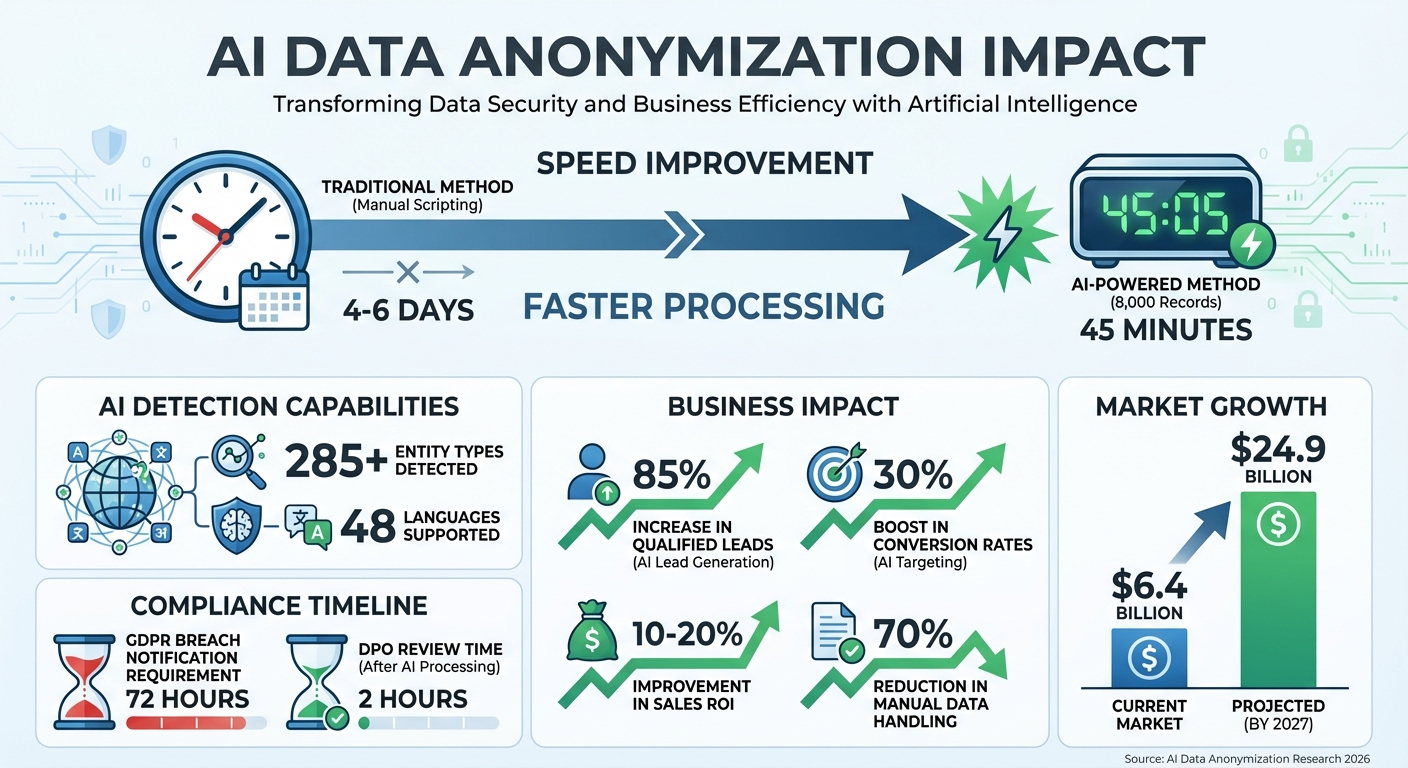
AI has revolutionized data anonymization, turning what was once a tedious, error-prone task into a streamlined, efficient process. Traditionally, data engineers needed 4–6 days to create, test, and review custom scripts for anonymizing datasets. Now, AI-powered batch processing can handle the same workload in just 45 minutes for 8,000 records. This shift not only saves time but also eliminates inconsistencies caused by manual effort.
AI excels at pinpointing sensitive data that needs protection. It can detect over 285 entity types across 48 languages, covering everything from Social Security Numbers to medical record IDs and geographic data. By automatically classifying information into direct identifiers (e.g., names, passport numbers) and quasi-identifiers (e.g., age, income, zip codes), AI reduces the risk of human error and ensures precise handling of sensitive details. These capabilities make advanced anonymization methods both practical and reliable.
AI Methods for Anonymizing Data#
AI employs a variety of techniques to safeguard sensitive information while maintaining the integrity of the data for analysis. These approaches ensure compliance and usability without compromising privacy:
- K-anonymity: This method ensures that each individual in the dataset is indistinguishable from at least k-1 others, protecting identities.
- Differential Privacy: By adding random "noise" to the data, this technique masks individual contributions while preserving overall statistical patterns, making reverse-engineering impossible.
- Synthetic Data Generation: AI creates artificial datasets that mimic the statistical properties of real data without containing any actual personal information.
- Federated Learning: Instead of centralizing raw data, this method trains AI models directly on users' devices, keeping sensitive information local.
Another effective approach is the "Replace" method, where AI substitutes real personal data with realistic synthetic alternatives. For instance, "John Smith" might be replaced with "David Chen". This preserves the data's structure and natural language patterns, making it ideal for training models. Unlike simple redaction (e.g., replacing text with [REDACTED]), this approach retains the dataset's usefulness. As George Curta from Anonym.legal explains:
"Proper anonymization is the path of least resistance and greatest legal certainty".
How Automation Speeds Up Anonymization#
AI-driven automation doesn't just enhance anonymization - it also accelerates the entire process. By eliminating repetitive manual tasks, automation ensures campaigns can move forward without unnecessary delays. Instead of engineers spending days writing scripts for each dataset, AI tools come equipped with pre-configured entity detection that works consistently across all data. This consistency simplifies the work of Data Protection Officers, ensuring regulatory standards are met.
Automation also generates an automatic audit trail, recording key metadata like detection confidence and applied methods. This documentation is critical for GDPR compliance and international data transfers. For example, in March 2026, a healthcare AI company anonymized 8,000 patient records for a cross-border transfer from the EU to the US. Using AI to identify seven specific entity types and applying synthetic substitution, the company cut the timeline from six days of manual work to just 45 minutes of processing plus two hours for review.
Balancing Privacy and Personalization#
For small businesses, the real challenge lies in finding AI tools that can strike the right balance between protecting privacy and delivering tailored experiences. Companies using AI for lead generation have seen an impressive 85% boost in qualified leads, while those using AI for targeting report a 30% increase in conversion rates. To make this work, privacy protections need to be part of your campaign infrastructure from the very beginning - not added as an afterthought. This aligns perfectly with AI's ability to quickly and accurately anonymize data, as discussed earlier.
Privacy-by-Design Principles#
The concept of privacy-by-design emphasizes integrating data protection into every step of your campaign's planning and execution. Start by mapping out how customer data flows through your system - where it enters, how it moves, and where it's stored. This process helps identify and eliminate unnecessary data collection before it becomes a compliance issue.
One of the most effective ways to protect privacy is through data minimization. Only collect the information you absolutely need for a specific purpose. For instance, if you're using an AI-powered receptionist to gather leads, you might only need a contact method and the reason for their inquiry - not sensitive details like their full address, date of birth, or job history. A great example is TechFirm Inc., which incorporated this principle into their AI receptionist. By using strategic encryption and adhering to GDPR's data minimization requirements, they ensured privacy while efficiently managing visitor queries. For businesses that deal with sensitive data, such as healthcare providers, having a Data Protection Officer (DPO) is essential to meet strict privacy standards.
Automation not only speeds up data anonymization but also ensures that personalized campaigns are built on anonymized behavioral insights. This approach keeps personalization effective while maintaining the integrity of customer data.
Personalizing Campaigns with Anonymized Data#
AI offers the ability to create personalized experiences without ever needing access to identifiable customer information. By analyzing non-sensitive behavioral signals - like the time spent on your pricing page, the content downloaded, or navigation patterns on your website - AI can prioritize engagement while keeping personal details out of the equation.
One effective method for maintaining privacy is the "Replace" approach. This involves using synthetic data substitutions that mimic real-world language patterns and structural context. These substitutions allow your AI models to learn and function effectively without compromising compliance. The result? Smart campaigns that respect privacy.
AI also excels at using public data sources - such as LinkedIn activity, company announcements, or industry news - to craft personalized outreach messages. For example, it can generate tailored opening lines for emails or calls without tapping into sensitive internal data. This creates a customized experience for prospects while keeping your customer database secure. The outcome is campaigns that feel personal yet avoid the risks tied to handling sensitive information.
Challenges and Risks in AI-Powered Anonymization#
AI has undoubtedly made data anonymization quicker and more efficient, but it’s not without its pitfalls. Missteps in this process can lead to serious legal and financial repercussions for businesses, making it crucial to understand the potential risks.
Understanding Reidentification Risks#
One of the most pressing concerns in data anonymization is reidentification - the ability to trace anonymized data back to specific individuals. This risk isn’t as rare as it might seem. Even when direct identifiers are removed, indirect clues like zip codes or birth dates can still expose identities.
There have been numerous instances where supposedly anonymized datasets were cross-referenced with public information, leading to the identification of individuals. This underscores the vulnerabilities in anonymization practices.
"The gap between 'I anonymized the emails' and 'this dataset is GDPR-compliant for ML training' is large, consequential, and routinely underestimated." - George Curta, March 12, 2026
AI offers tools like differential privacy (which adds statistical noise to obscure individual data) and synthetic data generation (creating artificial datasets that mimic real ones without containing personal information) to mitigate these risks . However, there’s a trade-off. Overzealous anonymization can render data less useful for campaigns, while lax anonymization leaves businesses exposed to breaches. Striking the right balance requires setting clear thresholds for risk and conducting thorough residual risk assessments before deploying anonymized datasets.
Beyond preventing reidentification, compliance with regulatory standards is vital to avoid penalties.
Meeting Regulatory Standards#
Even with advanced technical measures, businesses must ensure they meet legal requirements. Compliance isn’t just good practice - it’s mandatory, and regulators are paying close attention.
For instance, GDPR’s Article 5 enforces purpose limitation, meaning data cannot be used for purposes beyond what was originally intended without proper anonymization or explicit consent. In sectors like healthcare, HIPAA imposes even stricter standards for handling sensitive information. Additionally, for businesses transferring data between the EU and the US, adherence to Schrems II restrictions is critical - unless the data is fully anonymized, in which case it’s no longer classified as "personal data" and can bypass these restrictions.
Traditional anonymization scripts often fail to keep up with new PII formats or schema updates, leaving gaps in compliance. AI-powered tools address this by generating processing metadata - comprehensive records of entities identified, anonymization methods applied, and confidence scores. These records provide the audit trail required by a Data Protection Officer (DPO) to ensure compliance. Maintaining such trails also supports timely breach notifications, which must be reported within 72 hours under regulations like GDPR .
Proactive measures are essential. Implementing two-factor authentication and strict access controls limits who can interact with sensitive data and AI tools. Regular audits can help identify and address vulnerabilities before they escalate into breaches .
Implementing AI Anonymization in Your Campaigns#
To make the most of AI anonymization, it's essential to choose tools that fit your data needs and workflow. The right tools can help you safeguard sensitive data while maintaining its usefulness for your campaigns.
Choosing the Right AI Anonymization Tools#
Start by categorizing your data into two types: direct identifiers (like names and addresses) and quasi-identifiers (such as age, zip codes, or income). Then, set a risk threshold that ensures privacy without sacrificing too much data utility. For highly regulated data, like health records, aim for a stricter threshold closer to 0.
When evaluating tools, look for features like synthetic data generation, data masking, and k-anonymity (which ensures individuals can't be distinguished from at least k-1 others). A good tool should also provide detailed processing metadata, including identified entities, confidence scores, and applied anonymization methods. This metadata is crucial for Data Protection Officer (DPO) reviews and meeting regulatory requirements. For instance, one AI tool anonymized 8,000 records in just 45 minutes, followed by a 2-hour DPO review.
"The goal isn't to anonymize everything. It's to anonymize intelligently." - TrustArc
Integrating with Campaign Management Systems#
Once you’ve chosen the right tools, the next step is to integrate them into your campaign management systems. Many AI tools now work seamlessly with CRMs and even older legacy systems. For smaller businesses, platforms like Zapier can connect AI tools with thousands of apps, allowing anonymized lead data to flow directly into your CRM. This automation can cut manual data handling by up to 70%.
If your business relies on outbound campaigns, AI systems like My AI Front Desk can manage outreach via phone, text, and email while syncing with your CRM to organize contacts and leads. Advanced features, such as post-call webhooks, ensure anonymized call data is securely sent to external systems for analysis. These tools not only protect sensitive information but also allow for personalized targeting. Businesses using AI for lead generation have seen up to a 30% boost in conversion rates.
To implement these tools effectively, map out your data flows and apply strong cybersecurity measures from the start, following privacy-by-design principles. For tasks like campaign analytics or AI training, consider synthetic substitution - replacing real names (e.g., "John Smith") with realistic alternatives (e.g., "David Chen"). This approach keeps the data’s natural language structure intact while protecting privacy.
"Fusing AI innovation with stringent data privacy practices is non-negotiable and paves the way towards safe and responsible technological advancement." - My AI Front Desk
Conclusion#
AI-powered data anonymization is reshaping multi-channel campaigns by automating methods like k-anonymity, differential privacy, and synthetic data generation. These techniques go beyond traditional manual processes, offering stronger safeguards for sensitive information while keeping data functional for analysis and targeted marketing. This means businesses can create personalized campaigns, securely share data with partners, and train machine learning models - all without compromising customer privacy.
AI systems designed with privacy-by-design principles also help companies stay compliant with regulations like GDPR and CCPA. By limiting data collection and identifying re-identification risks faster than human oversight, these systems address privacy concerns more effectively. With data breaches posing significant risks, proper anonymization not only minimizes potential damages but also fosters trust with consumers.
The benefits extend beyond meeting legal requirements. Businesses leveraging AI for lead generation and targeting have reported conversion rate increases of 30%, along with sales ROI improvements of 10%–20%. The market for AI-driven personalization and predictive tools is also on the rise, expected to grow from $6.4 billion to $24.9 billion by 2027. Tools like My AI Front Desk illustrate how AI can streamline outbound campaigns and seamlessly integrate anonymized lead data into CRM systems.
"Establishing GDPR-compliance with AI receptionists is not merely a compliance issue, but a strategic objective that enhances business viability in the digital era."
– My AI Front Desk
FAQs#
How do I choose the right anonymization method for campaign data?#
When choosing an anonymization method, think about the type of data you’re working with, the rules you need to follow, and how you plan to use the data. Techniques like differential privacy, which introduces random noise to protect individual data points, and federated learning, which keeps data stored locally instead of centralized, are popular options. Keep regulations like GDPR or CCPA in mind as they can guide your decision. Sometimes, combining methods - like using differential privacy for sharing data and federated learning for training models - can strike a balance between maintaining privacy and ensuring the data remains useful.
How can I tell if anonymized data can still be reidentified?#
To assess whether anonymized data might be vulnerable to reidentification, it's crucial to examine how well privacy techniques, such as differential privacy, are implemented. Regular vulnerability testing is equally important. This can include measures like real-time alerts and scans to detect potential risks proactively. These practices play a key role in keeping data secure while adhering to privacy regulations.
What audit trail is required to prove GDPR/CCPA compliance?#
To comply with GDPR and CCPA, it's important to keep an audit trail that documents critical activities like data collection, processing, consent management, and deletion. This helps ensure accountability and provides transparency in how personal data is handled. Maintaining clear and detailed records is essential for meeting regulatory requirements.


