
Your phone rings while you're reviewing a client file, fixing a reconciliation issue, or getting ready for a meeting. The number is unfamiliar, so you let it roll to voicemail. You plan to call back in an hour.
In finance, that hour is often too late.
A serious prospect calling a CPA, mortgage broker, insurance office, or financial advisor usually isn't making a casual inquiry. They're comparing providers, reacting to a deadline, or trying to solve a problem that feels urgent. If nobody answers, they move to the next firm. That's why a finance answering service isn't just front-desk support anymore. It's part lead capture system, part compliance buffer, part client experience layer.
The old model was simple. A person answered calls, took a message, and emailed it over. The modern model is different. Hybrid AI-human systems can answer immediately, collect the right intake details, sync with your CRM, book appointments, and escalate sensitive situations to a person when judgment matters. For small financial firms, that's often the difference between controlled growth and constant leakage.
A missed call in finance rarely stays small.
A prospect looking for tax help before a filing deadline, a family shopping for a mortgage, or a business owner comparing bookkeepers usually wants direct contact now, not tomorrow. The preference is clear. Over half of retail customers with urgent issues prefer phone support, and another 30% prefer text, according to Sprinklr's call center statistics roundup.
That matters because many SMB financial firms still treat the phone like a passive channel. They rely on voicemail, a general inbox, or a rotating office admin. That setup works until it doesn't. One busy afternoon, one lunch hour, one staff absence, and your highest-intent inbound leads start slipping away.
The cost isn't just the call itself. It's the chain reaction after it:
If you're focused on getting clients as a financial advisor, phone response needs to sit next to outreach, referrals, and follow-up systems. Lead generation gets attention. Lead capture often doesn't.
Practical rule: If your best prospects call before they commit, the person or system answering that call is part of your sales process.
A specialized finance answering service closes the gap between interest and response. It answers when you're unavailable, screens for urgency, gathers structured intake details, and routes the caller based on rules you control.
That sounds operational. Yet, it is strategic.
In finance, the phone is where trust begins. If your business can respond promptly, sound competent, and move the caller to the next step without friction, you stop treating inbound calls like interruptions and start treating them like revenue.

A generic answering setup creates more risk in finance than in most industries. Clients and prospects aren't calling to ask whether you're open on Saturday. They're calling about loans, taxes, payroll, investments, fraud concerns, policy questions, and deadlines.
The sales side alone justifies taking phone operations seriously. In financial services, 66% of customers call before making a purchase, and 72% of loan shoppers make at least two calls to compare options, according to OnCall Centre's answering service statistics. If your system fumbles those early conversations, you're losing deals before a proposal ever goes out.
A standard voicemail doesn't just miss convenience. It misses the structure finance requires.
Financial firms need disciplined call handling because every interaction may touch regulated information, client identity, or records that need to be documented cleanly. A generic provider may answer politely, but that doesn't mean they know what they should collect, what they shouldn't collect, when to escalate, or how to log the interaction.
That gap causes problems fast. Staff start improvising. Messages arrive incomplete. Sensitive issues get summarized loosely. Nobody can trace who said what or what happened next.
The phone line should support your compliance process, not create exceptions to it.
A caller forms an opinion about your firm before they meet you. They listen for confidence, clarity, and control. If the call handler sounds detached, confused by financial terminology, or unable to direct next steps, the caller doesn't separate that experience from your brand. They assume that's how your office operates.
This is one reason many firms move beyond a general receptionist model and adopt a finance-specific workflow. Resources on using an AI phone receptionist in a financial planning business highlight the practical side of that shift. A key benefit is consistency. Every caller gets the same intake logic, escalation rules, and professional tone.
A basic service tends to break in three places:
| Risk area | What generic handling does | What finance needs |
|---|---|---|
| Sensitive information | Takes loose notes | Controlled intake and clear boundaries |
| Urgent issues | Sends a message later | Immediate triage and routing rules |
| Brand trust | Sounds outsourced | Sounds like your office and your process |
Finance firms don't need more ringing coverage. They need a system that can protect trust while capturing opportunity.
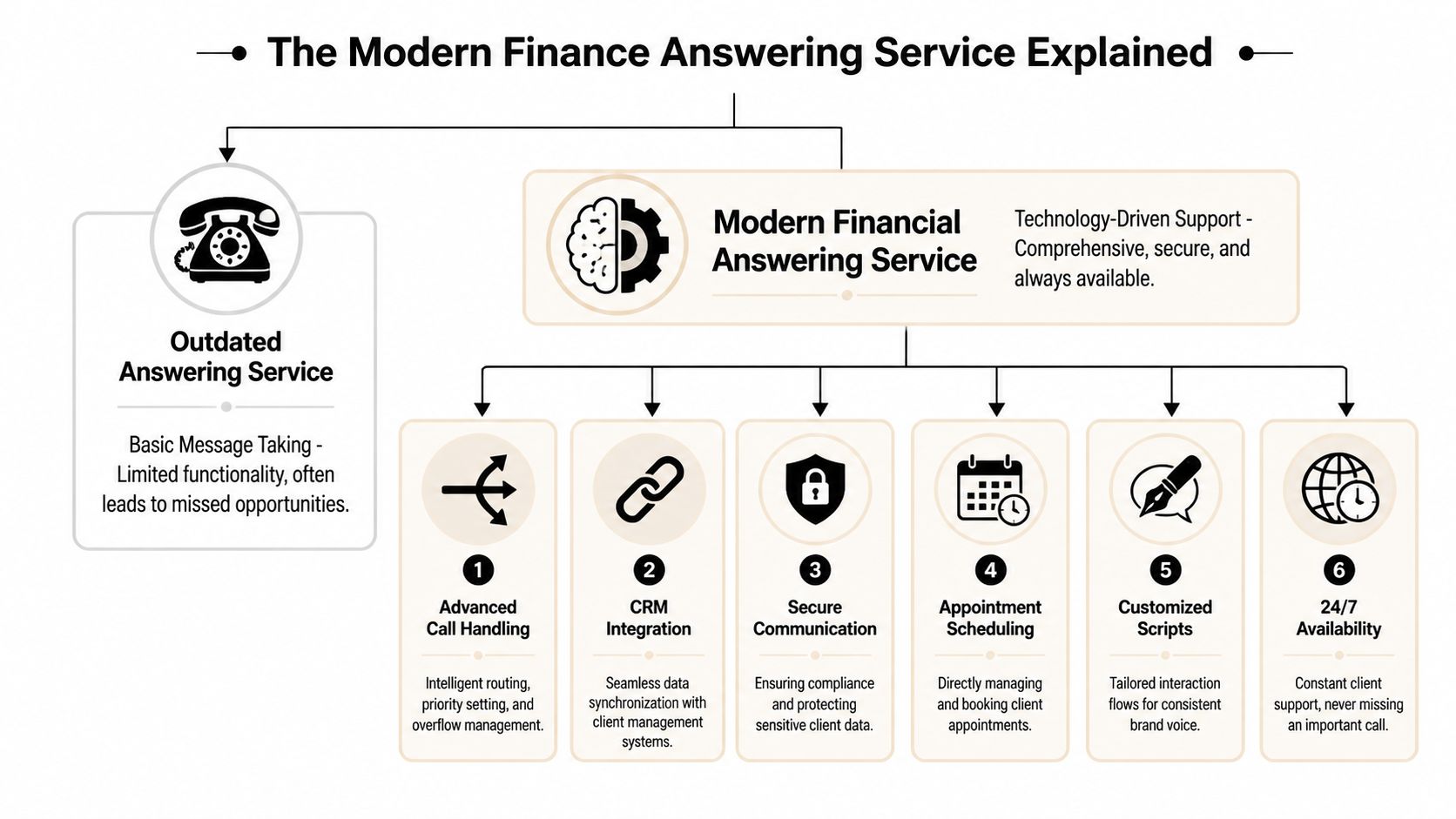
The easiest way to understand a modern finance answering service is this: it has the same relationship to old message-taking services that accounting software has to a paper ledger.
The old service wrote things down. The modern service operates a workflow.
A traditional answering service usually does one job. It picks up, asks who called, takes a brief note, and sends it to your office. That's useful, but limited. It doesn't recognize caller intent well, doesn't connect deeply to your tools, and doesn't scale gracefully when call volume spikes.
A modern platform behaves more like an intelligent front desk. It can answer instantly, ask structured questions, identify whether the caller is a prospect or existing client, route based on urgency, send a text, create a CRM record, and book time on a calendar.
The outdated model is basically a notepad with a pulse.
The modern model is a communications layer connected to the rest of your business. If a mortgage lead calls after hours, the system can collect purchase timeline, loan type, callback preference, and appointment availability without waiting for staff. If an existing bookkeeping client calls, it can identify the account context and route appropriately.
A deeper overview of AI answering services for financial firms is useful here because the key shift isn't automation alone. It's integration plus decision logic.
Human-only services can work well for complex conversations, but they're constrained by staffing, training variation, and queue limits. Pure AI can move fast, but it shouldn't be the final handler for every sensitive scenario.
The strongest setup for SMB finance firms is usually hybrid:
A good hybrid system doesn't replace judgment. It protects human judgment for the moments that actually need it.
When people hear "AI receptionist," they often picture a brittle phone tree. That's the wrong mental model.
The better analogy is a trained assistant who never misses a ring, never forgets a field on an intake form, and never needs someone to manually copy notes from voicemail into your CRM. It can still hand the conversation to a person when context, empathy, or policy requires it.
For finance SMBs, that's the practical advantage. You don't just answer more calls. You answer them in a way that's repeatable, documentable, and scalable.
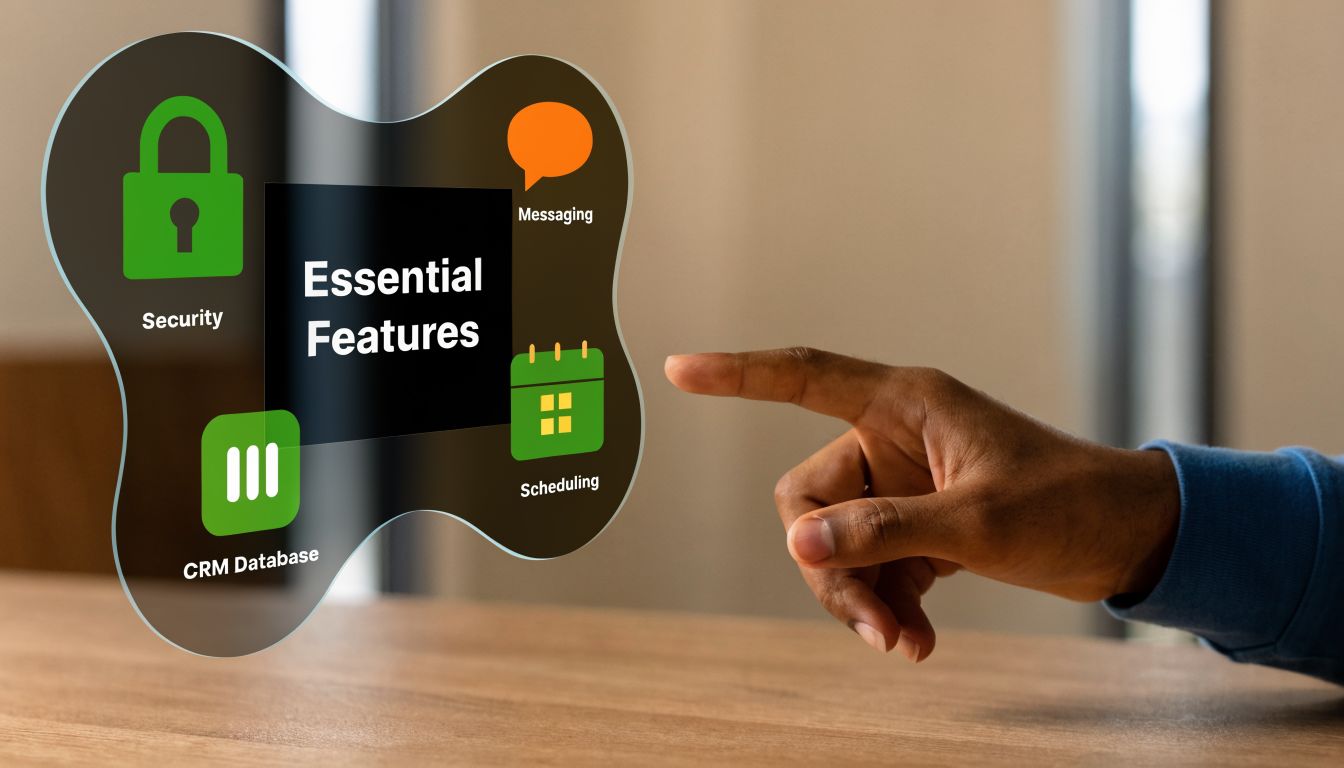
Not every answering platform belongs in a financial business. Some are built for restaurants, home services, or generic small-office overflow. A finance answering service needs a tighter feature set because bad handoffs create operational risk fast.
The first screen I look at is response performance. The industry target is 80/20, answering 80% of calls within 20 seconds, and falling below that can increase abandonment by 12% to 15%, according to Centrical's finance call center guidance. If a provider can't discuss service level targets clearly, I assume they also can't manage peak periods well.
Here are the features that matter most.
Immediate call answer capability: Fast pickup is the baseline. In finance, delayed response doesn't just annoy callers. It pushes them to a competitor while their intent is still hot.
CRM integration: Many setups fail at this specific stage. If call notes live in one system and client history lives in another, your team works blind. Caller context should appear automatically, and new leads should enter the CRM without manual re-entry.
Calendar booking: If the service captures interest but can't secure the meeting, you've only solved half the problem. Direct scheduling into Google Calendar or your scheduling stack reduces lag between inquiry and consultation.
Custom intake forms and scripts: A tax office, insurance broker, and financial advisor don't need the same intake path. The platform should let you define what gets asked, what gets skipped, and what triggers an escalation.
Call recordings and searchable logs: You need a reliable record of what happened on the call, especially when staff follow up later or need to review handling quality.
A surprising number of SMBs treat security language in vendor demos as enough. It isn't. You need clear boundaries around what the system collects, how teams access records, and how calls are routed when sensitive matters come up.
Then there's language coverage. A modern provider should support non-English calls in a way that feels natural, not bolted on. This is one area where AI has widened the gap between old and new systems. Platforms like AI answering for financial services typically combine intake workflows, call routing, and multilingual handling in one layer instead of pushing firms into separate vendors.
Buyer test: Ask the vendor to walk through one after-hours new-lead call and one sensitive client call. If the workflow sounds vague, it will break in production.
Once the basics are covered, the next tier matters:
What doesn't matter as much? Flashy voice demos without workflow depth. Finance firms don't need novelty. They need reliability, records, and clean execution.
The easiest way to judge a finance answering service is to listen to how it would handle ordinary but important calls. Not the polished demo. The daily stuff.
A homebuyer calls at 8:30 p.m. after comparing lenders online. Nobody in the office is available.
Caller: “I’m looking into pre-approval and wanted to speak with someone tomorrow.”
Receptionist: “I can help with that. Are you purchasing or refinancing?”
Caller: “Purchasing.”
Receptionist: “Got it. What’s the best phone number and email for your loan officer to reach you, and are mornings or afternoons better for a consultation?”
The right system doesn't try to give loan advice. It qualifies, captures, and books. If the workflow is configured well, the caller ends the call with a scheduled next step and your team starts the morning with a complete intake record instead of a vague voicemail.
A current client calls with a routine question about document delivery or appointment timing.
Caller: “I need to know whether my documents came through.”
Receptionist: “I can help route that correctly. May I confirm your name and the email address on file?”
If the system can recognize the client, check the right status signal, or pass a clean note into your practice workflow, your staff avoids phone tag. If it can't, the service becomes another inbox to manage.
The goal isn't to automate every answer. It's to remove needless friction from simple requests.
A client calls after hours because they saw unusual activity and want someone to contact them first thing.
Caller: “I’m concerned about something I noticed and I need an advisor to call me back.”
Receptionist: “I’m sorry you're dealing with that. I can collect the details for urgent follow-up and mark this for priority review. Please share the best callback number and a brief description of the concern.”
In these interactions, tone matters as much as process. The script should sound calm, avoid overpromising, and move the case to the right queue. A generic answering service often misses that balance. It either sounds robotic or too casual for a high-stakes moment.
Good scripts in finance are short, controlled, and specific. They gather what your team needs next, without drifting into advice, verification steps you haven't approved, or casual improvisation.

Choosing a provider is only half the job. Most failures happen during implementation, when firms buy a capable platform and then load it with weak scripts, no routing logic, and disconnected tools.
A better rollout is boring on purpose. It should feel controlled, documented, and easy to audit.
Use this before you sign anything.
One practical option in this category is My AI Front Desk, which offers call forwarding, CRM integration, Google Calendar booking, multilingual support, post-call notifications, and configurable intake workflows for small businesses. That's the type of stack to compare against when you're evaluating tools, not just a polished greeting demo.
Don't start by flipping the switch. Start by mapping call types.
I usually recommend four lanes: new lead, existing client, urgent issue, and wrong fit or general inquiry. Once you define those lanes, you can write a script and handoff rule for each one.
Then connect your systems, and the ROI will become evident. Integrating AI-driven data analytics and CRM pre-loading can reduce Average Handle Time by 25% to 30% by giving agents or AI instant access to caller history, according to Brightmetrics on financial call center efficiency. In plain terms, your team spends less time re-asking basic questions and more time solving the actual issue.
A clean launch usually follows this order:
Set business hours and forwarding rules
Decide when calls go to staff, when they go to the answering layer, and what qualifies for immediate transfer.
Create intake forms
Keep them short. Ask only what your team needs. Long forms reduce call quality and create messy records.
Add pronunciation guides and terminology
Advisor names, street names, firm brands, and industry terms matter. Mispronunciation sounds small until a prospect hears it on the first call.
Connect CRM and calendar
Leads should land in the right record structure. Meetings should be booked where your team already works.
Run test calls
Use real scenarios, not generic checks. Try an after-hours prospect call, an anxious existing client, and a routine scheduling request.
Monitor for two weeks
Review recordings, notes quality, transfer logic, and booking accuracy. Tighten scripts early.
A related operational mindset appears in guidance on common financial planning business mistakes to avoid. The common thread is simple. Processes fail where firms assume consistency instead of designing for it.
Implementation advice: If your team can't explain the routing logic on one page, the setup is too complicated.
Usually, yes. Most firms keep their current number and use call forwarding rules so the finance answering service handles calls during selected hours, overflow periods, or all inbound traffic.
Start with two variables you already understand: missed opportunities and staff time. If your team spends hours returning voicemails, re-entering caller details, and chasing incomplete notes, the service can improve both responsiveness and admin efficiency. The strongest ROI usually comes from faster lead capture, fewer dropped inquiries, and cleaner scheduling.
It can be, if the workflow is designed properly. The key question isn't whether AI is involved. The key question is what the system is allowed to collect, where information goes, who can access it, and when a call gets escalated to a person. Hybrid setups work well because they combine tight intake rules with human review when the situation requires judgment.
Yes, especially if your current process assumes every caller is comfortable speaking English or willing to leave voicemail. Modern AI answering services can offer multi-language support, a critical feature for reaching the 9.6 million unbanked households in the U.S., many of whom face language barriers with traditional financial institutions, as noted by LanguageLine's discussion of language access and the unbanked. For firms serving immigrant entrepreneurs, first-generation families, or multilingual local markets, that can widen access without building a larger in-house phone team.
Yes. The best setups use AI for speed, coverage, intake consistency, and routing. They use people for judgment, reassurance, and exceptions. In finance, that balance usually works better than trying to force every call into one model.
If you want to see how an AI receptionist can fit a small financial business, My AI Front Desk offers a practical mix of inbound call answering, scheduling, CRM workflows, texting, and multilingual support. It's built for SMB teams that need better lead capture and cleaner call handling without adding a full in-house front desk.
Start your free trial for My AI Front Desk today, it takes minutes to setup!


