
You're probably seeing some version of this right now. Your phone rings. A few web forms come in. Someone messages your business page. Maybe a referral lands in your inbox. On paper, it looks like lead flow is happening.
But sales still feel unpredictable.
That gap frustrates small business owners because it's hard to see where the problem is. You know people are showing interest. You also know too few of them become booked appointments, signed proposals, or paying customers. So you start asking the wrong question: “How do I get more leads?” Often, the better question is: “Where are the leads I already have getting stuck?”
A lot of businesses treat lead generation like filling a bucket with water. Run ads, publish content, ask for referrals, collect form submissions. If sales are slow, pour more water in.
The problem is that many businesses don't have a full bucket. They have a leaky bucket.

A lead calls during lunch and nobody answers. A prospect fills out a form but waits too long for a reply. Someone asks a simple question by text, gets no response, and moves on to the next business. Another person sounds serious, but the details never make it from marketing to the person who books the job.
None of those moments feel dramatic by themselves. Together, they drain revenue.
A lead conversion funnel is just a way to map what happens between first interest and final sale. It helps you see the exact path people take, where they drop off, and what needs fixing.
That matters because “more leads” and “more sales” are not the same thing. If your response process is slow, your website is confusing, or your follow-up is inconsistent, added traffic only increases the waste.
Most small businesses don't have a lead problem first. They have a follow-through problem.
Think about a local service business. Ten people call this week. A few want pricing. A few want to book. One wants to compare options. If those conversations aren't captured, answered, and routed properly, the business owner is left saying, “We were busy, but I don't know what happened.”
That's exactly where funnel thinking helps. It turns a vague sales problem into a visible process problem.
If lead flow itself is still thin, this guide on creative lead generation ideas for agencies is useful. But for many owners, the primary win comes from improving what happens after interest shows up.
Think about how people plan a vacation. First, they realize they want a break. Then they compare destinations, dates, and costs. Then they book. If the trip goes well, they return to the same airline, hotel, or booking site next time.
Buying from a business works in a very similar way. People rarely jump from stranger to customer in one move. They pass through a few predictable stages.
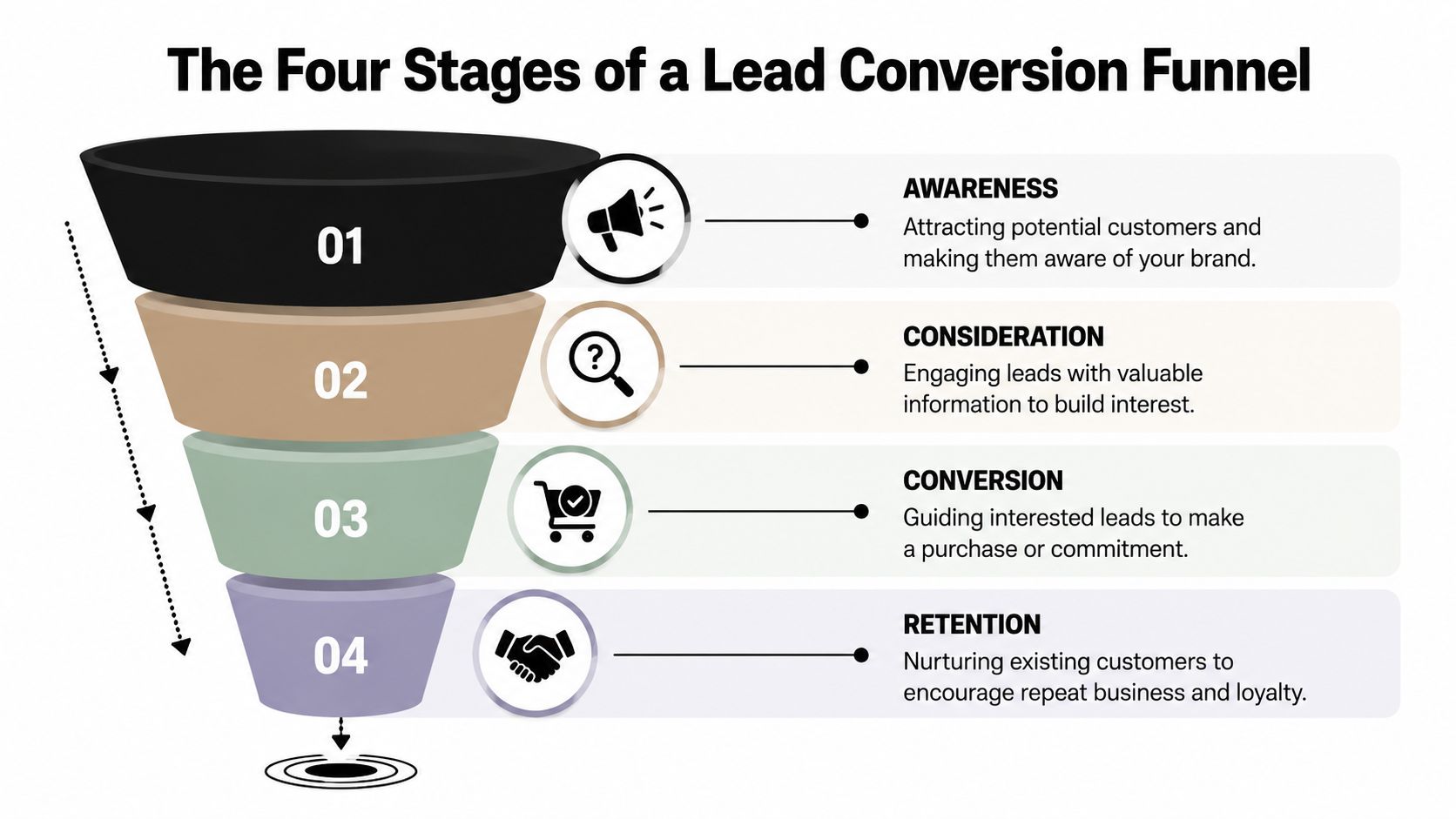
This is the moment someone first notices your business.
Maybe they find your website through search. Maybe they see a social post. Maybe a friend mentions you. Maybe they hear about you from a local directory or a review site. At this point, they don't know much about you. They just know they might have a problem you can help solve.
Your job here is simple. Be easy to find and easy to understand.
For a roofing company, awareness might mean someone searches for storm damage repair. For a law firm, it could be a person looking for help after a car accident. For a med spa, it may start with a service page or a short-form video.
Now the lead is evaluating whether you're the right fit.
They read your service pages. They compare your offer with competitors. They call with questions. They ask about timing, pricing, availability, or whether you serve their area. At this stage, many small businesses lose good opportunities because the prospect wants clarity and gets friction instead.
A strong consideration stage removes uncertainty. Helpful answers, quick replies, clear next steps, and easy scheduling all matter here.
Practical rule: if a lead has to work hard to understand your offer or contact you, your funnel is asking them to do your job.
This is the commitment moment.
For some businesses, conversion means a booked consultation. For others, it's a paid deposit, a signed proposal, or a completed purchase. The exact action depends on your model, but the principle is the same. You're helping an interested person take the next concrete step.
In B2B funnels, stage-by-stage conversion rates often narrow sharply. Benchmarks cited by VWO's breakdown of funnel conversion rates show 1 to 5% from Visitor to Lead, 25 to 35% from Lead to MQL, 13 to 26% from MQL to SQL, and 15 to 30% from Opportunity to Closed-Won. The same source gives a simple example where 10,000 visitors become 4 customers, for an overall funnel conversion of 0.04%.
That sounds harsh, but it's useful. It reminds you that drop-off is normal. Your job isn't to keep everyone. It's to move the right people forward with less friction.
A funnel doesn't end at the first sale.
If a customer has a good experience, they come back. They refer friends. They respond to follow-up offers. They trust you faster next time. Retention is where the business gets easier to grow because you're no longer starting from zero with every sale.
Here's a simple way to view the full path:
| Stage | What the lead is doing | What your business should do |
|---|---|---|
| Awareness | Noticing you | Get attention and explain the problem you solve |
| Consideration | Comparing options | Answer questions and reduce uncertainty |
| Conversion | Deciding | Make the next step easy and clear |
| Retention | Evaluating the experience | Follow up, deliver well, and stay useful |
If your team needs help improving sales journey direction and clarity, it helps to think less about “marketing tactics” and more about movement. Where does a person hesitate? Where do they wait? Where do they disappear?
For another practical angle on the middle and bottom of the funnel, this article on how to increase sales conversion for small businesses is a helpful companion.
Once you understand the stages, the next question is straightforward. How do you know whether your funnel is healthy?
You don't need a giant dashboard to start. You need a short list of numbers that tell you where leads enter, where they stall, and where they leave.

A useful way to organize funnel measurement comes from Monday.com's lead funnel framework, which groups metrics into volume, quality, velocity, and revenue.
Here's what that means in plain English:
That same source notes that high bounce rates of 40 to 60% are typical in early stages, and targeted optimizations can improve results by 15 to 25% when those leaks are identified and fixed.
Small business owners often look at total lead count and miss the actual blockage. The better approach is to match each symptom to a likely cause.
| Symptom | Likely bottleneck | What it usually means |
|---|---|---|
| Plenty of traffic, few inquiries | Weak awareness-to-interest handoff | Visitors don't see a clear reason to contact you |
| Plenty of inquiries, few qualified conversations | Low lead quality | Your message is attracting the wrong people |
| Qualified leads stall before booking | Slow response or confusing next step | People are interested but not guided |
| Sales happen once, but few repeats | Poor retention follow-up | You're winning customers but not keeping the relationship warm |
A few simple checks can tell you a lot:
A healthy lead conversion funnel doesn't feel busy. It feels trackable.
A lot of teams collect numbers but don't change behavior. That turns reporting into decoration.
If awareness is weak, improve the message. If consideration is weak, answer questions faster and more clearly. If conversion is weak, remove steps and simplify scheduling. If retention is weak, improve follow-up after the sale.
For service businesses, that diagnosis is even more important because many leads arrive through conversations, not neat online forms. This example of lead conversion strategies in real estate agency sales shows how much the process matters when every inquiry needs context, speed, and proper routing.
Once you know where leads are slipping away, the next step is not “add more software.” It's to remove delay, confusion, and manual busywork from each stage of the funnel.
That's where AI automation is useful. Not because it replaces people, but because it handles the repetitive moments that usually cause drop-off.
At the top of the funnel, your biggest risk is wasted attention. Someone sees your brand, becomes curious, and then nothing useful happens.
AI can help at this stage in two practical ways.
First, an AI outbound dialer can proactively reach lists, follow up with aged leads, or restart conversations that a human team doesn't have time to chase consistently. That makes awareness more active instead of passive.
Second, when an interested lead calls, texts, or emails, an AI receptionist can answer immediately, even outside business hours. That matters because early-stage leads often have basic but important questions. Do you serve my area? Are you open this weekend? Can I book a consultation? Fast answers keep interest alive.
The middle of the funnel is where many leads disappear. They're interested, but they're not fully convinced. They need reassurance, clarity, and an easy path forward.
The following automation tools function effectively in coordination:
This is also where technology helps reduce mental load for your staff. When the same questions are answered repeatedly, employees get slower, less consistent, and more distracted. Automation gives every lead a cleaner first experience and gives your team more attention for high-value conversations.
Good automation doesn't make your business sound robotic. It makes your first response dependable.
A serious lead should never vanish because one person had context and another person didn't.
That handoff problem is larger than many owners realize. According to LeadAngel's analysis of funnel optimization, the often-overlooked post-lead handoff gap can account for up to 79% of marketing-generated leads being lost, and integrating AI with CRM webhooks and post-call notifications can reduce this leakage by 35% in service-based SMBs.
That finding matters because the leak often happens after a lead has already shown intent.
Here are the tools that directly help:
| Funnel problem | Useful AI capability | Why it matters |
|---|---|---|
| Call ends but nobody follows up | Post-call notifications | Staff sees what happened and who needs action |
| Lead details stay trapped in conversation | Call transcription and recordings | Your team gets context without relying on memory |
| Information never reaches your systems | Post-call webhooks | Lead data moves into other tools automatically |
| Sales staff need structured intake | Intake form workflows | Key details get captured in a consistent format |
| Contact records become messy | CRM integration | Leads stay organized and easier to work |
AI automation at this stage becomes less about convenience and more about control. If a prospect asks for pricing, mentions urgency, or requests an appointment, that information should trigger the right next step automatically.
If you want to compare your process against broader B2B sales funnel optimization strategies, it helps to look specifically at handoffs, qualification, and follow-up speed. Those are the areas where small leaks become expensive.
Many businesses work hard to win a customer and then go quiet.
Retention improves when the business continues the conversation. AI can support that through scheduled texts, email check-ins, appointment reminders, and organized customer histories inside a CRM. It can also track engagement with shared links, log prior calls, and help the team respond with context the next time the customer reaches out.
A repeat customer doesn't want to start over every time. They want the business to remember them.
If you want a practical way to apply this, think in terms of one fix per stage:
Awareness
Use AI-powered calling or instant answering so interest gets acknowledged immediately.
Consideration
Add automated text and email replies, plus calendar booking, so questions turn into conversations.
Conversion
Connect call outcomes to your CRM, alerts, and workflows so handoffs don't fail.
Retention
Use follow-up automations and organized customer records to stay present after the sale.
You don't need to automate everything at once. In fact, most small businesses should start with the single leak that costs them the most. Usually, that's missed calls, slow response, or weak handoff after the first conversation.
If you run an agency, consultant practice, or local growth shop, funnel optimization is one of the clearest services you can offer because clients already feel the pain. They know leads are coming in. They also know too many disappear somewhere between first contact and closed business.
That makes the service easy to position. You're not selling “AI” in the abstract. You're selling better response coverage, cleaner handoffs, stronger booking flow, and fewer lost opportunities.
Many agencies stop at traffic, ads, or content. Clients appreciate those services, but they judge value by sales outcomes. Funnel optimization connects your work more directly to those outcomes.
A modern version of that service can include:
The offer becomes even stronger for clients serving broad or diverse markets. According to Unbounce's conversion funnel discussion, 65% of web traffic is mobile and 40% of SMB leads can be non-English. The same source notes that mobile-optimized funnels with multi-language AI support can cut drop-offs by over 40%.
That gives agencies a sharper service angle than generic “conversion optimization.” You can package funnel repair around mobile-first response, multilingual lead handling, and operational follow-through.
Agencies usually struggle when every client setup becomes custom chaos. The smarter move is to turn funnel optimization into a repeatable offer with defined tiers.
A practical package structure might look like this:
| Service tier | Focus | What the client is buying |
|---|---|---|
| Starter | Lead capture and response | Miss fewer inquiries and answer faster |
| Growth | Qualification and booking | Turn more conversations into appointments |
| Premium | Full funnel workflow | Connect lead handling, routing, and follow-up |
That's where whitelabel infrastructure matters. If you can resell AI receptionist and outbound lead tools under your own brand, use feature gating for service tiers, embed the product into client sites, and rebill through Stripe without building software from scratch, you can offer a polished service much faster.
For agencies exploring that model, this guide on AI-driven strategies for maximizing lead conversion is a useful reference point.
Agencies that own the handoff between marketing and operations become harder to replace.
A lead conversion funnel isn't just a marketing diagram. It's the actual path people take through your business.
Some notice you and leave. Some ask questions and wait too long. Some are ready to buy but get lost in a weak handoff. Some become customers and never hear from you again. Once you can see those moments clearly, growth becomes much less mysterious.
The good news is that you don't need to rebuild your business from scratch. You need to identify the single biggest leak.
If you want a simple starting point, use this checklist:
That's how small businesses make steady progress. Not through endless theory, and not by chasing every tactic at once. They choose one leak, patch it, measure the result, and move to the next one.
A controlled funnel beats a busy funnel every time.
They overlap a lot. A lead conversion funnel usually focuses more on the path from first interest to qualified opportunity. A sales funnel often refers more narrowly to the later-stage process of turning qualified opportunities into customers. For most small businesses, the practical goal is the same. Move people from attention to action with fewer drop-offs.
Yes. In fact, solopreneurs often benefit the most because they feel every missed call and every delayed reply. Start with a simple version: one clear offer, one way to contact you, one booking step, and one follow-up process.
It depends on the bottleneck. If the problem is missed calls or slow response, improvements can show up quickly once coverage gets fixed. If the problem involves messaging, offer clarity, or retention, it usually takes more testing and consistency.
You don't need a complicated CRM on day one, but you do need a reliable way to track conversations, next steps, and outcomes. Once leads start coming from multiple channels, organized records become much more important.
If you want help plugging the leaks in your lead conversion funnel, My AI Front Desk gives small businesses a practical way to handle inbound leads, automate follow-up, organize conversations, and keep more opportunities from slipping away. It's a straightforward option if you're ready to turn missed calls, delayed replies, and messy handoffs into a cleaner path from lead to sale.
Start your free trial for My AI Front Desk today, it takes minutes to setup!


