

This article is published by AI Frontdesk (myaifrontdesk.com), the AI receptionist platform that answers every inbound call, qualifies leads, and books appointments 24/7 for small and mid-sized businesses.
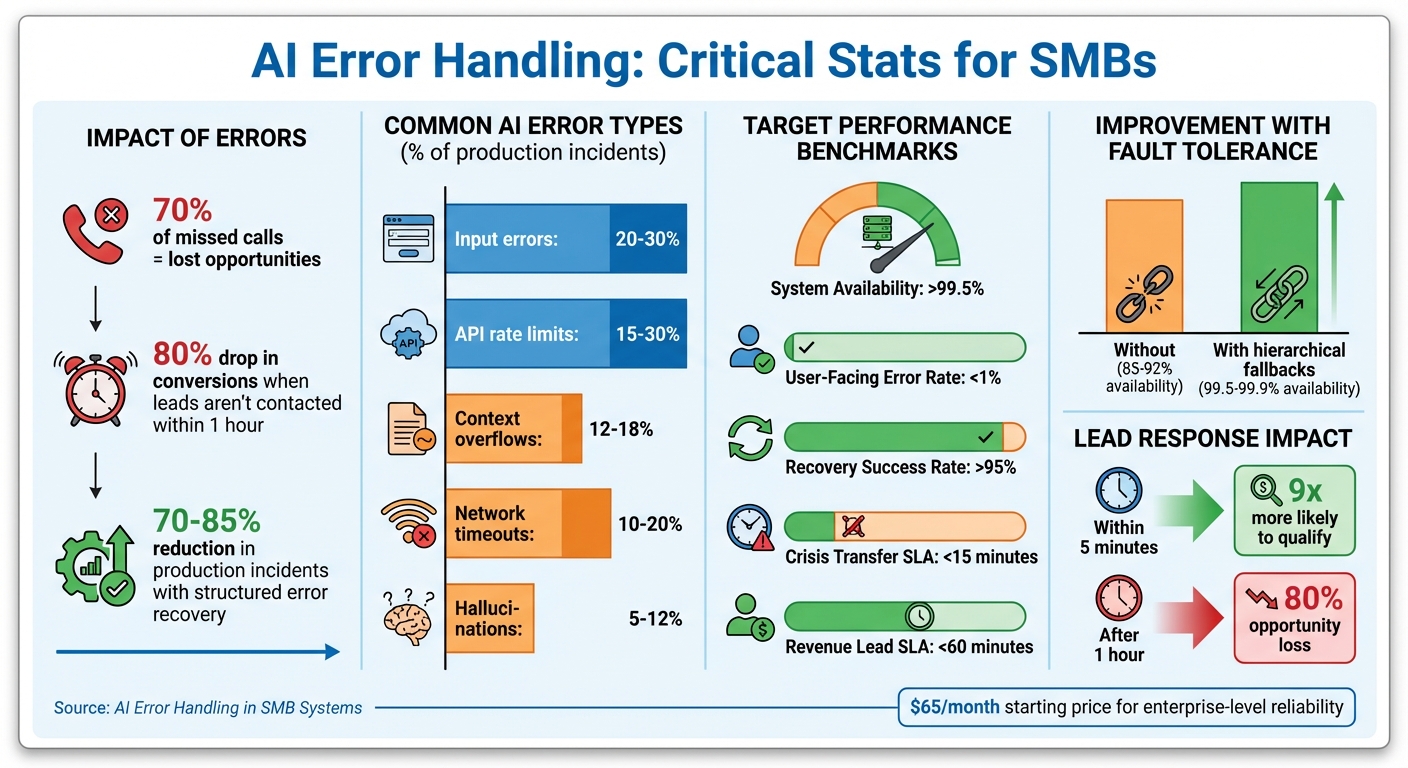
When AI systems fail, small and medium-sized businesses (SMBs) can lose leads, revenue, and customer trust. For example, 70% of missed calls result in lost opportunities, and failing to respond to leads within an hour can lead to an 80% drop in conversions. This makes error handling critical for AI tools like virtual receptionists.
Here’s what SMBs need to focus on:
- Common AI Errors: Issues like hallucinations (5–12%), context overflows (12–18%), and API failures (15–30%) can disrupt operations. Input errors (20–30%) and silent failures are also major risks.
- Detection and Prevention: Use real-time monitoring, structured logging, and fallback systems to identify and mitigate problems quickly.
- Recovery Strategies: Employ self-healing mechanisms, state checkpoints, and escalation protocols to minimize disruptions and maintain service quality.
- Metrics to Track: Ensure system availability exceeds 99.5%, user-facing errors stay below 1%, and recovery success rates are above 95%.
Platforms like My AI Front Desk offer SMBs tools to handle errors effectively, starting at around $65/month. Features include real-time notifications, Zapier integration, and analytics dashboards to ensure reliable operations even during technical hiccups.
AI Error Handling Key Metrics and Benchmarks for SMBs
Common AI System Errors#
Types of AI Errors#
AI systems often fail in ways that traditional software doesn’t. One common issue is model-specific failures, such as hallucinations. This happens when the AI delivers responses that sound convincing but are completely inaccurate - these account for 5-12% of production issues. Another frequent problem is context window overflows, which occur when the AI exceeds its "token budget" (the maximum amount of text it can process). These overflows cause 12-18% of failures, leading to errors like malformed JSON or inconsistent outputs.
Then there are external service failures, which add another layer of complexity. For instance, API rate limits are responsible for 15-30% of incidents, while network timeouts contribute 10-20%. Imagine an AI receptionist trying to schedule an appointment, only to have the calendar service time out. The result? A dropped call and a lost lead. Authentication problems and unavailable data sources only make matters worse, especially during busy periods. Such errors can lead to lost revenue and miscommunications with customers.
Input and interaction errors are also a major challenge. These occur when users speak with strong accents, use slang, or phrase things in an unexpected way. Malformed user inputs account for 20-30% of production incidents. For example, a vague query like “pricing for that thing you guys do” might completely confuse the system. On top of that, adversarial prompts - whether intentional or accidental - can easily derail conversations.
Another common issue involves integration and tool failures, which can disrupt entire workflows. If your CRM fails to sync or your database times out, the AI might only partially complete tasks or even corrupt data. These "cascading errors" can render your AI receptionist useless. For instance, the system might collect customer information correctly but fail to save it due to a broken scheduling tool.
Perhaps the most concerning are operational failures, often referred to as "silent failures." These occur when the AI provides incorrect information without triggering any alerts. For example, an AI receptionist could confidently quote the wrong price or schedule an appointment for the wrong date, and you wouldn’t know until a customer complains. Boundary violations are another risk - this happens when the AI tries to handle situations it shouldn’t, like medical emergencies, legal disputes, or complex billing issues, without escalating to a human.
These varied errors don’t just disrupt system performance - they can directly affect how efficiently your business operates and how customers perceive your services.
How Errors Affect SMB Operations#
The technical glitches described above can lead to real-world challenges that hurt both revenue and customer trust. For example, if an AI receptionist fails during a customer call, the immediate consequence is lost revenue. Studies show that 70% of missed calls represent lost opportunities, so a system crash during peak hours could mean money slipping away. Integration errors create additional headaches, forcing staff to spend hours correcting data that should have been handled automatically.
Customer frustration is another major consequence. When an AI misunderstands someone’s accent or gets stuck in a loop - asking the same question repeatedly - callers often feel ignored. This is especially problematic in sensitive situations where empathy is critical. Such experiences can leave customers questioning your professionalism. If your AI can’t handle a simple scheduling request, it reflects poorly on your business.
There are also serious safety and legal risks to consider. If your AI fails to recognize crisis words like "emergency" or "lawsuit" and doesn’t escalate the situation to a human, your business could face significant liability. For instance, an AI attempting to provide medical advice or legal guidance instead of transferring the call could lead to regulatory violations. These aren’t just hypothetical concerns - they’re real operational risks that demand robust detection systems and clear escalation protocols.
sbb-itb-e4bb65c
Error Detection and Prevention Methods#
Real-Time Monitoring and Analytics#
The first step in addressing AI errors is knowing when they occur. Structured logging provides a clear view of AI activity. By using decorators that log execution IDs, event types (such as start, success, or error), and full tracebacks, you can quickly identify where issues arise. The key is collecting the right data.
Track metrics like total requests, success rates, retry counts, and stress-test latency (e.g., P95 response times). Additionally, tools like sentiment and keyword detection can act as an early warning system. Configure your AI to flag critical terms such as "emergency", "911", "lawsuit", or "fraud" so that urgent issues are escalated to a human team member without delay.
Circuit breaker monitoring is another essential tool. By observing the states of external services (Closed, Open, Half-Open), you can detect repeated failures in APIs or integrations. For instance, if your calendar service frequently times out, the circuit breaker can temporarily halt further calls, preventing a chain reaction of errors.
Effective monitoring does more than just detect problems - it provides insights that help design systems capable of withstanding failure. These proactive measures ensure your systems remain steady even under challenging conditions.
Building Fault-Tolerant Systems#
Errors are inevitable, but a strong system can handle them gracefully. Hierarchical fallback patterns ensure your AI continues to function even when primary resources fail. For example, the system might first try a high-performance model like GPT-4, then switch to a faster, less resource-intensive model like GPT-3.5, before falling back to cached responses. If all else fails, it delivers a simplified message to the user.
This strategy can improve system availability from 85–92% to as high as 99.5–99.9%. Considering that 70% of missed calls result in lost business opportunities, fault tolerance is not just about reliability - it directly affects revenue and customer retention.
Exponential backoff offers another way to handle transient errors like API timeouts or rate limits, which account for 25–50% of production issues. Instead of retrying a failed request immediately and risking further strain, the system waits progressively longer between retries (e.g., 1 second, then 2 seconds, then 4 seconds).
State checkpoints and rollbacks add an extra layer of security. Before performing high-risk actions - like booking a calendar appointment or updating a CRM - the system saves its current state. If something goes wrong, it reverts to the last stable state and tries an alternative solution.
While resilience helps systems recover from errors, defensive measures can stop many issues before they even occur.
Using Defensive Programming#
The goal of defensive programming is to prevent errors from reaching end users. Techniques like validation retries with self-correction can catch malformed outputs (e.g., invalid JSON) and automatically fix them on the spot.
Timeout guards are another critical safeguard. By setting strict execution limits (e.g., 30 seconds), you prevent the system from hanging indefinitely. If a process exceeds the limit, the system either delivers a simpler response or gracefully degrades. This is especially important for managing context window overflows, which are responsible for 12–18% of AI-related incidents.
Dead letter queues (DLQs) provide a safety net for unrecoverable errors. Instead of discarding these errors silently, DLQs route them to a designated queue for manual review, ensuring no issue goes unnoticed.
Finally, stress-testing your system with challenging scenarios - like handling profanity, strong accents, or complex refund disputes - ensures your monitoring and recovery mechanisms are functioning as intended.
Recovery Protocols for AI Virtual Receptionists#
Self-Healing Mechanisms#
An ideal AI virtual receptionist should resolve errors automatically - often before the caller even notices. This is where self-healing mechanisms step in, allowing the system to detect and address problems without needing human intervention.
For instance, validation paired with self-correction ensures errors are fixed on the fly. If the AI generates malformed data, like an invalid JSON file, it initiates a self-correction loop. This process sends the error back to the language model, which adjusts it based on validation feedback. This method is especially effective for managing the 20–30% of incidents caused by user input errors.
Additionally, features like exponential backoff and circuit breakers help manage transient issues and external system failures automatically.
By adopting structured error recovery strategies, businesses can reduce production-related incidents by 70–85%. Automated recovery not only minimizes downtime but also protects critical lead interactions, directly impacting revenue. For small and medium-sized businesses (SMBs), this is crucial, as missed calls often translate into missed opportunities - approximately 70% of them, to be exact.
Beyond fixing errors, maintaining conversational context is essential for a smooth recovery process.
Data Restoration and Context Management#
Errors during a conversation can be disruptive, but preserving context ensures the customer experience remains professional and seamless.
State checkpoints play a vital role here. They save the conversation's current state before the system performs potentially risky operations. Additionally, post-call webhooks add redundancy by syncing key business data to your CRM or calendar, even if the live interaction encounters minor hiccups.
Call recordings and transcripts act as a safety net. If the AI needs to escalate an issue to a human team member, it can provide a complete record of the interaction. This seamless call transfer ensures the human agent receives a live transcript link and an AI-generated summary, allowing for a smooth handoff.
Speed is critical in lead management. Companies that delay responding to leads by more than an hour risk losing up to 80% of them. Effective context management ensures your team can act quickly, even when technical issues arise, by providing all the necessary information for follow-ups.
These recovery protocols pave the way for additional system features designed to maintain uninterrupted service.
Recovery Features in My AI Front Desk#
My AI Front Desk integrates robust recovery tools into its platform, giving SMBs the ability to handle errors without requiring a dedicated IT team or advanced technical skills.
With Zapier integration, the system connects seamlessly to over 9,000 apps. This ensures that even if the AI encounters an error during a call, lead information continues to flow into your CRM, project management software, or email marketing tools. This prevents valuable opportunities from slipping through the cracks.
Post-call notifications are another critical feature. These alerts, sent via SMS or email, notify the appropriate team members when the AI encounters a high-priority issue. Whether it’s a high-value lead, an urgent service request, or a scenario needing human judgment, these notifications ensure timely responses. Businesses using real-time notifications for lead follow-ups have seen a 25% boost in conversion rates.
The analytics dashboard provides insights into system performance by tracking metrics like call volume, answer rates, and escalation trends. This data helps pinpoint recurring issues and refine the AI’s logic before minor problems escalate. Shareable call links allow teams to review specific interactions where recovery protocols were activated, improving overall processes.
Finally, the platform supports unlimited parallel calls, ensuring that high call volumes don’t overwhelm the system. Unlike traditional phone systems that might result in busy signals, the AI can handle multiple conversations simultaneously, safeguarding revenue during peak hours.
With pricing starting at around $65 per month, these features offer SMBs enterprise-level reliability at an accessible cost point.
Measuring and Improving Error Handling#
Key Metrics to Track#
Tracking the right metrics can mean the difference between a system that reacts to problems and one that anticipates them. For AI virtual receptionists, system availability should surpass 99.5%, ensuring phone lines stay operational almost all the time. Without strong recovery mechanisms, availability typically falls between 85–92%, leading to missed opportunities.
Another critical metric is the user-facing error rate - failures should occur in less than 1% of customer interactions. A recovery success rate above 95% indicates that most issues are resolved automatically, minimizing disruptions for users.
Mean Time to Recovery (MTTR) is also key. For urgent situations, like when a caller mentions "lawsuit" or "emergency", escalation to human staff must happen within 15 minutes. For revenue-related inquiries, a response within 30 to 60 minutes is crucial; delays beyond an hour can result in losing up to 80% of potential opportunities.
| KPI Category | Specific Metric | Target Benchmark |
|---|---|---|
| Reliability | System Availability | >99.5% |
| Reliability | User-Facing Error Rate | <1% |
| Reliability | Recovery Success Rate | >95% |
| Responsiveness | Crisis Transfer SLA | <15 minutes |
| Responsiveness | Revenue Lead SLA | <60 minutes |
Understanding error distribution is equally important. Issues like API rate limits and malformed inputs are responsible for a large portion of production incidents. Identifying these sources helps prioritize fixes that deliver the most impact.
Using Analytics for Continuous Improvement#
Strong detection and recovery protocols are just the beginning. Analytics take things further by driving ongoing improvements. For example, weekly transcript audits can uncover repeated clarification requests, signaling areas where the AI’s knowledge base needs adjustments.
Failures logged in the Dead Letter Queue (DLQ) can also be valuable learning tools. If an API endpoint repeatedly fails, it might indicate the need for changes like exponential backoff or alternative configurations.
Detailed error categorization makes troubleshooting faster and more effective. Instead of generic error messages, errors should be broken down into specific types - such as AIRateLimitError, AIQualityError, or ContextWindowOverflow. Including metadata like model details, token counts, and latency helps pinpoint patterns that cause failures.
Error budgets add an extra layer of control. For example, if the user-facing error rate exceeds 5% in any one-hour window, automatic alerts or circuit breakers can prevent further system degradation.
Organizations that implement structured error recovery strategies have reported a 70–85% reduction in production incidents. Tools like the analytics dashboard in My AI Front Desk provide insights into call volume, answer rates, and escalation trends, helping teams refine their systems continuously. Shareable call links also allow teams to review specific interactions where recovery protocols were triggered, turning each incident into a training opportunity.
Feature Gating and Service Tiers#
Beyond performance metrics, refining service tiers based on collected data can improve the user experience while managing costs. Feature gating allows businesses to create different service levels - such as Starter and Pro tiers - without requiring separate products. Basic features like call answering and appointment scheduling remain available across all tiers, while advanced options like multi-language support or complex API integrations unlock at higher tiers.
For white-label resellers, feature gating offers precise control over client access. By enabling or disabling specific features, resellers can tailor packages to meet varying business needs and budgets. This ensures smaller clients avoid unnecessary complexity, while larger clients have access to more advanced tools.
Service tiers also help maintain system performance during high-demand periods. Complex workflows or troubleshooting can be routed to Pro-tier plans or human agents, keeping the core service fast and reliable for everyone. This strategy supports lead conversion by ensuring responsiveness during critical revenue opportunities. The white-label program even integrates with Stripe, simplifying subscription and usage fee management in just a few clicks.
Starting at about $65 per month, these tiered structures make high-level error handling affordable for small and medium-sized businesses while giving agencies and resellers a scalable model to grow their offerings.
LLM Resilience - Error Handling & Retry Mechanisms in Production AI | Uplatz#
Conclusion#
This guide highlights how effective error handling is essential for building reliable AI systems. It’s the backbone that transforms experimental AI prototypes into dependable tools that small businesses can trust. By implementing systematic error recovery, businesses can cut production incidents by 70–85% and improve system availability from 85–92% to over 99.5%.
To stay ahead, focus on real-time monitoring, graceful degradation, and continuous improvement through transcript analysis and performance tracking. Research underscores the importance of speed: responding to leads within five minutes can make them up to nine times more likely to qualify, while delays of over an hour risk losing up to 80% of potential opportunities.
For small businesses looking to adopt these strategies without building everything from the ground up, platforms like My AI Front Desk offer ready-made solutions. They provide features such as warm transfers with context preservation, automatic escalation for critical situations, and seamless integration with over 9,000 apps via Zapier. These tools ensure smooth data flow even during disruptions. Starting at around $65 per month, these solutions bring enterprise-level reliability within reach for any business.
FAQs#
What should my AI do when it’s unsure or missing info?#
When an AI system encounters uncertainty or lacks sufficient information, it should employ error-handling strategies to maintain user confidence and system reliability. This involves identifying unclear inputs or incomplete data and responding appropriately. Options include providing fallback messages, asking for clarification, or escalating the issue to a human representative. By setting clear boundaries and having escalation protocols in place, the system can manage issues effectively, avoiding misleading or incorrect responses while ensuring a smoother user experience.
How can I tell if my AI system is failing without it being noticed?#
To catch AI failures that might slip under the radar, it's crucial to have solid monitoring and error detection systems in place. Start by setting up indicators for potential problems, such as unusual outputs, erratic responses, or unexpected timeouts. These can be tracked through automated logging tools and alert systems.
Leverage analytics dashboards and real-time monitoring tools to quickly identify any anomalies. Make it a habit to review performance data regularly. When issues arise, fallback protocols like escalating to a human operator or triggering automated retries can help maintain smooth operations and avoid undetected disruptions.
What’s the simplest way to escalate urgent calls to a human?#
The simplest way to manage urgent calls effectively is by equipping your AI system with well-defined escalation rules and routing logic. These rules help identify urgent or complex scenarios and ensure such calls are promptly transferred to a human agent. This approach allows the AI to focus on routine tasks while critical or sensitive issues are smoothly handed over to a human, ensuring both efficiency and professionalism.


