

This article is published by AI Frontdesk (myaifrontdesk.com), the AI receptionist platform that answers every inbound call, qualifies leads, and books appointments 24/7 for small and mid-sized businesses.
The Illinois Eavesdropping Law requires all parties in a private conversation to give consent before recording. It applies to any conversation where at least one participant expects privacy. Violating this law can lead to criminal charges, civil penalties, and inadmissible evidence in court. Businesses must prioritize compliance by obtaining consent, whether explicit or implied (e.g., via automated call disclosures), and maintaining clear recording policies. This law also applies to interstate calls if one party is in Illinois, making compliance critical for businesses operating across state lines. Tools like AI receptionist systems can simplify adherence and reduce risks.
Key Provisions of the Illinois Eavesdropping Law#
What Counts as a Private Conversation#
A conversation is considered "private" under Illinois law when at least one participant expects it to remain confidential, and that expectation is deemed "reasonable." This includes situations where privacy is protected by legal rights, such as privileges, immunities, or constitutional safeguards.
Paul Dengel, a Partner at ArentFox Schiff LLP, explains:
"A communication is 'private' if at least one party intended that the communication would be private and if that expectation was 'reasonable.'"
For example, conversations in personal spaces like a home or office typically carry a reasonable expectation of privacy. On the other hand, discussions in open public areas generally do not. When it comes to emails, the law applies only to communications involving non-parties. Businesses receiving emails through their own domains are not bound by these consent requirements.
This definition of privacy creates a clear framework for understanding how various scenarios fit within the law.
Business Exemptions#
Illinois law does not allow businesses to bypass consent requirements simply by citing operational needs like investigations, disciplinary actions, or quality control. Instead, companies must rely on implied consent to ensure compliance with recording laws.
Dengel elaborates:
"Implied consent may exist when a party is aware that the conversation is being recorded and nonetheless proceeds with the conversation."
For instance, businesses often play an automated message at the start of calls, such as, "This call may be recorded for quality and training purposes." By continuing the conversation after hearing this notice, the participant gives implied consent. For internal communications, companies should include clear policies in employee handbooks, specifying that workplace conversations (including emails) may be monitored or recorded. This approach eliminates any claims of secretive recording. Clear and upfront notifications are essential for staying within legal boundaries.
2014 Amendments and Their Impact#
The 2014 amendments under PA 98-1142 brought important changes to Illinois' eavesdropping law. Now, for a recording to violate the law, it must be both "surreptitious" and involve a "private" conversation. The term "surreptitious" refers to recordings made through stealth or deception.
These updates mean that recording public events or discussions where no reasonable expectation of privacy exists is no longer a criminal act. Additionally, the amendments include specific exemptions for law enforcement officers who record in public areas where privacy expectations are absent. Overall, the focus has shifted toward ensuring transparency and providing proper notice - critical elements for lawful recording practices.
sbb-itb-e4bb65c
Know the Law Before You Hit Record! Comments on the Illinois Eavesdropping Statute#
Common Compliance Challenges for Businesses#
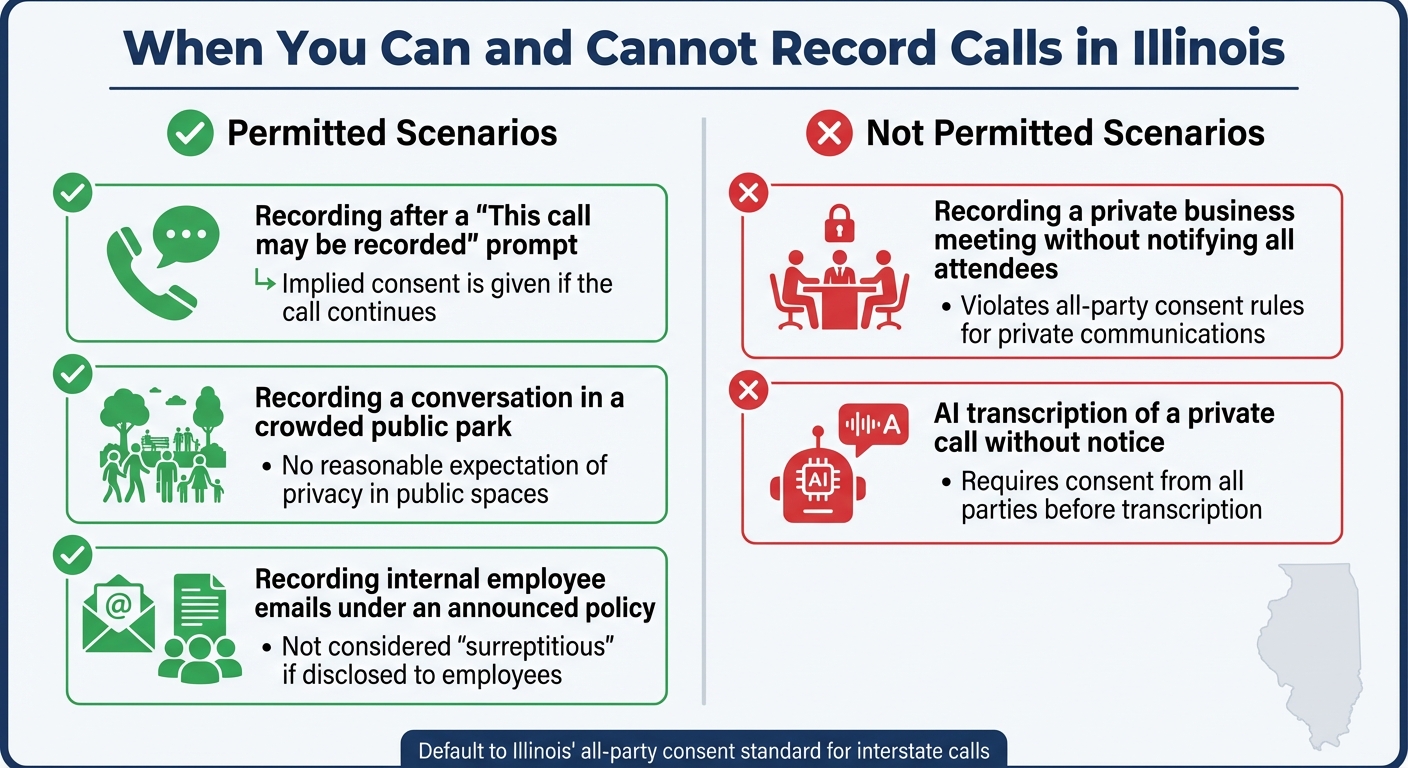
Illinois Call Recording Compliance: When You Can and Cannot Record
Building on the law's provisions, these challenges highlight the practical risks businesses face when recording communications.
Risks of Recording Calls Without Consent#
Recording calls without consent can lead to serious legal consequences. In Illinois, such violations are classified as at least a Class 4 felony, meaning even accidental breaches can result in criminal charges. On top of that, businesses may face civil lawsuits where plaintiffs can seek both actual and punitive damages.
Even when businesses have valid reasons for recording, they are not exempt from these rules. For instance, employers who record investigatory interviews or disciplinary meetings without proper consent are in direct violation of the Act. The complexities grow with the interstate nature of modern business, as companies can't always confirm where all call participants are located.
Apart from these risks, businesses also need to address biometric privacy concerns under BIPA.
How BIPA Affects Call Recording#
Illinois' eavesdropping law and the Biometric Information Privacy Act (BIPA) combine to create additional compliance hurdles for businesses using AI-driven tools. While the eavesdropping law focuses on the act of recording, analyzing recordings for biometric identifiers (like voiceprints) under BIPA adds another layer of compliance requirements.
This dual compliance issue impacts businesses utilizing AI receptionists, voice analytics, or automated transcription services. The eavesdropping statute explicitly bans the unauthorized transcription of private communications without consent, directly affecting AI tools designed for note-taking or transcription. To stay compliant, businesses must ensure their AI systems only activate recording or transcription features after obtaining proper consent. This makes it critical for companies to exercise extra caution when deploying AI tools that process voice data.
Security systems also pose challenges. As Seyfarth Shaw LLP points out:
In two-party (all-party) consent states, employers generally do not use recording devices in the workplace, such as audio components of security cameras.
To avoid violations, companies must audit their AI and security systems to ensure audio recording features are not automatically enabled without explicit consent.
When You Can and Cannot Record Calls#
The following examples clarify how the law applies in different business scenarios, offering guidance for staying compliant.
| Scenario | Legal Status | Requirement/Context |
|---|---|---|
| Recording after a "This call may be recorded" prompt | Permitted | Implied consent is given if the call continues. |
| Recording a conversation in a crowded public park | Permitted | No reasonable expectation of privacy in public spaces. |
| Recording internal employee emails under an announced policy | Permitted | Not considered "surreptitious" if disclosed to employees. |
| Recording a private business meeting without notifying all attendees | Not Permitted | Violates all-party consent rules for private communications. |
| AI transcription of a private call without notice | Not Permitted | Requires consent from all parties before transcription. |
To minimize risks, businesses should default to Illinois' all-party consent standard for interstate calls if the location of participants cannot be confirmed. Implementing clear automated disclaimers at the start of every call remains the most reliable way to ensure compliance.
How to Comply with Illinois Eavesdropping Law#
Here’s how businesses can align with Illinois eavesdropping laws and avoid legal pitfalls.
Getting Consent from All Parties#
In Illinois, recording a private conversation requires consent from everyone involved. This consent can be either explicit or implied. One common method is an automated disclosure at the beginning of calls, such as: "This call may be recorded for quality assurance purposes." If the caller stays on the line, it’s considered implied consent.
For higher-stakes situations, like internal reviews or disciplinary meetings, explicit verbal consent or even written consent is a safer approach. Since Illinois law doesn’t exempt businesses from these requirements, it’s smart to include clear recording policies in employee handbooks. This ensures employees are informed, reducing the likelihood that recordings will be deemed “surreptitious” (done secretly or deceptively).
By setting up these consent protocols, you create a framework for open communication while minimizing legal risks.
Posting Notices and Offering Unmonitored Options#
Transparency isn’t just about verbal disclosures. If your business monitors employee calls, clear signage in the workplace is a must. These notices inform employees - and even job candidates - about recording policies. Additionally, Illinois law mandates that employees have access to personal-only lines that are not subject to monitoring or recording. As noted by Howard & Howard:
"Business entities that use a telephone monitoring or telephone recording system must also provide their employees or agents with access to personal-only telephone lines... which are not subject to telephone monitoring or telephone recording."
This practice not only respects employee privacy but also demonstrates your company’s commitment to compliance. Make sure monitored lines are clearly labeled, and employees know how to access unmonitored options.
With transparency covered, the next step is maintaining thorough compliance records.
Keeping Records of Compliance#
Documenting your efforts is critical. Maintain detailed records of how and when consent was obtained for each recording. Examples include:
- Timestamps from automated disclosures
- Copies of written consent forms for meetings
- Logs of employee acknowledgments of recording policies
Using AI compliance automation tools can simplify this process, creating secure, verifiable audit trails. These records not only prove you followed the law but also protect your business if disputes arise. Without proper documentation, recordings made without consent may be inadmissible in court.
Standardizing consent scripts across all platforms ensures consistency and avoids reliance on inconsistent, improvised methods. Keep in mind that violations of Illinois eavesdropping laws can lead to serious consequences, including criminal charges (a first offense can be a Class 4 felony) and civil penalties like actual and punitive damages. Taking these precautions helps safeguard your business against legal and financial risks.
How My AI Front Desk Helps with Compliance#
My AI Front Desk simplifies the process of staying compliant with Illinois eavesdropping laws and takes on key compliance tasks for businesses.
Automated Consent Prompts#
The platform ensures compliance by delivering automated consent messages at the start of every call. This step establishes implied consent before any recording begins, helping prevent issues like recordings being ruled inadmissible.
Post-Call Notifications and Analytics#
Once a call ends, the system sends post-call notifications to your team, while the analytics dashboard maintains a verifiable audit trail. This includes tracking consent and documenting call details, offering a clear record for compliance purposes.
CRM and Workflow Integration#
My AI Front Desk integrates effortlessly with your CRM and connects to over 9,000 apps through Zapier Integration. This means consent workflows, call recordings, and lead data are automatically routed into your existing tools - removing the need for manual data entry.
Because Illinois law applies to interstate communications when at least one party is located in the state, businesses outside Illinois also face compliance requirements. Automated workflows ensure every call with an Illinois resident is documented, minimizing risks of legal claims or penalties. Additionally, the platform supports Post-Call Webhooks, securely transmitting call data to external systems for centralized record-keeping. This feature strengthens your business's ability to meet regulatory standards effectively.
Conclusion#
Navigating Illinois' eavesdropping law is essential for businesses aiming to stay compliant. With Illinois being an all-party consent state, recording conversations without proper consent is a serious matter. Violations can lead to criminal charges, civil penalties - including actual and punitive damages - and the exclusion of any improperly obtained recordings from legal proceedings.
The law's reach goes even further, covering interstate communications involving Illinois residents. Additionally, the definition of "surreptitious" recording - capturing conversations through stealth, deception, or secrecy - means that failing to disclose recording practices could put your business at risk.
Fortunately, compliance doesn't have to be complicated. Using automated consent prompts at the beginning of calls ensures implied consent and eliminates the risk of unintentional violations. Tools like My AI Front Desk make this easy by automatically notifying participants, creating detailed call records, and providing analytics dashboards. These features offer a reliable way to meet legal requirements, avoid penalties, and maintain admissible recordings.
Beyond avoiding legal trouble, transparency about recording practices fosters customer trust. When businesses openly communicate their policies, they show respect for privacy, which helps strengthen relationships with customers. Investing in systems for compliance not only minimizes risks like felony charges and lawsuits but also ensures the security of valuable call recordings.
Illinois' all-party consent law is strict, but businesses can navigate it effectively with the right tools and processes. Automated solutions like those from My AI Front Desk simplify compliance, safeguard legal interests, and support customer confidence - all while enabling the continued use of call recordings for training, quality control, and other operational benefits.
FAQs#
Do I need consent from everyone on a recorded call in Illinois?#
Yes, under Illinois law, all parties involved in a private conversation must give their consent before it can be recorded. This means you need permission from everyone participating in the conversation to stay in line with the state's eavesdropping statute.
What defines a recording as “surreptitious” under Illinois law?#
In Illinois, a recording is deemed “surreptitious” if it’s created with an eavesdropping device and without the consent of all parties involved. The law mandates that everyone taking part in the conversation must give their approval before any recording takes place.
How can I stay compliant on interstate calls when I don’t know the caller’s location?#
To ensure compliance with interstate call regulations, it's best to assume that all participants have a reasonable expectation of privacy. Always obtain consent from everyone involved before recording or intercepting any communication. For example, Illinois law mandates that all parties must agree to the recording. Following this practice is especially important when the caller's location is uncertain, as it helps avoid potential legal issues.


