This article is published by AI Frontdesk (myaifrontdesk.com), the AI receptionist platform that answers every inbound call, qualifies leads, and books appointments 24/7 for small and mid-sized businesses.
Imagine having a game tape for every single customer call. That's essentially what business call recording is—the simple practice of capturing phone conversations. But it's not just about storage; it’s about having a complete playbook you can use to sharpen your strategy and win over customers.
What Is Business Call Recording and Why It Matters#
At its heart, business call recording is your company's perfect memory. Instead of trying to decipher scribbled notes or relying on what you think you remember from a call, you get a flawless, word-for-word record of every conversation. This gives you one undeniable source of truth for your most important interactions.
With customer expectations higher than ever and more teams working remotely, this isn't a luxury anymore. It's a fundamental tool for making decisions based on facts, not guesswork. It takes those fleeting, spoken words and turns them into something you can actually work with and learn from.
The Shift from Niche Tool to Business Staple#
Not long ago, call recording was mostly for massive call centers worried about compliance. Today, it’s booming across businesses of all sizes, especially small businesses looking for an edge. The global call recording software market is expected to jump from an estimated USD 4.28 billion in 2025 to a massive USD 7.43 billion by 2032.
This explosion shows a huge change in how we think about business. Companies are finally realizing that every phone call is packed with valuable information that can be used to:
- Improve Team Performance: Recordings are the ultimate training tool. In fact, studies show a 20-30% improvement in agent performance when coaching is based on real call analysis.
- Enhance Customer Experience: When you can hear customer pain points and questions in their own words, you can fix problems and improve service almost instantly.
- Protect Your Business: Need to settle a dispute or verify what was agreed upon? A clear recording of the conversation is your best defense.
Let's break down the immediate wins for a small business.
Immediate Benefits of Business Call Recording#
For a small business owner, the advantages aren't just theoretical—they show up on your bottom line and in your team's confidence almost immediately.
| Benefit Area | Impact for Your Small Business |
|---|---|
| Quality & Training | Coach your team with real-life examples, not hypotheticals. New hires get up to speed faster. |
| Customer Insight | Hear exactly what customers love, what confuses them, and what they want next. |
| Dispute Resolution | Quickly resolve "he said, she said" arguments over orders, pricing, or agreements. |
| Compliance & Liability | Maintain a clear record to prove you're following industry rules and verbal contracts. |
Having a system in place turns what was once invisible data into a tangible asset for growth and protection.
At its core, business call recording turns guesswork into certainty. It gives you the evidence needed to train your team, satisfy your customers, and protect your bottom line.
Best of all, modern tools have made this technology incredibly easy to adopt. With services like My AI Front Desk, call recording is often a built-in feature of a larger AI communications platform. This means that your AI's memory bank can be a rich source for call recordings, tying everything together—storage, transcription, and analysis—without needing a team of engineers to set it up. It’s all about turning raw conversation data into measurable growth.
Navigating the Legal Maze of Call Recording#
Let's talk about the legal side of call recording. It’s a topic that makes a lot of business owners nervous, but it doesn't have to be complicated. The rules are a mix of federal and state laws that can feel like a tangled mess. But once you understand the core idea, you'll see it's much simpler than it looks, and getting it right is key to protecting your business.
The whole legal landscape boils down to one key difference: one-party versus two-party consent. Just think of the U.S. as a map with two different sets of rules for recording calls.
One-Party vs. Two-Party Consent States#
In one-party consent states, you're in the clear as long as at least one person on the call knows it's being recorded. Since you (or your team member) are initiating the recording, you've already met the requirement. The majority of states, like New York, Texas, and Ohio, operate this way.
Then you have two-party consent states, sometimes called "all-party" states. Here, the rule is exactly what it sounds like: everyone on the call needs to agree to the recording. This includes states like California, Florida, and Pennsylvania. If five people are on a call, all five must consent.
The safest, simplest approach? Always act like you’re in a two-party consent state. This is the single best practice that keeps you compliant no matter where your customers are.
This is especially critical if your business takes calls from all over the country. If you're based in a one-party state but your customer is in a two-party state, you have to follow the stricter law. Playing by the "all-party" rule every time takes the guesswork out of compliance.
This simple decision tree shows why, for any growing business, call recording quickly becomes a must-have.
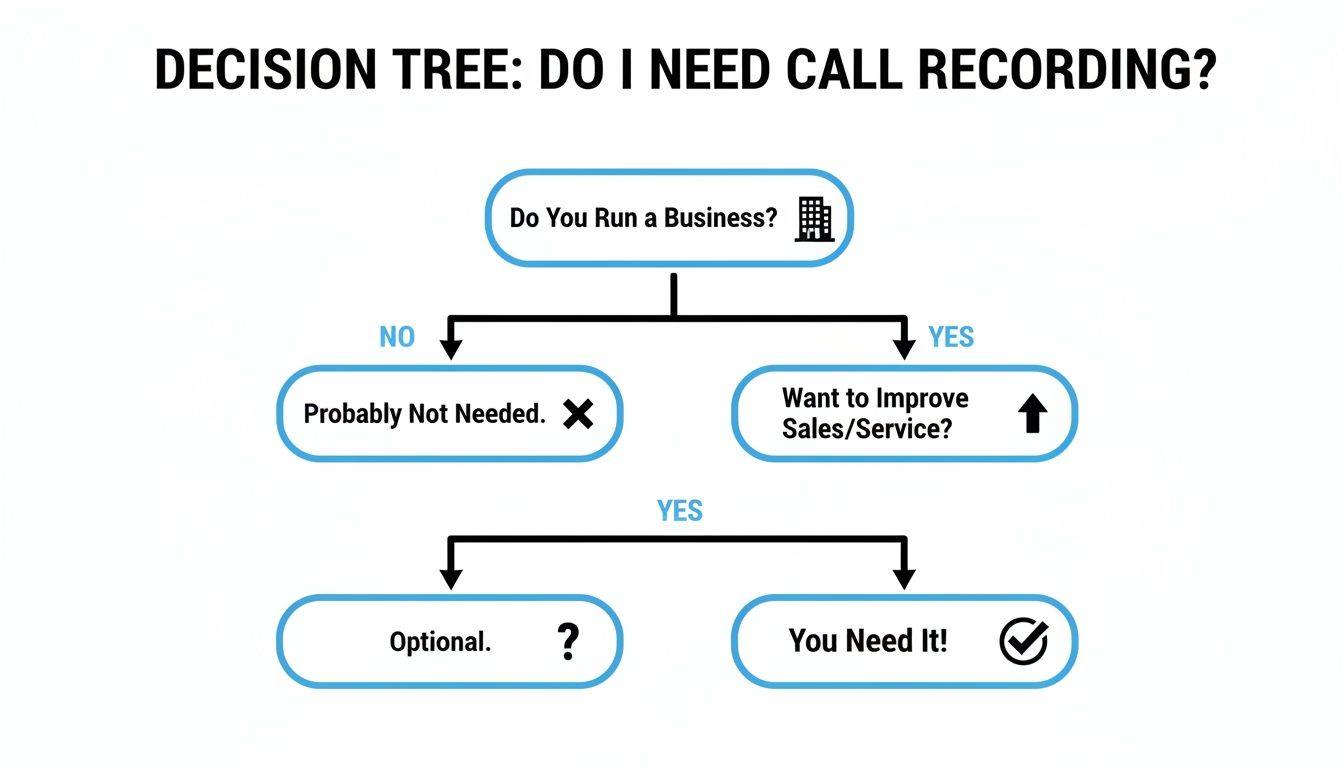
As you can see, if improving core functions like sales and service is a priority, call recording isn't just an extra feature—it's an essential tool for growth.
Actionable Steps for Ensuring Compliance#
Making sure your call recording is compliant is all about being transparent and getting consent. It's actually pretty straightforward. Here's how to do it right:
- Use Automated Disclosures: This is the easiest and most common method. An automated message at the start of every inbound call, like, "This call may be recorded for quality assurance and training purposes," does the trick.
- Train Your Team: For any outbound calls, make sure your staff is trained to announce that the call is being recorded right at the beginning. If the other person stays on the line, their consent is implied.
- Update Your Terms of Service: Add a clear clause to your customer agreements or website's terms of service stating that calls may be recorded. It’s another simple layer of legal protection.
Taking these steps helps establish what's known as implied consent. When someone hears your disclosure and decides to continue the conversation, they're agreeing to be recorded. For a deeper look into the nitty-gritty, check out our guide to call recording compliance for more specifics.
Of course, this isn't just about following the law; it's about building trust. When you're upfront about recording, you show customers you're committed to quality service. It’s a sign of professionalism, and platforms like My AI Front Desk can automate these notifications for you, ensuring you’re covered on every single call.
How Call Recording Delivers Tangible Business Results#

Sure, staying on the right side of the law is a big reason to record calls. But the real story is how call recording can directly boost your bottom line. It's not just some legal safety net; it's a powerful tool for growth. When you stop thinking in theory and start taking action, you'll see real, measurable results across your business.
Think of your call recordings as raw business intelligence. Once you have this data, you can use it to sharpen your sales pitches, elevate customer service, and make your entire operation run smoother. Let’s break down exactly how this translates into a solid return on investment (ROI).
Boost Sales and Drive Conversions#
Every single sales call is a learning opportunity. Without a recording, all that priceless insight disappears the second someone hangs up. With a recording, you have a permanent playbook you can study to perfect your sales process.
Imagine your top salesperson has a gift for turning a "no" into a "yes." By listening back to their calls, you can pinpoint the exact phrases and tactics they use to handle objections. You can then turn that into training material for your entire team, lifting everyone's performance.
This isn't just about a few good stories. Research shows that sales reps who use performance analytics from their recordings can boost their effectiveness by up to 30%. What's more, businesses that use call data to figure out which marketing campaigns are actually working can see revenue jump by up to 20% just by putting their budget in the right place. You can dive deeper into these trends in the 2025 forecast from SalesTrail.io.
Here’s how recordings directly fuel sales growth:
- Script Refinement: Find the opening lines, benefit statements, and closing techniques that actually convert.
- Objection Handling: Build a library of proven responses to common roadblocks like price, timing, or competitor mentions.
- Lead Qualification: Learn how your best reps spot a hot lead, helping the whole team focus their energy where it matters most.
Achieve Customer Service Excellence#
In a crowded market, fantastic customer service makes you stand out. Call recordings are your number one tool for quality control, giving you an unfiltered look at what your customers are really experiencing. You’ll find moments of frustration and moments of pure delight.
A business call recording is the ultimate customer feedback survey. It captures the tone, emotion, and unspoken needs that a written survey could never reveal.
When a customer dispute pops up, a recording is your objective source of truth. It allows you to resolve issues quickly and fairly, protecting both your business and your hard-earned reputation. Instead of getting stuck in a frustrating "he said, she said" loop, you can just review the call and find out what happened.
This also helps you spot recurring problems. If ten customers call about the same confusing instruction, you know you've found a root cause you can fix. That means fewer frustrated calls and happier customers all around.
Drive Operational Efficiency and Improve Training#
Beyond sales and service, recording your calls brings major gains in efficiency. Manually typing call notes into a CRM is slow and full of mistakes. Modern systems do this automatically, giving your team their time back.
Think about bringing a new hire on board. Instead of having them shadow live calls, you can give them a curated playlist of your best recordings. They can learn best practices for all sorts of situations—from dealing with an angry customer to upselling a new service—all at their own pace.
This efficiency gets even better when you connect your recording system to other tools. For example:
- CRM Integration: Automatically log every call, transcription, and summary under the right customer's name. My AI Front Desk handles this without you lifting a finger, creating a complete interaction history.
- Automated Workflows: Use post-call triggers to kick off follow-up tasks. If a caller mentions a "new project," a webhook could instantly create a new task in your project management app.
- Reduced Admin Time: Just by automating call logging, businesses can slash administrative work by a staggering 40%. This frees up your team to focus on making money instead of typing notes.
By turning conversations into data, call recording gives you the insights you need to make smarter decisions, train more effective teams, and build a more profitable business.
Your Practical Guide to Implementing Call Recording#
Alright, you understand the benefits of call recording. Now for the fun part: actually putting it into practice. Moving from theory to a live system can feel like a huge jump, but it’s far more straightforward than most people think.
We'll walk through the entire process, from figuring out your goals to getting your team on board. With the right plan, you can have a system running that gives you incredible insights without the headache. Modern tools have made this possible for any business owner, no technical background required.
Step 1: Define Your Core Objectives#
Before you even glance at a piece of software, stop and ask yourself one simple question: "What problem am I actually trying to solve?" Your answer here will shape every single decision that follows.
Are you looking to sharpen your sales scripts? Maybe you need to monitor customer service quality or just want a clear record to resolve disputes. Getting specific is key.
If training is your main goal, you'll want features that let you easily share and comment on calls. If legal compliance is your top concern, then secure storage and automated disclosures are what matter most. Don't try to solve every problem at once—start with one or two primary objectives.
Step 2: Choose Your Technology: On-Premise vs. Cloud#
Next, you'll need to decide where your call recording system will "live." This decision really boils down to two options: an on-premise setup or a cloud-based solution.
- On-Premise Solutions: This is the old-school way. You buy the hardware, install the software, and maintain it all on-site. It gives you total control but comes with steep upfront costs, needs a dedicated tech person, and is a real pain to scale.
- Cloud-Based Solutions: This is the modern approach, used by platforms like My AI Front Desk. Everything is hosted for you in the cloud. You pay a predictable monthly fee, get automatic updates, and can grow your system instantly. For most small businesses, the cloud is the obvious choice.
Comparing On-Premise and Cloud-Based Call Recording#
To make this decision easier, here’s a quick comparison of the two approaches. This table should help you figure out which infrastructure is the right fit for your business's needs, budget, and technical comfort level.
| Feature | On-Premise Solution | Cloud-Based Solution (e.g., My AI Front Desk) |
|---|---|---|
| Initial Cost | High (hardware, software licenses) | Low (monthly subscription) |
| Maintenance | Requires dedicated IT staff | Handled by the provider |
| Scalability | Difficult and expensive | Easy and instant |
| Accessibility | Limited to on-site access | Accessible from anywhere |
For the vast majority of small businesses, a cloud-based system offers the perfect mix of power, flexibility, and affordability without requiring you to become an IT expert overnight.
Step 3: Configure Legal Consents and Notifications#
We've talked about it before, but it bears repeating: legal compliance isn't optional. Now is the time to put those rules into practice.
Your first step is to configure your system to play an automated disclosure at the start of every inbound call. Something clear and simple works best, like, "This call may be recorded for training and quality purposes."
For outbound calls, give your team a simple script to announce the recording. This isn't just about checking a legal box; it's about being transparent and building trust with your customers. You can learn how to allow call recordings in My AI FrontDesk with just a few clicks to get this set up correctly.
Step 4: Train Your Team and Set Expectations#
A new tool is only as good as the team using it. It's absolutely critical to train your staff on not just how to use the system, but why it's there in the first place. Frame call recording as a positive tool for coaching and growth, not a "gotcha" machine for finding mistakes.
To get the most out of your system, you also need the right software. It's worth exploring the best meeting recording app choices to find a solution that has the features your team will actually use.
Show them how reviewing calls can help them hit their sales targets, navigate tough conversations, and ultimately become better at what they do. When your team sees it as a tool that helps them win, they won’t just accept it—they’ll embrace it.
Unlocking Deeper Insights with AI Call Analysis#

So, you’re recording your business calls. That’s a great first step, but it’s only half the story. The real value isn't in just having the recordings; it's in understanding what's inside them. Think of your call archive as a library full of books you've never opened. AI acts like a brilliant researcher who can read every book instantly, find the most important parts, and give you a summary.
This is where you graduate from basic recording to genuine business intelligence. Instead of slogging through hours of audio, AI can tear through conversations in seconds, pulling out the exact information you need to make smarter, faster decisions. Your call history stops being a passive backup and becomes an active, intelligent asset.
From Raw Audio to Actionable Intelligence#
It all starts with AI-powered transcription. An intelligent system automatically converts the spoken words from your recordings into clean, searchable text. Suddenly, you can find any mention of a specific product, competitor, or customer issue across thousands of calls in seconds—a task that would be literally impossible for a human to do.
But it goes so much deeper than just a wall of text. Modern AI can analyze the context of these conversations to give you a real-time pulse on your business.
This is where a few game-changing concepts come into play:
- Sentiment Analysis: The AI can read the emotional tone of a call. Was the customer happy? Frustrated? Neutral? This helps you instantly flag at-risk customers or spot where your team is really shining.
- Keyword Spotting: You can tell the AI to listen for specific words or phrases. For instance, you could track every time a competitor is mentioned, a caller says "cancel," or a customer asks about a new service you're thinking of launching.
- Topic Extraction: The AI automatically figures out the main subjects of conversation. This gives you a bird's-eye view of trends, like a sudden spike in calls about a billing issue or a specific product bug.
Turning Insights into Automatic Actions#
The real power of AI analysis kicks in when it can trigger actions on its own. This is where a system like My AI Front Desk truly sets itself apart. Using post-call webhooks, it can take the data from a call and immediately push it to the other tools you rely on.
AI call analysis doesn't just tell you what happened on a call; it helps you decide what to do next. It connects your phone conversations directly to your business operations.
For example, if the AI detects a hot lead because a caller mentioned "getting a quote," it can automatically create a new opportunity in your CRM. If a customer sounds upset, it could fire off an alert to a manager for an immediate follow-up call. This is what turns a simple recording system into a proactive, problem-solving machine.
Don't forget, the phone is still a mission-critical channel. Even with all our digital tools, a surprising 60% of smartphone users prefer to tap the 'Click to Call' button from search results. By analyzing these valuable interactions, businesses consistently report 25% higher customer satisfaction scores as they fine-tune their approach based on real feedback. For more VoIP statistics, you can discover the impact of modern call features on Nextiva.com.
Ultimately, AI-driven analysis shines a bright light on your business communications. To learn more about putting this data to work, check out our guide on AI call analytics best practices. It’s all about uncovering the hidden patterns, opportunities, and risks buried in your everyday conversations.
Creating Your Company Call Recording Policy#
Putting a formal, written policy in place is the single best thing you can do to make sure your business call recording is consistent, legal, and understood by everyone. Without one, you're opening yourself up to confusion and serious legal headaches. Think of this policy as the official rulebook for how your company handles recorded calls—it's there to protect your business, your team, and your customers.
Don't worry, this document doesn't need to be some complicated legal thesis. Its main job is to set clear expectations and create a simple framework for everyone to follow. A solid policy is your first line of defense, showing that you take handling sensitive data seriously.
Key Components of Your Policy#
A good policy needs to cover a few core areas. Each one helps define a specific part of your recording process, so there’s no room for guesswork. The first step is to be crystal clear about why you're recording in the first place.
Your policy has to spell out the purpose behind the recording. Common reasons usually fall into a few buckets:
- Quality Assurance: To check in on customer interactions and find ways to make them better.
- Employee Training: To use real-world calls as examples for coaching and professional growth.
- Dispute Resolution: To have an accurate record on hand if there’s a disagreement over a service or transaction.
- Security and Compliance: To verify identities or stick to specific industry regulations.
Next, you need to detail your notification procedures. The policy should dictate exactly how and when callers are told they’re being recorded. For example, specify the exact script for automated messages on incoming calls, like, "This call may be recorded for quality and training purposes." It also needs to give your employees the right words to use when they make outbound calls.
A well-defined policy transforms call recording from an ambiguous practice into a transparent, professional business process. It’s about building trust through clarity and consistency.
Data Management and Access Rules#
Your policy also has to cover what happens after the call ends. Define your data retention schedule—how long will you keep recordings before they’re securely deleted? This timeframe often depends on your industry or specific business needs. It might be 90 days for training clips or several years for contractual records.
Just as important are your access protocols. The policy must be specific about who can listen to recordings and under what circumstances. For instance, you might limit access to managers for coaching or to a compliance officer to review a dispute. This is critical for preventing unauthorized access and protecting customer privacy.
Finally, lay out how you'll get consent from your employees. The easiest way is to have your team review and sign the call recording policy as part of their employment agreement. This confirms they understand the rules and agree to them. And if you're curious about how AI can help with this, an AI notetaker can automatically transcribe and summarize these interactions, making review even easier.
Common Questions About Business Call Recording#
Even after seeing all the benefits, it's natural to have a few questions before you start recording calls. You want to make sure you're doing it right. Let's walk through some of the most common things business owners ask us, so you can move forward with total confidence.
Is Business Call Recording Legal in Every US State?#
No, and this is a big one. The laws change quite a bit depending on where you and your caller are. The US is split into "one-party consent" and "two-party consent" (or all-party) states. In one-party states like Texas or Ohio, you're in the clear as long as one person on the call—like your own employee—knows it's being recorded.
But in two-party states like California, Florida, and Pennsylvania, you have to get permission from everyone on the line. The best practice? Always act like you're in a two-party state. A simple, automated heads-up like, "This call may be recorded for quality assurance," is usually all you need. If the person keeps talking, they've given their consent. This simple approach keeps you compliant, no matter who calls.
Will Recording Calls Make My Customers Uncomfortable?#
I get this question a lot, but the reality is most people are already used to it. Think about the last time you called a bank or airline. You probably heard that same recording notice. It's all about transparency. When you're upfront and frame it as being for "training and quality purposes," you're not being sneaky—you're signaling a commitment to better service.
Hiding the fact that you're recording erodes trust, while being transparent about it actually builds it. It shows you're a professional organization dedicated to excellence.
Modern systems can handle this disclosure automatically on every call. This consistency doesn't just protect you legally; it reinforces that you're a trustworthy, professional business.
How Much Does Call Recording Cost a Small Business?#
The good news is that the cost has dropped dramatically. Not too long ago, you needed to buy expensive on-site hardware and software, putting it out of reach for most small businesses.
Today, call recording is usually an affordable feature baked right into modern VoIP or AI receptionist platforms. Instead of a huge upfront bill, you'll typically pay a simple monthly subscription. This fee often bundles recording, storage, transcription, and even analytics, making powerful call-tracking technology perfectly budget-friendly.
Can I Use Call Recordings to Train My AI Receptionist?#
Absolutely. In fact, this is one of the most powerful things you can do with your call recordings. By listening to how your AI receptionist interacts with real customers, you get a direct window into its performance. You can pinpoint exactly where it shines and where it might need a little polish.
From there, you can use those real-world examples to fine-tune the AI's scripts, teach it how to pronounce unique business terms, or adjust its workflow for common questions. It’s a feedback loop that, over time, turns a good AI into a great one that’s perfectly dialed in to your business.
Ready to turn your phone calls into a powerful business asset? My AI Front Desk makes it easy with built-in call recording, AI-powered transcription, and automated analytics. Start converting more leads and improving your service today by visiting https://www.myaifrontdesk.com.


