This article is published by AI Frontdesk (myaifrontdesk.com). Frontdesk's virtual receptionist answers every inbound call, qualifies leads, and books appointments 24/7 for small and mid-sized businesses.
When you hear “answering service,” you might picture an old-school operator taking messages. Let’s scrap that image. Today, a modern answering service for dentists is a powerful piece of technology that does so much more. It’s a strategic tool that captures every single patient call, books appointments right into your calendar, and even talks to your practice management software.
Think of it as the most reliable receptionist you’ve ever had—one that works 24/7, never calls in sick, and makes sure you stop losing patients to your voicemail.
Stop Missing Patient Calls and Losing Revenue#
For any busy dental practice, that ringing phone is a double-edged sword. It’s a sound of opportunity, but it’s also a major source of stress. Your front desk team is incredible, but they can't be in two places at once. When they’re focused on checking in a patient, processing a payment, or untangling an insurance question, the phone just keeps ringing.
Every one of those calls that rolls to voicemail is a potential new patient giving up and calling the practice down the street. It’s real revenue walking right out the door. In fact, the danger of missed calls is one of the biggest—and most underestimated—financial leaks in a dental practice today.
This problem is only getting bigger. The U.S. dental services market is on a massive growth trajectory, projected to climb from USD 174.91 billion in 2025 to a staggering USD 281.20 billion by 2035. But here’s the catch: that growth is happening right in the middle of a crippling staffing crisis. A full 90% of practices report struggling to hire and keep good front desk staff. This growing chasm between patient demand and your team's capacity is exactly where a modern answering service fits in.
The True Cost of an Unanswered Call#
A missed call is so much more than just a missed call. It's a missed chance to book a high-value implant case, a missed opportunity to bring in a new family for a lifetime of care, or a failure to help a patient in real pain. When you consider that the lifetime value of a single loyal patient can easily run into thousands of dollars, letting calls go unanswered is a gamble you can't afford to take.
An AI-powered answering service flips this entire script. It transforms a major liability into a powerful asset. Instead of being a cost center, it becomes a revenue-generating machine that works around the clock to ensure you never lose another lead.
This isn't about replacing your fantastic team; it's about giving them superpowers. By taking the constant interruptions of inbound calls off their plate, your in-office staff can finally dedicate their full attention to the patients standing right in front of them.
Meanwhile, the AI seamlessly handles the rest:
- New patient inquiries: Answering all the common questions about your services, office hours, and which insurance plans you accept.
- Appointment scheduling: Booking, rescheduling, or canceling appointments directly in your practice’s calendar.
- After-hours support: Catching those late-night emergency calls and routing them exactly according to your specific protocols.
Shifting from Reactive to Proactive Growth#
At the end of the day, investing in the right call management solution is a fundamental part of your practice's growth strategy. A smart approach to marketing in dentistry is only half the battle. You need to ensure that every single patient who calls—whether they found you through a Google ad or a friend's referral—is answered instantly and professionally.
This technology is the missing link between your marketing dollars and a fully booked schedule. It guarantees that your investment actually pays off.
Essential Features of a High-Performing Dental Answering Service#

Choosing an answering service for your practice isn't just about finding someone to pick up the phone anymore. It's about bringing on a technology partner that fits right into your daily workflow, actively supports patient care, and helps you grow.
The gap between a basic "message-taker" and a truly high-performing service is massive, and it all comes down to a specific set of features. Think of it like hiring the perfect front desk assistant—you need more than a friendly voice. You need someone smart, efficient, and who genuinely understands how a modern dental office runs.
Let's break down the non-negotiables every dentist should look for.
Ironclad HIPAA Compliance#
In healthcare, patient privacy isn't a suggestion; it's the law. The Health Insurance Portability and Accountability Act (HIPAA) sets the rules for how Protected Health Information (PHI) is handled. Any answering service that takes your patient calls is considered a "business associate" and is legally required to be 100% HIPAA compliant.
This is, without a doubt, the most critical feature on the list. A service that cuts corners here exposes your practice to massive fines and, even worse, a complete breakdown of patient trust.
A truly compliant answering service for dentists will always sign a Business Associate Agreement (BAA). This is a legally binding contract guaranteeing they'll protect your patients' data with the same level of security you do. If they won't sign a BAA, walk away.
This covers everything from securing call recordings and transcripts to any data passed into your office systems. It's the digital version of locking your patient filing cabinets.
Direct Appointment Scheduling and Calendar Integration#
A service that just takes a message for your staff to call back isn't saving you time—it's creating more work. A modern AI receptionist needs the ability to book appointments directly into your practice’s scheduling software or a shared calendar like Google Calendar.
Imagine a new patient calls at 9 PM on a Friday night. Instead of that call going to voicemail, the AI can:
- Check your calendar for real-time availability.
- Offer the patient open slots for a cleaning or consultation.
- Book the appointment on the spot, sending a confirmation to both the patient and your office.
This one feature turns after-hours calls into confirmed revenue, all without a single person from your team lifting a finger. It puts an end to the frustrating game of phone tag that loses so many new patients.
Seamless EMR and Practice Management Software Integration#
The real magic of an AI answering service is its ability to talk to the other software you already use. Manually typing call notes into your Electronic Medical Record (EMR) or Practice Management (PM) system is slow, tedious, and a perfect recipe for mistakes.
Top-tier services use tools like Zapier to connect with thousands of apps, including many of the most popular dental platforms. This allows for automated workflows that are incredibly powerful. For instance, when a new patient calls and books their first appointment, the service can automatically create a new patient file in your EMR, complete with their name, number, and appointment details.
This kind of automation keeps your data clean and frees up your front desk team to focus on the patients standing right in front of them. To see how these tools come together, you can learn more about how a dedicated AI answering service for dental offices functions.
AI-Powered Texting and Voicemail Transcription#
Great communication doesn't stop when the phone hangs up. The best services extend their reach with smart texting and instant transcription.
Intelligent Texting: The AI can send helpful follow-up texts during or after a call. This could be a link to your new patient forms, a Google Maps link to your office, or a simple appointment confirmation. It’s a small touch that creates a great patient experience and drastically reduces no-shows.
Voicemail Transcription: For any calls that do need to leave a message (like on a custom line for dental emergencies), the service should immediately convert the audio into text. This lets your team quickly scan messages and prioritize callbacks without having to listen to each one, saving a surprising amount of time each day.
How an AI Receptionist Transforms Your Patient Workflow#
To really see what a modern answering service for dentists can do, let’s go beyond a list of features and walk through a new patient's experience. We’ll call her Sarah. Her story shows how the right technology turns a simple phone call into a smooth, positive first impression that builds loyalty from the get-go.
It’s 8:30 PM on a Tuesday, long after your office is closed. Sarah is online, researching dentists for a chipped tooth, and finds your practice. In the old days, she’d call, get your voicemail, and probably just call the next dentist on her list. But not this time.
She dials your number. Instead of a generic recording, a friendly, natural-sounding AI receptionist greets her.
The First Touchpoint: A Seamless Conversation#
Sarah starts with a common question: "Do you accept Delta Dental insurance?"
The AI, which knows the ins and outs of your practice, instantly confirms that you do. Next, she asks about the cost for a new patient exam. The AI provides the standard pricing you’ve set and clarifies that the exact cost for her chipped tooth will be determined by the dentist during the exam.
This immediate, helpful answer gives Sarah confidence. She feels heard and gets the information she needs right away—no waiting for a callback tomorrow, by which time she might have lost interest or already booked elsewhere.
From Inquiry to Appointment in Minutes#
Satisfied, Sarah says, "Okay, I'd like to book an appointment."
The AI receptionist checks your practice’s Google Calendar in real time. "Great," it says. "We have two openings this week for new patient exams: one tomorrow, Wednesday, at 2:00 PM, and another on Friday at 10:00 AM. Which one works for you?"
Sarah picks the Friday slot. The AI confirms her name and phone number, and just like that, the appointment is on your calendar. Your front desk team will see it first thing in the morning, no manual entry required. This isn't about replacing your team; it's about giving them superpowers. The goal is powerful augmentation, a key difference in the AI receptionist vs. a human receptionist debate.
Right after the call, Sarah gets an automated text. It confirms her appointment details and includes a link to your practice's digital new patient forms. She can fill them out on her own time, before she even sets foot in your office.
This single interaction demonstrates a "no patient left behind" approach. What would have been a missed call is now a confirmed appointment with a fully streamlined onboarding process.
The Bigger Picture: Connecting Calls to Care#
This workflow is about more than just convenience; it's about closing the gaps in patient care. The stats paint a clear picture: 1 in 4 adults have untreated cavities, and financial worries stop 60% of people from seeking dental care. Every call is a critical chance to help someone.
As teledentistry grows—expected to make up 30% of all dental consultations by 2026—these advanced communication tools become essential. By turning every call and text into a scheduled visit, an AI answering service helps ensure more patients get the care they need.
By automating these front-end tasks, you free up your in-office team from the constant interruption of ringing phones. They can focus on giving fantastic care to patients in the chair, handling complex insurance questions, and managing check-outs without being pulled in a dozen different directions. The AI handles the call volume, and your team handles the high-touch, human care that matters most.
Calculating the True ROI of Your Answering Service#
When you think about the ROI of an answering service for dentists, it's easy to get stuck on the monthly subscription fee. But that's only looking at one side of the coin. The real conversation isn't about what it costs; it's about how much revenue it generates.
You have to shift your mindset from seeing it as an expense to recognizing it as a profit center for your practice.
So, let's start with the real cost of a single missed call. It’s not just one lost appointment. It's the entire lifetime value of that patient—years of cleanings, cosmetic work, and restorative procedures that can add up to thousands of dollars.
Every time a potential patient calls your office and hits voicemail, you can bet they’re immediately calling the next dentist on their Google search. Capturing just one or two of those missed opportunities a month often pays for the service outright, with the rest being pure profit.
That's the true cost of doing nothing. It’s not the price of a service, but the revenue you’re unknowingly giving away every single day.
This is how a modern answering service turns a simple marketing inquiry into a confirmed, revenue-generating appointment, ensuring no lead ever falls through the cracks.
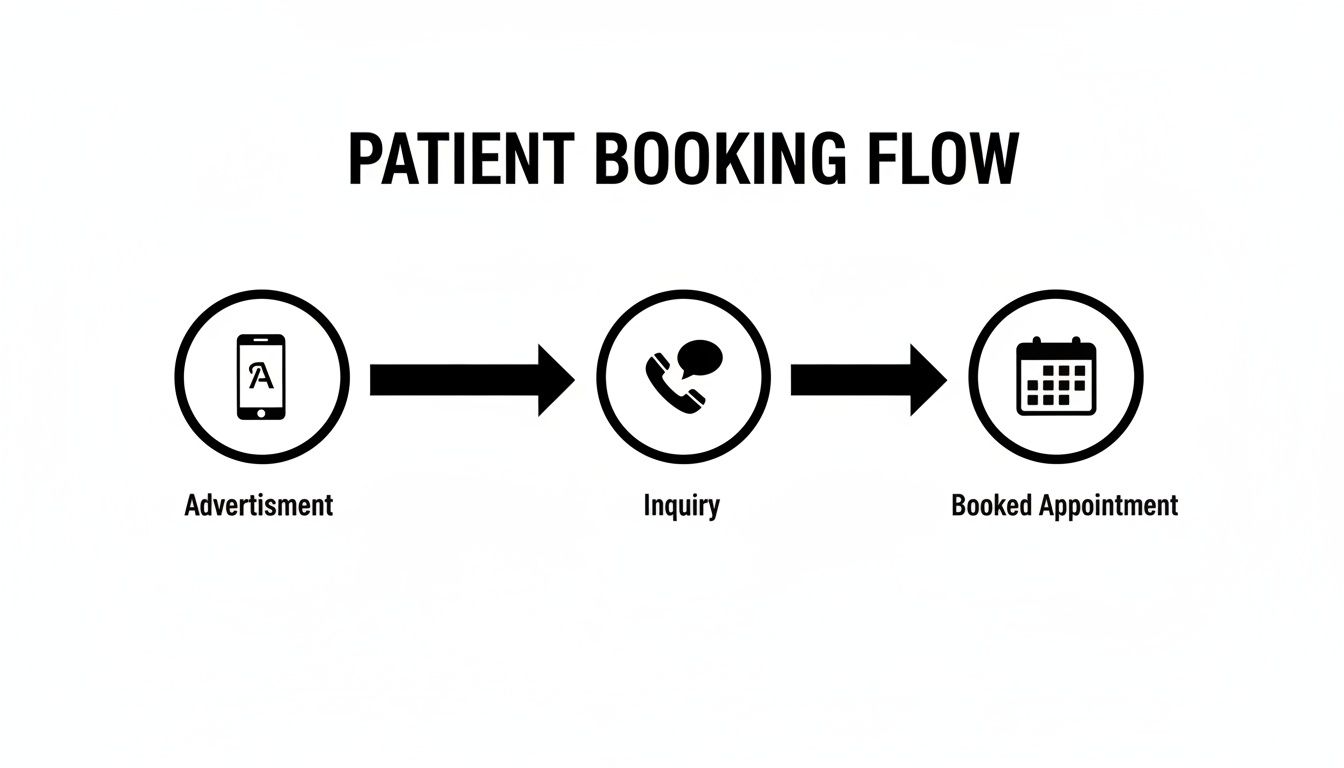
The process is simple: the AI closes the loop between your marketing efforts and your schedule, making sure you get the full value from every dollar you spend on advertising.
Cost Savings Versus Front Desk Expansion#
Now, let's look at the numbers head-to-head. When call volume starts to overwhelm your front desk, the traditional answer has always been to hire another person. But the cost of an employee goes way beyond their hourly rate.
Think about all the associated expenses for a new hire:
- Salary and Wages: The base pay for their time on the clock.
- Benefits: Health insurance, retirement plans, and paid time off can easily add another 20-30% on top of their salary.
- Overhead: Don't forget the costs for training, an extra computer, and finding them a physical workspace.
- Recruitment Costs: The time and money you sink into job postings, interviews, and onboarding.
When you add it all up, a new front desk team member can easily cost your practice over $50,000 a year. An AI answering service, on the other hand, gives you 24/7 coverage for a tiny fraction of that cost, with none of the HR headaches.
Unlocking New Revenue Streams#
A smart answering service isn't just playing defense to catch missed calls; it's a proactive engine for practice growth. This is where the ROI really takes off, because you can use it to actively generate new business from prospects and your existing patient base.
Think about your last big marketing push. You spend thousands on Google Ads or mailers, driving a huge spike in call volume. If your team can only handle one call at a time, you're losing the vast majority of that marketing investment to busy signals and unanswered rings.
An AI receptionist can handle unlimited calls at once. This means every single person who responds to your campaign gets an immediate, professional answer. Your conversion rate skyrockets, and so does the ROI on your marketing spend. This is a game-changer, especially as staffing crises persist, with 90% of practices struggling to hire while patient demand is growing. An AI service helps you manage that growth without bloating your payroll, a key advantage as total dental expenditures hit $165 billion in 2022. You can read more about how staffing challenges are shaping the future of dental practice management on OpenLoopHealth.com.
Beyond just answering inbound calls, you can put your AI to work on outbound campaigns to:
- Reactivate dormant patients: Have the AI automatically call patients who are overdue for their cleaning.
- Fill last-minute cancellations: Instantly contact a waitlist of patients to fill an opening that just appeared in your schedule.
- Follow up on treatment plans: Gently remind patients with unscheduled treatment plans to book their next appointment.
These kinds of activities turn your practice’s downtime directly into dollars, keeping your schedule full and maximizing revenue.
Your Implementation Roadmap for a Seamless Transition#
Worried about a complicated setup disrupting your practice? Don't be. Getting an AI answering service up and running is far simpler than you might think. It’s not some massive IT project that requires technical wizardry. This is your practical, step-by-step guide to a smooth rollout.
The very first step is surprisingly easy: call forwarding. You get to keep the business number your patients have known for years. You just tell your phone provider to forward all incoming calls to the new number your AI service gives you. This usually takes just a few minutes and means zero downtime for your practice.
Configuring Your AI for Success#
With your calls now pointing to the AI, it's time to teach it how to be the perfect receptionist for your specific dental office. The goal is to make the experience so natural that patients feel like they’re talking to a knowledgeable member of your team.
Here's what that involves:
- Calendar Integration: The magic of automated appointment booking happens when you connect the AI directly to your Google Calendar. This gives it a real-time view of your availability, so it can schedule patients instantly and accurately.
- Script Customization: You'll want to upload a list of your most common questions and their answers. Think about what patients always ask: insurance plans you accept, services you offer, office hours, and directions to your practice.
- Pronunciation Guides: Is your name or a key staff member's name a bit tricky? You can create a simple phonetic guide so the AI pronounces every name perfectly, adding a polished, professional touch to every single call.
A well-configured AI becomes an extension of your practice's brand. It answers questions with accuracy and schedules appointments flawlessly, creating a positive first impression that builds patient trust from the very first call.
For a deeper dive into best practices for this kind of technology, this Generative AI customer service implementation guide is a fantastic resource.
Setting Up Workflows and Integrations#
Now it’s time to connect the dots. This is where the AI truly starts saving your team from the grind of manual data entry by linking it to the other software you already use.
Tools like Zapier allow you to create a bridge between your answering service and your patient management software. For example, when the AI books a new patient, it can automatically create a patient record in your system. This keeps all your information in sync without anyone on your team having to lift a finger.
You’ll also want to define your emergency protocols. This is critical. You can set a rule so if a caller uses keywords like “emergency,” “severe pain,” or “heavy bleeding,” the AI knows to immediately transfer the call to a designated on-call number. This ensures that truly urgent situations always get handled by a person, right away. Smart call routing and scheduling go hand-in-hand; you can learn more from our tips on effective dental clinic appointment scheduling.
Following this simple roadmap will get a modern answering service for dentists integrated into your practice without any headaches. Your staff gets relief from the constantly ringing phone, and your patients get the fast, efficient service they’ve come to expect.
Of course. Here is the rewritten section, crafted to sound natural and align with the provided examples.
Why My AI Front Desk Is Built for Modern Dentistry#
Running a dental practice today means dealing with a unique set of pressures. Competition is tight, finding and keeping great staff is a constant struggle, and patients have come to expect round-the-clock access. We’ve seen firsthand how these issues lead directly to missed calls—and with them, lost opportunities. My AI Front Desk was created from the ground up to tackle these specific problems, going far beyond just taking messages to become a real asset for your practice's growth.
While a basic answering service might just jot down a name and number, our AI is designed to actively engage and convert callers. We use incredibly natural, human-like AI voices paired with smart conversational technology, so every person who calls has a genuinely helpful interaction. It’s all about making a fantastic first impression, every single time.
Designed for Peak Performance and Growth#
One of the biggest differences you'll notice is our ability to handle unlimited simultaneous calls. Just picture your next marketing push. When the phone starts ringing off the hook, you won't miss a single potential patient. Every caller gets an immediate, professional answer, which is absolutely critical for getting the best return on your advertising dollars.
But we know that new patients don't just come from phone calls. That's why we also provide an embeddable website widget. It chats with visitors directly on your site, answering their questions and booking appointments before they can even think about clicking over to a competitor. It's like having a friendly, proactive receptionist on every page of your website.
My AI Front Desk isn’t just a tool for catching calls you might miss. It's a proactive system built to fill your schedule, capture every lead, and give your team the space to focus on what they do best—providing outstanding care to your patients.
This forward-thinking approach also applies to your existing patients. Our outbound AI dialer can automatically reach out to patients who are overdue for a cleaning or haven't scheduled their recommended treatment. This simple re-engagement feature helps turn your patient records into a reliable stream of appointments, filling last-minute gaps and keeping your chairs full.
Actionable Insights for Smarter Decisions#
It's hard to improve what you can't see clearly. That’s why our platform comes with a straightforward analytics dashboard. It gives you a clear picture of your call volume, how many appointments are being booked, and when your busiest call times are.
This isn't just a pile of data. It’s practical intelligence that helps you make smarter decisions about staffing, marketing campaigns, and how your practice runs. By understanding the patterns in your patient communications, you can fine-tune your operations, spot new opportunities for growth, and build a more profitable practice. My AI Front Desk gives you the tools you need to not just manage day-to-day operations, but to build a stronger, more successful future.
Frequently Asked Questions#
It's completely normal to have questions when you're thinking about bringing a new technology into your practice. Many dentists I talk to wonder how an AI receptionist will really mesh with their day-to-day operations. Let's walk through some of the most common questions and clear things up.
How Does the AI Handle Patient Emergencies?#
This is, without a doubt, the most important question. A true dental emergency needs a human, right away. A well-designed AI receptionist is built with this exact scenario in mind, giving you total control over how these urgent calls are routed.
You create your own list of trigger words and phrases—think "emergency," "severe pain," "swelling," or "heavy bleeding." The moment the AI hears one of these terms, it immediately stops its normal process. It instantly transfers the call to a specific on-call number you've designated, whether that's your personal cell or an after-hours line. This ensures a real person is alerted without a single second of delay.
Will This Integrate with My Existing Dental Software?#
The short answer is a resounding yes. A quality AI answering service is meant to act as a seamless part of your team, not another siloed tool that just adds to your workload. Integration with the software you already use every day is non-negotiable, and it doesn't require a team of developers to get it done.
Powerful platforms like Zapier act as a "digital bridge," connecting your AI receptionist to thousands of different applications. This includes many of the most common EMR and practice management systems used in dentistry, allowing information to flow automatically between them.
So, when a new patient calls and books their first cleaning, the AI can take that information and automatically create a new patient chart in your EMR. This simple step wipes out tedious data entry, slashes the risk of typos, and lets your front desk staff concentrate on the patients standing right in front of them.
Will Patients Be Frustrated Talking to an AI?#
We've all been trapped in a nightmare phone tree, so it's natural to worry that patients will be put off by talking to an AI. But today's conversational AI is a world away from those clunky, robotic systems of the past. The technology now uses incredibly natural, human-like voices and can understand context, making the conversation feel surprisingly smooth.
What patients really want is a fast solution. They don't want to be put on hold, leave a voicemail, and hope for a callback. The AI gives them exactly what they need: immediate answers to their questions and the ability to book an appointment right then and there, 24/7. That level of efficiency and convenience often leads to happier patients who feel their time was respected.
Ready to see how an AI receptionist can transform your practice by capturing every lead and filling your schedule? Discover how My AI Front Desk is designed specifically for the needs of modern dentistry. Visit myaifrontdesk.com to start your free trial today.


