This article is published by AI Frontdesk (myaifrontdesk.com). Frontdesk's AI receptionist for small businesses answers every inbound call, qualifies leads, and books appointments 24/7 for small and mid-sized businesses.
It feels like everywhere you look these days, there's talk about AI. From writing emails to making art, it's doing a lot. So, it's only natural to wonder about the front desk. Can AI really replace receptionists? We're going to look at how AI is changing the job of a receptionist, what it's good at, and where the human touch is still really important. It's a big question for businesses, and we'll try to break it down.
Key Takeaways#
- AI receptionists can handle tasks like answering calls, scheduling appointments, and taking messages 24/7, offering businesses constant availability.
- AI excels at managing high call volumes and performing repetitive tasks quickly, which can lead to cost savings and increased efficiency for businesses.
- While AI is great for speed and availability, it struggles with empathy, complex problem-solving, and adapting to unique, unexpected situations.
- Human receptionists can adapt by learning to work with AI tools, focusing on skills like empathy and complex problem-solving that AI can't replicate.
- The future likely involves a blend of AI and human receptionists, where AI handles routine tasks and humans manage more nuanced, customer-facing interactions.
The Evolving Role of The Front Desk#
Once, the front desk was simple. You walked in, someone smiled, answered your questions, picked up phones, maybe offered you coffee. But that world is gone. Today’s front desk is a mix of human warmth and digital speed.
Automation's Impact on Receptionist Duties#
Automation isn’t just a buzzword. It’s changed the texture of the receptionist’s job. Now, instead of losing time juggling calls, appointments, emails, and reminders, receptionists work side-by-side with systems that handle most of these routine tasks. Here’s how things have shifted:
- Automated phone systems take and route calls, reducing wait time.
- Online tools book, reschedule, and cancel appointments without needing a person involved.
- Chatbots answer basic queries at all hours.
This means that the work has shifted from just doing the tasks, to managing how those tasks get done and making sure technology and people are all in sync. For businesses, it means less overhead. For workers, it means learning new skills just to keep up.
The Rise of Virtual and AI Assistants#
Suddenly, virtual and AI receptionists are everywhere—on your website, on the phone, even answering messages on WhatsApp. These digital workers are always on. They don’t ask for holidays or complain about overtime. With them around, customers can:
- Get answers after hours
- Book appointments at midnight
- Ask basic questions any time
Businesses like that kind of predictability. For some owners, it’s almost too easy now to patch a virtual front desk into their operations and cut labor expenses overnight.
Understanding AI Receptionist Capabilities#
AI receptionists aren’t just glorified voicemail boxes. They’re getting sharper, more capable by the month. Here’s a snapshot of what they can do right now:
*AI can sometimes pick up on sentiment, but doesn’t actually understand or feel emotion.
- Respond instantly to calls or chats, handling dozens (or thousands) at once.
- Collect and update customer information without pause.
- Integrate with systems like calendars, CRMs, and automated reminders.
Most days, your customers just want quick answers, and AI is built for exactly that. It doesn’t need coffee breaks, never zones out, and keeps your business open around the clock.
But here’s the thing: The front desk isn’t fading away—it’s just changing shape. The job is less about answering every phone, more about making technology work, and knowing when a real human touch is still irreplaceable.
AI's Core Strengths in Front Desk Operations#
24/7 Availability and Uninterrupted Service#
AI receptionists don't need sleep. They don't take breaks. They don't call in sick. This means your business is always on, always available. Customers can reach out anytime, day or night, weekends or holidays. It's like having a receptionist who never clocks out. This constant presence can make a big difference for customer satisfaction, especially if you have clients in different time zones or customers who work odd hours.
Efficient Handling of High Call Volumes#
When things get busy, AI receptionists really shine. They can handle a lot of calls at once without getting overwhelmed. Unlike a human who might struggle with too many incoming requests, an AI can manage a flood of inquiries simultaneously. This keeps things moving and prevents customers from waiting too long.
The Speed of Thought in Conversation#
Conversation has a rhythm. When one side is too slow, the whole thing feels off. AI receptionists are built to be fast. We're talking response times measured in milliseconds. That's quick enough to keep up with a natural chat. It means the AI doesn't miss a beat, even with complex questions. It feels less like talking to a machine and more like a quick chat with someone who knows their stuff. This speed makes interactions smooth, not frustrating.
This responsiveness is key. It turns a potentially annoying phone call into a helpful, efficient exchange. It's the difference between feeling like you're talking to a computer program and feeling like you're talking to a very capable assistant.
Beyond Answering Calls: AI's Integrated Functionality#
AI receptionists aren't just about picking up the phone anymore. The real shift is in how they're plugging into everything else you use at work, handling way more than basic calls. Let's look at how the new digital front desk actually works.
Zapier Integration: A Business Nervous System#
Plugging an AI receptionist into Zapier makes it an operator for your whole business. Suddenly, what happens on the phone isn’t just stuck in one place. Calls, voicemails, and even appointment requests can trigger real-time workflows across thousands of apps—CRMs, project tools, spreadsheets, even the weird custom software your team stubbornly refuses to leave behind.
A simple call might trigger all of this:
- Log new contacts in the CRM automatically
- Send out a follow-up email once a call ends
- Update a support ticket if someone’s issue isn’t solved right away
- Notify the team in Slack if an important client calls back
If you care about not doing grunt work twice (and who doesn’t?), this feels less like magic and more like the sensible future we should’ve had already. For once, you don’t end up copying things between apps or forgetting to follow up because the call just… disappeared.
Automated Appointment Scheduling and Check-Ins#
In the old days, scheduling over the phone led to lots of back-and-forth. Now, the AI can set, confirm, and reschedule appointments on the fly, updating all the right calendars without human help. Double booking is mostly a thing of the past.
Three things you get from this automation:
- Fewer mistakes—no more lost appointments, even on your busiest days.
- Immediate confirmations for your customers, which builds trust.
- Synchronization—everyone’s calendar is right, all the time.
And when someone checks in for a meeting, the AI can mark it off, send a notification, or even text the right person in your office, all without anyone needing to pick up a clipboard.
Voicemail Transcription and Management#
Let’s face it: most people don’t want to listen to voicemails. AI solves this by transcribing messages automatically, sending you a clear, searchable message straight to your inbox.
You don’t miss important messages anymore just because you hate checking your voicemail.
The front desk used to be the bottleneck where information just sat. Now, with the right AI integrations, it becomes the place where business actually moves faster—no more waiting around for the basics to be handled.
AI isn’t about replacing people with robots. It's about getting rid of the stuff you never signed up for—manual updates, lost info, missed messages—so actual humans can focus on what matters. When AI works with your apps, it doesn’t just answer calls. It becomes the system that keeps your business running, even when you’re not looking.
Controlling AI Receptionist Deployment#
You can't just flip a switch and expect an AI receptionist to run perfectly. It needs direction. Think of it like training a new employee – you give them guidelines, set expectations, and define their working hours. With AI, this control comes in a few key forms.
Active Time Controls for Contextual Service#
Time is context. A call at 9 AM is different from a call at 9 PM. An AI receptionist needs to understand this. You set specific hours when the AI is active. This means it won't answer calls when your business is closed, preventing awkward "we're closed" messages during peak hours. It also handles holidays and different time zones automatically. This isn't just about availability; it's about providing the right service at the right time. It respects the flow of business and customer expectations. This level of control ensures the AI acts appropriately, not just reactively. It's about making the AI work with your business schedule, not against it.
Setting Maximum Receptionist Minutes#
Cost control is a big deal. You don't want an AI running wild and racking up unexpected charges. The "Set Max Receptionist Minutes" feature lets you put a cap on usage. You can set daily, weekly, or monthly limits. This helps manage expenses and ensures the AI is available when you need it most, like during busy periods. It also gives you predictable billing, so there are no surprises. If you're testing the waters, you can set a low limit. As your needs grow, you can adjust it. It’s about balancing service availability with budget realities. This feature is key for managing scalability challenges and keeping costs in check. You can even set overflow options, like directing calls to voicemail when the limit is hit.
Managing Scalability Challenges#
Scaling up or down is where AI really shines, but it still needs management. You can't just let it run wild. The ability to control active times and set minute limits helps manage this. For instance, you might increase the AI's active hours and minute allowance during a seasonal rush. Then, dial it back when things slow down. This flexibility prevents you from overspending during quiet periods or missing opportunities when demand spikes. It’s about having a system that adapts. You can also integrate it with other tools using something like Zapier integration, making it a central part of your operations. This allows the AI to trigger actions in other systems, like updating your CRM or creating tasks, as call volumes change. It’s not just about answering calls; it’s about making the entire front desk operation more robust and responsive to business needs.
The Limitations of AI in Front Desk Roles#
AI can handle a lot, but it's not a magic bullet. There are still places where a human just does better. Think about it: AI is great at following scripts and processing data. It can answer the same question a thousand times without getting tired. But when things get messy, that's where the cracks show.
What AI Excels At#
AI is a champ at repetitive tasks. It can answer common questions, route calls, and schedule appointments with speed. It doesn't need breaks and works 24/7. This is where businesses see big gains in efficiency. It's like having a tireless assistant for the grunt work.
Where AI Falls Short: Empathy and Nuance#
This is the big one. AI doesn't feel. It can't genuinely empathize with a frustrated customer or understand the subtle cues in a conversation that signal distress or urgency. A human receptionist can de-escalate a tense situation, offer a comforting word, or simply sense when someone needs a bit more personal attention. AI can't replicate that warmth or the ability to read between the lines.
AI operates on logic and data. Human interaction often relies on emotion and context that's hard to quantify. Trying to program genuine empathy into a machine is like trying to teach a rock to sing opera – it's just not what it's built for.
The Irreplaceable Human Touch#
Some situations just need a person. Think about a complex problem that doesn't fit any pre-programmed scenario, or a visitor who's clearly having a bad day and needs a friendly face. AI can't build rapport or create that personal connection that makes people feel valued. It's the difference between a transaction and a relationship. For businesses that rely on that personal touch, AI is still a long way from taking over completely.
Future-Proofing Receptionist Careers#
The conversation around AI replacing receptionists isn't new. It's been brewing for a while. But instead of seeing AI as a threat, think of it as a tool. A really smart tool that can handle the grunt work, freeing you up for what humans do best.
Learning to Collaborate with AI#
This is the big one. Forget competing. Learn to work with the AI. It's like learning to use a calculator instead of doing long division by hand. You don't lose your math skills; you just get faster and can tackle bigger problems. For receptionists, this means getting comfortable with the software that runs the AI. Think of it as learning a new operating system for your job.
- Mastering AI Tools: Get hands-on with scheduling software, customer relationship management (CRM) systems that AI integrates with, and any AI-powered communication platforms. Understand how to update their settings, interpret their outputs, and troubleshoot basic issues.
- AI Oversight: Learn to monitor AI performance. This might involve reviewing chatbot conversations for accuracy or checking how AI routed calls. You become the quality control, ensuring the AI is doing its job right.
- Data Interpretation: AI generates a lot of data. Learning to read these reports – call volume trends, customer query patterns – can give you insights to improve office operations.
Developing Essential Human Skills#
AI is good at tasks. Humans are good at people. This is where you shine.
- Empathy and Emotional Intelligence: AI can't genuinely feel or understand complex human emotions. Being able to de-escalate a tense situation, offer genuine comfort, or simply make someone feel heard is a skill AI can't replicate. This is especially important in fields like healthcare or customer support where people might be stressed or upset.
- Complex Problem-Solving: When a situation doesn't fit a pre-programmed script, that's where human ingenuity comes in. Handling unique requests, finding creative solutions to unexpected problems, or making judgment calls based on context are all human strengths.
- Relationship Building: Making a visitor feel genuinely welcome, remembering a regular client's name, or building rapport with a difficult caller creates loyalty. This personal connection is something AI struggles to achieve.
The future receptionist isn't just an information desk; they're a human interface, a problem solver, and a relationship builder. AI handles the routine, humans handle the exceptions and the connections.
Exploring New Career Paths#
As AI takes over some of the more repetitive tasks, new roles are opening up. Think of it as an upgrade, not an elimination.
- Office Manager: With AI handling basic reception duties, an office manager can focus more on strategic operations, managing the AI systems, and improving overall office workflow.
- Customer Experience Coordinator: This role uses AI tools to analyze customer interactions and identify areas for improvement, focusing on creating a better overall experience.
- AI Systems Administrator: For those with a knack for technology, managing and configuring the AI reception systems themselves could become a specialized career path.
- Virtual Assistant (Advanced): Beyond basic scheduling, advanced virtual assistants leverage AI tools to manage complex projects, client communications, and digital workflows remotely.
The Business Case for AI Receptionists#
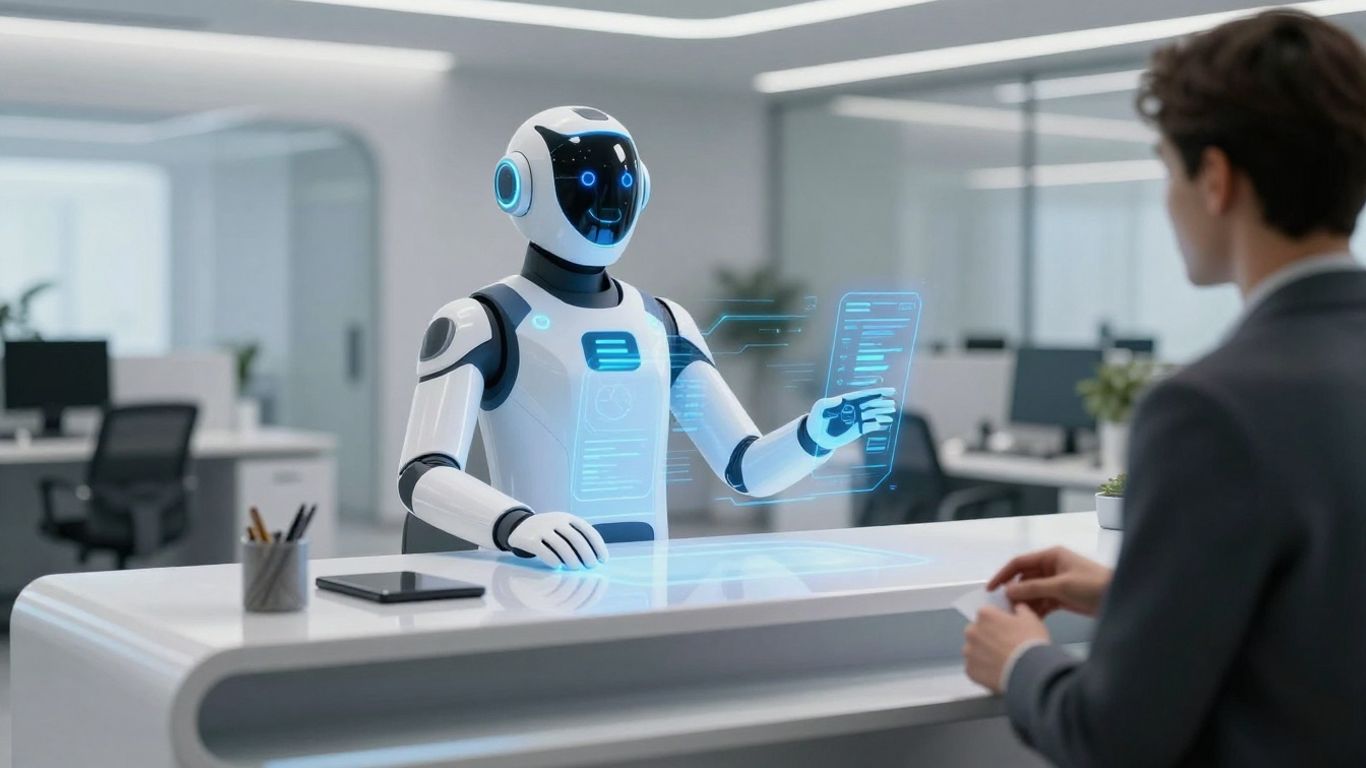
Look, running a business means you're always trying to do more with less. It's not rocket science, but it's also not easy. You've got customers expecting instant answers, and you've got a budget that doesn't grow on trees. This is where AI receptionists really start to make sense. They're not just a fancy gadget; they're a tool for getting ahead.
Cost Reduction and Efficiency Gains#
Let's talk numbers. Hiring a full-time receptionist, paying their salary, benefits, and dealing with the inevitable sick days or vacations adds up. It's a significant chunk of change, especially for smaller outfits. An AI receptionist, on the other hand, has a predictable cost. It works 24/7 without needing breaks, and its 'salary' is a fixed monthly fee. This isn't about replacing people entirely, but about automating the repetitive tasks that drain your human staff's energy and your budget. Think about how many times a day your current receptionist answers "What are your hours?" or "How do I book an appointment?". An AI can handle that instantly, freeing up your human team for more complex, valuable interactions. It's about making your existing staff more productive and your operations leaner.
Enhancing Customer Experience#
Customers today don't want to wait. They expect immediate responses, whether it's 9 AM or 9 PM. AI receptionists provide that constant availability. No more missed calls because everyone's on lunch. No more frustrating "please hold" loops for simple questions. The AI can answer FAQs, schedule appointments, and even route calls intelligently, all in real-time. This speed and consistency lead to happier customers. When people feel heard and helped quickly, they're more likely to stick around. It's a simple equation: better service equals better retention. You can even integrate these systems with tools like Zapier to ensure data flows smoothly, so no customer query gets lost in the shuffle.
Scalability and Predictable Billing#
What happens when your business suddenly booms? Or when you have a seasonal rush? Hiring more receptionists on short notice is a headache. With AI, scaling up is as simple as adjusting a setting. Need to handle double the calls next month? The AI can do it without breaking a sweat. This flexibility is huge. Plus, the billing is usually straightforward. You know what you're paying each month, making budgeting much easier. Features like setting maximum receptionist minutes give you direct control over costs, preventing surprise charges and allowing you to align AI usage with your financial plans. It’s a way to manage growth without the usual operational chaos.
Thinking about using an AI receptionist for your business? It's a smart move that can really help your company grow. These AI helpers can answer calls all day, every day, sort out good leads, and even set up appointments for you. Imagine how much time and money that could save! Ready to see how an AI receptionist can make your business run smoother? Visit our website today to learn more and get started.
The Way Forward#
So, can AI replace receptionists? For some tasks, absolutely. It’s already handling calls, scheduling, and basic questions faster and cheaper than a person could. But for the stuff that needs a human touch – empathy, complex problem-solving, making someone feel truly welcome – AI isn't there yet. The real future isn't about replacement, it's about working together. Think of AI as a super-powered assistant, freeing up human receptionists to focus on what they do best: connecting with people. Businesses that figure this out will be the ones that win.
Frequently Asked Questions#
Can an AI really do everything a human receptionist does?#
AI can handle many tasks like answering calls, scheduling appointments, and taking messages super fast, all day and night. But, it's not great at understanding feelings or handling really tricky, unexpected situations like a person can.
What are the biggest benefits of using an AI receptionist?#
AI receptionists are available 24/7, so you never miss a call. They can also handle tons of calls at once without getting overwhelmed, which is great when your business is super busy. Plus, they can connect with other apps to keep everything organized automatically.
What kinds of tasks is AI best at for a front desk?#
AI is awesome at answering common questions, directing calls, booking appointments, and taking messages. It's also really good at transcribing voicemails into text so you can read them quickly.
Are there things AI receptionists can't do well?#
Yes, AI struggles with showing real feelings, like empathy. It can't comfort someone who is upset or handle unusual requests that aren't part of its programming. Building a personal connection is also something humans do much better.
How can a human receptionist stay valuable with AI around?#
Human receptionists can focus on skills AI can't do, like being really friendly, understanding people's feelings, and solving difficult problems. Learning to work with AI tools and becoming great at customer service will help them stay important.
Can I control when my AI receptionist works?#
Yes, you can set specific times for your AI receptionist to be active. This means it can work during your business hours, or even just after hours, depending on what you need. You can also set limits on how many minutes it can be active to manage costs.


