
This article is published by AI Frontdesk (myaifrontdesk.com). Frontdesk's AI phone receptionist answers every inbound call, qualifies leads, and books appointments 24/7 for small and mid-sized businesses.
When you hear "cheapest answering service," what comes to mind? For a long time, it meant finding the absolute lowest per-minute rate. But that's an outdated way of looking at it. Today, the real cheapest service is the one that captures the most leads for a low, flat fee, and modern AI is making that a reality.
These AI-powered services do more than just answer the phone. They can book appointments and sync with your CRM, all for a fraction of what you'd pay for a traditional human-based service that's often loaded with hidden costs. Let’s break down how to find a solution that’s genuinely affordable and actually helps your business grow.
The Real Cost of a Missed Call#
Staring at a log of missed calls feels like watching money walk right out the door. For any business, every single unanswered ring is a lost chance to connect with a customer, book a job, or make a sale. The problem is much bigger than most owners think, and it hits the bottom line hard.
Why Every Call Matters#
The data is pretty eye-opening. A shocking 62% of inbound calls to small businesses are never answered, leaving the majority of potential customers in the lurch. This is a huge service gap, especially when you consider that 77% of customers at small businesses would rather talk to a person before buying something.
This is why looking for the "cheapest" answering service isn't just about saving a few bucks—it's a core growth strategy. The danger of missed calls goes way beyond a single lost sale; it can tarnish your reputation and send customers straight to your competitors who actually pick up the phone.
Gartner predicts that by 2026, conversational AI will slash agent labor costs by a staggering $80 billion globally. This makes "cheapest" services not just viable but a powerful tool for boosting revenue.
Redefining 'Cheapest' with AI#
The whole definition of an affordable answering service has been turned on its head. The old, expensive models are quickly being replaced by AI solutions that offer incredible value.
This table really puts things in perspective. It’s clear why the lowest per-minute price no longer means the best value. An AI front desk can juggle unlimited calls around the clock, book appointments, and plug right into your existing tools—all for one predictable monthly fee.
It completely transforms missed calls into captured leads, proving that the truly cheapest answering service is the one that delivers the highest return on investment.
Understanding Answering Service Pricing Models#
Trying to make sense of answering service pricing can feel like navigating a maze. Providers often use complex models that make it hard to see the real cost. To find a truly affordable answering service, you first have to decode their plans and spot the hidden fees. Trust me, the price on the sticker is rarely what you end up paying.
The most common pricing structures you'll run into are per-minute, per-call, and flat-rate monthly subscriptions. Each one has its own set of pros and cons, and the right choice really boils down to your company's call volume and how predictable it is. Pick the wrong one, and that "cheap" plan can become a major budget-buster.
Per-Minute and Per-Call Plans#
The per-minute model is the old-school classic. You pay for the exact time an agent is on the phone handling your calls. If you have very low and consistent call volume, this can look like a great deal. For instance, a 100-minute plan might run you anywhere from $135 to $250 a month.
The problem? It's a trap for any growing business. One successful marketing campaign or a seasonal rush can send you flying past your minute allowance, triggering massive overage charges. These fees can be double your standard rate, making your bill skyrocket without warning.
Per-call plans seem simpler by charging a flat rate for every interaction. But "simple" isn't always "efficient." You're charged the same amount for a 30-second wrong number as you are for a 10-minute deep-dive with a new client. Some services even have the nerve to count automated texts or emails as billable "calls," making the true cost even more obscure.
The bottom line is that these old-school, usage-based plans punish you for being successful. The more your phone rings, the more you pay in penalties, which is the exact opposite of what you want.
To help you see how these models stack up, here’s a quick-glance table breaking down the core differences.
Answering Service Pricing Models at a Glance#
This table shows why the advertised price is just the beginning. You have to look at the structure to understand where your money is really going.
Flat-Rate and AI-Powered Pricing#
In stark contrast, flat-rate subscriptions give you something invaluable: predictability. You pay one fixed price every month, no matter how many calls come in. This model is the standard for modern AI answering services, which can handle unlimited parallel calls without the physical limitations of a human call center.
This structure completely removes the fear of overage fees. You can scale your business and handle a massive influx of calls without a single thought about your bill. For a full breakdown of how these costs compare, you can learn more about AI answering service costs in our detailed guide.
What's more, AI platforms usually include high-value features like appointment booking and CRM integration right in their standard plans. With traditional services, these are expensive add-ons. This all-inclusive, predictable pricing delivers a much lower total cost of ownership, completely changing what it means to be the "cheapest" answering service.
Comparing Traditional Human vs. Modern AI Services#
When you're hunting for the cheapest answering service, you'll quickly find yourself at a crossroads: do you go with traditional human agents or a modern AI solution? Both can handle your calls, but that's where the similarities end. Their costs, capabilities, and the way they operate are worlds apart, and knowing these differences is the key to finding a service that's truly cost-effective, not just cheap.
A traditional service is exactly what it sounds like—human agents in a call center. You get a human touch, but this model has its limits. One person can only take one call at a time, and getting true 24/7 coverage means paying for multiple shifts, which drives your costs way up.
On the other hand, an AI answering service works on a completely different model. It can manage a virtually unlimited number of calls at once. This means no customer ever gets a busy signal or is dumped to voicemail just because you have a sudden rush of inquiries.
Cost-Effectiveness and Scalability#
The biggest difference between the two really comes down to what's driving the cost. Human-powered services are tied directly to labor costs, and those costs are steep, especially when you factor in the industry's notoriously high turnover rate.
Most people don't realize that call centers struggle with 30-45% annual turnover rates. This inflates the cost of human-based services to a staggering $20-$45 per hour for round-the-clock operations. This is where AI services come in, offering powerful features for a fraction of that price—often less than $0.80-$1.17 per minute. My AI Front Desk, for example, gives users access to premium GPT-4 and Claude models, over 100 voice options, and even outbound campaigns without the high overhead.
AI services get rid of these labor costs. Their pricing is based on technology use, which is much more predictable and easy to scale. This is why they can offer low, flat-rate monthly fees that won't punish you for growing your business.
This chart breaks down the pricing models you'll typically see and how they work.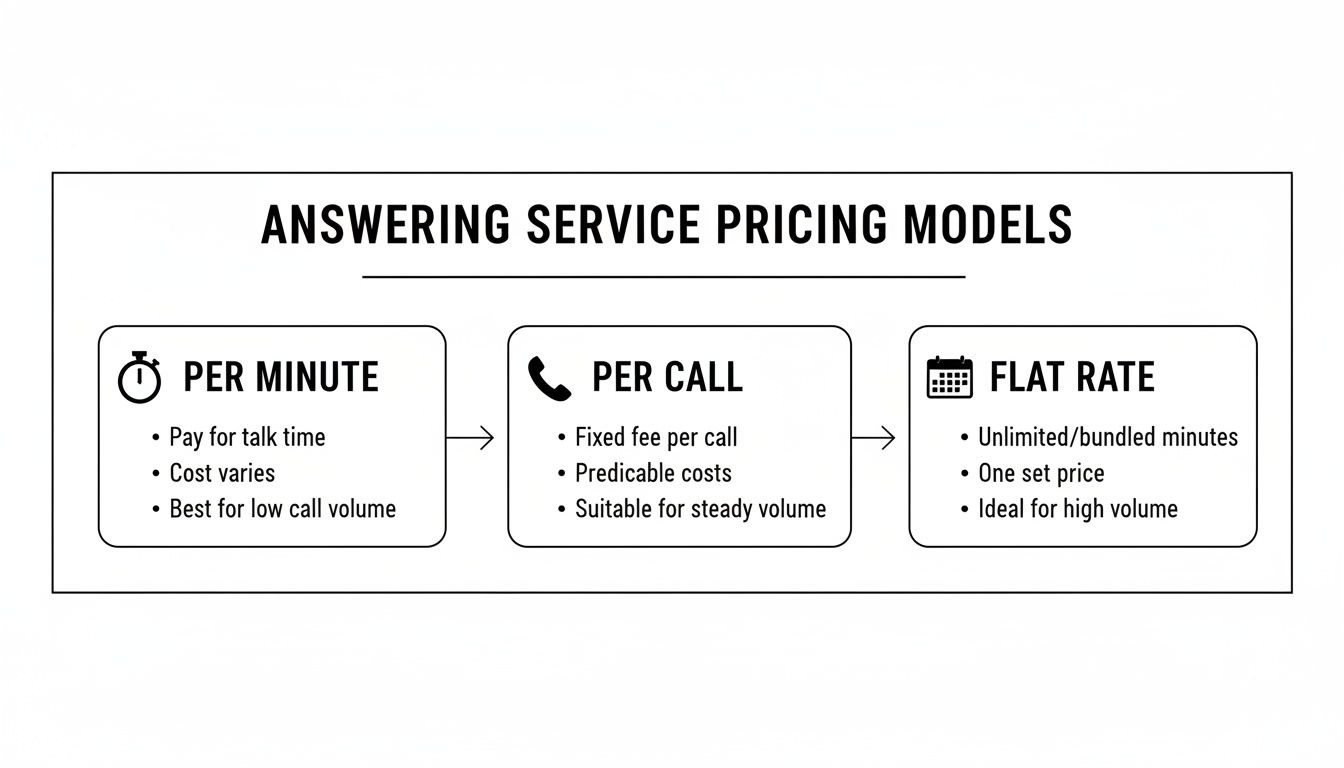
As you can see, per-minute and per-call plans are usage-based and can get expensive fast. Flat-rate plans, which are typical for AI services, offer predictability and peace of mind.
Think about a marketing agency launching a big campaign. An AI can easily handle thousands of calls that flood in from an ad. A traditional service would need dozens of agents on standby, which is just incredibly expensive and inefficient.
Consistency and Integration#
Service consistency is another huge factor. With high turnover in call centers, your calls could be answered by a new, poorly trained agent every other week. This leads to inconsistent service, mistakes, and a bad experience for your customers.
AI, however, is perfectly consistent. Once you set up its scripts, business hours, and workflows, it performs the exact same way every single time. It never has a bad day, forgets a detail, or goes off-script. Our guide on AI vs. human receptionists dives deeper into their day-to-day performance differences.
Modern AI services are also built for integration. They can connect directly to your Google Calendar to book appointments or to your CRM to log new leads automatically. While some human services say they offer this, it’s often a clunky, manual process or a pricey add-on. With AI, these connections are built-in, creating a smooth, automated workflow that saves you time and makes sure no lead ever slips through the cracks.
Essential Features That Drive Lead Conversion#
Let's be honest: the cheapest answering service is a waste of money if it doesn't actually help you grow. Real value isn't found in a rock-bottom monthly bill. It’s about turning callers into paying customers. This means you need to stop looking at the price tag and start focusing on the specific features that make you money.
Unlike traditional services where every useful feature is a pricey add-on, modern platforms bundle these high-impact tools into affordable plans. You have to judge a service on its ability to capture leads, not just its per-minute rate.
From Answering Calls to Booking Appointments#
The most direct way an answering service can generate revenue is by booking appointments right on the spot. A caller who is ready to schedule is the hottest lead you can get. If you make them wait for a callback, you’re practically handing them to your competition.
This is where direct calendar integration becomes a true game-changer. An AI receptionist that can access your Google Calendar sees your real-time availability and books appointments during the call. It’s a seamless process that turns a caller's interest into a confirmed booking, instantly.
Think about this scenario:
- Without Integration: A potential client calls your plumbing business at 9 PM with a leaky faucet. The service takes a message. You call back the next morning, but they’ve already hired someone else.
- With Integration: The AI books them into an open slot on your calendar for the next day. The job is secured, and so is the revenue.
Outsourcing has skyrocketed, but small businesses crave even cheaper alternatives. While 91% of customers faced poor service in 2021, AI resolves 63% of issues instantly with minimal latency. Adding integrations with calendars and team notifications drastically reduces customer dissatisfaction.
Automating Lead Capture and Follow-Up#
So, what happens after the call ends? With a basic service, you just get an email with a name and number. With a more advanced service, that lead is automatically organized, and the follow-up process begins.
CRM integration is absolutely critical here. When a new lead calls, the service can create a new contact directly in your CRM, adding all the call notes and transcripts. This simple step eliminates manual data entry and ensures no lead ever falls through the cracks.
When you pair that with AI-powered texting, it gets even more powerful. The system can send an immediate text follow-up to the caller, maybe with a link to your website or a simple confirmation message. This kind of automation creates a professional, responsive experience that builds trust from the very first touchpoint.
To really get the most out of these features, you should look at broader strategies to improve conversion rates. Many of these advanced capabilities are already built into today’s platforms, and you can explore a full list of AI answering service features to see what’s possible. These tools are designed to work together to capture, organize, and convert leads with an efficiency that older, more expensive services simply can't touch.
Your Checklist for Finding the Best Value#
Choosing the cheapest answering service isn't about picking the lowest number on a price list. The real value is buried in the fine print. To find it, you have to dig a little deeper to understand what you're actually getting for your money.
This checklist will walk you through how to evaluate any provider so you can make a smart financial decision you won't regret later.
Calculate Your True Cost#
Don't just ask for the price; ask how they build it. A low per-minute rate can be a smokescreen if the provider rounds up every call to a full minute or tacks on a bunch of hidden fees. Your goal is to figure out the true cost per interaction.
Before you even think about signing a contract, you need total transparency. A service that’s genuinely affordable won't play games with its fee structure. Use this list to get the real numbers:
- Ask for Billing Increments: Do they bill per second, or do they round up to the nearest minute? A 35-second call shouldn't cost the same as a 60-second one.
- Identify All Fees: Are there extra charges for setup, holidays, or account maintenance? What about fees for patching calls through to your team?
- Clarify Overage Rates: What's the penalty if you go over your plan’s minutes or calls? Sky-high overage fees can wipe out any savings you thought you were getting.
If a provider gets cagey about these details, that's a huge red flag. The best services are proud of their simple, predictable pricing.
Assess Scalability and Future Needs#
Your business isn't going to stay the same size forever, and your answering service needs to be able to keep up. A plan that looks like a bargain today could become a costly bottleneck tomorrow.
Think about your busy seasons or upcoming marketing campaigns. Can the service handle a sudden flood of calls without dropping them or hitting you with massive overage fees? This is one area where AI-powered services shine, as they can handle unlimited simultaneous calls without the extra cost.
Verify Key Integrations and Experience#
The best value comes from a service that fits right into your current workflow. A cheap service that forces you to spend hours on manual data entry isn't a good deal at all.
Here are the final things to check off your list before you make a choice:
- Confirm CRM Integration: Does it connect with your CRM to automatically log new leads and call notes? Manually entering that data is a hidden cost in both time and the risk of errors.
- Test the Customer Experience: Run a small trial. If you’re looking at an AI service, is the voice natural and easy to talk to? For a human-powered service, are the agents professional and on-brand?
- Evaluate Booking Capabilities: Can it schedule appointments directly into your calendar (like Google Calendar) right on the call? This feature alone can deliver a massive return by locking in revenue instantly.
You’ve picked your service—great. But the real magic happens when you get it up and running. A smooth implementation is what turns that new expense into an immediate asset for your business.
Getting your answering service live involves a couple of quick technical steps and some strategic thinking to make sure it acts like a natural extension of your team from day one.
The first step is call forwarding. Don't worry, you get to keep your existing business number. You’ll just set it up to automatically send incoming calls to the new number your answering service provides. Most services have made this dead simple, usually just a switch you flip in your account settings.
Dialing In Your Call Handling Strategy#
Once the phones are pointing in the right direction, it’s time for the fun part: strategy. This is where you teach the service to sound and act like you. Whether you chose human agents or an AI, a solid call script is non-negotiable.
Your script is the playbook. It needs to clearly outline:
- The Greeting: How should your business be introduced on every call?
- Key Information: What are the top 5-10 questions you get all the time? Give them the answers.
- Lead Qualification: What specific questions separate a hot lead from a casual inquiry?
- Action Steps: When should a call be transferred to you? When is it just a message? When should they book an appointment directly?
If you're going with a modern AI service, you can get even more specific. Pronunciation guides are a lifesaver, letting you teach the AI how to say unique names or tricky industry jargon correctly.
One of the coolest things about AI is the voice library. You can literally audition voices to find one that fits your brand—whether that’s professional and no-nonsense or warm and welcoming.
Tracking and Tweaking for a Better Bottom Line#
Your service is live, but you're not done. The only way to make sure you’re getting your money's worth—even from the cheapest plan—is to keep an eye on performance. Any good service will give you an analytics dashboard to track metrics like call volume, how long calls are lasting, and how many appointments are being booked.
Use that data. If you see a bunch of people asking the same question you didn't think to include in the script, add it. If you notice callers are dropping off at a certain point, tweak the script or the AI's prompts. This isn't a "set it and forget it" tool. It’s a dynamic part of your business that gets better with a little attention, making sure it’s not just answering calls, but actually making you money.
Frequently Asked Questions About Answering Services#
When you're looking into answering services, a few key questions always seem to pop up. Let's tackle them head-on so you can feel confident you're making the right choice—without any lingering doubts about cost, setup, or keeping your number.
Can I Keep My Existing Business Phone Number?#
Yes, you absolutely can. Any service worth its salt, whether it uses live agents or AI, knows how important your established number is. You won't have to change a thing for your customers.
The process is simple and known as call forwarding. You just set up your current business line to automatically redirect incoming calls to the new number your answering service provides. It’s seamless, so your customers will never notice a difference. They just keep dialing the number they've trusted for years.
Are Per-Minute Plans Always the Cheapest Option?#
Not at all. In fact, they can often be a trap for your budget. That low per-minute rate looks great on paper, but these plans usually have other costs lurking in the fine print, like monthly base fees or shocking overage charges when you have a busy week.
For businesses with call volumes that go up and down, a flat-rate plan is almost always more predictable and affordable. This is where AI services really shine—one set monthly fee often covers every single inbound call, no penalties attached.
How Difficult Is It to Set Up an AI Answering Service?#
This is one of the biggest misconceptions. Setting up an AI answering service is incredibly quick and easy. Most modern platforms are designed to get you up and running in just a few minutes, right from a simple online dashboard.
You can tweak your scripts, set your business hours, and connect tools like your Google Calendar with a few clicks. It's a world away from the onboarding process for some traditional services, which can sometimes drag on for weeks.
Ready to see how an affordable, powerful AI can transform your business? My AI Front Desk captures every lead with 24/7 availability, instant appointment booking, and seamless CRM integration. Start converting more callers into customers today.


