

This article is published by Frontdesk AI (myaifrontdesk.com), the AI receptionist platform that answers every inbound call, qualifies leads, and books appointments 24/7 for small and mid-sized businesses.
You’re probably in a familiar spot. Sales isn’t the problem. Clients ask for SEO, local search help, content, links, reporting, and “something that brings real leads.” The problem starts right after the proposal is signed.
Your account team is stretched. Your fulfillment team is already juggling deadlines. Hiring an in-house SEO lead sounds good until you add up salaries, management time, QA, reporting, process documentation, and the risk of building around one specialist who may leave just as the service starts to sell.
That’s where a seo white label reseller program becomes less of a shortcut and more of a business model. Used well, it lets an agency expand without turning every new sale into an operations problem. Used badly, it turns into a margin leak and a client retention issue. The difference comes down to how you package it, who you partner with, and whether you stop selling SEO in isolation.
Why Your Agency's Growth Has Stalled (And How to Fix It)#
A lot of agencies stall at the same point. They’re good at getting meetings. They know how to position websites, ads, branding, or automation. Then a prospect asks, “Can you also handle SEO?” The agency says yes, because saying no feels like leaving money on the table.
A few clients later, the cracks show. Nobody owns keyword strategy. Reports arrive late. Delivery depends on freelancers. Clients expect momentum every month, but the agency is improvising fulfillment with each account.

The fix usually isn’t “hire faster.” It’s “stop treating fulfillment like it has to be built from scratch.”
According to RankYak’s overview of white label SEO reseller programs, agencies can offer SEO under their own brand while avoiding execution costs, often keeping 50%+ profit margins per sale, and FATJOE serves over 1,000 agencies monthly through this reseller model. That matters because it proves the model isn’t niche. It’s already how many agencies add SEO without building a full internal department.
What this changes for an agency owner#
The practical shift is simple:
- You keep the relationship and control the offer, pricing, and positioning.
- The provider handles execution such as content, links, audits, or local SEO tasks.
- Your team stops bottlenecking growth every time a new client says yes.
Practical rule: If your agency’s sales pipeline is healthier than your delivery capacity, adding staff isn’t your only scaling option. Partnering can be the more disciplined move.
The agencies that get the most from this model don’t view it as outsourced labor. They treat it as a new service line with clear packaging, margins, reporting standards, and client-fit rules.
Understanding the SEO Reseller Program Model#
The easiest way to understand a seo white label reseller program is to think like a general contractor. A homeowner hires one company to manage the project. That company might bring in electricians, plumbers, and roofers, but the client still sees one brand leading the job.
That’s how reseller SEO works. Your agency is the contractor. The provider is the specialist crew. The client hires you, not the backend partner.
If you want a useful refresher on how SEO agencies work, Raven SEO breaks down the delivery side well. It’s worth reviewing because reselling only works when you understand the mechanics well enough to sell, scope, and manage expectations.
The three parties in the model#
The reseller
This is your agency. You own:
- Sales
- Discovery
- Proposal and pricing
- Client communication
- Retention and account strategy
You also own the uncomfortable conversations. If the campaign is behind, the client calls you. That’s why reseller success still requires strong account management.
The provider
The white-label provider handles technical execution. Depending on the partner, that may include local SEO, on-page updates, content creation, link building, audits, and reporting.
Good providers also make it easier to package adjacent services. For agencies building a broader white-label offer, platforms like white-label service infrastructure show how resellers can extend beyond one channel and package multiple behind-the-scenes services under one brand.
The end client
The client wants outcomes, responsiveness, and clarity. They usually don’t care whether a deliverable comes from an internal team or a white-label partner. They care whether the agency looks organized and whether the work maps to business goals.
Why agencies choose this model#
The appeal is operational, not theoretical.
- Speed to market: You can start selling faster than if you had to hire and train a full team.
- Broader service menu: SEO becomes available to current clients who already trust your agency.
- Less delivery risk: You avoid building every workflow, SOP, and reporting system yourself.
- More focus on strengths: Many agencies are better at sales and relationships than deep technical SEO production.
The reseller model works best when the agency acts like a strategist and operator, not just a pass-through vendor.
What works and what doesn’t#
What works is a clear split of responsibilities. Your agency handles positioning, onboarding, goals, and communication cadence. The provider handles fulfillment inside a documented scope.
What doesn’t work is pretending the provider will save a weak client process. If your onboarding is messy, your expectations are vague, and your account manager can’t explain what’s being done, a reseller partnership won’t fix that. It will amplify it.
Navigating SEO Reseller Pricing and Service Models#
A lot of agencies get stuck here. They find a provider, copy the wholesale menu into a proposal, add a markup, and call it a new service line. Then sales starts promising one thing, fulfillment delivers another, and margins disappear into revisions, status calls, and client confusion.
The pricing model matters because it shapes delivery, reporting, and account management. It also determines whether SEO can be bundled cleanly with conversion services that affect revenue after the click. If the SEO offer is messy, the broader package gets harder to sell.
Three service models show up repeatedly.
Comparison of SEO Reseller Program Models#
| Model Type | Best For | Pricing Structure | Typical Agency Markup | Management Effort |
|---|---|---|---|---|
| Fixed monthly packages | Local businesses and standardized offers | Predefined recurring monthly fee | Often marked up significantly, depending on positioning and support included | Low to moderate |
| A la carte services | Agencies filling specific gaps like links or content | Per deliverable or per task | Depends on how the work is packaged and explained | Moderate |
| Custom retainers | Larger or more complex accounts | Specific monthly scope and pricing | Variable, based on strategy and account complexity | High |
Fixed monthly packages#
This is usually the best starting point.
Fixed packages work well for local SEO, multi-location businesses with similar needs, and agencies that want a service their sales team can explain in two minutes. The scope is easier to control. The client knows what recurs each month. Your account managers are less likely to spend half their week translating custom production work into plain English.
A standard package often includes local optimization, on-page fixes, content, link or citation work, and monthly reporting. The upside is predictability. The downside is rigidity. A client with unusual technical issues, heavy competition, or urgent CRO needs can outgrow the package fast.
Use this model when the goal is repeatable delivery and clean margins.
A la carte services#
A la carte makes sense when your agency already owns part of the strategy.
That usually means the internal team handles planning, client communication, and maybe audits, while the reseller fills execution gaps such as content production, technical fixes, or link acquisition. This can be profitable, but only if someone on your side is controlling scope tightly. Without that control, the service turns into a stack of disconnected tasks that clients struggle to value.
Internally, this model can be useful. Externally, it often needs to be wrapped into a clearer monthly offer.
Clients buy outcomes, not line items.
Custom retainers#
Custom retainers fit agencies that already have strong operators, stronger account management, and clients willing to pay for strategy instead of commodity production.
This model gives you room to shape the work around the account. It also creates more ways to lose money. Scope creep shows up fast. Approval cycles get longer. Reporting becomes harder because each client is effectively buying a different version of SEO.
The upside is bigger account value. The trade-off is more operational pressure on your team. The reseller is still only one part of delivery. Your agency has to manage priorities, QA, communication, and client expectations without letting the account drift.
How to choose the right pricing model#
Start with the sales motion you already have, not the one you wish you had.
If your agency closes local service businesses, fixed packages are usually the cleanest fit. If you sell into complex verticals with multiple stakeholders, custom retainers may be worth the extra management load. If you already have in-house SEO leadership but need production capacity, a la carte can work.
Then look at margin in real terms. Not just wholesale cost versus client fee. Include account management time, revision requests, kickoff calls, reporting prep, and any strategic layer your team adds. Agencies often underprice reseller SEO because they price the deliverables and ignore the labor around them.
This gets even more important if you plan to bundle SEO with conversion support. A differentiated offer is not "we get traffic." It is "we get qualified traffic, capture leads, and help the client respond fast enough to turn that demand into booked revenue." That is where services like an AI receptionist can raise package value without forcing you into custom software builds. Reviewing AI receptionist pricing options for agency package planning can help you structure a higher-ticket offer around both acquisition and conversion.
The mistake agencies make#
They pick the service model that is easiest for the provider to fulfill.
A better test is simpler. Choose the model your sales team can sell clearly, your account team can manage without constant exceptions, and your clients can connect to business results. If the offer also creates room to bundle conversion services, you have something stronger than a generic SEO resale package. You have a service line tied to revenue.
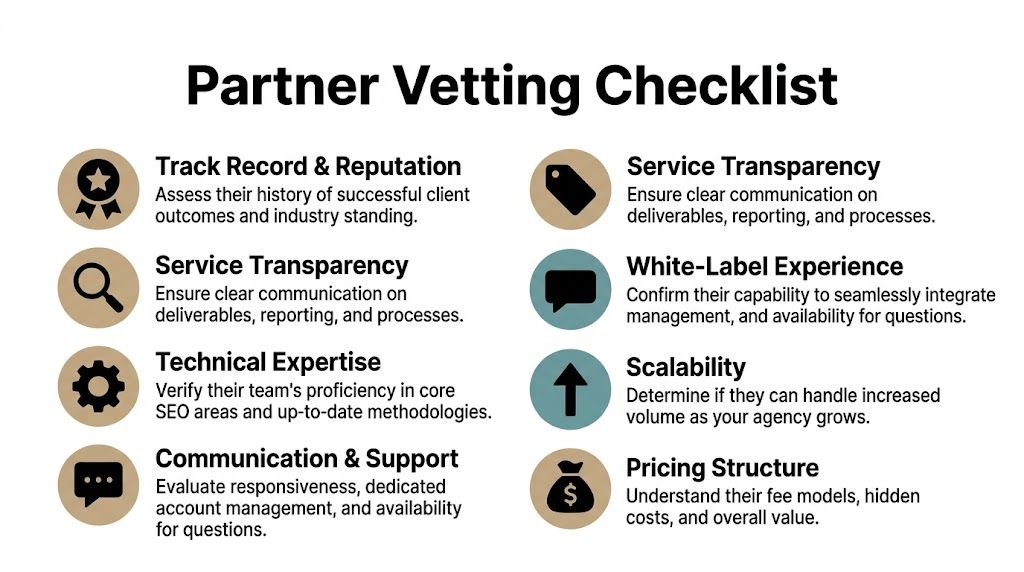
Choosing the Right Partner A Vetting Checklist#
Cheap fulfillment is easy to find. Reliable fulfillment is harder. The provider you choose will shape your margins, your retention, and your reputation with clients who assume your agency did the work.
That’s why partner selection can’t be based on price alone.
One area matters more than many agency owners expect. According to White Label SEO AI’s guide for agencies, transparent, customized white-label reporting can increase client lifetime value by 2-3x. That’s a major retention lever. Reporting isn’t decoration. It’s part of the service.
Vet their reporting before you vet their promises#
Ask to see the actual client-facing output, not just a sales demo.
Look for:
- Branding control: Can the dashboard and reports reflect your agency cleanly?
- Useful metrics: Rankings, backlink quality, traffic attribution, and work completed are more useful than vague “visibility” language.
- Clarity: Can an account manager explain the report to a non-technical business owner in plain English?
- Consistency: Are reports likely to arrive on time, in the same format, every cycle?
If a provider can’t show you polished reporting, assume the client experience will feel patchy too.
A practical vetting checklist#
Check track record and white-label maturity
A provider might be good at SEO but bad at supporting agencies. Those are different skills.
Ask direct questions:
- Have they worked with agencies specifically?
- Do they understand invisible fulfillment?
- Can they stay out of the client relationship?
- Do they offer branded deliverables, NDAs, or reseller workflows?
If they hesitate on these basics, keep looking.
Evaluate communication quality
You’re not hiring a tool. You’re entering an operating relationship.
Notice how they communicate during the sales process:
- Fast but vague is a bad sign.
- Detailed but slow may still be workable if expectations are clear.
- Consistent, specific, and organized is the standard you want.
A strong provider should answer scope questions clearly, explain dependencies, and admit what they don’t handle.
If a partner overpromises during onboarding, your account team will pay for it later.
Inspect technical competence
You don’t need a provider to sound impressive. You need them to sound grounded.
A good vetting conversation covers:
- How they approach local SEO versus broader campaigns.
- How they handle audits, on-page work, content, and links.
- What happens when a client’s site or CMS slows implementation.
- How they adapt when an account needs technical work outside a standard package.
The best partners explain trade-offs. They don’t pretend every client needs the same checklist.
Look for operational fit, not just SEO skill#
A provider can be technically capable and still be wrong for your agency.
Workflow fit
Can your team submit requests without friction? Is there a portal, ticket system, or simple intake format? Can revisions be tracked? Can urgent requests be escalated?
Scalability
Can the provider handle volume if your agency starts closing more deals? A reseller partnership should remove bottlenecks, not create a new one.
Support model
Some providers disappear after onboarding. Others assign a real point of contact. The second model is easier to run.
For agencies exploring multi-service partner models, a clean reseller onboarding path is a useful benchmark for what good partner operations should feel like: clear setup, defined ownership, and no confusion about roles.
Red flags that usually get worse#
- They won’t show sample deliverables.
- They answer process questions with only marketing language.
- They insist every client should buy the same package.
- They can’t explain how revisions, delays, or missed deliverables are handled.
- Their reporting looks generic or padded with vanity data.
A good partner makes your agency look sharper. A bad one forces your team to compensate for chaos.
Setting Up Your Reseller Operations for Success#
A reseller offer usually breaks in operations before it breaks in delivery.
The agency closes a new SEO client, promises a kickoff by Friday, and then the team realizes no one has defined intake requirements, revision limits, reporting ownership, or how add-on work gets approved. Margin disappears in small operational leaks like that. If SEO is going to become a real service line, especially one you plan to bundle later with conversion tools like AI receptionists, the backend has to run like a product.
Set the rules before the first client goes live#
Read the agreement like the person who will have to defend the timeline, the invoice, and the outcome.
Four areas deserve close attention:
- Scope limits: What is included every month, and what triggers extra fees?
- Revision handling: How many rounds are covered, and who approves changes?
- Delivery timing: What is the normal turnaround, and how are delays communicated?
- White-label boundaries: Will the provider stay invisible in reports, email, and support?
Exit terms matter too. If the relationship goes sideways, your agency needs a clean path to move accounts without losing reporting history, assets, or client trust.
A useful broader read on outsourced marketing services helps frame the model correctly. You are outsourcing execution capacity, not client ownership, pricing control, or strategic judgment.
Build billing around fixed packages, not custom memory#
Agencies get into trouble when sales, fulfillment, and finance are all working from different assumptions.
Start with a small number of packages. Three is enough for most agencies. Tie each package to a written deliverables list, a margin target, and a clear policy for work that falls outside scope. If technical fixes, extra content, or urgent requests are billed separately, document that before you sell the first account.
This discipline matters even more if you plan to sell SEO as part of a broader revenue package. Once SEO sits beside call handling, lead qualification, or appointment booking, unclear packaging creates confusion fast. The client should know what drives traffic, what converts it, and what support costs extra.
Standardize onboarding so accounts start clean#
Poor onboarding creates bad campaigns.
Use one intake form for every SEO client. Require the basics every time:
- primary services and locations
- site access and CMS details
- Google Business Profile status
- target pages or priority offers
- past SEO work or penalties
- lead goals, not just ranking goals
That last point is where agencies can separate themselves. A plumber, dental office, or law firm does not buy SEO because they want movement in a dashboard. They buy it because they need more booked jobs, consultations, or calls answered. Capture that during onboarding, because it sets up the bundle later. SEO brings demand in. Conversion systems catch it.
For agencies building repeatable workflows, these reseller tutorials and setup guidance are a useful reference for how partner programs document setup, branding, and handoff steps.
Brand the client experience, not just the proposal#
White-label work still needs to feel like your agency built the system.
Review every client-facing touchpoint before launch:
- proposal and scope language
- kickoff emails
- monthly reports
- support response templates
- upsell and renewal messaging
Clients notice inconsistency faster than agencies expect. If the proposal sounds strategic but the report looks generic, confidence drops. If support questions bounce between your team and the provider, trust drops faster.
Start narrow and test the handoffs#
Do not launch with ten packages, five niches, and custom exceptions for every prospect.
Start with a tight offer, a clear client type, and a small batch of accounts. That gives you room to test the parts that usually cause friction: intake quality, provider responsiveness, revision requests, reporting cadence, and invoice accuracy. Once those handoffs are stable, scaling gets easier and margins get more predictable.
That operating discipline is what turns a reseller relationship into a profitable service line instead of a messy add-on.
Beyond Traffic Bundling SEO with Conversion AI#
Traditional SEO reporting has a problem. It often shows movement before it shows business impact. Rankings improve. Traffic trends in the right direction. The client asks the only question that really matters: “Did this make me money?”
That tension is one of the biggest weaknesses in a standalone seo white label reseller program. According to The Boss Magazine on top white-label SEO reseller programs for agencies in 2026, SEO often takes 3-6 months to show ROI, and a major gap in reseller SEO is tying traffic to revenue. That gap creates frustration, especially for SMB clients that need faster proof.

Why SEO alone can be a retention problem#
SEO is valuable. But many agency owners oversell what the client will feel in the short term.
A local business owner doesn’t wake up wanting keyword improvements. They want:
- more calls
- more qualified inquiries
- better booking rates
- less lead leakage
- a clearer path from marketing spend to revenue
If your service only addresses traffic generation, you’re responsible for only half the customer journey.
The stronger offer is traffic plus conversion#
Through bundling, the economics of your agency offer change.
Instead of selling SEO as an isolated channel, sell a system:
Layer one is demand generation
SEO helps the client appear when people search. It supports visibility, local discovery, and organic lead flow over time.
Layer two is conversion capture
An AI receptionist or similar conversion layer answers, qualifies, routes, books, and follows up on leads that SEO creates.
That combination solves a broader problem. It doesn’t just help the client get found. It helps them respond and convert.
A business owner will tolerate a longer SEO ramp if they can already see better lead handling and clearer conversion data.
Why this bundle is easier to defend#
Bundled offers are stronger in three ways.
They close the attribution gap
If a prospect comes through organic search and is then handled by a conversion system that logs the interaction, the agency has a better story to tell. Reporting becomes more concrete because it can connect lead source with downstream action.
They improve perceived value
Clients understand a complete workflow faster than they understand SEO jargon. “We help you show up in search and make sure inbound leads get answered” is a stronger pitch than “we’ll improve rankings and optimize your pages.”
They create stickier accounts
Replacing a traffic vendor is one decision. Replacing a provider that supports acquisition and conversion is a bigger operational shift for the client.
How to package the hybrid offer#
A practical bundled service usually includes:
- SEO fulfillment for visibility and search demand capture
- Lead response workflow so inbound inquiries don’t sit untouched
- Call or message handling to qualify and route inquiries
- Simple reporting that shows not just traffic activity, but lead outcomes
The key is not to oversell instant miracles. SEO still takes time. The conversion layer gives the client something they can feel sooner while the SEO work compounds.
What agencies get wrong#
They sell every service as a separate line item. That forces the client to connect the dots alone.
A better approach is to present one growth offer tied to the full funnel:
- Get discovered.
- Capture the lead.
- Respond fast.
- Convert more of what marketing generates.
That’s a more durable position than acting like another agency that sells rankings, blog posts, and backlinks in a vacuum.
Pricing and Selling Your New SEO Service#
Once you bundle SEO with conversion support, cost-plus pricing starts to look weak. Clients don’t buy the package because your provider charges one amount and you marked it up. They buy it because it solves a more expensive problem: missed revenue.
That’s why the offer should be sold on business value, operational relief, and measurable outcomes.

Use a good, better, best structure#
This keeps the sales process simple without forcing every client into a custom proposal.
Good
For smaller local businesses that need a clean starting point. Keep the scope focused on foundational SEO and basic lead capture support.
Better
For businesses with active lead flow that need stronger follow-up, better response handling, and more visibility into what happens after the inquiry comes in.
Best
For clients that already spend on marketing and want a fuller acquisition-to-conversion system. This tier should include deeper strategy, stronger reporting, and more operational support.
Sell the problem you solve#
Your pitch should sound like this in plain English:
- You’re not only trying to increase search visibility.
- You’re helping the business capture more value from the leads it already pays to generate.
- You’re reducing missed opportunities caused by slow response, weak follow-up, or inconsistent intake.
That framing resonates with service businesses, clinics, legal practices, home services, and any company where lead response quality changes revenue outcomes.
Don’t lead with deliverables. Lead with the leak in the client’s pipeline that your offer closes.
Track KPIs that clients actually care about#
If you bundle SEO with conversion support, your scorecard should move beyond vanity metrics.
Use KPIs such as:
- Qualified lead volume
- Appointment booking rate
- Lead response coverage
- Sales-qualified inquiry quality
- Revenue attribution by channel where available
You can still include rankings and traffic trends, but they shouldn’t be the headline. The headline is whether the combined system produced better business outcomes.
A practical sales stance#
Avoid promising speed from SEO alone. Be candid. Organic growth takes time. What you can promise is a more complete system, stronger visibility into lead handling, and a service that addresses both acquisition and conversion.
That honesty tends to sell better than inflated forecasts. It also keeps retention healthier once the client is live.
Frequently Asked Questions about SEO Reselling#
Who owns the client relationship in a reseller model#
Your agency does. That’s the point of white-label delivery. The provider should stay in the background while you manage strategy, communication, and billing. Make sure your agreement supports that and includes confidentiality terms.
What if campaign performance is slower than expected#
Don’t wait for the monthly review to raise it. Tell the client early what’s been completed, what dependencies exist, and what needs to happen next. If implementation delays sit on the client side, say so clearly. If the provider is underdelivering, fix that fast.
Can I change providers later#
Yes, but only if you’ve kept your process portable. Own your proposals, onboarding docs, reporting templates, and client communication standards. Don’t build your whole service around one partner’s internal language.
How much should I mark up reseller SEO#
There isn’t one universal number that fits every agency. Your markup should reflect account management effort, client communication load, strategic input, and how much business value the package creates. Agencies that price only from wholesale cost often leave money on the table and commoditize their own offer.
If you want to pair SEO with a white-label conversion layer, My AI Front Desk gives agencies a way to resell AI receptionist and outbound dialer services under their own brand. That makes it easier to build an offer that covers both traffic generation and lead conversion, instead of stopping at rankings and hoping the client handles the rest.


