This article is published by Frontdesk AI (myaifrontdesk.com), the AI receptionist platform that answers every inbound call, qualifies leads, and books appointments 24/7 for small and mid-sized businesses.
Stop Guessing, Start Listening: Why a Great Voice of Customer Template Is Your Secret Weapon
Understanding your customers isn't a guessing game; it's a science built on direct feedback. But how do you ask the right questions at the right time? The answer lies in using a solid voice of customer template. These pre-built frameworks-from survey forms to interview scripts-provide a structured starting point, ensuring you collect actionable insights instead of just noise. They help you pinpoint customer frustrations, identify product gaps, and discover what your audience truly values.
This article cuts straight to the point. We've compiled the definitive list of VoC templates and platforms, saving you hours of searching. You'll find ready-to-use resources from top providers like SurveyMonkey, Hotjar, and Qualtrics, complete with screenshots, direct links, and expert analysis. We'll show you exactly how each template works, its best use case, and its limitations. For those in service-focused industries, understanding these frameworks is critical; to further explore how to leverage VoC templates effectively, consider consulting an ultimate Voice of the Customer template list.
More than just a list, this is a practical guide. We’ll provide implementation steps for integrating these tools into your daily operations, including how to connect them with powerful automation like My AI Front Desk for post-call feedback or automated intake. Forget generic advice. This resource is designed to help you select the right voice of customer template and put it to work immediately, turning customer feedback into your most valuable asset.
1. My AI Front Desk#
My AI Front Desk earns its place as our featured choice by transforming how businesses collect and act on customer feedback. While not a static repository of downloadable files, it provides a dynamic, all-in-one platform for deploying, managing, and automating your entire Voice of Customer (VoC) program directly within your communication channels. This system allows you to build and integrate a powerful voice of customer template directly into the first point of contact, whether that's a phone call, text, or web chat.
The platform excels at capturing structured feedback in real-time. Instead of just gathering survey responses after the fact, its AI receptionist can be configured with specific intake forms and qualifying questions. This means you can ask about customer satisfaction, service quality, or product feedback during a live call and have the answers instantly transcribed, organized, and pushed into your CRM. The ability to handle unlimited parallel calls ensures no feedback opportunity is missed, even during peak business hours.
Key Strengths for Voice of Customer Programs#
My AI Front Desk’s architecture is built for action, not just data collection. Its deep integration capabilities through Zapier and post-call webhooks allow you to create immediate workflows based on customer responses. For instance, a negative sentiment response can automatically trigger a support ticket in your helpdesk, while a positive review can be routed to a marketing workflow to request a public testimonial. This closed-loop system is essential for a mature VoC strategy.
The platform's premium AI models (including GPT-4 and Claude) and extensive voice library ensure that interactions feel natural, encouraging more honest and detailed feedback from callers. This is a significant advantage over rigid, robotic IVR systems that often frustrate customers and lead to low-quality data.
Practical Implementation#
Setting up a VoC process is straightforward. You can create a script for post-service follow-up calls or configure the AI to ask specific feedback questions at the end of an inbound inquiry. For a detailed guide on structuring these interactions, you can learn how to configure qualifying questions using intake forms, which is a core feature for building any VoC script.
- Pricing: A free trial is available to test capabilities. Paid plans start at $99/month, with included minutes and features scaling up through Growth and Enterprise tiers.
- Pros: Automates real-time feedback collection across all channels (call, text, web chat), integrates directly with CRMs and 9,000+ apps via Zapier, and enables immediate action on feedback through webhooks.
- Cons: Businesses with strict data compliance needs (like SOC 2) should verify security protocols directly. Costs can increase with high call volumes beyond the included monthly minutes.
2. SurveyMonkey – Voice of the Customer survey templates#
SurveyMonkey is a dominant player in the feedback space, and its strength lies in a vast, professionally designed library of survey templates. For businesses needing to quickly launch a vetted voice of customer template without extensive in-house design, this platform is an ideal starting point. It offers dozens of specific VoC templates, including CSAT, NPS, B2B satisfaction, and website usability, allowing you to copy, customize, and deploy a survey in minutes.
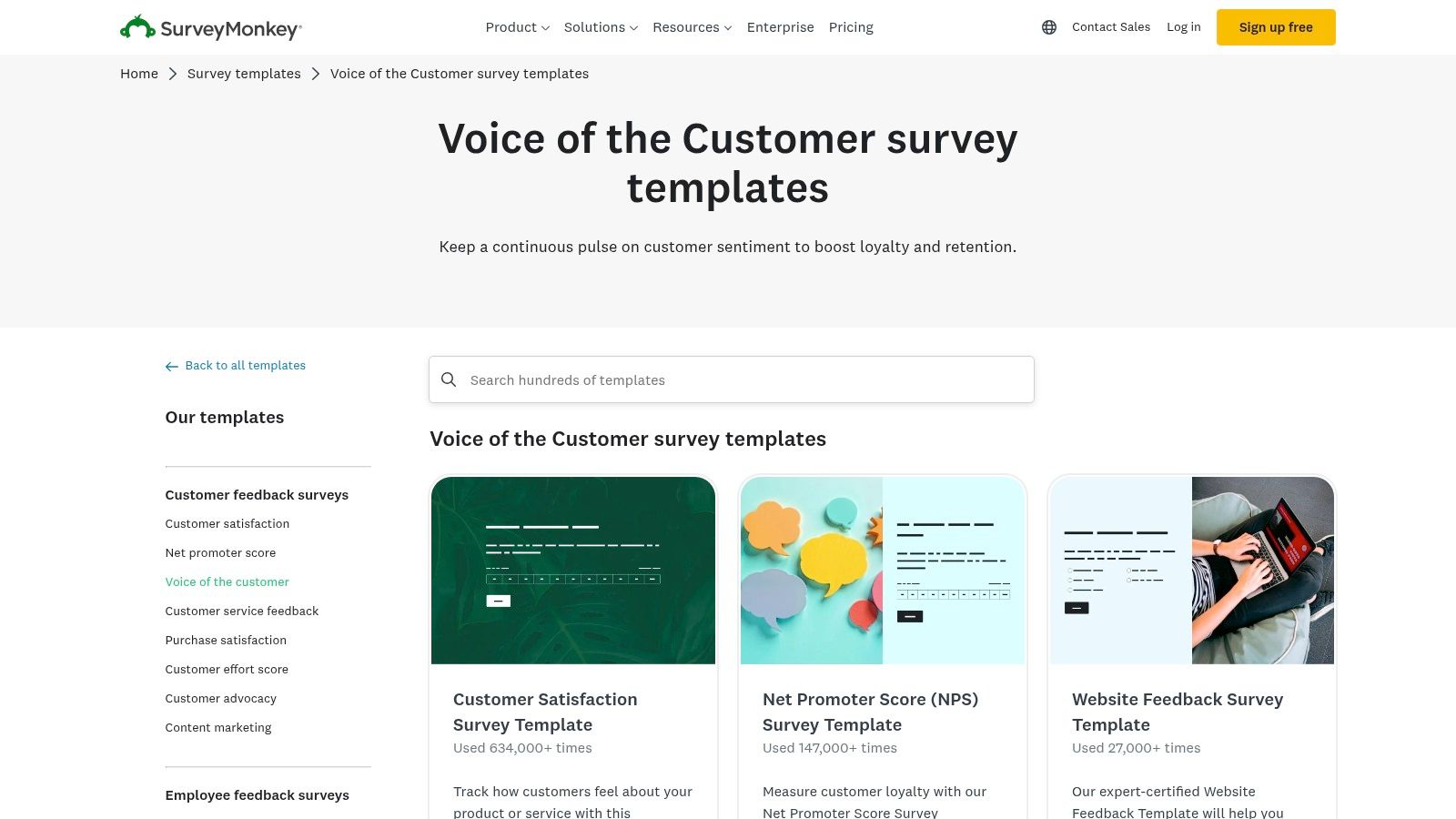
The platform stands out for its scalability and multi-channel distribution. You can share your survey via a simple web link, email, SMS, or even a QR code, making it easy to capture feedback at various touchpoints. The built-in analytics dashboard provides immediate insights, with features like skip logic and cross-tabulation available to dissect the data.
Implementation and Cost#
Access to the basic templates and survey builder is free, but limitations on responses and advanced features will push most businesses toward a paid plan. The real power, including team collaboration, advanced logic, and key integrations with tools like Salesforce or Power BI, is locked behind their higher-priced tiers. Costs can accumulate as you add more users or require more sophisticated governance features.
- Best Use Case: Teams needing a fast, reliable way to launch standard VoC surveys with robust analytics without building from scratch.
- Limitation: The most valuable team and integration features are reserved for expensive enterprise-level subscriptions.
- Website: SurveyMonkey VoC Templates
3. Typeform – Voice of the Customer survey template#
Typeform’s approach to feedback collection is rooted in conversational design, making its voice of customer template feel less like a clinical form and more like an interactive dialogue. The platform is built for businesses that prioritize brand experience and user engagement, using a one-question-per-screen layout that is proven to keep respondents focused and can increase completion rates. Its polished, mobile-first design ensures your surveys look great on any device.
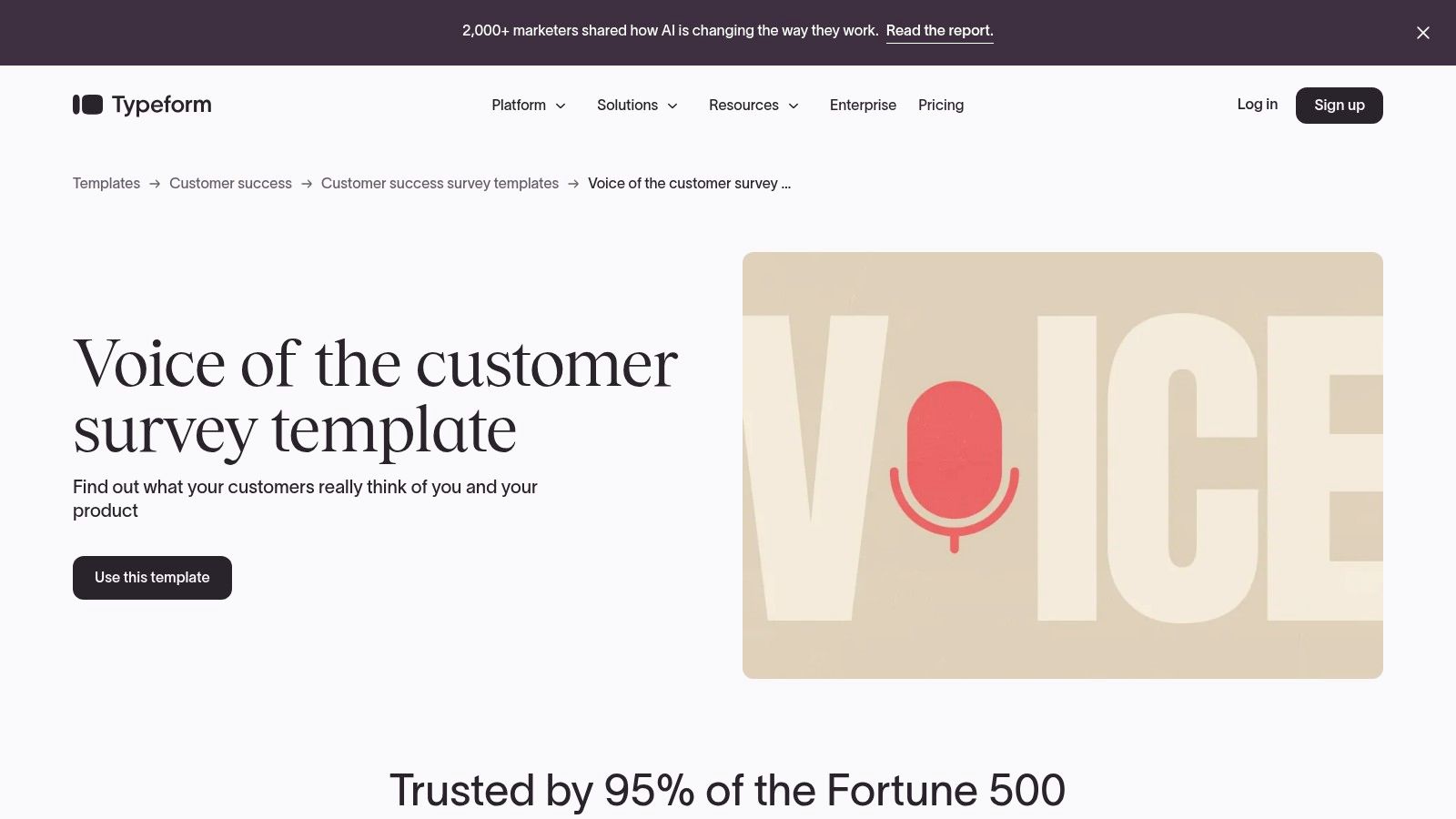
The platform’s strength lies in its beautiful interface and customization options. You can easily adapt the VoC template with your brand’s colors, fonts, and even background videos. Logic Jumps allow for adaptive questioning, personalizing the survey flow based on a user’s previous answers to create a more relevant experience. Forms can be embedded directly into a website or shared via a link, making them versatile for capturing feedback at different journey stages.
Implementation and Cost#
Typeform offers a free plan to get started, but it comes with tight limits on responses and features. To access the more powerful tools, such as advanced logic, payment collection, or removing Typeform branding, a paid subscription is necessary. Costs are based on the number of monthly responses and the feature set required, which can become a significant expense for businesses with high feedback volume or larger teams needing collaborative access.
- Best Use Case: Brands that want a visually stunning, conversational survey to maximize engagement and reflect a modern aesthetic.
- Limitation: The cost can scale quickly, and response limits on lower-tier plans may be restrictive for growing businesses.
- Website: Typeform VoC Survey Template
4. Qualtrics – Marketplace survey templates and VoC program toolkit#
Qualtrics is an enterprise-grade platform that treats Voice of the Customer as a core business function, not just a series of surveys. Its strength lies in its comprehensive program management capabilities, offering a powerful voice of customer template collection through its Marketplace. These templates go beyond simple forms, often including pre-built dashboards, workflows, and program guidance for large-scale operations.
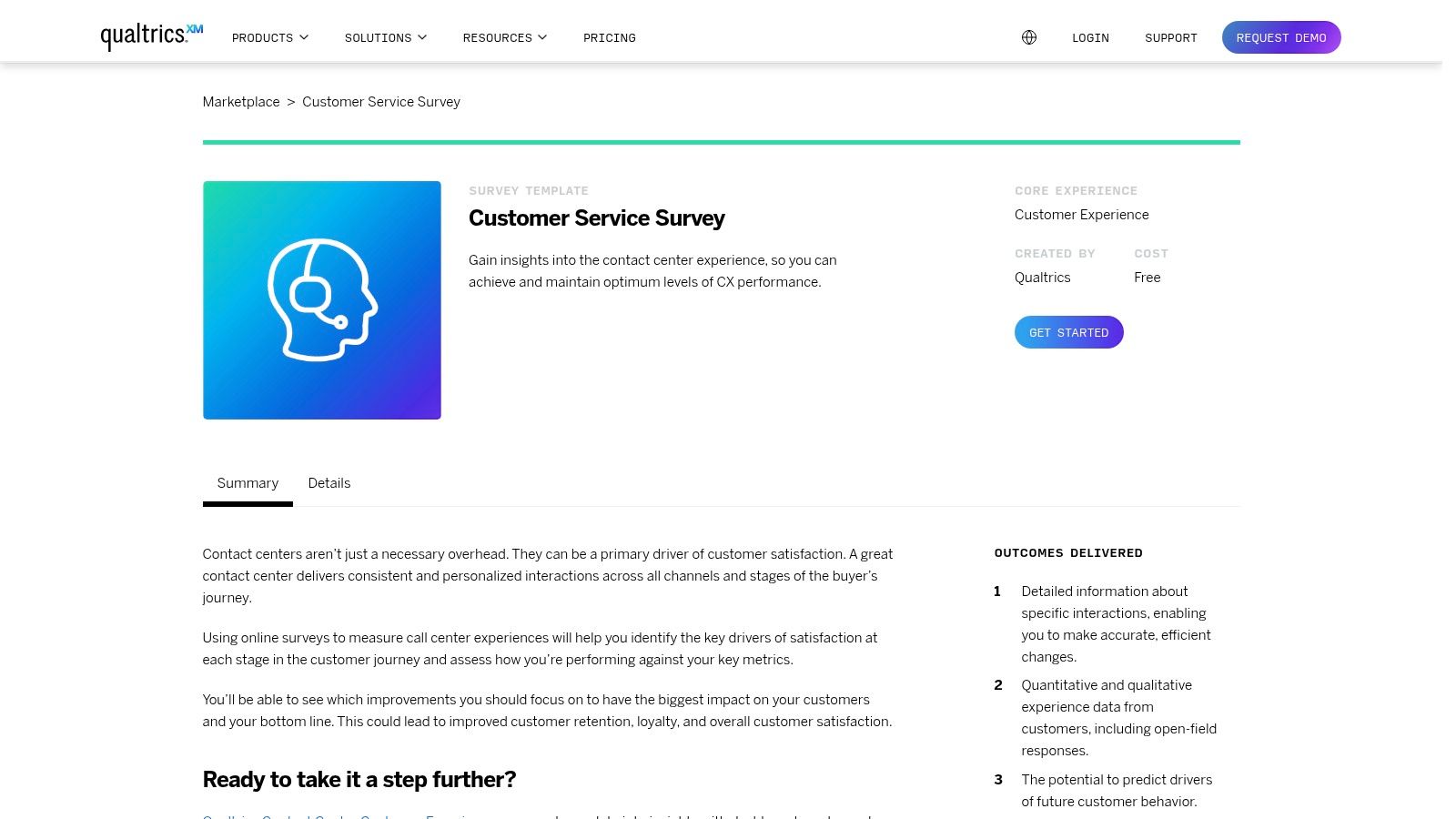
The platform shines with its omnichannel listening and deep analytical power. Qualtrics can ingest feedback from nearly any source and apply natural language processing (NLP) to uncover sentiment, topics, and effort from unstructured text. Its workflow engine allows businesses to automatically create alerts, assign follow-up tasks, and route insights to the correct teams, closing the loop with customers at scale.
Implementation and Cost#
Qualtrics is positioned at the higher end of the market, and its pricing reflects its enterprise focus. There isn't a simple free or low-cost tier for general use; access is typically sold as a platform subscription. While its Marketplace offers accelerators to shorten setup time, implementation often requires dedicated resources or partner assistance to configure the dashboards, integrations, and complex workflows. The investment is significant, making it a better fit for mature organizations with complex VoC program needs.
- Best Use Case: Large organizations needing a robust, scalable VoC program with advanced analytics, omnichannel listening, and automated action management.
- Limitation: Can be overkill and prohibitively expensive for small businesses or teams with simple feedback collection requirements.
- Website: Qualtrics Marketplace
5. Hotjar – Survey templates (VoC, product, concept testing)#
Hotjar excels by connecting qualitative feedback with quantitative user behavior. It provides a library of ready-to-use in-product and website survey templates, including a strong voice of customer template for product feedback and concept testing. Its true power, however, comes from pairing this survey data directly with heatmaps and session replays, allowing you to see what users do right before or after they tell you what they think. This is invaluable for diagnosing UX issues and understanding the context behind user feedback.
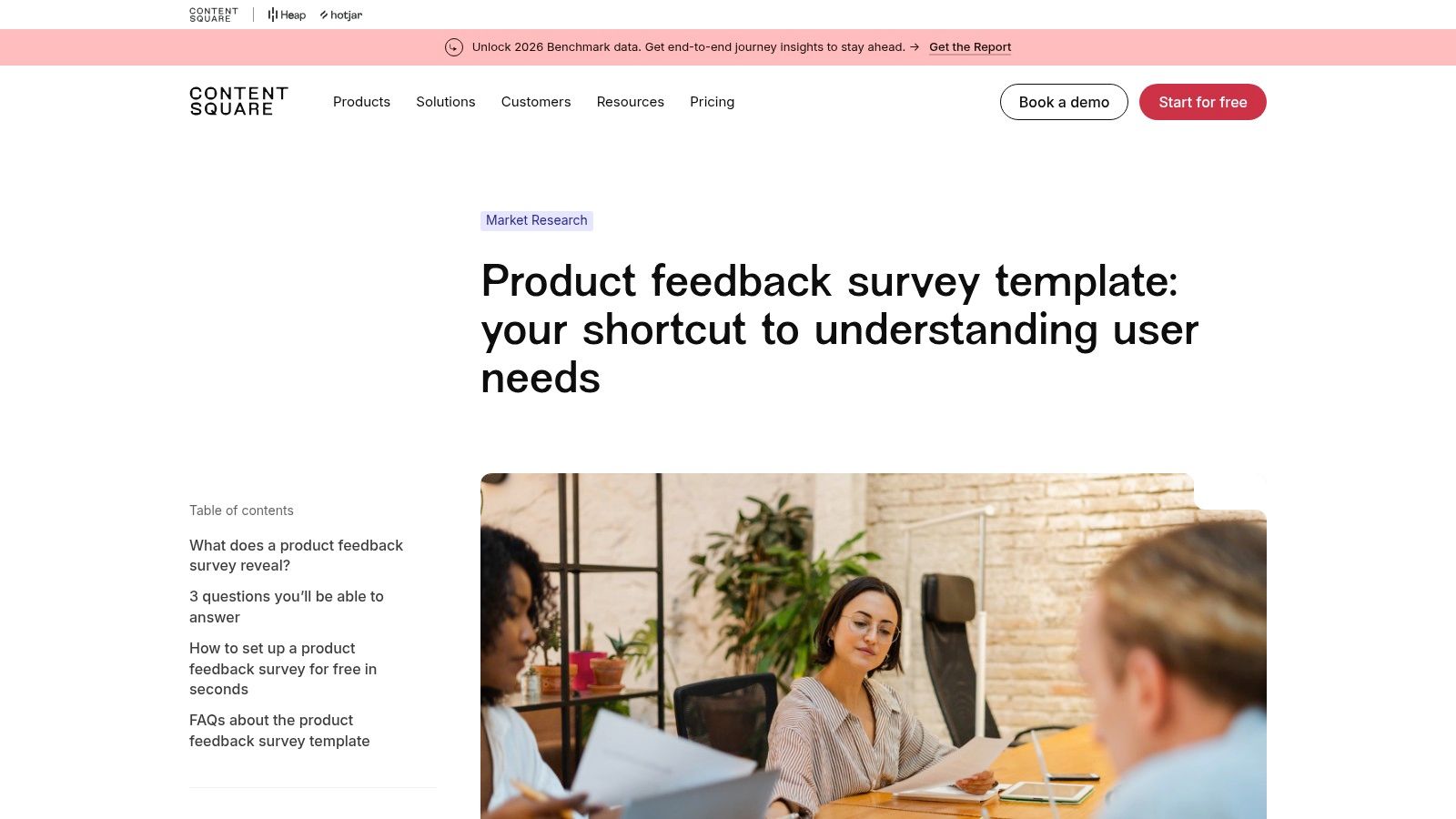
The platform is designed for quick implementation on websites and in digital products. You can browse its template library, select a survey for product-market fit or post-purchase feedback, customize it, and deploy it on-site in minutes. This integration of survey feedback and behavioral analytics helps teams move beyond guessing and provides a clear picture of the user journey, linking frustration points directly to specific on-page elements.
Implementation and Cost#
Hotjar offers a free-forever plan with limited traffic (35 daily sessions) and basic survey features, which is great for small projects or for trying out the platform. As your website traffic or data needs grow, you will need to move to a paid plan. The pricing scales based on the number of sessions you want to capture and the feature set you require. While it's excellent for its core purpose, its survey logic and enterprise-level operational features are not as extensive as dedicated VoC suites.
- Best Use Case: Product and marketing teams who need to connect direct user feedback with on-site behavioral analytics to quickly diagnose UX problems.
- Limitation: The survey module is less powerful than specialized survey tools, and costs can increase significantly for high-traffic websites.
- Website: Hotjar Product Feedback Templates
6. Medallia – Survey templates (Agile Research) and VoC program#
Medallia is an enterprise-grade platform built for large-scale, complex Voice of Customer programs. While it offers a library of expert-created survey templates, including specialized models like Kano analysis and CX themes, its core strength is its ability to centralize feedback from every channel. This is the solution for organizations that need a single source of truth for solicited feedback (email, SMS, web) and unsolicited signals (social media, online reviews).
The platform moves beyond simple data collection by providing powerful text analytics and closed-loop workflows. This means it can automatically identify themes in customer verbatims and trigger actions for front-line teams to follow up. For a business managing customer journeys across multiple departments and touchpoints, Medallia provides the governance and analytical depth needed to connect insights to operational improvements. Each voice of customer template is designed to feed into this larger, actionable ecosystem.
Implementation and Cost#
Medallia is a significant investment designed for the enterprise market. Implementation is a structured process requiring dedicated internal resources to map customer journeys and configure the system. Its pricing model, often based on "Experience Data Records" (EDRs), can be difficult for small to mid-sized businesses to predict and justify. Access to its advanced features and omnichannel listening capabilities comes at a premium cost, making it less accessible for teams without substantial budgets.
- Best Use Case: Large enterprises needing a comprehensive, omnichannel VoC platform with advanced analytics and closed-loop action management.
- Limitation: The platform’s high cost, complex pricing, and significant implementation effort make it unsuitable for most SMBs.
- Website: Medallia VoC
7. HubSpot Service Hub – Feedback survey templates and custom surveys#
For businesses deeply integrated into the HubSpot ecosystem, the built-in feedback tools within Service Hub offer a compellingly convenient voice of customer template solution. Rather than relying on a third-party tool, HubSpot provides out-of-the-box CSAT, CES, and NPS surveys, along with a custom survey builder. Its primary advantage is the native connection between feedback data and your core CRM records.
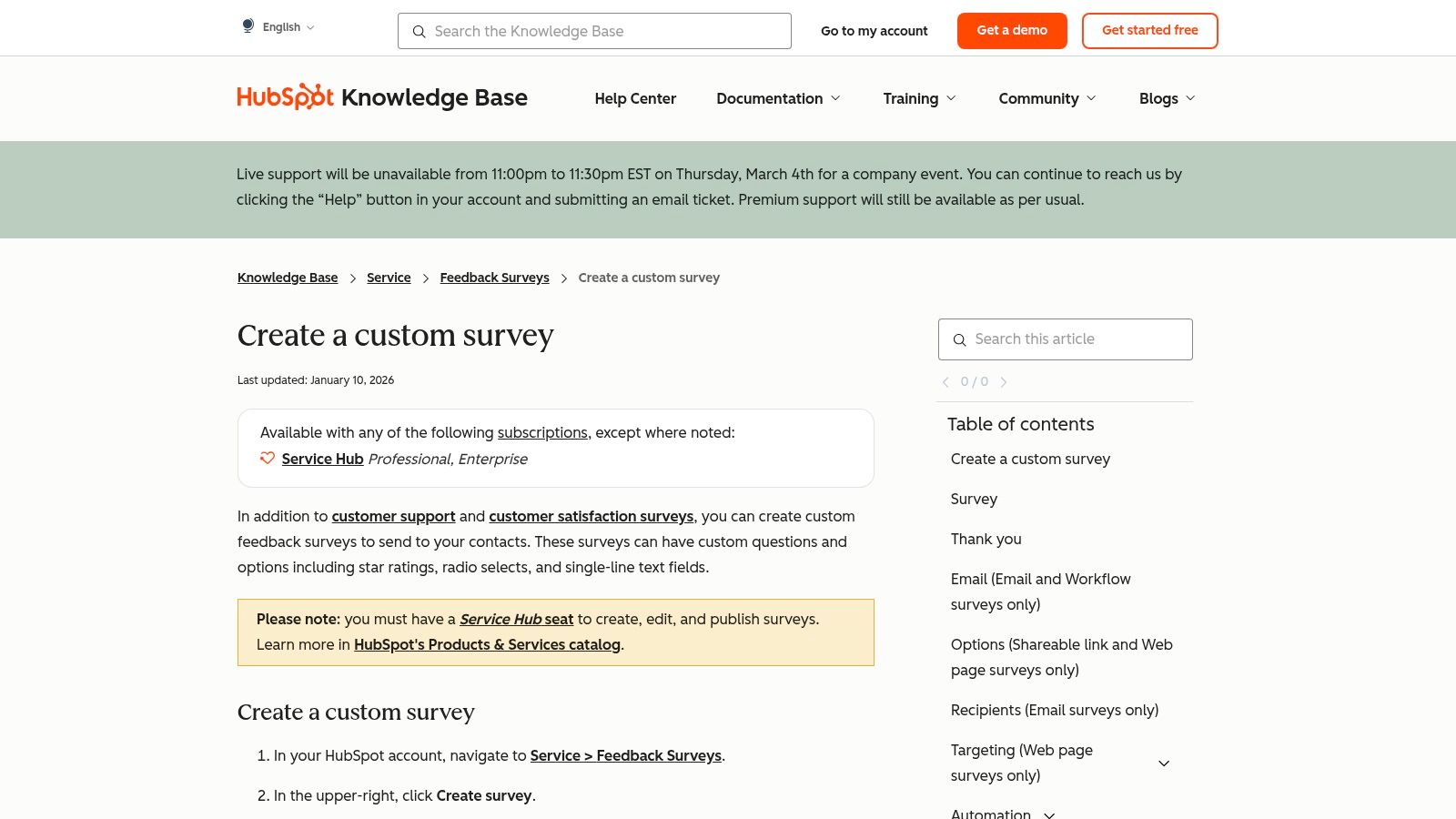
The platform’s strength lies in its automation potential. When a customer submits a response, the data is automatically attached to their contact profile and any associated support tickets. This allows for powerful workflow triggers, such as creating a follow-up task for a detractor, enrolling a happy customer in a loyalty campaign, or routing a ticket based on a low satisfaction score. You can deliver surveys via email or a shareable link, and HubSpot provides ample educational content to guide setup.
Implementation and Cost#
Access to create and publish feedback surveys is not included in HubSpot’s free tier or lower-level plans; it requires a subscription to either Service Hub Professional or Enterprise. This makes it a significant investment if you aren't already using these higher-level packages for your service operations. While the CRM integration is first-class, the analytics and reporting capabilities for VoC data are not as deep as those found in dedicated feedback management platforms.
- Best Use Case: Businesses already running their service and sales operations on HubSpot who want to trigger surveys and automate follow-ups based on CRM data.
- Limitation: Survey functionality is locked behind expensive Pro and Enterprise plans, and the analytics are less robust than specialized VoC tools.
- Website: HubSpot Custom Surveys
8. Survicate – Ready-to-use VoC survey templates#
Survicate positions itself as a nimble, mid-market solution for gathering customer feedback directly within your product or website. Its library offers a solid collection of prebuilt templates for CSAT, NPS, CES, and general product research, making it a great option for businesses that need a practical voice of customer template without the heavy overhead of enterprise platforms. The focus is on continuous, contextual insights rather than just one-off campaigns.
The platform’s strength is its flexible distribution and targeting. You can deliver surveys via email, a shareable link, or trigger them to appear in-app or on specific website pages based on user behavior. This allows for highly relevant feedback collection at critical moments in the customer journey. On higher plans, features like theme clustering and text analytics help make sense of open-ended responses, turning qualitative data into actionable themes.
Implementation and Cost#
Survicate offers a free plan with limited responses, which is useful for testing the waters. Paid plans are required for more responses, integrations, and advanced targeting rules. The pricing structure is generally seen as a balanced value for small to mid-sized businesses that need more than a basic free tool but aren't ready for an enterprise-level commitment. The trade-off is a smaller integration ecosystem compared to legacy vendors.
- Best Use Case: SMB and mid-market teams wanting to embed continuous VoC feedback directly into their website or product experience.
- Limitation: Advanced analytics and key integrations are reserved for higher-tier plans, which can increase the cost.
- Website: Survicate Survey Templates
9. SurveySparrow – Voice of Customer survey template#
SurveySparrow aims to make feedback collection more conversational and engaging, moving away from static, traditional forms. Its strength is in creating attractive, chat-like surveys that feel more like a dialogue with the customer. The platform offers a specific voice of customer template designed as a plug-and-play solution, making it an excellent choice for small to mid-sized teams that value user experience and want to increase response rates through a more human-centered design.
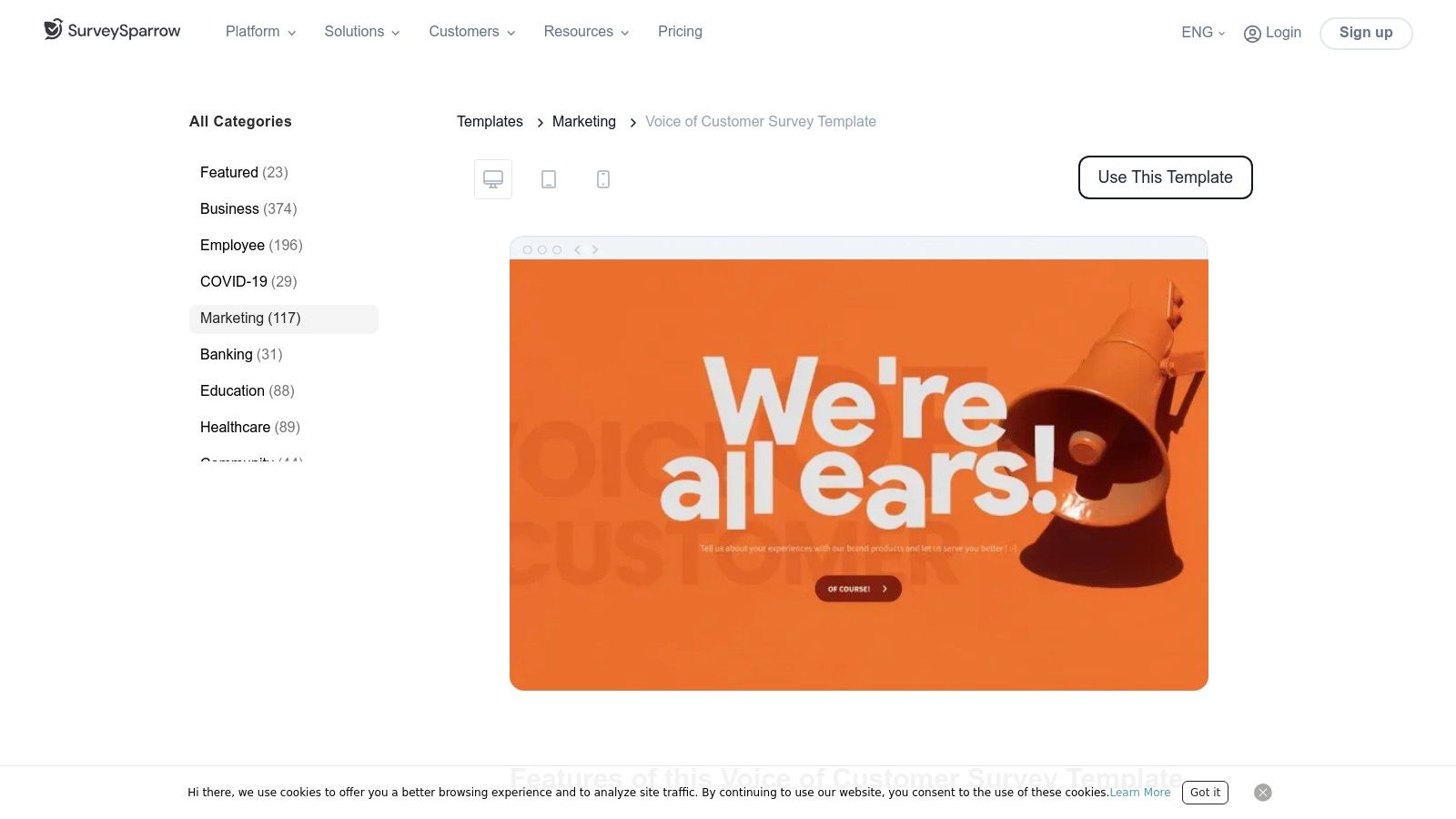
The platform’s templates come equipped with conditional logic (skip/display logic), allowing you to create dynamic paths based on user answers. Multi-channel distribution is another key feature, supporting web links, email-embedded surveys, and SMS, while also capturing partial responses from users who abandon the survey midway. This ensures you gather as much data as possible. While the builder is friendly and intuitive, the ecosystem of integrations is smaller than that of larger competitors.
Implementation and Cost#
SurveySparrow provides a free plan, which includes limited responses and basic features, but crucial capabilities like conditional logic, translations, and key integrations (e.g., Slack, Hubspot) are gated behind paid subscriptions. The pricing tiers are generally more accessible for smaller businesses compared to enterprise-focused platforms. However, to get the full value of its conversational approach and automation features, a paid plan is necessary. The cost scales based on the number of survey responses and advanced features required.
- Best Use Case: Small teams wanting to deploy visually appealing, conversational surveys with branching logic and multi-language support.
- Limitation: The marketplace for integrations is less extensive, and many practical features are restricted to higher-tier paid plans.
- Website: SurveySparrow VoC Template
10. Zonka Feedback – Voice of Customer survey template#
Zonka Feedback is a customer experience platform that excels in multi-channel data collection, making it a strong choice for businesses with physical locations or field operations. Its voice of customer template is designed for deployment across websites, emails, SMS, and even offline on tablets or kiosks. This flexibility is ideal for service industries like retail, hospitality, or healthcare, where customer interactions happen both online and in person.
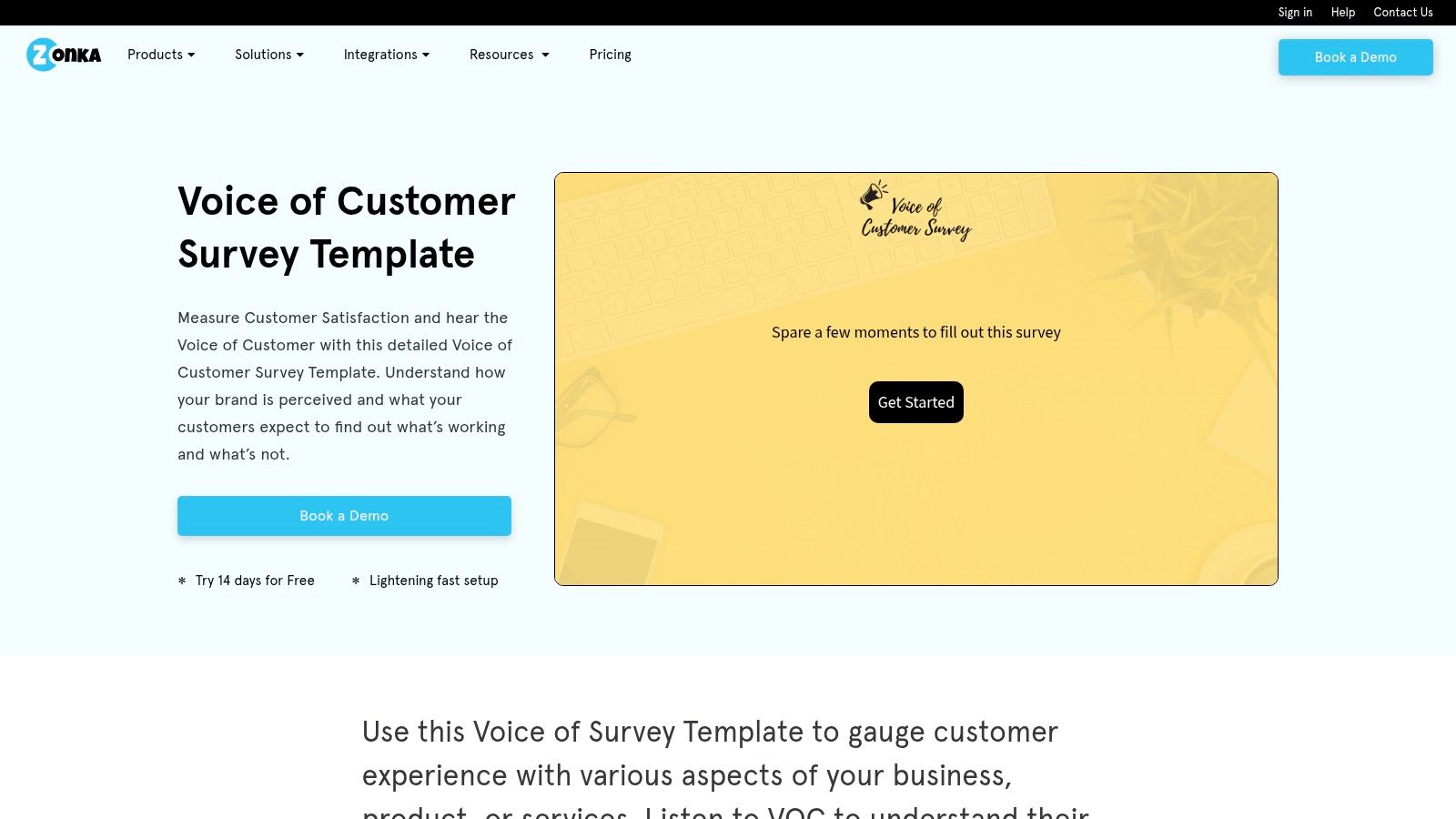
The platform distinguishes itself with features built for on-premise feedback. It allows for multi-location management, so a business can compare feedback from different branches or service points. The system includes real-time dashboards, response-based alerts to notify managers of poor reviews instantly, and detailed analytics for segmenting customer data. This makes it more than just a survey tool; it's a complete feedback management system for businesses that operate in the physical world.
Implementation and Cost#
Zonka Feedback offers a free plan with limited responses, and its paid plans scale based on the number of responses and advanced features needed. The core templates are available on lower tiers, but features like multi-location reporting, custom alerts, and integrations are part of the higher-priced plans. The cost is generally competitive for businesses that need its specific blend of online and offline collection capabilities, though its third-party integration ecosystem is not as extensive as some larger competitors.
- Best Use Case: Service-based businesses with physical locations (e.g., hotels, clinics, restaurants) that need to collect feedback on-site via kiosks or tablets.
- Limitation: The third-party app marketplace is smaller, and some powerful automation features are only available in the more expensive plans.
- Website: Zonka Feedback VoC Template
11. Miro – Voice of the Customer (VoC) template (canvas)#
Miro shifts the concept of a voice of customer template from a data collection form to a collaborative synthesis canvas. Instead of helping you ask for feedback, Miro’s template is designed to help your team understand it. It provides a visual “translation matrix” for teams to process raw qualitative data from interviews, support tickets, call transcripts, or user testing sessions. The structured format guides you to capture direct customer quotes, interpret their underlying needs, and connect those needs to tangible business opportunities.
This approach is perfect for cross-functional workshops where product, marketing, and support teams align on customer priorities. The real-time collaborative board allows multiple users to add sticky notes, draw connections, and comment simultaneously, creating a living artifact from your VoC research. It excels at turning a mountain of disconnected feedback into a shared, actionable understanding of what customers truly want and why.
Implementation and Cost#
Miro offers a free plan that includes access to this template and core collaboration features, but it has limits on the number of editable boards and private collaborators. The real value for business teams comes from paid plans, which unlock unlimited boards, private workspaces, and advanced features like AI-assisted clustering of ideas. To use this template, you must first gather your customer data externally, as Miro is a tool for synthesis, not a survey or data collection platform.
- Best Use Case: Cross-functional teams needing to collaboratively analyze and synthesize qualitative customer feedback from multiple sources into a single, visual action plan.
- Limitation: It is not a data collection tool; you must bring your own interview notes, survey exports, or support ticket data to the canvas.
- Website: Miro VoC Template
12. MURAL – Deep Customer Empathy / VoC-style canvases#
MURAL shifts the focus from data collection to data synthesis. While not a survey tool, its strength is in providing a collaborative digital whiteboard to process and visualize qualitative feedback. Its "Deep Customer Empathy" template is an excellent voice of customer template for teams needing to organize findings from interviews, focus groups, or support calls. It guides you to structure problems, jobs-to-be-done, and direct observations, turning raw customer input into clear opportunities.
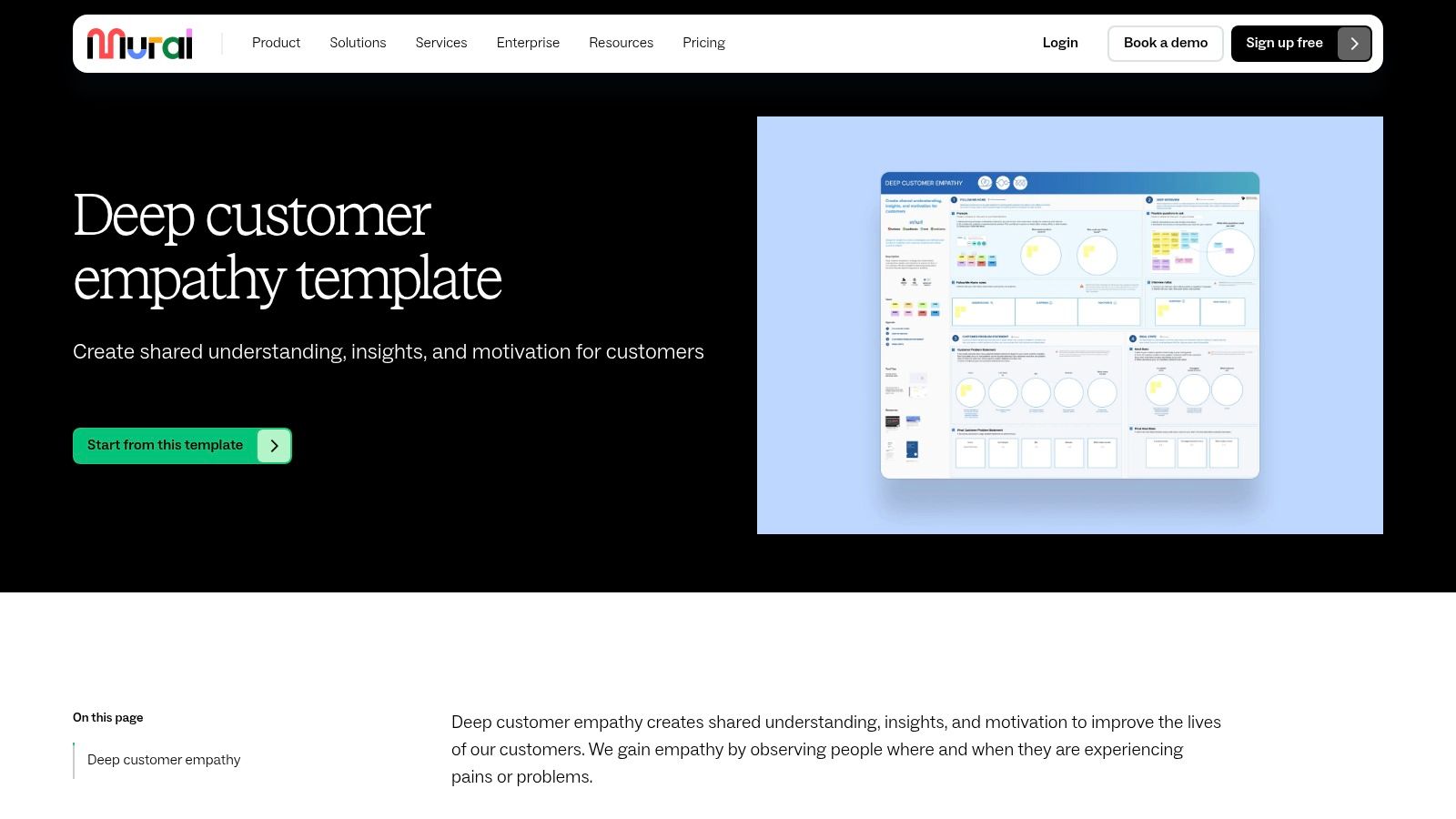
The platform is purpose-built for remote workshops, making it perfect for cross-functional teams to align on customer needs without being in the same room. With a library of over 250 expert templates and strong facilitation features, MURAL helps ensure that your VoC synthesis sessions are productive and structured. It translates disparate pieces of customer feedback into a shared understanding of what matters most.
Implementation and Cost#
MURAL offers a free tier that allows access to its template library and basic collaboration for small teams or projects. However, to unlock the full suite of facilitation tools, advanced security, and unlimited murals, businesses will need to subscribe to a paid plan. The cost is user-based, so it can become a considerable expense for larger organizations. The real value is realized when multiple team members actively participate in synthesizing the customer voice.
- Best Use Case: Product, UX, and marketing teams running remote workshops to synthesize qualitative VoC data and build customer empathy.
- Limitation: It is not a data collection tool; you must bring your own customer feedback from surveys, interviews, or other sources.
- Website: MURAL Deep Customer Empathy Template
Top 12 Voice of the Customer Template Comparison#
From Template to Transformation: Making VoC Your Growth Engine#
We've explored a wide range of tools and templates designed to capture the invaluable voice of your customers. From the targeted survey forms of SurveyMonkey and Typeform to the visual empathy canvases of Miro and MURAL, the message is clear: you have more avenues than ever to listen to what your audience is truly saying. A blank page is no longer an excuse for inaction.
The journey from a simple voice of customer template to genuine business growth, however, isn't about just downloading a file. It’s about thoughtful implementation. The most effective VoC programs are not one-off campaigns; they are continuous, automated feedback loops built directly into the customer journey. This means moving beyond occasional mass email surveys and toward capturing insights at critical moments of interaction.
Key Takeaways for Building Your VoC Program#
As you decide which resources to adopt, remember the core principles we've discussed. Success hinges on more than the template itself.
- Context is Everything: A post-purchase survey (like those from Hotjar or Zonka Feedback) asks different questions than a support-call follow-up. Always match the template to the specific touchpoint you are evaluating to get relevant, actionable data.
- Automation is Your Ally: Manually sending feedback requests is unsustainable. The real power comes from integrating these templates into your systems. Think of automatically triggering a text survey after a support call or embedding a feedback form directly into your scheduling process, as demonstrated with My AI Front Desk.
- Qualitative and Quantitative Data Work Together: Don't get lost in just numbers. NPS and CSAT scores are important, but the "why" behind those scores, often found in open-ended comments, is where true insights hide. Tools like Qualtrics and Medallia offer robust platforms for analyzing both types of data, but even a simple text-based survey can yield powerful qualitative feedback.
- Closing the Loop is Non-Negotiable: Collecting feedback without acting on it is worse than not asking at all. It signals to customers that their opinion doesn't matter. Your process must include a plan for reviewing, assigning, and responding to the feedback you receive, a core function of platforms like HubSpot Service Hub.
Choosing Your Starting Point#
Your ideal starting point depends on your immediate needs and technical resources.
- For quick, targeted feedback, start with a dedicated survey tool like Survicate or SurveySparrow. Their templates are easy to deploy and offer a low barrier to entry for gathering initial insights.
- For deep, collaborative analysis, a visual canvas from Miro or MURAL can help your team synthesize existing data and build detailed customer personas. This is great for strategic planning sessions.
- For embedding feedback into daily operations, an integrated solution is your best bet. If your business relies on phone calls and appointments, automating feedback collection at the point of contact is the most direct path to operational improvement.
Ultimately, the best voice of customer template is the one you actually use. Start small, pick one critical touchpoint, and implement a feedback loop. Whether it's a simple post-call survey or a comprehensive annual customer study, the act of listening is the first step toward building a more resilient, customer-centric business. The templates are your map, but the consistent effort to listen and adapt is what will guide you to your destination.
Ready to stop chasing feedback and start capturing it automatically? My AI Front Desk integrates seamlessly into your customer communications, turning every phone call and appointment into an opportunity for insight. Use our platform to automatically send a post-call text with a survey link, gather feedback through intake forms, and build a continuous Voice of Customer program without lifting a finger. See how it works at My AI Front Desk.


