This article is published by AI Frontdesk (myaifrontdesk.com). Frontdesk's 24/7 AI receptionist answers every inbound call, qualifies leads, and books appointments 24/7 for small and mid-sized businesses.
It feels like every day there's a new AI tool popping up, promising to change how we do things. One area getting a lot of attention is the front desk. We've all probably wondered, with all this tech, will receptionists be replaced by AI? It's a big question, and the answer isn't as simple as a yes or no. Let's break down what AI can actually do at the front desk and what it can't, and figure out what this means for the people who work there.
Key Takeaways#
- AI receptionists can handle many routine tasks, like answering calls 24/7 and scheduling, freeing up human staff for more complex duties.
- While AI is getting better, it still struggles with genuine empathy, complex problem-solving, and understanding deep cultural nuances, areas where human receptionists excel.
- The real power of AI at the front desk comes from its ability to connect with other business tools, automate data flow, and provide instant insights.
- AI receptionists offer significant cost savings by reducing overhead and labor costs, with flexible models that can scale with business needs.
- Instead of outright replacement, AI is more likely to lead to hybrid roles, where receptionists gain new skills to work alongside AI, much like ATMs changed the role of bank tellers.
How AI Receptionists Are Changing Front Desk Work#
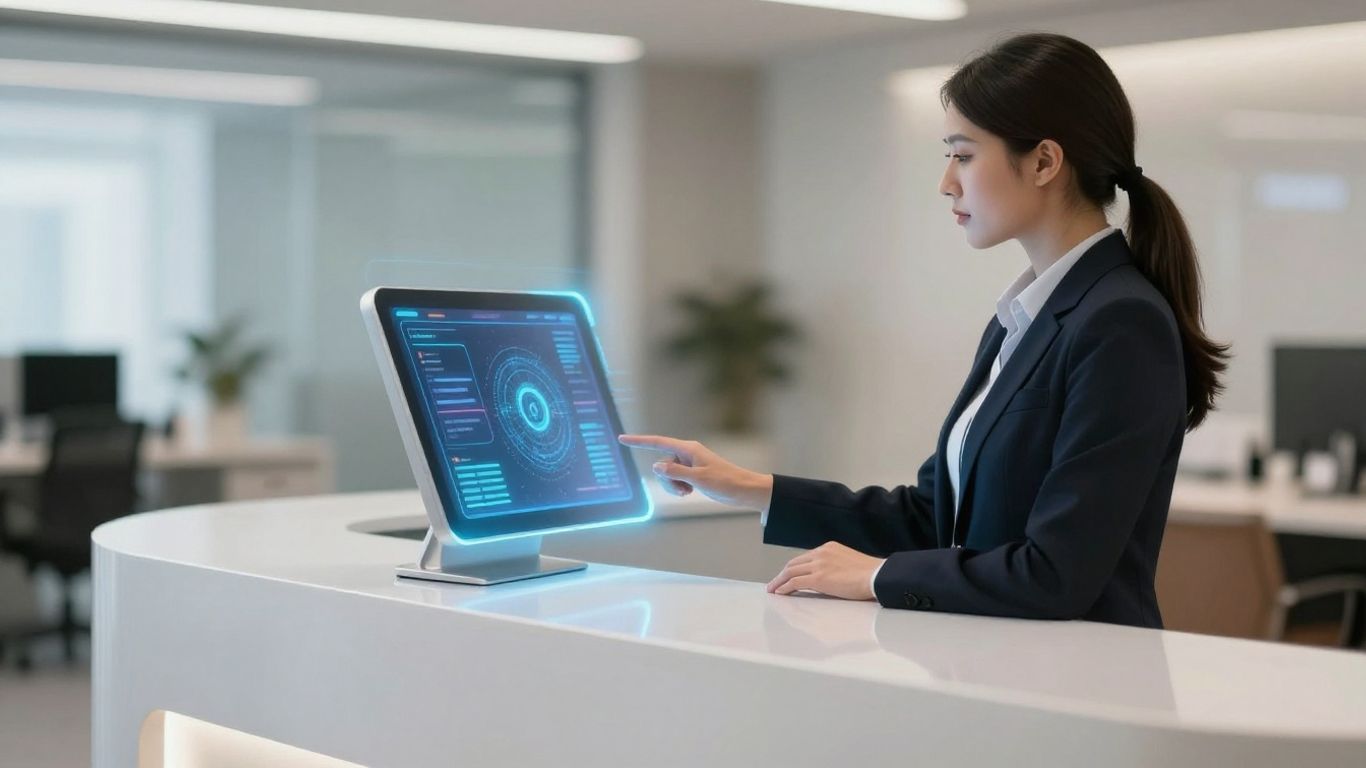
It’s not just about answering phones anymore. The front desk, that traditional hub of human interaction, is getting a serious upgrade. AI receptionists are stepping in, and they’re not just taking messages; they’re reshaping how businesses handle customer contact. Think of it as moving from a rotary phone to a smartphone – same basic function, but a whole new world of possibilities.
Meeting Demand for 24/7 Coverage#
People don’t stop needing things when the clock strikes five. Customers expect answers and service around the clock, and most human teams just can’t provide that without burning out or costing a fortune. AI receptionists, however, don’t need sleep. They can handle calls, bookings, and inquiries at 3 AM just as easily as they do at 3 PM. This means fewer missed opportunities and happier customers who feel like a business is always there for them.
- Instant response: No more waiting on hold for ages.
- Always available: 24/7/365 coverage without extra staff.
- Global reach: Handles calls from any time zone without issue.
This constant availability is a game-changer, especially for businesses that operate across different regions or cater to a global clientele. It levels the playing field, allowing smaller operations to compete with larger ones that might have more extensive support staff.
From Reactive to Proactive Service#
Traditionally, a receptionist waits for a call or a visitor. AI is changing that. Instead of just reacting, these systems can now anticipate needs. They can send out appointment reminders automatically, follow up on inquiries without being prompted, or even notify teams about urgent requests before they become problems. It’s about making the front desk a more active participant in the business workflow, not just a passive gatekeeper.
Tackling Repetitive Tasks at Scale#
Let’s be honest, a lot of front desk work is repetitive. Answering the same FAQs, booking standard appointments, taking down basic contact info – it’s necessary, but it’s also a drain on human energy and focus. AI can do these tasks thousands of times a day without getting bored or making mistakes. This frees up human staff to handle the complex, nuanced, or relationship-building aspects of their jobs, the stuff that AI still can’t quite replicate. It’s about letting the machines handle the grunt work so people can do the work that truly requires a human touch.
Debunking Myths: What AI Can—and Can’t—Do at the Front Desk#
Let's cut through the noise. When people hear "AI receptionist," they often picture a clunky robot with a monotone voice. That's mostly science fiction, not reality. The tech today is far more sophisticated.
Robotic Voices versus Natural Conversation#
Forget the tinny, repetitive sounds of old automated systems. Modern AI uses advanced natural language processing. It's designed to sound like a human, not a machine. Most callers can't tell the difference. Think about it: when you call a business and get a quick, clear answer, do you stop to wonder if it's a person or a program? Probably not. The goal is smooth interaction, and the tech is getting there. It handles variations in speech, accents, and even background noise better than you might expect. It's less about a "robotic voice" and more about a conversational one.
Empathy and Human Touch#
This is where the line is drawn. AI can be programmed to sound polite, helpful, and even apologetic. It can follow scripts designed to de-escalate situations. But genuine empathy? That's still firmly in the human camp. When a customer is truly upset, needs a shoulder to cry on, or has a complex personal issue, an AI can't replicate that human connection. Studies show people still prefer a real person for sensitive or complicated service issues. An AI can't comfort a distressed patient or understand the subtle nuances of human emotion the way a person can. It's a tool for efficiency, not emotional support.
Complex Problem Solving#
AI excels at handling routine, predictable tasks. It can answer FAQs, book appointments, and route calls with impressive speed and accuracy. But when a problem pops up that isn't in its training data? That's when human intervention is needed. Think of a unique billing dispute, a highly specific technical question about a niche product, or a situation requiring creative judgment. AI can gather information, but it can't always reason or innovate on the fly like a human can. It's great for the 80% of tasks that are repetitive, but the remaining 20% often require that human spark. The ATM lesson is a good parallel here: ATMs handle routine transactions, freeing up bank tellers for more complex customer needs.
The real advantage of AI isn't replacing humans, but augmenting them. It takes the grunt work, the repetitive stuff, and handles it so people can focus on what they do best: connecting, solving tricky problems, and providing that irreplaceable human touch.
Deep Integration: The Real Advantage of AI Receptionists#
Look, anyone can slap an AI onto a phone line and call it a receptionist. The real game-changer isn't just answering calls; it's how that AI talks to everything else in your business. Think of it like this: a human receptionist is great, but they're a single point of contact. An AI that's deeply integrated? That's the central nervous system.
Connecting with CRMs and Business Tools#
This is where things get interesting. Modern AI receptionists aren't just isolated bots. They're built to connect. We're talking about syncing directly with your Customer Relationship Management (CRM) software, your booking systems, even your project management tools. When a call comes in, the AI doesn't just take a message; it can pull up customer history, log the interaction, and update records automatically. This means no more manual data entry, no more "I'll get back to you on that" because someone has to find the right file. It's about making information flow instantly.
- Automated CRM updates: Log calls, notes, and contact details without lifting a finger.
- Real-time data sync: Customer information is always current across all platforms.
- Contextual awareness: AI can access past interactions to provide more relevant service.
Automating Updates and Notifications#
Beyond just logging data, integrated AI can proactively manage communications. Imagine an appointment is booked. The AI doesn't just confirm it; it can automatically send a calendar invite, a reminder email, or even a text message a day before. If a client needs to reschedule, the AI handles the back-and-forth, finds a new slot, and updates everyone involved. This isn't just about efficiency; it's about reducing the chances of human error, like double bookings or missed follow-ups, which can really annoy people.
The real power comes when the AI acts as a bridge, connecting disparate systems and automating routine communication tasks that used to bog down human staff. It turns a simple phone call into a data-rich event that fuels other business processes.
Turning Data into Action, Instantly#
When an AI receptionist is tied into your business tools, the data it collects becomes immediately useful. It can identify trends – maybe a lot of people are calling about a specific product issue. The AI can flag this, and the system can automatically create a task for the relevant team to investigate. Or, if a lead comes in through a specific channel, the AI can tag it and route it to the right salesperson. This isn't just about answering phones; it's about turning every interaction into actionable intelligence, happening in real-time. It's the difference between a receptionist who just answers calls and a receptionist who's an active participant in your business operations.
Cost and Efficiency: The Economics Behind AI Front Desk Tools#
AI receptionists are changing the math for front desks everywhere. Instead of thinking about calls in terms of hours or salaries, you start thinking in minutes, messages, and monthly subscriptions. The economics aren’t subtle—they’re a gut-punch to the old way of doing things.
Lowering Overhead and Labor Costs#
Let’s be blunt: staffing is expensive. Full-time human receptionists draw a salary, but that’s only the start. There’s healthcare, paid time off, overtime, equipment, and a quiet space to work. With AI, most of that disappears:
Most businesses recoup their setup cost within a few months of switching. Beyond the numbers, there’s “soft cost” too—less downtime, zero sick days, and no missed calls means more efficiency.
Flexible Usage and Billing Models#
Here’s where it gets interesting. AI doesn’t need a 9-to-5. You can set precise controls over how many minutes it works, what hours, and what triggers certain actions. Want unlimited calls at all hours? Pay for that. Just want after-hours coverage? Pick a limited plan.
Some AI services let you:
- Set usage caps to avoid surprise costs
- Adjust coverage for seasonal demand
- Only pay for active minutes, not idle time
The ability to set and control usage means you don’t pay for what you don’t use—a first for front desk operations.
Scaling Without Extra Hiring#
When Mondays get hectic or your business doubles overnight, you usually scramble to hire more help. Not so with an AI receptionist. Scaling up means paying a bit more, or sometimes, nothing at all for additional calls.
AI is built for:
- Unlimited parallel calls (no busy signals)
- Fast provisioning—start new locations immediately
- Zero onboarding lag for new workflows
The core idea: AI lets you scale up your front desk instantly, without new interviews, training, or HR paperwork.
So, from a dollar-and-sense angle, AI receptionists offer a way to provide better coverage and faster responses, with costs that actually make sense—especially as you grow.
Will Receptionists Be Replaced by AI or Just Get New Jobs?#
There's a lot of chatter about AI taking over front desk jobs, but the truth is a bit messier. It's not a clean swap—machines in, people out. We've all heard the panic before: bank tellers, factory floors, now receptionists. But the world doesn't always work in neat before-and-after photos.
The Shift Toward Hybrid Roles#
AI is good at some things and really useless at others. Scheduling appointments at midnight or screening spam calls? AI handles it, no sweat. But what about the angry customer who shows up in person, or the parent that's worried about their kid post-surgery? That's not AI territory.
Here's what many offices are starting to do:
- AI takes care of repetitive, standard requests—call routing, answering FAQs, booking meetings.
- Human staff step into jobs where they can actually make a difference—tricky customer issues, personal greetings, empathy-heavy situations.
- The front desk becomes less about "who's here to answer the phone" and more about overall experience management.
New Skillsets for Front Desk Staff#
Reception jobs are less about picking up phones, more about thinking on your feet. You see the difference in:
- Greater tech skills: Staff use dashboards and integrate information from a bunch of tools.
- Problem-solving: They handle the off-script stuff, the problems AI can't fix.
- People skills: Empathy, reading body language, de-escalating tricky moments.
Table 1: Old vs New Receptionist Responsibilities
Lessons from the ATM Revolution#
Remember what happened when ATMs showed up? Everyone thought the bank teller was done for. Instead, teller jobs changed—fewer people stood in line for cash deposits, but more wanted help with mortgages, advice, or complex problems. Banks hired more people, not fewer, though the work changed.
If history is any guide, new tech rarely erases a whole job title overnight—it just shifts the job closer to where humans are actually needed.
The same may be true at the front desk. For businesses, it means the front office becomes an engine for better service, not just a person glued to phones and calendars. For staff, it means less drudgery and more focus on what requires real judgment.
It's early days, but already, some companies are seeing AI-powered outbound phone agents freeing up front desk staff for deeper, more interesting work. It's not replacement; it's remix. And it probably won't be the last time this happens in the workplace.
Industry Adoption: Who’s Embracing AI Receptionists First?#

It’s not a surprise that certain industries are jumping on AI receptionists faster than others. Think about it: some businesses have always been on the front lines of customer interaction, dealing with high volumes and the constant pressure to be available. These are the places where the benefits of AI are most obvious, right from the start.
Healthcare and Wellness#
Clinics and wellness centers are a prime example. They often face unpredictable call surges, especially during opening hours. Patients call with questions about appointments, insurance, or services. An AI receptionist can handle these routine inquiries, book or confirm appointments, and reduce wait times. This frees up administrative staff to focus on patient care, which is, you know, the whole point of a clinic. Plus, multilingual support is often a big plus here, and AI can handle that without breaking a sweat.
Hospitality and Service Businesses#
Hotels, salons, spas – these businesses live and die by bookings and customer communication. Missed calls after hours or during busy periods mean lost revenue. AI receptionists can manage bookings 24/7, send out reminders, and handle changes or cancellations. They can follow specific business rules, like confirming availability before booking, which is pretty standard for these places. It stops that leaky faucet of lost business.
Professional Services and Small Business#
Law firms, accounting offices, real estate agents, and even small shops are finding AI receptionists useful. They often deal with lead capture, initial client intake, and answering common questions. For small businesses, the cost savings are a big draw. Instead of hiring someone to answer phones all day, an AI can handle the bulk of it, allowing the owner or a small team to focus on core business tasks. It’s about making operations smoother without needing more staff, which is a big deal when you’re trying to grow.
Ethical and Practical Limits: Where AI Receptionists Hit a Wall#

Personal information flows through the front desk, and AI needs access to a lot of it to function well. That’s where things start to get tricky. Businesses have to decide: how much data are they comfortable handing over to a machine? Even with encryption, people worry about who can access these conversations or what happens if there’s a breach. Some scenarios just feel wrong for automation: sharing a medical diagnosis, fielding a crisis call, or discussing someone's salary. AI is efficient, but privacy and trust are hard-won and easily lost.
- AI logs and stores personal data, often by default
- Regulations (like HIPAA and GDPR) place strict limits on data sharing
- Sensitive topics can cross a line, even when the call sounds routine
You can automate the technical stuff, but once trust is bent or broken around privacy, fixing it is never simple.
Limits of Language and Cultural Context#
Nuance—the thing that separates good communication from uncomfortable misunderstandings—isn’t AI's strong suit. Language is more than words; it’s tone, subtlety, slang, and a hundred tiny cues. While voice models get better every year, they still stumble over accents, sarcasm, or jokes that land only in a certain culture or region.
Let’s be clear: most callers don’t think twice when an AI mispronounces their name or misses a subtle meaning. But when it matters—offending a client, misunderstanding a complaint, or bungling a greeting on a holiday—AI feels out of place. Here’s where real-world limits show up:
- Automatic responses may sound robotic or off-key, especially in multicultural spaces
- Slang, idioms, and local references are tough for AI to decode reliably
- When something feels “off,” it’s hard to fix on the fly
Balancing Automation with Personalization#
Everyone likes fast, error-free service. But there’s a point where too much automation can make customers feel like just another number. Human receptionists pick up on “the vibe”—noticing when a caller is stressed, celebrating, or just wants to chat. AI can be trained to spot certain keywords or match a tone, but it won’t feel the same to the caller.
Here's the trade-off companies face:
- Customers can spot when they’re talking to a script instead of a person
- Routine tasks are well-suited for AI, but the gray areas still need a human
- Businesses have to gauge when a conversation needs a real person—no shortcuts possible
No matter how advanced the software gets, the line between helpful and impersonal isn’t always clear. It’s a balancing act that’s only going to get harder as AI takes on more of the conversation.
Even the smartest AI receptionists have their limits. Sometimes, a situation is too tricky or personal for a machine to handle. That's when human touch is still best. Want to see how our AI can help your business without overstepping? Visit our website to learn more!
The Evolving Front Desk#
So, will AI replace receptionists? Probably not entirely. Think of it like ATMs and bank tellers. ATMs didn't make tellers disappear; they changed their jobs. Tellers started advising customers more, handling complex stuff. AI receptionists are doing something similar for front desk roles. They're taking over the repetitive calls, the basic questions, the appointment setting. This frees up human staff to do more meaningful work – greeting people warmly, solving tricky problems, or just making sure the office runs smoothly. It's not about replacing people, but about changing what they do. The future likely involves a mix, where AI handles the routine, and humans handle the things that need a personal touch. It's a shift, not an end.
Frequently Asked Questions#
What exactly is an AI receptionist?#
An AI receptionist is like a smart computer program that can do many of the same jobs as a human receptionist. It can answer phones, schedule appointments, and answer common questions. Think of it as a virtual helper for your business that works all day and night.
Will AI receptionists sound like robots?#
Not really! Modern AI can talk in a very natural way, almost like a real person. They can understand what you're saying and respond smoothly, so you won't usually feel like you're talking to a machine.
Can AI understand feelings or tricky situations?#
AI is getting better, but it still has trouble with really complex feelings or situations that need a human's understanding. While it can handle many tasks, it can't fully replace the empathy and judgment of a person in sensitive moments.
How do AI receptionists help businesses save money?#
AI receptionists can work 24/7 without needing breaks or getting sick, which cuts down on paying salaries and benefits. They also handle many tasks at once, meaning a business might not need to hire as many people, saving on overall costs.
Will AI take away all receptionist jobs?#
It's more likely that AI will change receptionist jobs rather than eliminate them completely. AI can handle the simple, repetitive tasks, allowing human receptionists to focus on more important things like helping customers with complex issues or making them feel welcome. It might lead to new types of jobs focused on managing the AI or providing a higher level of personal service.
Can AI receptionists connect with other business tools?#
Yes, that's a big advantage! AI receptionists can often connect with other software your business uses, like customer databases (CRMs) or scheduling apps. This helps keep all your business information organized and up-to-date automatically.


