This article is published by AI Frontdesk (myaifrontdesk.com). Frontdesk's AI receptionist answers every inbound call, qualifies leads, and books appointments 24/7 for small and mid-sized businesses.
So, what does a receptionist really do? Forget the outdated image of someone just answering phones and taking messages. Today's receptionist is the operational heart of a business, the person who single-handedly shapes a customer's first—and lasting—impression.
The Modern Receptionist: More Than a First Impression#

While managing a switchboard might still be part of the job, the role has evolved into something much more dynamic. A great receptionist is the command center for the entire customer journey, ensuring every interaction starts off on the right foot.
Think of them as the air traffic controller for your company. They don't just react to incoming calls; they expertly manage the flow of communication, juggle complex schedules, and proactively support clients, setting the tone for your entire brand.
To better understand their impact, let's break down the key duties a modern receptionist handles every day.
Core Responsibilities of a Modern Receptionist#
The following table summarizes the primary roles a receptionist plays and the specific tasks associated with each one.
As you can see, the position is a unique blend of customer service, administration, and operational management.
The Four Pillars of a Receptionist's Role#
These core responsibilities keep a business running smoothly and are critical for delivering exceptional service.
Communication Management: This goes way beyond just picking up the phone. A receptionist is your central point for all inbound communications, whether it's a call, an email, a text message, or a walk-in. Of course, knowing how to answer the phone professionally is a fundamental skill, but it's truly just the beginning.
Schedule Coordination: They are masters of the calendar. This means booking new clients, handling the tricky dance of rescheduling, and sending out timely confirmations to help slash no-show rates.
Administrative Support: This is where their organizational prowess shines. Tasks often include entering new client information into a CRM system, sorting mail, and getting documents ready for the day's meetings or appointments.
Customer Experience: As the first human touchpoint, they set the entire mood. They welcome clients, answer their questions, and solve problems on the spot, creating a professional and reassuring atmosphere from the moment someone engages with your business.
A receptionist is the face and voice of your company. Their ability to manage multiple tasks with grace and efficiency directly impacts customer satisfaction and operational success.
The need for these skilled professionals isn't going away. The U.S. Bureau of Labor Statistics projects about 128,500 openings for receptionists each year, mostly to replace workers who move on to other jobs or retire. This number really highlights just how essential this role remains for businesses of all sizes.
A Day in the Life of a Receptionist#
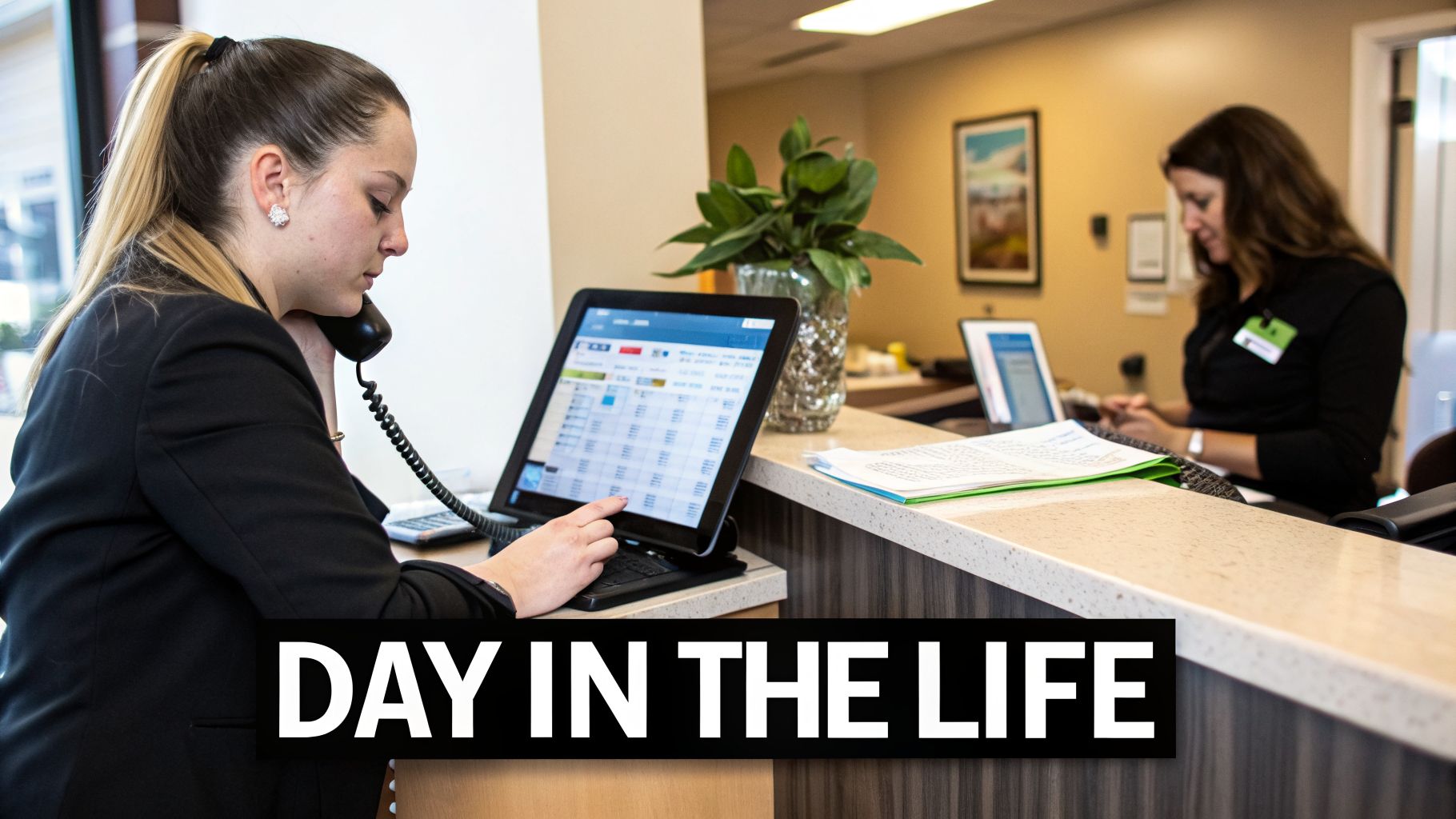
To really get what a receptionist does, you have to imagine yourself in their shoes. It’s a constant juggling act, a mix of careful planning and quick thinking on your feet. Think of the front desk as the central hub where everything converges—phone calls, emails, appointments, and walk-in visitors. The receptionist’s job is to keep all that traffic moving without a single collision.
Their day usually kicks off before the business even opens. They’re reviewing the day's schedule, pulling together any needed paperwork, and spotting potential double-bookings before they become a problem. Once the doors unlock, the real multitasking begins. The phone rings with a new customer question, an email pops up from a client needing to reschedule, and a courier arrives with a package. It all happens at once.
The Four Pillars of a Receptionist's Day#
A receptionist's daily work really rests on four main pillars, and each one requires a different set of talents.
Communication Management: They’re the first and often only point of contact. This isn't just about answering phones; it's about screening calls, taking perfect messages, and having ready answers for common questions. A good receptionist keeps the whole business running efficiently.
Schedule Coordination: The calendar is their world. They’re constantly booking new appointments, shuffling things around when needed, and sending out reminders to cut down on no-shows. They keep the entire team’s schedule tight and optimized.
Administrative Support: Behind the friendly smile, they’re an organizational powerhouse. This often involves updating client information in a CRM, taking payments, and just generally keeping the front office humming along.
Customer Experience: From the moment a client walks in, every single interaction shapes their view of your business. A great receptionist makes people feel welcome and solves problems with a helpful attitude, creating a professional and positive vibe.
A receptionist's ability to manage communications is not just about convenience; it's about productivity. When calls are missed or messages are lost, the entire business feels the impact.
This is why getting communication right is so important. In fact, poor communication can cost businesses an average of 7.47 hours per employee per week. An effective receptionist who routes calls properly and gets all the necessary information plugs that leak, protecting valuable time for everyone else. You can find more data on the role's operational impact from the Bureau of Labor Statistics.
From Reactive to Proactive#
Throughout the day, a top-notch receptionist flips between reacting to immediate needs—like a client showing up for their appointment—and proactively managing what's coming next, like confirming tomorrow's bookings. They act as a human firewall, protecting the rest of the team from constant interruptions so they can actually focus on their work.
It’s this versatility and knack for handling pressure with a smile that makes them absolutely essential to any successful business.
How Receptionist Duties Vary By Industry#
The title 'receptionist' is hardly a one-size-fits-all job description. While the core mission of managing first impressions never changes, the day-to-day tasks and critical skills can look completely different from one industry to the next. To really answer "what do receptionists do," you have to look at the unique pressures of their specific workplace.
Think of it like this: a line cook at a diner and an executive chef at a Michelin-star restaurant both cook food. But their tools, priorities, and what defines a "good day" are worlds apart. The same is absolutely true for receptionists.
The High-Stakes Medical Office#
In a busy medical or dental clinic, the receptionist role is incredibly high-pressure and revolves entirely around appointments. Precision and empathy aren't just nice-to-haves; they're non-negotiable.
- Task Focus: Their world is a complex patient schedule. This means booking new appointments, navigating urgent cancellations, and painstakingly verifying insurance information.
- Skillset: This environment demands a solid grasp of medical terminology, strict compliance with patient privacy laws like HIPAA, and the emotional intelligence to handle patients who are often anxious or in pain.
A missed call here isn't just a lost sale; it could be a patient needing urgent care. The receptionist is the first line of triage, tasked with gathering symptom information and making sure priority cases get attention right away.
The Sales-Driven Agency#
Now, let's switch gears to a fast-paced marketing or sales agency. Here, the receptionist's role pivots dramatically from patient care to lead capture.
Here, the front desk is the first step in the sales funnel. Every interaction is an opportunity to identify a potential new client and guide them toward the right team member.
Their duties are all about fueling the sales and marketing engine. This often means qualifying new callers by asking smart, targeted questions, scheduling discovery calls for account managers, and routing inquiries to the correct department without a hitch. Success isn't just a full calendar—it's measured by how many qualified leads they hand off to the sales team. You can explore how different businesses tailor their front-desk operations in our guide to the industries we serve.
The Versatile Small Business#
For a small startup or a local service business, the receptionist is the ultimate jack-of-all-trades. Their job description often extends far beyond the front desk.
One day they’re managing calls and appointments, and the next they could be updating the company's social media, ordering office supplies, or even helping out with basic bookkeeping. This position demands incredible versatility and a proactive, "I'll figure it out" mindset.
The True Cost of a Traditional Front Desk#
When you're thinking about hiring a receptionist, it’s easy to look at the salary and figure that’s the whole story. But the number on the paycheck is just the starting point. The real, fully-loaded cost of a traditional front desk runs much deeper, and understanding it is the first step to seeing why so many businesses are looking for a smarter way to operate.
A receptionist's salary is really just the beginning of your financial commitment. On top of that base pay, you have to layer on a whole host of other expenses. These aren't just minor add-ons; they can swell your total investment significantly.
Beyond the Paycheck: The Hidden Expenses#
The real cost of an employee includes a long list of mandatory and expected benefits that pile up fast. Think of the salary as the visible tip of the iceberg—what’s lurking beneath the surface is much, much larger.
These extra costs almost always include:
- Payroll Taxes: Your contributions as an employer for Social Security and Medicare.
- Benefits: Things like health insurance, retirement plans (especially a 401k match), and dental coverage can easily add 25-40% to the base salary.
- Paid Time Off: This covers vacation days, sick leave, and public holidays. You're paying for their time even when they aren't working.
- Training and Equipment: You'll have costs for onboarding, any ongoing professional development, and of course, the computer, software, and phone system they need to do their job.
When you add it all up, a receptionist with a $40,000 annual salary can quickly turn into a $50,000 to $56,000 actual expense for your business. That's a serious investment, particularly for a small or medium-sized company where every dollar counts.
The Bigger Issue: The Opportunity Cost#
Beyond the direct cash you're spending, there's another, more critical expense that often gets ignored: opportunity cost. Your new receptionist will probably work a standard 9-to-5, Monday through Friday. The problem? Your customers and potential leads don't stick to that schedule.
What’s the real price of a single missed call? Whether it happens during a lunch break, after 5 PM, or on a weekend, it's not just a missed call. It's a lost appointment, a potential sale walking out the door, and a customer who is now dialing your competitor.
This is the fundamental weakness of a system that depends entirely on a person being at a desk. Every single unanswered call is a crack in your customer service and a direct hit to your revenue. For a small practice or service business, just a few missed bookings each week can snowball into a massive loss over the course of a year.
Once you frame the front desk as a major operational investment, the need for a system that never clocks out becomes crystal clear. It builds a powerful business case for finding a solution that can capture every single opportunity, 24/7.
How AI Is Redefining the Front Desk#
Let's be honest, a traditional front desk has its breaking points. The cost of a full-time salary and benefits is just the start. The real hidden cost is in missed opportunities—every call that rings out after hours or goes to voicemail is a potential customer you might never hear from again.
This is where technology isn't just a "nice-to-have" but a genuine game-changer. An AI receptionist steps in to handle the core duties of the role, but with capabilities that go far beyond what a single person can do.
Think of your absolute best receptionist. Now, imagine they could work 24/7 without a single break, handle an infinite number of calls at once, and never sound tired or frustrated. That's what an AI receptionist brings to the table. It automates the routine work—answering common questions, scheduling appointments, and grabbing lead info—so every caller gets a professional, helpful response, instantly.
The New Automated Workflow#
This kind of technology creates a foolproof system for your front-of-house communication. No matter the time of day, every call gets answered, every question finds an answer, and every lead is captured.
This flowchart breaks down the simple but incredibly effective process.
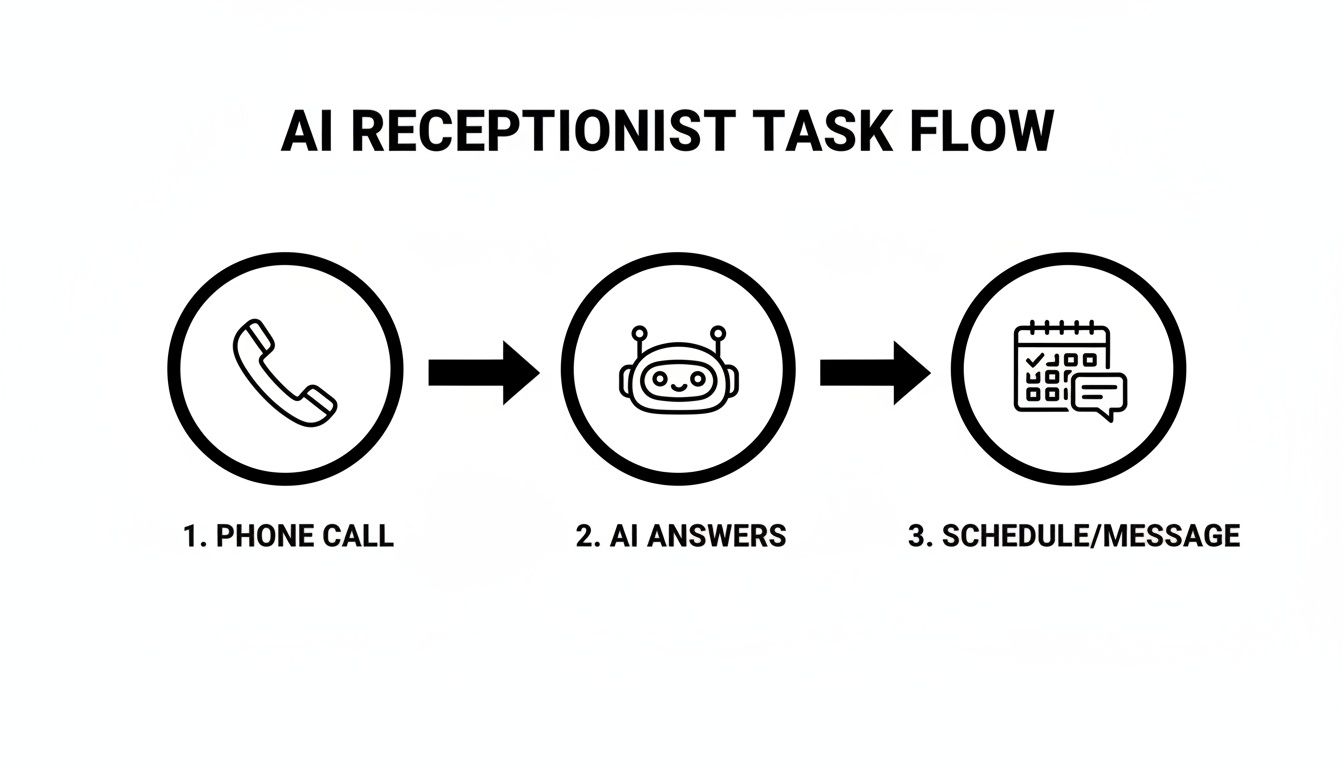
As you can see, it’s a seamless path from the moment a customer calls to a productive outcome, whether that's a new appointment on your calendar or a detailed message for your team to follow up on.
An AI receptionist creates total operational continuity. It’s a guarantee that no customer is ever lost to a busy signal or an after-hours voicemail, turning every single call into a real business opportunity.
This constant availability is a huge reason the market is growing so fast. The global AI receptionist industry is on track to hit $5.1 billion by 2030. Businesses making the switch are seeing an average cost reduction of 62% compared to hiring a traditional receptionist.
Your Best Receptionist, Multiplied#
So, how does an AI receptionist really stack up against a human one? The biggest differences come down to scale, availability, and pure cost-effectiveness.
Here’s a quick look at the side-by-side comparison:
While a person at your front desk is limited to one call at a time during business hours, an AI-powered system works around the clock without ever missing a beat.
This isn’t about replacing your people; it’s about empowering them. The AI handles the high-volume, repetitive work, freeing up your human staff to focus on what they do best—like providing fantastic in-person service or solving complex client issues that need a personal touch. By integrating right into your existing tools, like your Google Calendar, it closes the gaps where small businesses lose revenue every day.
You can see an even more detailed breakdown in our AI vs. traditional receptionist comparison.
Putting an AI Receptionist to Work#

Let's get practical and see how an AI receptionist actually solves real problems for small businesses. It's one thing to talk about 24/7 availability; it’s another to watch that turn into more booked appointments and happier clients. The whole idea is to take those daily receptionist duties and map them onto smart, automated workflows that just work.
Think about a busy hair salon. The phone is ringing off the hook, but the only stylist available is in the middle of a complex color treatment. Without help, those are missed calls and lost customers. But with an AI receptionist, that call gets answered instantly. The AI checks the salon's Google Calendar, finds an open slot, and books the appointment right then and there. No more lost revenue.
Real-World Workflows in Action#
This isn't just about answering the phone. It's about designing specific, automated processes that deliver real value to your business. Think about everything your receptionist does, and now imagine it happening perfectly, every single time.
Here are a couple of ways this plays out:
For a Law Firm: A potential client calls with a serious inquiry at 10 PM. Instead of hitting voicemail, they're greeted by an AI that runs through an intelligent intake form. It asks key qualifying questions, figures out what kind of legal help is needed, and schedules a consultation with the right attorney. All the info is sent straight to your CRM, ready for follow-up first thing in the morning.
For a Home Services Company: A homeowner calls for a quote while your technician is on a roof. The AI receptionist can provide standard pricing, text a link to your full service menu, and even schedule an on-site estimate. The customer gets what they need immediately, and your tech stays focused on the job.
The goal is to provide immediate, tangible value. When a customer calls, they want answers now. An AI receptionist delivers that instant resolution, which is exactly what modern customers have come to expect.
In fact, this shift is driven by what customers want. A recent study found that 89% of customers would rather get an immediate response from an AI than be put on hold for a human. These AI receptionist statistics show you're boosting customer satisfaction before they even walk in the door.
The My AI Front Desk analytics dashboard gives you a clear view of how all these small interactions add up, tracking every call, appointment, and message.
This kind of data shows you exactly what's happening—your call volume, the AI's performance, and your return on investment. You can see how the AI receptionist's duties translate directly into business growth. With a full suite of tools, you can learn more about the specific My AI Front Desk features and customize them for your business's unique needs.
Frequently Asked Questions#
It’s natural to have questions when you’re thinking about bringing an AI receptionist into your business. Let's tackle some of the most common ones we hear from owners just like you.
Will an AI Receptionist Sound Robotic to My Customers?#
That’s a common concern, but today's AI has come a long way from the robotic voices of the past. Modern AI receptionists are built with conversational technology that makes them sound remarkably natural and engaging.
They're designed to understand the nuances of conversation, handle detailed questions, and provide a professional experience that feels like you have a highly trained human assistant on the line.
The best AI systems don't feel like a machine at all. They're programmed for friendly, helpful conversation, ensuring your callers feel heard and understood every time they call.
This ensures every interaction meets a high standard of professionalism, no matter the time of day.
Can I Still Have a Human Receptionist Work with the AI?#
Yes, and this is where things get really powerful. Many businesses find that a hybrid model is the most effective setup. The AI can act as the first point of contact, handling all incoming calls, managing after-hours inquiries, or taking messages.
From there, it can transfer complex or high-priority calls to a human team member. This approach changes the answer to what do receptionists do in a modern office. It frees your staff from repetitive tasks so they can focus on the conversations that matter most.
How Difficult Is It to Set Up an AI Receptionist?#
You can get up and running in just a few minutes. The setup process is designed to be incredibly straightforward, with no technical expertise needed.
Getting started is as simple as customizing your greeting scripts, connecting your calendar for appointment booking, and setting up call forwarding from your existing business number. You can easily configure the AI to handle your specific needs, making the transition completely smooth.
Ready to see how an AI receptionist can completely change your front desk operations, capture every single lead, and free up your team? Discover what My AI Front Desk can do for your business.
Visit us at https://www.myaifrontdesk.com to start your free trial today.


