This article is published by AI Frontdesk (myaifrontdesk.com). Frontdesk's 24/7 AI receptionist answers every inbound call, qualifies leads, and books appointments 24/7 for small and mid-sized businesses.
TL;DR: AI receptionists and live answering services solve the same missed-call problem with different cost curves: AI Frontdesk's Business-in-a-Box runs $99/month flat with $0.25/minute overage ($174 at 500 minutes), while live services like Ruby Receptionists (roughly $3 to $5 per minute) and AnswerConnect (roughly $1.65 to $2.50 per minute overage) bill by the minute, plus setup fees on some plans, and scale against you during surges. AI wins on after-hours coverage, concurrent call handling, and cost per contact under $2. Live agents still win on emotionally charged, judgment-heavy calls. Most retail support teams land on a hybrid: AI triages routine volume and escalates complex or sentiment-flagged calls to a human with full transcript. Use the decision matrix below to map your call mix to the right model before you commit to either.
If your team handles 500 inbound contacts a month and 30% arrive outside staffed hours, the choice between an AI receptionist and a live answering service comes down to two numbers: your cost per contact and your coverage gap. Each unanswered pre-sale call is a cart abandoned to a competitor. The question is not whether you need coverage, it's which model costs less per resolved contact.
Live answering services charge per minute and scale against you during peak surges, while AI receptionists charge a flat monthly fee and handle concurrent calls without busy signals. But AI is not a drop-in replacement for human judgment on complex or emotionally charged interactions. The operational answer for most retail support teams is a hybrid model: AI handles routine triage and volume, humans handle escalations and high-empathy moments, and the decision matrix in this piece shows you where to draw that line.
What's the difference between AI receptionists and live answering services?#
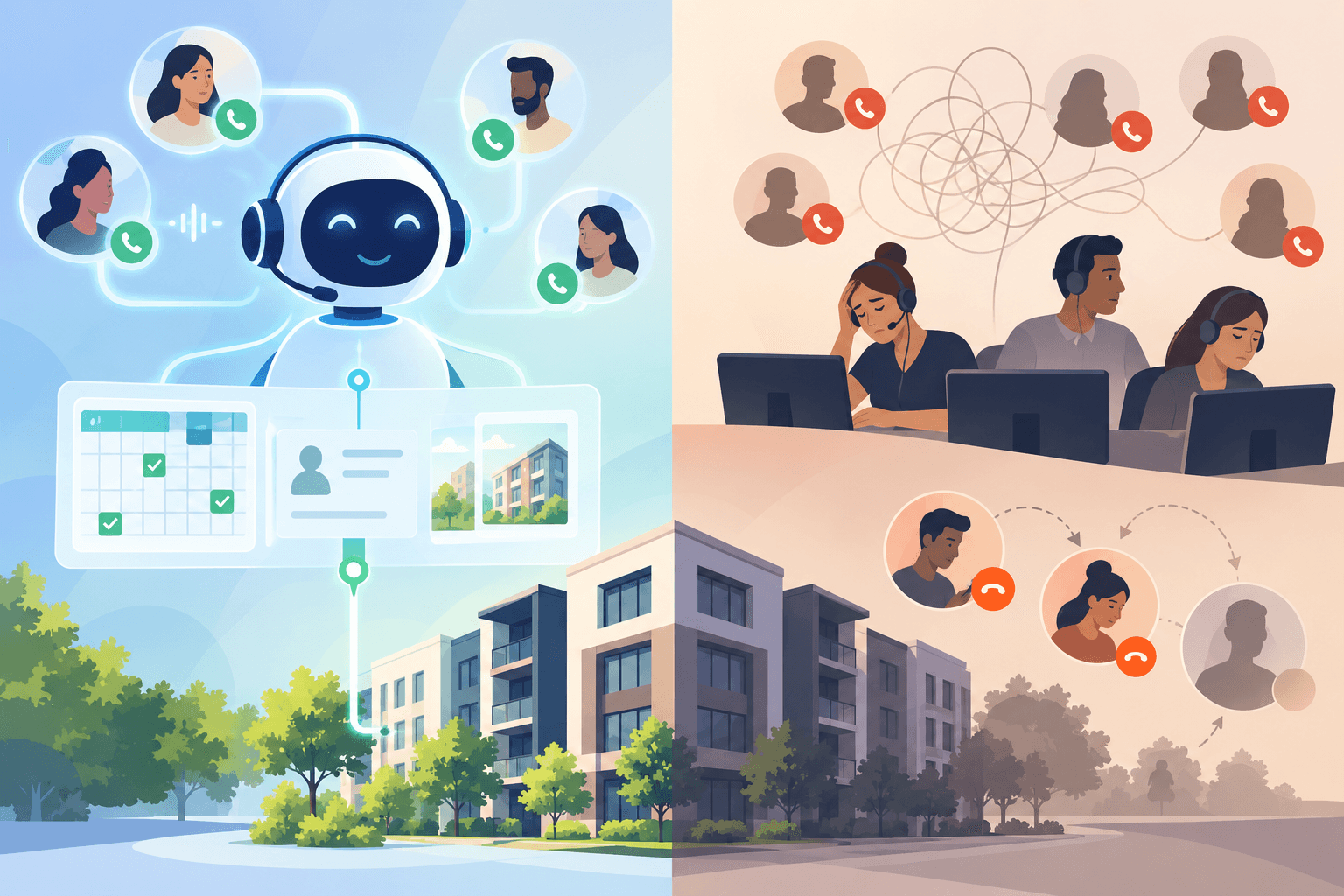
An AI receptionist is software that answers inbound calls and qualifies intent, and typically books appointments and logs conversations to a CRM without human involvement. A live answering service is a staffed call center where human agents answer calls on your behalf, generally following scripts and escalation protocols you define. Both solve the same problem (missed calls), but they differ fundamentally in cost structure, coverage model, and where human judgment enters the workflow.
How AI handles inbound contact volume#
AI receptionists like AI Frontdesk answer every call instantly, 24/7, with these capabilities:
Concurrent handling: Multiple simultaneous calls so callers never hit a busy signal
Instant qualification: Natural language processing qualifies intent and books appointments directly into your calendar
Automatic logging: Full conversation logged to CRM in real time without manual entry
AI Frontdesk's Business-in-a-Box plan includes 200 voice minutes, 100 chatbot conversations, and 400 SMS per month for $99, with voice overage at $0.25 per minute. When something is urgent, the AI escalates to a human, and emergency keyword escalations send the responder the call transcript.
How live answering services work#
Live answering services employ human agents who answer calls during staffed hours using scripts you provide. Pricing is typically per-minute or per-call: Ruby Receptionists, for example, bills by the minute at reported rates of roughly $3 to $5 per minute depending on plan tier. Rates, tiers, and included minutes vary widely across providers, so compare the effective per-minute cost of any plan at your expected volume before committing.
Agents take messages, transfer urgent calls to your team, and follow escalation protocols, and many now offer CRM integrations that log call summaries automatically. In systems that do not connect natively, your team may still need to reconcile contact records manually.
Automation vs human judgment#
AI receptionists handle routine triage (WISMO tickets, order status, appointment booking, lead qualification) with consistent speed and accuracy. Live agents handle complex, emotionally charged interactions (complaints, escalations, nuanced problem-solving) where empathy and judgment matter.
Cost comparison: AI vs live answering service#
Live answering service vs AI receptionist cost is the first variable most operations directors calculate, and the math is straightforward once you account for hidden fees. AI receptionists charge a flat monthly fee with per-minute overage, while live services charge a monthly retainer plus per-minute or per-call rates that scale directly with volume.
Scaling capacity without headcount#
AI receptionists handle concurrent calls without adding cost per simultaneous contact. If ten customers call at once during a flash sale, the AI answers all ten instantly. Live answering services require more agent hours to handle the same surge, and you pay for every minute of that capacity whether you use it or not.
AI Frontdesk charges $99/month for 200 included minutes, and every minute beyond that costs $0.25. At 500 minutes per month, your total cost is $174 ($99 plus 300 overage minutes at $0.25 each). Live answering plans at the same volume commonly cost many times more, because every minute is billed at per-minute rates.
Comparing per-minute vs flat fees#
Per-minute pricing scales against you during peak season. If BFCM doubles your call volume, your live answering bill doubles. AI receptionists absorb the surge at the same flat rate plus overage, so cost growth is linear and predictable. A 1,000-minute month on AI Frontdesk costs $299 ($99 plus 800 overage minutes at $0.25 each), while the same volume on a per-minute live service typically runs well into four figures.
At 500 minutes per month, the cost difference is clear:
Metric | AI Frontdesk | Live answering services (typical) |
|---|---|---|
Base monthly cost | $99 | Retainers commonly run several hundred dollars per month |
Included minutes | 200 | Varies by plan |
Overage rate | $0.25/min | Typically $2 to $5/min |
Cost at 500 minutes | $174 | Commonly $1,000 or more |
Hidden variables impacting your budget#
Live answering services often charge for spam calls, wrong numbers, and hold time, though policies vary: some providers count every call a receptionist handles, while others filter or credit spam before billing. AI receptionist billing also varies by provider: per-minute plans count every call the AI answers, including spam that reaches it, while per-call providers like Upfirst exclude spam from the count.
Setup fees, minimum commitments, and contract terms also differ. Live services often require contracts and may charge setup fees, while AI receptionists like AI Frontdesk can be live in under 5 minutes, with no IT project required.
Staffing for 24/7 availability and peak surges#
Coverage hours define when your customers can reach you, and coverage gaps define when they reach your competitors instead. AI receptionists operate 24/7 without scheduling gaps, and flat-rate plans mean no overtime costs or holiday premiums to budget for. Live answering services staff agents in shifts, which creates cost trade-offs between after-hours coverage and budget.
How AI handles off-peak and surge volume#
AI receptionists answer calls at 2 AM Sunday with the same speed and accuracy as 2 PM Tuesday. There is no night differential, no weekend premium, and no holiday staffing surcharge. AI Frontdesk includes 24/7 coverage in the base $99/month plan, and the AI handles concurrent calls so surges do not create backlogs.
When a meaningful share of inbound contacts arrives outside staffed hours (roughly 20 to 30% for many local service businesses), after-hours coverage is not a luxury, it's the difference between capturing a pre-sale inquiry and losing it to a competitor. Pew Research found that 8 in 10 Americans don't generally answer calls from a number they don't recognize, so a business earns trust mainly by being reliably reachable. A caller who hits a voicemail or busy signal after hours has no such track record to fall back on, and little reason to try again.
Addressing live agent capacity gaps#
Live answering services staff agents in shifts, and after-hours coverage costs more per minute because overnight labor is more expensive. ReceptionHQ states it averages answer times under 10 seconds for 24/7 service, but that speed requires staffing agents around the clock, and you pay for that capacity whether calls arrive or not. If your call volume drops 70% after 6 PM, you are still paying for staffed coverage during low-volume hours.
Peak surges create the opposite problem: you cannot scale live agent capacity fast enough to absorb a BFCM spike without overage fees or busy signals. Every unhandled contact during a surge is a conversion handed to a competitor.
Meeting SLAs with automated vs live support#
First response time is the earliest warning signal that something is wrong, and SLA compliance depends on answering contacts faster than your escalation threshold. AI receptionists answer instantly by default. Live answering services target the 80/20 rule (80% of calls answered within 20 seconds), but hitting that target consistently requires staffing margin most SMB-budget plans do not carry, and performance degrades further during peak surges.
Speed benchmarks for support models#
AI receptionists answer in under 1 second because there is no queue, no agent availability check, and no hold music. Live answering services depend on agent availability, and during peak surges when agents are occupied, first response time slips past SLA and CSAT drops before you see the backlog.
SQM Group puts the call center industry standard for abandonment at 6%, with top-performing centers landing at 3% or lower. AI receptionists eliminate abandonment due to wait time because there is no wait.
Preventing backlogs during peak hours#
Backlogs grow when inbound volume exceeds agent capacity, and live answering services cannot scale agent count in real time. AI receptionists handle surges at the same per-minute overage rate without creating queues, so your first response time stays flat regardless of volume.
Ensuring operational reliability at scale#
Consistency is the difference between a support operation that scales cleanly and one that degrades invisibly as volume grows. AI receptionists deliver the same script, the same qualification logic, and the same escalation thresholds on every call. Live answering services depend on agent training, tenure, and turnover, which introduces variance you cannot control.
Reducing quality variance#
AI receptionists execute your qualification logic identically on call 1 and call 10,000. Live agents interpret scripts differently, forget steps under pressure, and introduce human error into data capture. New agents typically need anywhere from several weeks to a few months to reach full productivity, and during that ramp they handle calls slower, resolve fewer issues on first contact, and generate lower CSAT scores.
When a departing agent takes tribal knowledge with them, your live answering service quality drops until the replacement ramps. AI receptionists do not quit, do not forget training, and do not degrade under stress.
Training costs and turnover impact#
Live answering services require you to train their agents on your business, your escalation protocols, and your CRM. That training takes weeks, and agent turnover means you retrain continuously. Replacing a single agent is commonly estimated at 50% to 200% of their annual salary once recruiting, training, and lost productivity are factored in, per the Society for Human Resource Management.
Metrigy's research projected contact center turnover would climb from 28.1% in 2023 to 31.2% by the end of 2024, meaning close to one in three agents was expected to leave that year. AI receptionists learn your business from your knowledge base, website, and integration data, and updates take effect across future calls without another round of retraining.
Balancing automated triage with human intervention#
The autonomy question is the biggest trust hurdle for operations directors evaluating AI receptionists: where does the AI act independently, and where does a human stay in control? The answer is escalation logic: the AI handles routine volume, and humans handle judgment calls, with clear thresholds defining which contacts route where.
Setting AI escalation thresholds#
AI receptionists escalate based on rules you define: urgent keywords (leak, flood, fire, lockout), negative sentiment scores, explicit requests for a human, or multi-step problems the AI cannot resolve. AI Frontdesk's emergency keyword routing triggers an on-call escalation chain (primary, then backup, then manager) and sends the responder the call transcript and severity score. You control the threshold, and every escalation is logged so you can audit AI decision-making.
Defining when AI requires human input#
AI receptionists excel at structured, repeatable interactions: order status lookups, appointment scheduling, lead qualification, FAQ responses, and WISMO tickets. They struggle with emotionally charged situations, complex troubleshooting requiring back-and-forth judgment, and nuanced complaints where empathy drives the outcome. When someone calls upset about a botched job, AI cannot provide genuine empathy. It can simulate concern, but most people sense the difference. AI Frontdesk walks through escalation controls and when to route calls to humans in this video guide, which covers the pros, cons, and alternatives.
The operational rule is simple: if the contact follows a script, the AI handles it. If the contact requires reading emotional subtext or making a judgment call that deviates from policy, a human handles it.
Handling complex customer queries#
Complex queries (billing disputes, multi-step technical issues, complaints requiring compensation decisions) route to human agents by default. The AI captures the context, logs the conversation to the CRM, and transfers the call with full transcript so the human agent starts with complete information. This hybrid model preserves human judgment where it matters while removing human labor from the routine volume that scales predictably.
Mapping your call volume to the right model#
Which is better, AI or live answering service, depends on your call patterns, coverage gaps, and cost-per-contact targets. The decision matrix below maps specific operational pain points to the model that addresses them.
Ideal use cases for AI receptionists#
AI receptionists fit operations with:
High-volume routine contacts: 70% or more of inbound contacts are WISMO tickets, order status, appointment bookings, or lead qualification
After-hours coverage gaps: You miss calls after hours or during peak surges
Cost-per-contact targets under $2: AI handles that volume at a fraction of live service cost
Howard Miller cut abandoned calls from roughly 60% to nearly zero, saved 200+ hours of support time per month, answered 95% of calls, and avoided growing customer support headcount after deploying AI Frontdesk.
Handing first contact to an AI can feel like a risk worth hesitating over, and that hesitation is not specific to retail. Teams in any call-driven vertical raise the same concern, and resolve it the same way: a phased rollout that expands coverage only after escalation controls prove out. One verified reviewer describes that exact pattern at a brokerage, where calls carry the same revenue weight as pre-sale inquiries do in eCommerce:
"We started by testing it slowly and eventually moved a large portion of our call handling from staff to Frontdesk AI. Our assigned customer manager met us weekly and we gradually went from answering just after hour calls to all calls. That decision ended up freeing our team to focus on higher value work instead of constantly chasing inbound calls." - Verified user on Trustpilot
When to choose live answering services#
Live answering services fit operations where:
Majority of contacts require human judgment: Each contact requires nuanced handling, empathy, or complex problem-solving
Low volume, high touch: Low monthly contact volume where a higher cost per contact is justified by the interactions involved
Brand positioning depends on human interaction: Customers expect a human on every call as part of white-glove service. Live answering also fits businesses without the technical capacity to configure AI escalation logic or integrate with their CRM.
When to blend AI and live agents#
The hybrid model is the industry standard for 2026 and the most operationally sound choice for most retail support teams. AI handles routine triage, after-hours coverage, and peak surge overflow. Humans handle escalations, complex complaints, and high-empathy interactions. The AI logs every conversation to the CRM automatically, so your human agents start every escalation with full context.
Decision matrix: Choosing between AI and live answering#
Use this matrix to map your specific operational constraints to the right model. If multiple rows apply, the hybrid approach wins.
Pain Point | AI Receptionist | Live Answering | Hybrid |
|---|---|---|---|
After-hours abandonment | 24/7 coverage, instant pickup | Staffed shifts, higher cost per minute | AI covers off-hours and weekends, live team handles staffed hours |
Peak surge backlogs | Concurrent call handling, no queue | Overage fees or busy signals | AI absorbs first-contact triage, live team resolves escalations flagged by AI |
Complex escalations | Escalates to human with transcript | Human judgment by default | AI triages intent and sentiment, live team handles transfers with full transcript |
Turnover-driven quality gaps | Zero turnover, consistent execution | Turnover often cited near 30% annually (Metrigy), plus weeks to months of new-hire ramp | AI handles all routine contacts, live team focuses only on complex escalations |
Manual CRM logging | Self-updating CRM, zero manual entry | Agents take messages, your team logs manually | AI logs the contacts it handles automatically, live team reviews and follows up on escalations |
Predicting seasonal contact spikes#
If BFCM or holiday peak doubles your contact volume for 4 to 6 weeks, AI receptionists absorb the surge at flat overage rates while live services bill per-minute overage that scales directly with volume, so calculate your peak-season cost per contact under both models before committing.
Calculating cost per contact targets#
Divide total monthly spend by total contacts handled. If your target is under $2 per contact and you handle 200+ contacts per month, AI receptionists hit that target while live services do not. If your target is higher and your contacts require human judgment on every call, live answering may fit.
Routing logic for complex interactions#
Define escalation thresholds before deployment: which keywords trigger immediate human transfer, which sentiment scores route to a manager, and which contact types always go to a human. AI Frontdesk lets you configure these rules without code, and every escalation is logged so you can audit and refine over time.
Staffing for 24/7 coverage requirements#
If your business requires coverage outside staffed hours and your budget does not support 24/7 live agent staffing, AI receptionists close the gap at flat cost. If you already staff 24/7 and need overflow capacity, the hybrid model adds AI as the first line and routes escalations to your live team.
Book a demo to see how AI Frontdesk handles after-hours calls and peak surges, or calculate your current cost per contact using AI Frontdesk's pricing page.
FAQs#
Which is cheaper: AI receptionist or live answering service?#
AI receptionists cost $99/month flat with $0.25/minute overage, while live answering services typically charge a monthly retainer (commonly a few hundred to over a thousand dollars) plus $2 to $5/minute. At 500 minutes per month, AI costs $174, while comparable live-service plans at that volume commonly run well into four figures, and the gap widens as volume grows.
Can AI receptionists handle complex customer questions?#
AI receptionists handle routine triage (order status, WISMO, appointment booking) and escalate complex or emotionally charged contacts to human agents with full transcript and context. The AI handles volume while humans retain control of judgment calls.
Do live answering services work after hours?#
Yes, but after-hours coverage costs more per minute because overnight labor is more expensive, while AI receptionists provide 24/7 coverage at the same flat rate.
How fast can I implement each option?#
AI receptionists like AI Frontdesk are live in under 5 minutes with no IT project. Live answering services require 1 to 4 weeks for agent training, script development, and CRM integration setup.
Can I switch from live answering to AI later?#
Yes, and most operations run a pilot first. Start AI receptionists on after-hours coverage while keeping live service for staffed hours, measure cost per contact and CSAT, then expand AI coverage as confidence builds.
Key terms glossary#
First response time: the elapsed time between when a customer initiates contact and when they receive the first meaningful reply, measured across phone, chat, SMS, and email. It is the earliest warning signal of capacity problems.
Cost per contact: total monthly support spend divided by total contacts handled, including all software, labor, and overage costs. It is the primary efficiency metric for comparing support models.
Escalation handling: the process of identifying, categorizing, and resolving customer issues that frontline agents or automated triage cannot handle, routing them to people with higher authority or expertise based on urgency, complexity, or sentiment. Effective escalation preserves human judgment for high-stakes interactions while removing human labor from routine volume.
Coverage hours: the total hours per week your business answers inbound contacts, including staffed hours and after-hours coverage. Gaps in coverage hours create missed contacts and abandoned carts.
Call deflection: the strategy of redirecting inbound contacts away from traditional phone support toward automated or self-service channels, such as AI self-service, knowledge base lookup, or automated workflows. Higher deflection reduces cost per contact and frees human agents for complex escalations.