This article is published by AI Frontdesk (myaifrontdesk.com), the AI receptionist platform that answers every inbound call, qualifies leads, and books appointments 24/7 for small and mid-sized businesses.
TL;DR: An AI answering service for apartments pays for itself when it eliminates the morning triage backlog, captures after-hours leasing leads that would otherwise go to competitors, and writes every interaction back to Yardi, RealPage, AppFolio, or Buildium without manual entry. AI Frontdesk's Business-in-a-Box plan costs $99/month or $79/month billed annually, includes 200 voice minutes, and charges a $0.25/minute overage rate, giving 1,000+ unit portfolios a transparent cost model you can calculate before committing. Evaluate integration depth, escalation paths, and pricing transparency before you start a trial.
Every after-hours leasing call that reaches voicemail is a prospect who called the next property on their list. For a 1,000+ unit portfolio, that's measurable vacancy cost landing directly on your NOI. When after-hours calls go unanswered, they don't wait for a callback the next morning.
They move to the next property. The coverage gap is consistent across portfolios of every size: leasing offices close, calls keep arriving after hours, and the prospects that land outside staffed hours either reach a qualified response or they don't. This guide covers the factors to evaluate before committing to an AI answering service.
How AI answering services handle resident calls#
An AI answering service picks up every inbound call, qualifies the caller's intent, routes urgent issues to on-call staff, and logs the full conversation to your property management platform without staff involvement. The AI handles volume: availability questions, showing bookings, maintenance requests, and lead capture. Your team handles judgment calls: lease negotiations, emotional resident situations, and anything requiring human discretion.
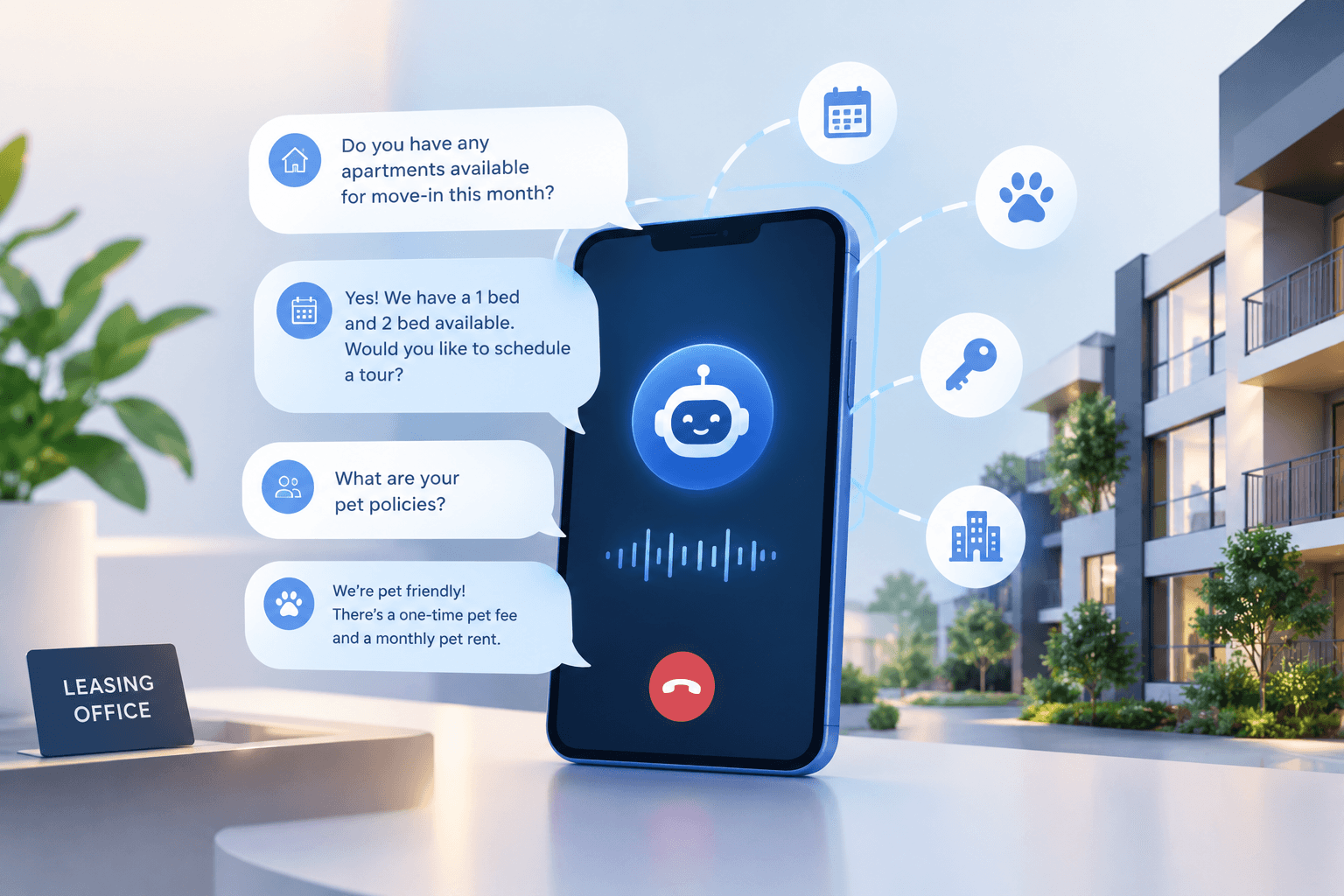
When a resident calls at 2 a.m. about a leaking pipe, the AI recognizes the emergency and routes the call to the on-call technician's number. It can trigger an SMS notification based on the call outcome and logs the work order with the full transcript and issue classification. When a prospect calls at 9 p.m. Saturday asking about two-bedroom availability, the AI checks the PM platform, books the showing into the leasing calendar, and creates the guest card with structured notes captured from the conversation.
Escalation triggers are configured by property, issue type, and urgency level from the dashboard. Maintenance emergencies, fair housing questions, and complex lease negotiations all hand off immediately to a human supervisor with the full transcript attached.
Capturing leasing leads outside office hours#
The after-hours coverage gap is where most portfolios lose measurable occupancy. When your leasing office closes at 6 p.m. and a prospect calls at 8 p.m., that call either gets answered or it doesn't. If it goes to voicemail, the prospect's next call is to the property down the street. If it gets answered by an AI that can check availability, book a showing, and log the guest card, that prospect stays in your pipeline.
The math is straightforward. Each missed after-hours call is a potential vacancy day, and each vacancy day is lost rent you'll never recover. If your average rent is $1,500 and your portfolio runs a 5% vacancy rate across 1,000 units, you're looking at roughly $2,500 per day in vacancy cost. Run those numbers against your own rent and vacancy rate and the figure becomes concrete quickly.
What immediate response changes#
Immediate response changes the outcome. When the AI answers on the first ring, qualifies the prospect, and books the showing before the call ends, that lead doesn't have time to call the next property. The confirmation text arrives while the prospect is still thinking about your community. The calendar invite lands in their inbox. The guest card is already in your PM platform when the leasing team arrives the next morning.
Contrast that with voicemail. The prospect leaves a message (maybe), your team calls back the next day (if they have time), and by then the prospect has already toured two other properties and has an application in somewhere else. The vacancy cost calculator is simple: every unanswered after-hours call is either a booked showing or a lost lead.
"I especially like that it can handle inquiries outside our normal working hours instead of sending callers straight to voicemail." - Ruxandra H. on G2
The self-updating CRM works like a call sheet that fills itself in after every interaction. Every call, text, and chat gets turned into structured data. Smart Variables extract structured data from the conversation (name, unit number, issue type, urgency, callback preference) and map it directly to the resident record in your PM platform.
No one types up notes between calls. No one forgets to log the interaction. No one updates the record three days later when they finally clear the backlog.
This isn't a Zapier workaround that breaks when an API changes. AI Frontdesk writes guest cards, work orders, and call notes directly to Yardi Voyager, RealPage OneSite, AppFolio, and other PM platforms through integrations. The data syncs bidirectionally, so your rent roll reflects current leasing activity and your maintenance queue reflects current work orders without manual reconciliation.
The before state is familiar to every operations director. Onsite teams might arrive to a voicemail box with a dozen-plus messages, an email inbox full of overnight resident inquiries, and a maintenance queue with requests that came in through multiple channels. The first hour of every shift goes to sorting, logging, and routing before any proactive leasing or retention work begins. That's capacity you're paying for but not getting.
The after state is a clean queue. Every overnight call has been answered, qualified, and logged. Urgent issues have already been routed to on-call staff. Routine maintenance requests are in the work order system with priority levels assigned.
Leasing inquiries are guest cards with showings already booked. The team's first hour goes to actual work: following up on qualified leads, coordinating vendor schedules, and addressing resident needs that require human attention.
Choosing the right AI service for your portfolio#
Core capabilities to evaluate include automated call routing by property and issue type, direct calendar integration for leasing appointments, maintenance request categorization and prioritization, after-hours resident inquiry handling, and bidirectional data sync with your PM platform. Generic AI voice tools can answer calls. The question is whether they can write data back to Yardi without custom development, whether their pricing model works at 1,000+ unit scale, and whether they escalate appropriately when a resident situation requires human judgment.
The comparison tables below show how AI Frontdesk stacks up against other options multifamily operators evaluate. Each platform has strengths depending on your technical resources and workflow requirements.
Developer-focused platforms:
Platform | Pricing Model | Key Strength | AI Frontdesk Covers This Need With |
|---|---|---|---|
Vapi AI | Usage-based (~$0.05/min platform fee, ~$0.08–$0.14/min all-in) | Highly customizable, developer-grade API control | PM-specific integrations without requiring developer resources |
Retell AI | Usage-based ($0.11–$0.25/min typical range) | Low latency, native CRM integrations | Native CRM integrations to Yardi, AppFolio, RealPage, Buildium |
Bland AI | Usage-based ($0.11–$0.14/min depending on plan) | Flexible developer control, transparent per-minute billing | Transparent $99/month + $0.25/min overage pricing |
Support-focused platforms:
Platform | Pricing Model | Key Strength | AI Frontdesk Covers This Need With |
|---|---|---|---|
Elise AI | Not public | PM-specific depth, established multifamily brand | Leasing and maintenance workflows with native PM integrations |
HubSpot Breeze | $20/seat/month to $4,300+/month for the HubSpot Hub subscription, plus $0.50 per resolved conversation for Breeze Customer Agent | Ecosystem depth, unified CRM | Direct PM platform sync without adopting a new CRM |
Zendesk | Per-agent pricing | Support workflow depth, enterprise trust | Flat $99/month with no per-seat fees |
Elise AI carries deep multifamily-specific workflows and an established brand in the vertical, and AI Frontdesk covers the same leasing and maintenance use cases at $99/month with native integrations to Yardi, AppFolio, RealPage, and Buildium. AI Frontdesk provides the same call-handling capabilities as Vapi AI, Retell AI, and Bland AI without requiring developer resources or custom integration work. HubSpot Breeze, which recently moved to outcome-based pricing, benefits from ecosystem depth if you're already running HubSpot CRM, and AI Frontdesk writes directly to your existing PM platform rather than requiring you to adopt a new CRM. Zendesk's per-agent pricing scales with headcount as your support team grows. AI Frontdesk covers the same ticket volume at $99/month flat with no per-seat fees.
AI Frontdesk integrates natively and bidirectionally with Yardi Voyager, AppFolio, RealPage OneSite, Buildium, Entrata, Knock CRM, and ResMan, writing guest cards, work orders, and call notes directly to each platform without manual entry. AI Frontdesk offers AppFolio integration setup guidance, showing the configuration process for mapping properties and enabling bidirectional sync.
How AI automates data entry in your PM platform#
Manual data entry is where records fall behind and errors creep in. A leasing agent takes a call, books a showing, and tells themselves they'll update the guest card later. Later becomes tomorrow. Tomorrow becomes next week. The guest card never gets updated, the follow-up task never gets created, and the lead goes cold because no one sent the confirmation email.
AI Frontdesk removes the manual step entirely. The guest card gets created during the call. The work order gets logged with the full transcript. The resident file updates in real time. The data is current, accurate, and complete without anyone touching a keyboard.
Platform-specific workflows show how this works in practice:
Yardi: When a prospect calls about availability, the AI checks Yardi Voyager for current unit availability and pricing, books the showing into the leasing calendar, and creates a guest card in Yardi with the prospect's name, contact information, issue type, and callback notes captured from the conversation.
AppFolio: When a resident calls about a maintenance issue, the AI creates a work order in AppFolio with the resident's unit number, contact information, issue description, and call notes, then sends the resident a confirmation. The work order enters the property's maintenance queue for assignment and tracking.
RealPage and Buildium: Resident communication logs, maintenance history, and leasing activity sync bidirectionally. When a resident calls with a billing or account question, the AI logs the inquiry with the resident's unit number, contact information, and issue description, and routes it to the appropriate team member with the full transcript attached.
Transparent pricing for 24/7 call management#
AI Frontdesk's Business-in-a-Box plan costs $99 monthly or $79 annually and includes voice, chat, SMS, email, CRM, ticketing, and outbound automation under one subscription. The plan includes 200 voice minutes per month, 100 web chatbot conversations, and 400 SMS. Voice overage costs $0.25 per minute.
For comparison, hiring a full-time receptionist typically costs several thousand dollars per month and still leaves you exposed during off-hours, holidays, and high-volume days. A live answering service charges per call or per minute, with rates that compound quickly at portfolio scale. AI Frontdesk's pricing model is transparent: you know the base cost, you know the overage rate, and you can calculate true cost at your call volume before committing.
The 200-minute base allocation covers approximately 40 calls at 5 minutes each. Any portfolio taking more than 40 calls per month should calculate overage costs before committing. For example, a high-volume portfolio receiving hundreds of calls per month at several minutes per call would use substantially more than the included 200 minutes. Portfolios with high call volume can contact sales for custom enterprise pricing, which includes volume discounts, API access, custom integrations, a dedicated account manager, white-glove onboarding, and higher data retention limits.
Portfolio-scale operators deploy AI Frontdesk to centralize call handling and eliminate missed calls across properties. Z&A Management reduced call-handling costs by roughly 75% after deploying AI Frontdesk. These are portfolio-scale operators with measurable outcomes, not solo landlords with a handful of units.
Measuring ROI: Metrics that matter for apartment operators#
ROI for an AI answering service comes from three sources: vacancy cost reduction (fewer missed after-hours leads means shorter days-to-lease), headcount avoidance (no need to hire additional leasing staff or after-hours coverage), and response time improvement (faster maintenance response drives higher renewal rates). The cost-benefit breakdown comparing live agent hourly rates versus automated AI subscription pricing is straightforward.
A full-time receptionist costs $3,000 to $5,000 per month including salary, benefits, and overhead. That receptionist works standard business hours, leaving nights, weekends, and holidays uncovered. An AI answering service provides continuous 24/7 coverage at a flat monthly rate plus usage-based overage. For portfolios receiving hundreds of calls per month, the AI provides around-the-clock coverage at a cost structure that remains predictable regardless of call timing.
When after-hours calls arrive and your portfolio receives significant leasing inquiry volume, capturing those leads has measurable impact on occupancy. Booking showings from after-hours calls that would have otherwise gone to voicemail translates directly into additional applications and leases. The exact conversion rates vary by market and property, but the pattern is consistent: answered calls convert at higher rates than voicemail.
Evaluating AI partners for your portfolio#
The evaluation checklist for an AI answering service comes down to five factors: integration depth with your existing PM platform, pricing transparency at your call volume, escalation paths for complex situations, compliance documentation for fair housing and audit trails, and references from portfolio operators managing 1,000+ units. Operators managing a handful of units have different problems than you do. Ask for references from companies at your scale.
AI Frontdesk provides guidance on evaluation criteria, walking through the questions to ask vendors about integration methods, pricing models, and escalation workflows before committing.
Live demo of property software sync#
Ask for a live demo showing a call writing data to Yardi or AppFolio in real time. The demo should show the AI answering a leasing inquiry, checking availability in the PM platform, booking a showing, and creating a guest card with the transcript attached. If the vendor can't show the integration working live, ask why. Native integrations should work in a demo environment, not just in marketing materials.
Handling unresolved tenant requests#
Ask how the AI tracks and escalates unresolved issues. If a resident calls three times about the same maintenance request, does the AI recognize the pattern and escalate to a supervisor? If a prospect calls twice without booking a showing, does the AI flag them for follow-up? The system should track unresolved issues and ensure nothing falls through the cracks.
Auditing AI for fair housing compliance#
Fair housing compliance requires consistent, documented responses to protected class inquiries. Ask how the AI handles questions about protected classes, whether responses are scripted and consistent, and whether transcripts are stored for audit trails. AI Frontdesk maintains call transcripts and structured data capture for compliance documentation, but housing providers remain responsible for fair housing compliance regardless of the tools they use.
Reviewers consistently cite call handling efficiency and automatic scheduling as primary value drivers. One reviewer noted:
"The AI receptionist has been a huge help for managing incoming calls. It answers quickly, handles customer questions, qualifies leads, and can book appointments without requiring someone from our team to be available every time. It has made our front-office workflow much more efficient." - Jasper Q. on Trustpilot
The pattern across reviews is consistent: after-hours coverage, automatic scheduling, and elimination of manual call logging are the outcomes that matter most to operators. Start a 7-day free trial or book a demo to see the self-updating CRM process a live leasing call.
FAQs#
What does an AI answering service for apartments cost?
AI Frontdesk's Business-in-a-Box plan costs $99/month with 200 voice minutes included and a $0.25/minute overage rate. Portfolios with high call volumes should calculate their expected usage based on their average call volume and duration to estimate total monthly costs.
Does AI Frontdesk integrate with Yardi, AppFolio, and Buildium?
Yes, AI Frontdesk integrates natively and bidirectionally with Yardi Voyager, AppFolio, RealPage OneSite, Buildium, Entrata, Knock CRM, and ResMan. Guest cards, work orders, transcripts, and resident files sync in real time without Zapier or manual data entry.
How does AI handle after-hours maintenance emergencies?
The AI recognizes emergency keywords and escalation triggers configured in the dashboard, routes the call immediately to the on-call technician's phone number, can trigger an SMS notification based on the call outcome, and logs the work order in the PM platform with the full transcript and issue classification.
What happens when the AI can't handle a call?
The AI escalates to a human supervisor in real time with the full transcript when it encounters fair housing questions, emotional resident situations, complex lease negotiations, or any scenario requiring human judgment. Escalation rules are configurable from the dashboard.
How long does it take to set up an AI answering service?
AI Frontdesk can be live in under 5 minutes for basic call answering. PM platform integration, custom routing rules, and escalation paths are configured from the dashboard with no IT project or implementation timeline required.
How do I calculate ROI for an AI answering service?
Multiply your after-hours call volume by your property's showing-to-lease conversion rates and average rent. The specific conversion rates vary by market, but capturing additional after-hours calls translates into measurable additional lease revenue.
Key terms glossary#
Days-to-lease: The number of days between when a unit becomes available and when a new lease is signed. Shorter days-to-lease directly improves occupancy rate and NOI.
Guest card: A record in the property management platform that captures a leasing prospect's contact information, unit preferences, move-in date, budget, and tour history.
Make-ready: The process of preparing a vacant unit for a new resident, including cleaning, repairs, painting, and any necessary upgrades before the unit can be shown or leased.
Rent roll: A report showing all units in a property or portfolio, current rent amounts, lease terms, and resident information. Used to track occupancy and revenue.
Turn time: The number of days between when one resident moves out and the unit is market-ready for the next resident, including make-ready work.
Work order: A maintenance request logged in the property management platform with the resident's unit number, issue description, priority level, and assigned vendor.


