
This article is published by AI Frontdesk (myaifrontdesk.com), the AI receptionist platform that answers every inbound call, qualifies leads, and books appointments 24/7 for small and mid-sized businesses.
What if you could capture every single customer inquiry and sales lead, 24/7, without a single one ever going to voicemail? For a growing number of businesses, this isn't a fantasy—it's the new reality, all thanks to a virtual assistant for customer service. This isn't just another piece of software; it's a strategic, around-the-clock team member that ensures you never miss an opportunity.
Why Your Business Needs a Virtual Service Assistant#
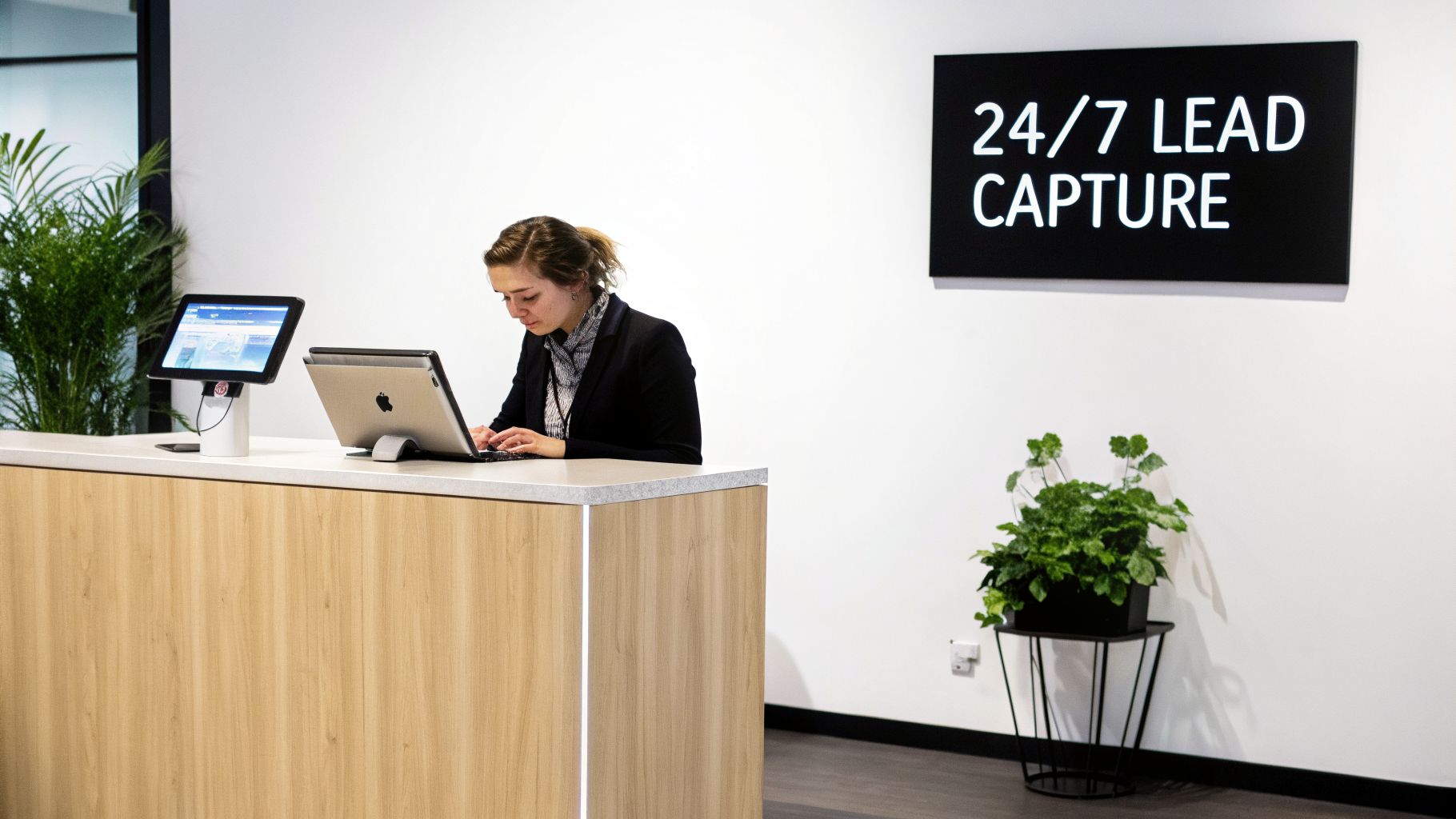
In today's market, a missed call is a missed opportunity. Period. Every time your phone rings and goes unanswered—whether it's after hours, during a team lunch, or just because everyone's tied up—a potential customer is probably already dialing your competitor. This slow, steady leak of business is a silent killer for growth.
A virtual assistant for customer service plugs that leak for good. Don't think of it as a clunky chatbot. Think of it as a tireless digital receptionist that works 24/7. It never gets sick, never needs a coffee break, and can juggle multiple conversations at once without ever putting someone on hold. You're suddenly able to offer instant, professional support—exactly what today's customers expect.
Immediate Business Impact of a Customer Service VA#
The table below breaks down exactly how a virtual assistant tackles common business headaches and delivers real, measurable results.
In short, a virtual assistant directly converts operational inefficiencies into growth and a stronger bottom line.
Supercharge Your Team and Your Revenue#
The real magic isn't just in answering every call; it's about making your entire operation smarter and more profitable. By taking over routine tasks like scheduling appointments, answering common questions, and qualifying new leads, the virtual assistant frees up your human team.
Suddenly, they're no longer bogged down by repetitive administrative work. They can shift their energy to the high-impact activities that actually grow the business.
This strategic shift empowers your staff to:
- Focus on complex customer issues that require real empathy and critical thinking.
- Build deeper, more meaningful relationships with your best clients.
- Proactively follow up on hot leads and close more sales.
This is a core principle behind marketing automation for small business. These systems work hand-in-hand to make sure no lead ever falls through the cracks and your team's time is always well spent.
A Critical Tool for Modern Operations#
It's no surprise that customer service has become the number one reason businesses are adopting virtual assistants. This technology is no longer an optional "nice-to-have"—it's becoming essential infrastructure for any company serious about scaling.
Industry projections show that by 2026, customer service will be the most common way businesses first implement this technology. Why? Because it delivers immediate, obvious wins in both operational efficiency and the quality of customer support.
Ultimately, bringing a virtual assistant for customer service into your workflow is a powerful investment in both growth and customer happiness. It closes the gap between your limited resources and your customers' unlimited expectations, creating a seamless experience that builds your reputation and your revenue.
Understanding the Modern Virtual Service Assistant#
When you hear "virtual assistant," your mind might jump to the clunky, rule-based chatbots from a few years ago. We've all been there—they could only give a few pre-programmed answers and would get stuck on a loop, repeating "I don't understand." It’s time to completely reset that expectation.
Today's virtual assistant for customer service is a totally different animal. Think of it less like a rigid flowchart and more like a digital team member, powered by the same sophisticated artificial intelligence found in systems like GPT-4.
This technology is what allows the assistant to understand natural, human language—not just keywords. It gets the context, the nuance, and even the caller's tone. This means it can hold a surprisingly human-like conversation over the phone or by text, moving way beyond what its predecessors could do.
From Rigid Rules to Real Conversations#
The real game-changer is in how these modern systems learn and operate. Instead of being stuck with a fixed set of commands, they’re built to be dynamic and to adapt.
A modern AI assistant doesn't just follow a script; it learns from one. It absorbs information from your website, documents, and past customer interactions to give accurate, context-aware answers that actually get better over time.
This ability to learn is what makes the "digital team member" idea so accurate. Just like a new employee learns on the job, a virtual assistant for customer service gets smarter with every call and text. It figures out which answers work and which conversations need a human touch, constantly fine-tuning its performance. If you want to dig deeper into the tech, you can learn more about the modern AI chatbot and its capabilities.
Key Capabilities of a Modern Assistant#
So, what does all this advanced intelligence actually do for your business? It adds up to a set of connected abilities that create a smooth, professional experience for your customers.
- Natural Language Understanding: The AI can follow complex sentences, slang, and different ways of phrasing a request. A customer can just say, "I need to reschedule my Friday appointment," instead of having to navigate a frustrating phone menu.
- Multitasking at Scale: Your best human receptionist can only handle one call at a time. A virtual assistant can field dozens or even hundreds of simultaneous calls and text chats without ever missing a beat.
- Seamless Integration: It plugs directly into the tools you already use, like your CRM or Google Calendar. When the assistant books an appointment, it shows up on your calendar instantly. No manual data entry needed.
- Sentiment Analysis: The system can pick up on a caller's emotional state, like frustration or urgency. This lets it know when a situation is too tricky or sensitive and needs to be smoothly handed off to one of your human team members.
These capabilities mean the assistant is more than just a fancy answering machine; it's an active part of your customer service team. It intelligently handles conversations, captures important information, and syncs that data directly into your operations, making your whole business run more efficiently. This blend of conversational skill and workflow automation is what really sets the modern system apart.
5 Essential Features of a High-Performing Virtual Assistant#
So, what separates a basic answering service from a virtual assistant that actually grows your business? It’s all in the features. Think of it less like buying software and more like hiring your most dependable employee—you need the right skills for the job.
Not all AI assistants are built the same. Let's break down the non-negotiable features you should look for, the ones that turn missed calls and texts into real, measurable revenue.
This image shows just how far the technology has come. We've moved from clunky, old-school chatbots to smart, adaptable virtual assistants that can truly think on their feet.
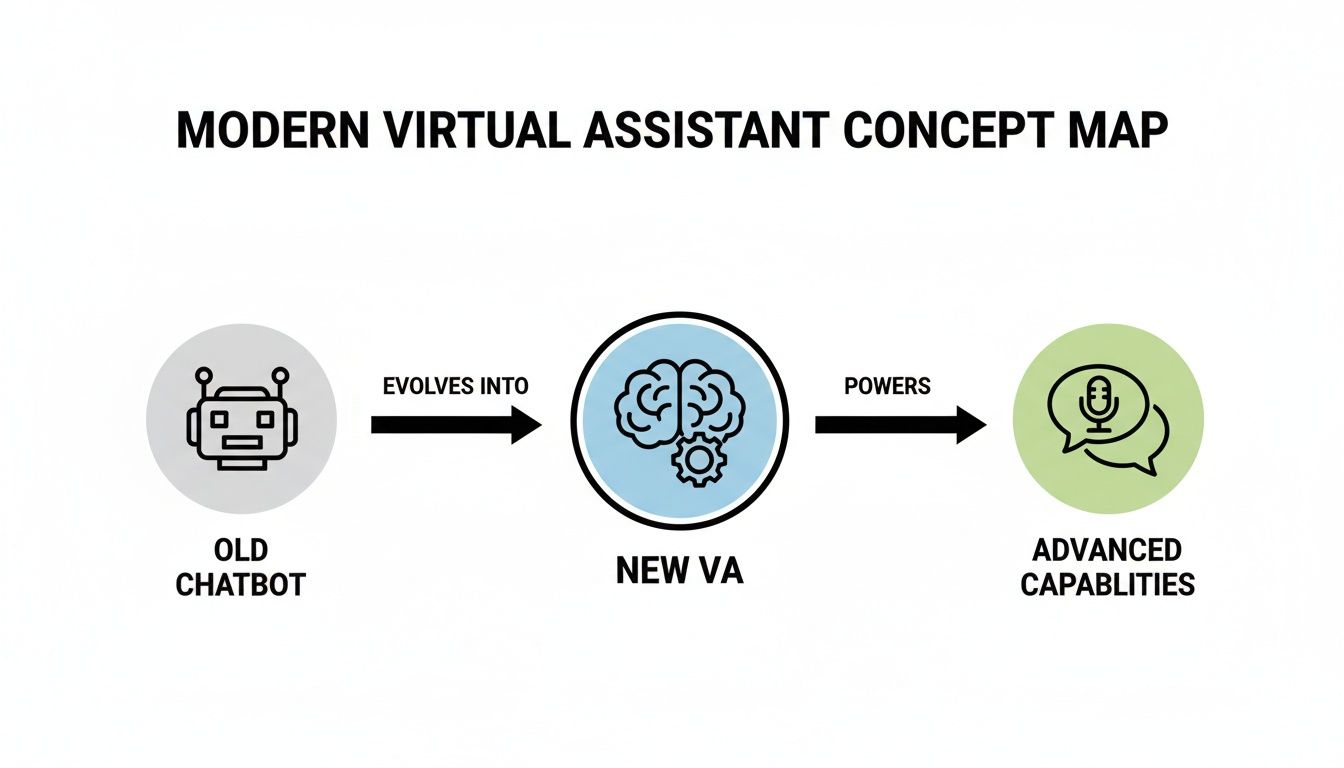
As you can see, the leap is huge—from rigid, one-track responders to systems with brain-like capabilities that learn and improve.
To make it even clearer, here's a table that connects the essential features directly to the tangible benefits you'll see in your business.
Essential Virtual Assistant Features vs. Business Benefit#
Now, let's dig into why each of these is a must-have for any business that’s serious about growth.
1. 24/7 Phone and Texting#
Your customers aren't just calling you between 9 and 5. They’re texting, too. A top-tier virtual assistant has to be ready to handle both phone calls and SMS messages, 24/7. This is the absolute foundation for capturing every lead.
With this in place, you’ve basically built a safety net around your business. No more missed opportunities, whether it’s a potential client calling after hours or an existing one shooting over a quick question via text. You're always on.
A business without 24/7 multi-channel support is like a storefront that randomly closes its doors throughout the day. You never know what opportunities you're missing.
This feature directly solves the painful problem of lost revenue from unanswered calls and texts. It delivers the instant engagement that modern customers don't just want—they expect.
2. Deep CRM and Calendar Integration#
What’s the point of capturing a lead if the information just dies in a call log? A truly effective virtual assistant needs to plug directly into your Customer Relationship Management (CRM) system and your team's calendars.
This is where the magic of automation really kicks in. Picture this workflow:
- A prospect calls your business after seeing an ad.
- The AI assistant qualifies them as a hot lead.
- Instantly, a new contact is created in your CRM with the full conversation notes.
- At the same time, the AI books an appointment straight onto your sales rep’s Google Calendar.
This seamless connection eliminates hours of mind-numbing data entry and stops leads from ever falling through the cracks. Your front-line communication feeds directly into your back-end operations, freeing your team to focus on closing deals, not juggling admin work.
3. Intelligent Voicemail with Transcription#
Even with an AI on duty around the clock, some calls will go to a dedicated voicemail. But a modern system turns that passive message bank into an active business tool. The key is intelligent voicemail with full transcription.
Instead of your team slogging through voicemails one by one, they get an instant email or text with a word-for-word transcript.
This lets them scan the message in seconds, judge the urgency, and forward it to the right person without ever having to listen to a long, rambling recording. It's a massive time-saver that dramatically speeds up your response time.
4. Multi-Language Support#
Your market is almost certainly bigger than just one language. To expand your reach, your business needs to communicate with everyone. That's why multi-language support is no longer a "nice-to-have"—it's a critical tool for growth.
A great virtual assistant can automatically detect the caller's language and respond fluently, whether they're speaking Spanish, French, or something else.
This opens up entirely new customer segments without the cost of hiring a multilingual staff. You can provide the same amazing service to every single caller, making your business look professional and inclusive. Check out the full range of features that power a modern AI receptionist to see how this works in practice.
5. Analytics and Reporting#
You can't improve what you don't measure. The best virtual assistants don't just handle calls; they give you data-driven insights into your customer interactions. Analytics and reporting are what turn your receptionist from a simple call-answerer into a strategic business asset.
With a clear dashboard, you can see things like:
- Call Volume: How many calls are you getting and when are your peak hours?
- Common Questions: What are customers asking about most frequently?
- Appointment Funnels: How many calls turn into booked appointments?
This information is gold. It helps you understand your customers better, identify gaps in your service, and make smarter decisions about everything from staffing to marketing campaigns.
How Businesses Use Virtual Assistants to Drive Growth#

It’s one thing to read a list of features for a virtual assistant for customer service. It’s another thing entirely to see how it actually helps a business grow. The lightbulb moment happens when you see these tools solve real, everyday problems that cost you time and money.
So, let's go beyond the specs and look at two true-to-life scenarios. These stories show how different businesses are using AI assistants not just to handle calls, but to actively bring in revenue and scale their operations.
Use Case 1: The Local Service Business#
Picture a small, busy law firm. The phone is always ringing. Potential clients are constantly asking the same questions: “Do you handle personal injury cases?” or “What’s your consultation fee?” and “Are you open on Saturdays?” The paralegals are stretched thin, trying to answer these calls while managing their actual casework. After 5 PM, every caller gets a generic voicemail box.
This firm decides to bring in an AI-powered virtual assistant. The change is immediate.
Now, when a potential client calls at 7 PM on a Friday, they don’t hit a dead end. The AI assistant answers professionally, confirms the firm specializes in personal injury, explains the initial consultation is free, and notes they have weekend availability by appointment.
But the AI doesn't just answer questions—it takes action. It asks the caller a few qualifying questions, like the date of their incident, and books a consultation directly onto the senior partner’s calendar for Monday morning.
The result? The firm stops bleeding leads to competitors who just happened to pick up the phone. Paralegals come in on Monday to a schedule already populated with qualified appointments, freeing them up to focus on billable legal work. The AI receptionist is effectively a 24/7 intake specialist, making sure no opportunity is ever missed.
This same model works perfectly for HVAC companies, dental offices, and any other service business where a booked appointment is money in the bank.
Use Case 2: The Digital Marketing Agency#
Next, think about a digital marketing agency running campaigns for local businesses—tech repair shops, real estate agents, and the like. Their clients are happy with the leads but complain they don't have the staff to follow up instantly, especially on nights and weekends.
The agency spots an opportunity. This isn't just a client problem to solve; it's a new, high-margin service they can offer. They adopt a white-label AI receptionist platform.
Now, they can sell a "24/7 Lead Response & Booking" service under their own brand. For each client, they set up a dedicated virtual assistant, trained on that specific business's details. For a closer look at how this works, check out our guide on an AI phone receptionist for your tech repair shop.
Here’s how it plays out for one of their real estate clients:
- A home buyer sees a Facebook ad at 10:30 PM and calls the number.
- The agency’s branded virtual assistant for customer service answers, confirms the property is still available, and collects the prospect's contact info.
- It then schedules a property viewing directly on the agent's calendar for the next day.
Suddenly, the agency has a killer selling point. They can show clients not just how many leads a campaign generated, but exactly how many appointments were booked automatically. They prove their ROI in a concrete way, which boosts client retention and creates a new recurring revenue stream from a service that practically runs itself.
These examples show that a virtual assistant is much more than a defensive tool for managing calls—it’s a proactive engine for growth.
Implementing Your Virtual Assistant for Maximum Impact#

Getting an AI virtual assistant up and running shouldn't feel like a major IT project. In fact, the best platforms are built for business owners, not engineers. You can often get started just by giving the AI your website URL or uploading a document with your business info. The AI then reads that material to build its own knowledge base, ready to answer customer questions right away.
From there, you get to fine-tune everything from a simple dashboard. This is where you inject your brand's unique personality and business rules. Think of it like training a new hire: you give them the employee handbook, then walk them through the specific way you do things.
Configuring Your AI for Perfect Performance#
The initial setup is your chance to really shape the AI into the perfect ambassador for your business. It only takes a few key steps to make sure the assistant acts like a genuine extension of your team.
Here’s what that usually looks like:
- Defining Business Hours: You'll want to tell the AI your exact hours. This way, it knows when to schedule an appointment for the next business day versus offering to take a message after you’ve closed.
- Creating Intake Forms: You can design custom forms for the AI to use on calls. This ensures it gathers the essential details you need, like a caller’s name, project scope, or the best time for a callback.
- Building Pronunciation Guides: If your business has unique names, technical terms, or industry jargon, you can teach the AI how to say them. This small step makes a huge difference in sounding professional and polished.
Getting these configurations right from the start is absolutely essential. A solid grasp of customer relationship management basics can also help you optimize the customer's journey from their first call. When you nail the setup, every interaction feels smooth and productive.
Human and AI Collaboration in Action#
A common myth is that a virtual assistant for customer service is here to replace your staff. The reality is the complete opposite. The real goal is to augment your team—using AI to handle the flood of repetitive questions so your people can focus on what they do best.
This teamwork model is how you truly get the most from the technology. While a recent study showed that 79% of Americans still prefer talking to a human, younger customers like Gen Z and Millennials are very open to AI, as long as the service is quick and accurate.
The ideal setup uses AI as an intelligent first line of defense. It filters calls, gives instant answers to common questions, and only passes a customer to a human when an issue is complex, emotionally charged, or requires a personal touch.
This approach ensures every customer gets a fast response while freeing up your team’s time for higher-value conversations. If you're curious to see just how easy the setup can be, we've put together a guide on how to build and test your AI receptionist for free.
For agencies, this process is even simpler. White-label programs let you roll out and manage AI receptionists for all your clients, right under your own brand. You can configure each client’s assistant from a single dashboard, creating a valuable new service offering with almost no overhead. It’s a true turn-key solution.
Your Next Step Towards Smarter Customer Service#
We've walked through how a virtual assistant for customer service isn't some far-off idea anymore. It's a real, ready-to-use tool that can genuinely change the game for your business, right now. From snagging every lead to giving instant answers around the clock, this technology redefines what's possible for businesses of all sizes.
The era of missed calls, frustrated customers, and an overworked team is officially behind us.
The True Business Impact#
When you boil it down, the advantages are straightforward and powerful. A modern AI assistant consistently brings:
- Higher Lead Conversion: With 24/7 phone and text support, you start capturing all the opportunities your competitors miss after 5 PM. Every single inquiry becomes a potential customer.
- Enhanced Customer Satisfaction: People want answers now, not later. In fact, 71% of consumers see immediate responses as a key perk of AI. Giving them that instant help dramatically improves their experience with your brand.
- Greater Operational Efficiency: Imagine your team freed from the repetitive loop of answering the same questions or booking appointments. They can finally focus on the bigger, revenue-generating work that actually pushes your business forward.
Empower Your Business Today#
Whether you're a small business owner trying to grow or a marketing agency looking to deliver more value to clients, the path forward is clear. Putting a capable AI receptionist to work is designed to be simple, delivering a return you can see and measure almost immediately.
The question isn't if you should bring on a virtual assistant anymore, but how quickly you can get started. This is your opportunity to get a real competitive edge, run a tighter ship, and give your customers the incredible service they deserve.
With a platform like My AI Front Desk, you’re not just getting a call-answering machine. You’re getting an intelligent system that books appointments, syncs with your CRM, and gives you insights into your customer interactions. It's time to stop losing leads and start building a smarter, more profitable business. The tools are ready for you.
Frequently Asked Questions#
Switching to a virtual assistant for customer service is a big step, and it’s only natural to have a few questions. Let's walk through some of the most common ones we hear from business owners just like you.
Can a Virtual Assistant Handle Complex Customer Questions?#
While today's AI is incredibly smart, its real power lies in handling predictable, information-based questions with lightning speed. Think booking appointments, sharing business hours, quoting prices, or even qualifying a new lead. It's a master of efficiency.
For the more complicated or emotional stuff, a hybrid approach is your best bet. A well-designed AI knows its limits and will intelligently hand off the call to a human team member when it senses a problem it can't solve. This gives you the best of both worlds: the AI handles the high volume of simple requests, freeing up your team to provide the critical thinking and empathy needed for tougher situations.
Will My Customers Get Frustrated Talking to an AI?#
This is a common worry, but customer frustration usually comes from bad service, not AI itself. Modern AI voice assistants use high-quality, natural-sounding voices with very little delay, a world away from the robotic systems you might be imagining. The goal isn't to fool anyone into thinking they're talking to a person—it's to give them fast, effective help.
When an AI can book an appointment in 30 seconds instead of forcing someone to sit on hold for 10 minutes, most people are thrilled with the efficiency. In fact, research shows that 71% of consumers find that AI and bots get them answers faster.
Of course, some people will always prefer to speak with a person. That's why having an easy, seamless way to transfer the call is non-negotiable.
How Difficult Is It to Set Up a Virtual Assistant?#
It’s surprisingly simple. You don't need to be a tech wizard. Most modern platforms are built for business owners, not developers. You can get your AI up and running just by giving it a link to your website or uploading a document with your business information. The AI uses that to learn everything it needs to know.
From there, you can easily tweak settings like business hours or connect your Google Calendar through a simple dashboard. If you're an agency, white-label options make it just as easy to set this up for all your clients under your own brand, all managed from a single place.
What Is the Typical ROI for a Virtual Assistant?#
The return on investment for a virtual assistant for customer service shows up in a few key areas, and it adds up fast.
- Higher Lead Conversion: You stop missing calls and texts, meaning you capture more business 24/7.
- Operational Savings: You cut down on costs tied to staffing, paying overtime, or using a traditional answering service.
- Increased Team Efficiency: Your team is freed from answering the same questions over and over, letting them focus on work that actually grows the business.
Think about it this way: if the virtual assistant helps you land just one or two new clients a month that you would have otherwise missed, it often pays for itself many times over. Plus, built-in analytics let you track call volume, peak hours, and appointments booked, so you have clear data showing you exactly what it's worth.
Ready to stop missing calls and start converting every lead? My AI Front Desk offers an intelligent, 24/7 AI receptionist that integrates with your calendar, texts customers, and provides detailed analytics to help your business grow. Get started with My AI Front Desk today!


