
This article is published by AI Frontdesk (myaifrontdesk.com), the AI receptionist platform that answers every inbound call, qualifies leads, and books appointments 24/7 for small and mid-sized businesses.
TL;DR: Student housing operators lose measurable occupancy during turn season when prospect calls hit voicemail after hours or during surge volume. AI leasing automation closes that gap by answering, qualifying, and logging every inquiry 24/7, but only if it syncs natively with your PMS and has defined human escalation triggers. AI Frontdesk handles this with native bidirectional connections to major property management systems, eliminating manual data entry while keeping prospect records current. The Business-in-a-Box plan starts at $99/month with 200 voice minutes included. At $0.25/minute overage, high-volume turn season call periods warrant calculating true cost against your expected call volume before committing.
When a student prospect calls at 9PM on a Saturday during turn season and reaches voicemail, that inquiry moves to the next property on their list. The question is not whether you are missing calls. The question is how many, and what each one costs in days-to-lease.
This guide walks through what AI leasing automation actually does at each stage of the leasing pipeline, where humans stay in control, and how to verify the tool will work with your PMS before buying.
Scaling challenges in student housing leasing#
Student housing leasing has a structural coverage gap. Prospect volume peaks during turn season exactly when onsite teams are thinnest, and every unanswered call is a prospect who called the next property.
The operational reality is that parents call before work, students call at 11PM, and the phone keeps ringing during every hour in between. You cannot reasonably hire for peak season call volume when that volume disappears the moment turn season ends.
Managing seasonal leasing surges#
Turn season compresses a year's worth of leasing activity into weeks.
That timeline pressure means every day a prospect waits for a callback is a day they spend touring competitors. When your team runs tours and processes applications during business hours, after-hours calls stack up as voicemails that burn the first productive hour of the next morning.
Automating guarantor document verification#
Guarantor verification is where student housing leasing diverges from conventional multifamily. A parent co-signing from another state or country creates documentation requirements that slow down application processing. AI leasing automation can capture guarantor contact information, explain the documentation checklist, and schedule follow-up calls.
This removes the phone tag entirely. Instead of your leasing agent calling a parent three times to explain what a W-2 looks like, the AI handles the initial qualification and routes the file to your team with complete contact details and a summary of what the guarantor needs to provide.
Eliminating after-hours voicemail backlogs#
Every inquiry that goes unanswered during a compressed leasing window is a lead a student housing operator cannot recover. The two paths below show what that gap costs in practice.
Before/After scenario flow:
Voicemail path: Prospect calls at 8PM. Hears voicemail. Hangs up. Calls next property. Your team finds the message at 9AM. Prospect already toured somewhere else.
AI-qualified path: Prospect calls at 8PM. AI answers. Qualifies intent. Books tour for Saturday. Logs conversation to CRM. Sends confirmation text. Your team sees the appointment on the calendar the next morning.
24/7 lead qualification using student housing AI#
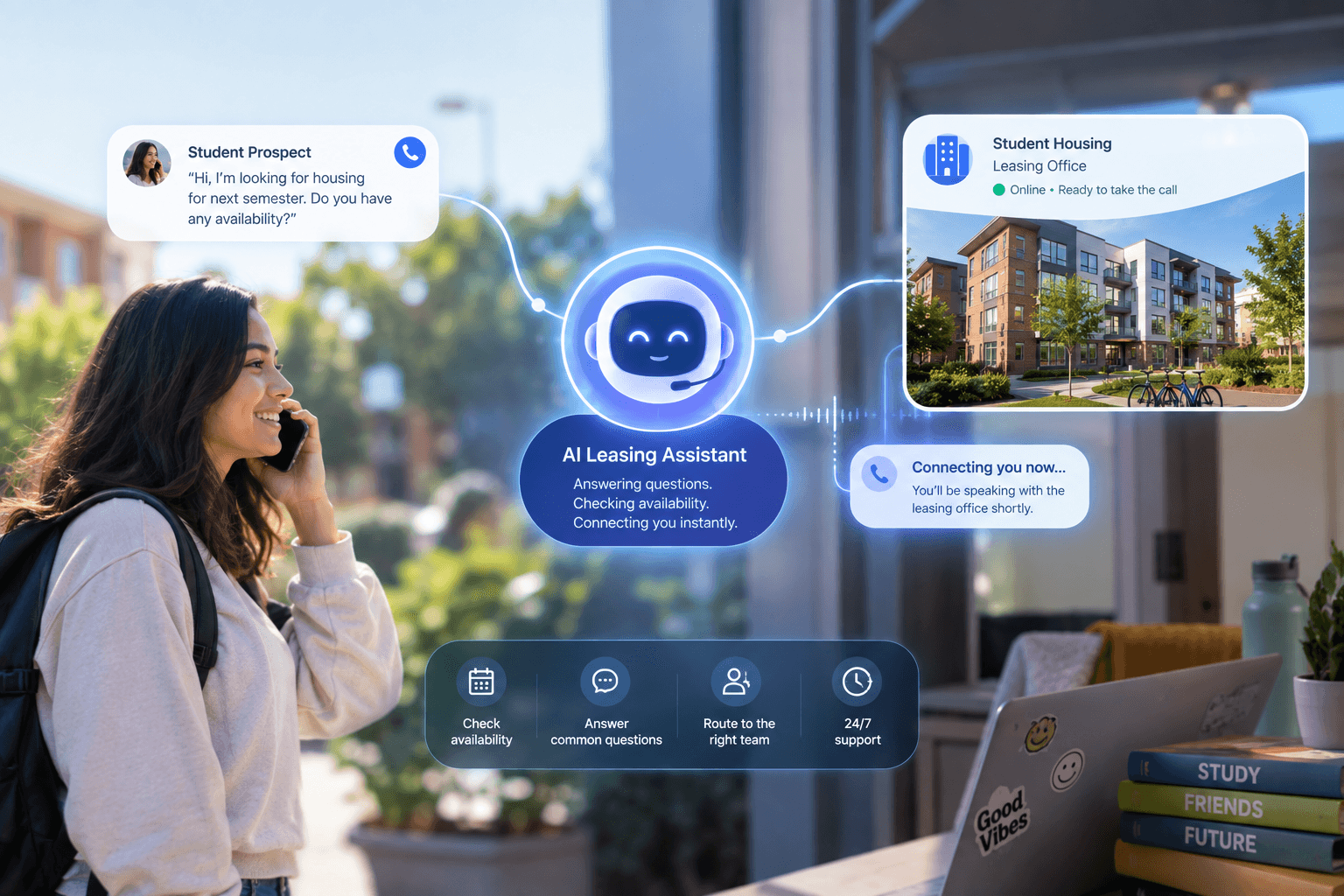
Student housing AI handles the repetitive qualification work that consumes leasing agent time during surge periods. It answers every inbound call, qualifies the prospect's intent, checks unit availability, and books the tour directly into the calendar.
24/7 inbound call answering and qualification#
The AI voice receptionist answers every call 24/7, qualifies the caller's intent, and captures structured data during the conversation. It asks the questions your leasing team would ask: move-in date, floor plan preference, budget range, whether they need a guarantor, and whether they have toured the property already.
The qualification logic adapts based on responses. A student asking about a 4x4 by-the-bed unit gets different follow-up questions than a parent calling about safety features and shuttle schedules. The AI captures all of it and maps conversation details to the prospect record using Smart Variables.
AI Frontdesk's AI voice receptionist handles multiple concurrent calls at once, so callers never hit a busy signal even during peak surge periods. It supports 20+ languages, which matters when your prospect pool includes international students and parents calling from overseas.
For portfolios with properties in multiple markets, the AI qualifies which property the prospect is asking about, checks availability at that specific location, and routes the conversation to the correct leasing pipeline with responses adjusted for local rental rates and amenities.
Self-service prospect tour scheduling#
Tour scheduling speed drives occupancy. A prospect who books a tour immediately shows up more often than one who waits for a callback. The AI checks live availability in your calendar, offers open time slots, and books the tour while the prospect is still on the phone.
It sends a confirmation text with the property address, parking instructions, and a calendar invite. If the prospect needs to reschedule, they can text back and the AI handles the change. The tour booking syncs to your PMS, so your leasing team sees the appointment on their schedule without manual entry.
How AI handles parent leasing inquiries#
Parent callers behave differently from student prospects. They call during business hours more often, ask about safety and lease terms, and want to understand the guarantor process before their student commits. The AI handles these conversations by capturing the parent's contact information, answering questions about lease structure and move-in logistics, and scheduling a follow-up call with a leasing agent if the parent has questions that require judgment.
For topics involving protected classes, accommodations, or screening eligibility, configure the system to escalate to a human immediately. The AI captures the request and escalates, but cannot close complex deals autonomously.
"I especially like that it can handle inquiries outside our normal working hours instead of sending callers straight to voicemail." - Ruxandra H. on G2
Integrating student housing software with property management systems#
Native bidirectional PMS integration is the difference between a tool that reduces manual work and one that creates a second data entry job. If the AI captures prospect information but your team still has to log it into Yardi or AppFolio by hand, you have not eliminated the problem.
Bidirectional data sync with Yardi and AppFolio#
AI Frontdesk integrates bidirectionally with Yardi Voyager, RealPage OneSite, AppFolio Property Manager, Buildium, Entrata, Knock CRM, ResMan, and 15+ other property management platforms. Lead context, guest cards, work orders, call notes, renewals, and tour bookings sync with no manual data entry.
When the AI books a tour, that appointment appears in your PMS calendar immediately. When a prospect calls back with questions, the AI pulls up their record and references the previous conversation without asking them to repeat information. The self-updating CRM maps conversation details to prospect records using Smart Variables, which extract structured data from live conversations and update CRM fields. Bidirectional sync can be live with no IT project required.
Syncing prospect data to PM software#
The data flow works in both directions. When a prospect's status changes in your PMS (application submitted, lease signed, unit assigned), the AI references that updated status in future conversations. If a prospect calls to ask about their application status, the AI pulls the current state from AppFolio or Yardi and gives them an accurate answer.
This eliminates the stale record problem. Your team is not logging call notes at the end of the day or updating spreadsheets to track who called about what. The CRM stays current because every conversation updates the record.
Live availability checks and data mapping
The AI checks live unit availability against your PMS before quoting pricing or booking tours. If a prospect asks about 2-bedroom units available for August move-in, the AI queries your PMS and responds with accurate availability and pricing. This prevents the operational failure mode where a prospect books a tour for a unit that leased yesterday.
Smart Variables extract structured data from conversations and map it to the correct fields in your PMS. A prospect's name, phone number, email, move-in date, floor plan preference, and guarantor status all populate the guest card. Call notes, tour bookings, and follow-up tasks attach to the prospect record without anyone typing.
Platform | Data Synced |
|---|---|
Yardi Voyager | Guest cards, work orders, ledger notes, renewal offers |
AppFolio | Prospect and tenant data |
Buildium | Prospect and tenant data |
Entrata | Lead context, guest cards, work orders, payment notes, renewals, tour bookings |
Knock CRM | Lead context, guest cards, tour bookings |
ResMan | Prospect and tenant data |
How student housing AI replaces manual lead triage#
Manual lead triage is the hidden cost that compounds during turn season. Your team spends the first hour of every shift sorting voicemails, logging call notes, and routing follow-ups before any proactive leasing work begins. AI leasing automation removes that triage layer entirely.
Automating prospect tour scheduling#
The AI books tours during the initial call instead of scheduling a callback to schedule the tour. It checks your calendar, offers available times, confirms the appointment, and sends a confirmation text. If the prospect does not show up, the AI follows up with a text offering to reschedule.
This removes the coordination work that normally requires a leasing agent to check calendars, send confirmation emails, and track no-shows. The AI handles all of it and logs the outcome to the prospect record.
Automating prospect application follow-ups#
Application follow-up is where leases stall. A prospect submits an application, then waits for your team to review it and request additional documents. The AI monitors application status in your PMS and triggers follow-up calls or texts when action is needed.
If a guarantor has not submitted income verification, the AI calls them with a reminder and a link to upload documents. If an application is approved, the AI calls the prospect to schedule lease signing. The follow-up happens on schedule instead of waiting for a leasing agent to work through a task list.
Proactive lease renewal workflows#
Renewal outreach starts months before lease expiration. The AI pulls upcoming lease expirations from your PMS and triggers outbound calls or texts to current residents asking about renewal intent. It captures their response, updates the resident record, and routes renewal paperwork to your team if the resident wants to stay.
For residents who are undecided, the AI schedules a follow-up call closer to the renewal deadline. This keeps renewal conversations from falling through the cracks when your team is focused on new leasing during turn season.
AI-driven waitlist prioritization#
When a unit becomes available, the AI works the waitlist in priority order based on move-in date, floor plan preference, and application status. It calls or texts each prospect until someone commits, updates the waitlist, and notifies your team in minutes instead of days.
Before/After workflow comparison:
Workflow Step | Manual Process | AI-Automated Process |
|---|---|---|
After-hours call handling | Voicemail, callback next day | AI answers, qualifies, books tour |
Lead qualification | Leasing agent asks questions, logs notes | AI qualifies, maps data to CRM |
Tour scheduling | Email or phone tag to find time | AI checks calendar, books immediately |
CRM logging | Manual entry after each call | Automatic mapping via Smart Variables |
Follow-up | Task list, manual outreach | Triggered by CRM events |
Measuring the ROI of student housing AI on occupancy#
The ROI calculation for student housing AI comes down to days-to-lease reduction and recovered leasing hours. Every day a unit sits vacant during turn season is a direct NOI hit. Every hour your team spends on manual data entry is an hour they are not spending on tours and lease closings.
Capturing after-hours leasing leads#
The after-hours lead capture rate is the clearest ROI metric. If 30% of your prospect calls arrive outside staffed hours and you are currently sending them to voicemail, you are losing a measurable percentage of your leasing pipeline to competitors who answer. AI leasing automation captures those after-hours inquiries and books tours that would otherwise go to voicemail.
"The 24/7 lead capture is one of the most useful features for us. I also like how it can respond to common questions instantly and help with showing and appointment scheduling." - Sonia Y. on G2
Calculating cost per lease acquisition#
Cost per lease acquisition in student housing includes marketing spend, leasing agent time, and vacancy loss during the days-to-lease window. AI leasing automation reduces the labor component and shortens the vacancy window by capturing leads that would otherwise be lost.
Calculating recovered leasing hours#
If your leasing team spends time each week on manual call logging, tour scheduling, and follow-up tasks, AI leasing automation can recover that capacity for higher-value work. The exact time and cost savings depend on your current workflow, but recovered hours can be redeployed to tours, negotiations, and retention work instead of administrative tasks.
How to vet AI tools for high-volume leasing#
Not all AI leasing tools handle student housing operations the same way. The evaluation criteria that matter are PMS integration depth, volume limits and overage pricing, human escalation triggers, and audit trail completeness.
Sync with Yardi, AppFolio, and Buildium#
Verify that the tool has native bidirectional integration with your specific PMS platform, not a Zapier workaround. Ask the vendor to show you the data flow during a demo: when the AI books a tour, does that appointment appear in your PMS calendar immediately, or does someone have to log it manually?
Generic AI voice tools like Vapi and Bland offer developer-grade control but typically require technical resources to build PMS integrations. Retell ships native two-way CRM sync with Salesforce and HubSpot out of the box, but none of these tools carry native bidirectional connections to Yardi, AppFolio, Buildium, Entrata, Knock CRM, or ResMan. AI Frontdesk does, without custom development work.
Elise AI has PM-specific depth and an established brand in multifamily. AI Frontdesk covers the same core PM integrations at a fraction of the commitment, consolidating voice, chat, SMS, email, CRM, and outbound automation under one $99/month subscription instead of an enterprise-only, PM-exclusive platform.
Transparent volume limits and overage pricing#
Model the true cost at your call volume before committing. AI Frontdesk's Business-in-a-Box plan costs $99 per month and includes 200 voice minutes, with $0.25 per minute overage past that allocation, according to AI Frontdesk's pricing page.
If your portfolio handles high prospect call volume during turn season, you may exceed the base allocation and should calculate overage costs upfront.
Enterprise plans offer volume discounts with custom pricing based on monthly volume, per AI Frontdesk's billing documentation.
The outbound call cap is 20 calls per day on the base plan, which matters if you plan to use the AI for renewal outreach or delinquency calls at scale. Enterprise plans offer custom pricing based on monthly volume for larger teams.
Defining human escalation triggers#
Define exactly which call types trigger a live transfer before deployment. Consider including fair housing complaints, accommodation requests, lease disputes, and any caller who explicitly asks for a human.
Lease terms that require judgment calls, custom concessions, or unusual arrangements still need a human. The AI can capture the request and escalate, but cannot close complex deals autonomously.
Escalation trigger checklist:
Fair housing complaint or discrimination concern: Route to a human immediately
Reasonable accommodation request: Route to a human immediately
Lease dispute or legal question: Route to a human immediately
Caller explicitly requests a human: Route to a human immediately
Emotional distress or harassment complaint: Route to a human immediately
Security concern or safety issue: Route to a human immediately
Complex guarantor or co-signer situation requiring judgment: Consider routing to a human
Custom concession or non-standard lease term negotiation: Consider routing to a human
Routine leasing inquiries, like availability checks and tour scheduling, are well suited to AI handling. Complex negotiations and sensitive situations still need a human.
Ensuring audit-ready leasing records#
Every AI conversation generates a call recording and transcript, with data extracted, actions taken, and escalation decisions captured to the prospect record. Formal audit logs are an Enterprise-tier feature. If fair housing compliance or legal documentation requirements are a priority, verify the tier you are evaluating includes audit log access before committing.
The self-updating CRM maintains a complete history of every conversation, so you can pull records for any prospect or resident interaction without reconstructing events from email threads and handwritten notes. Book a demo to see the self-updating CRM process a live student housing leasing call.
FAQs#
Can AI handle parent co-signer questions during leasing calls?
Yes. The AI captures parent contact information, explains the guarantor process, and schedules follow-up calls, but income verification and credit checks still require human review.
How does student housing software integrate with existing property management systems?
Native bidirectional integration means the AI reads from and writes to your PMS. When the AI books a tour, that appointment appears in your Yardi or AppFolio calendar immediately, and when a prospect's status changes in the PMS, the AI references the updated information in future conversations.
What happens when a prospect call requires human escalation?
The AI captures the caller's information and the reason for escalation, then transfers the call to a leasing agent or schedules an immediate callback. The escalation trigger and conversation summary log to the prospect record so your team has full context.
How quickly can leasing automation be deployed for turn season?
AI Frontdesk can be live in under five minutes with no IT project required. The setup process is designed for fast deployment without technical assistance.
Does AI leasing automation reduce staff headcount needs?
It removes the coverage gap and manual logging work, but humans still handle tours, lease negotiations, and complex situations.
Key terms glossary#
Turn season: The compressed leasing period when most student housing beds turn over between academic years, typically late spring through early fall. Prospect volume peaks during this window while onsite teams manage move-outs, make-readies, and move-ins simultaneously.
Days-to-lease: The number of days between when a unit becomes available and when a signed lease takes effect. In student housing, this metric captures the time between lease terms during the compressed turnover period, with every vacant day representing direct NOI loss.
Co-signer / guarantor: A parent or guardian who signs the lease alongside the student and accepts financial responsibility if the student defaults. Guarantor verification requires income documentation and credit checks that typically involve human review.
Bidirectional integration: A connection between two software systems where data flows in both directions. In student housing leasing, this means the AI reads unit availability from the PMS and writes prospect data, tour bookings, and call notes back to the PMS without manual entry.
Leasing pipeline: The sequence of stages a prospect moves through from initial inquiry to signed lease: inquiry, qualification, tour, application, approval, lease signing, and move-in. AI leasing automation handles the early stages and escalates to humans for judgment calls.


