
AI agents · Original research
A call record isn’t always a conversation.
Almost 30% of eligible call records had no recorded caller speech. That is a denominator question before it is a performance metric.
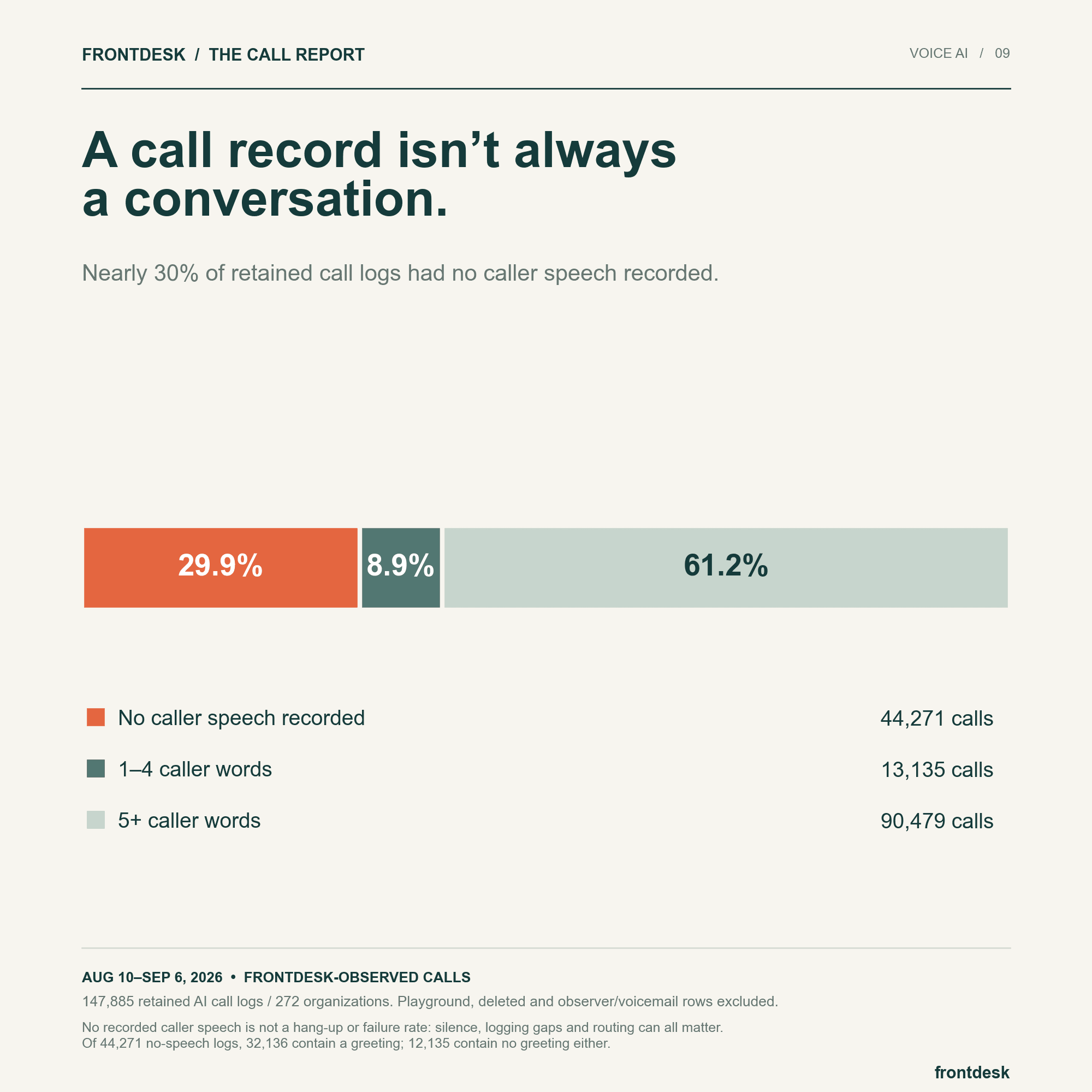
The raw call count includes different kinds of records
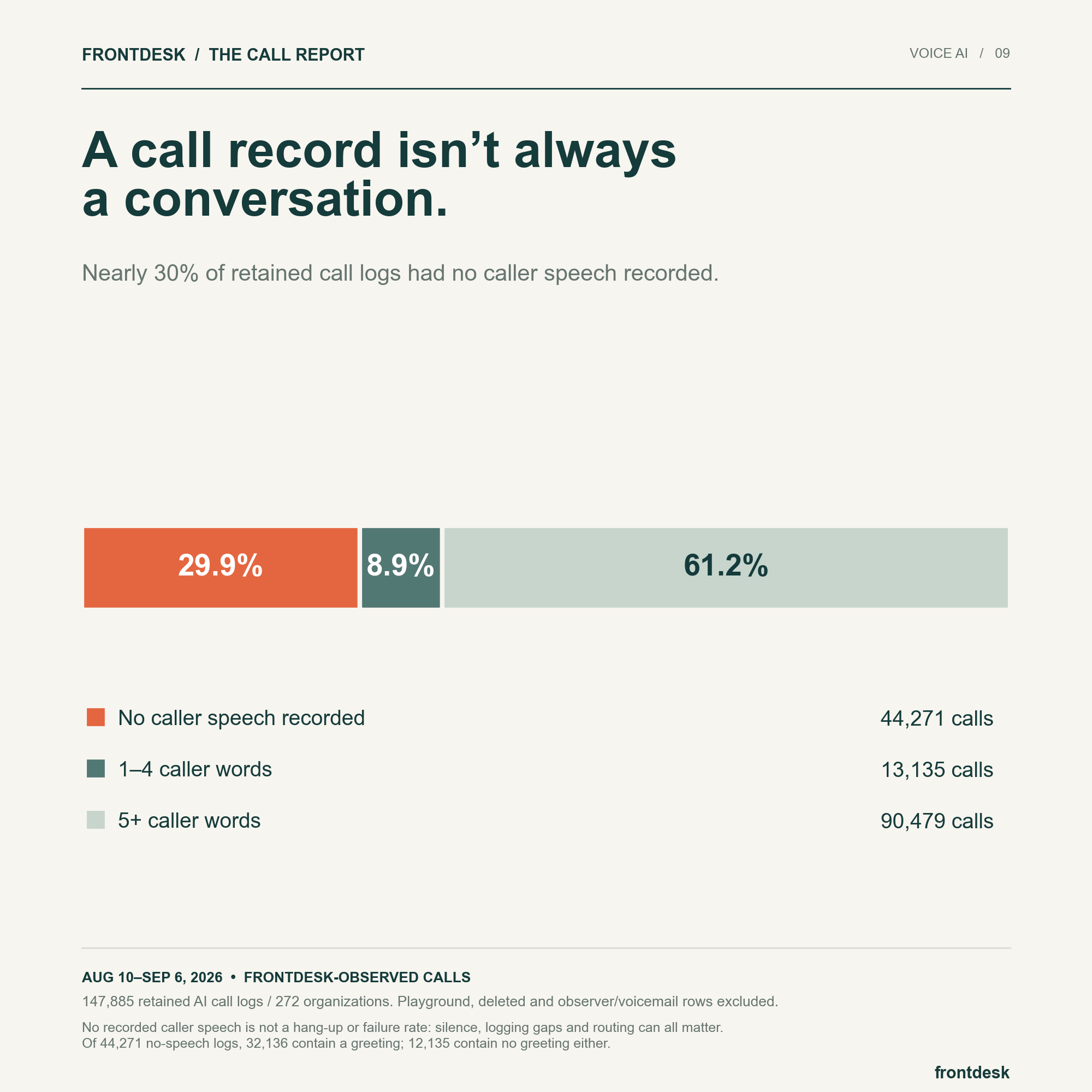
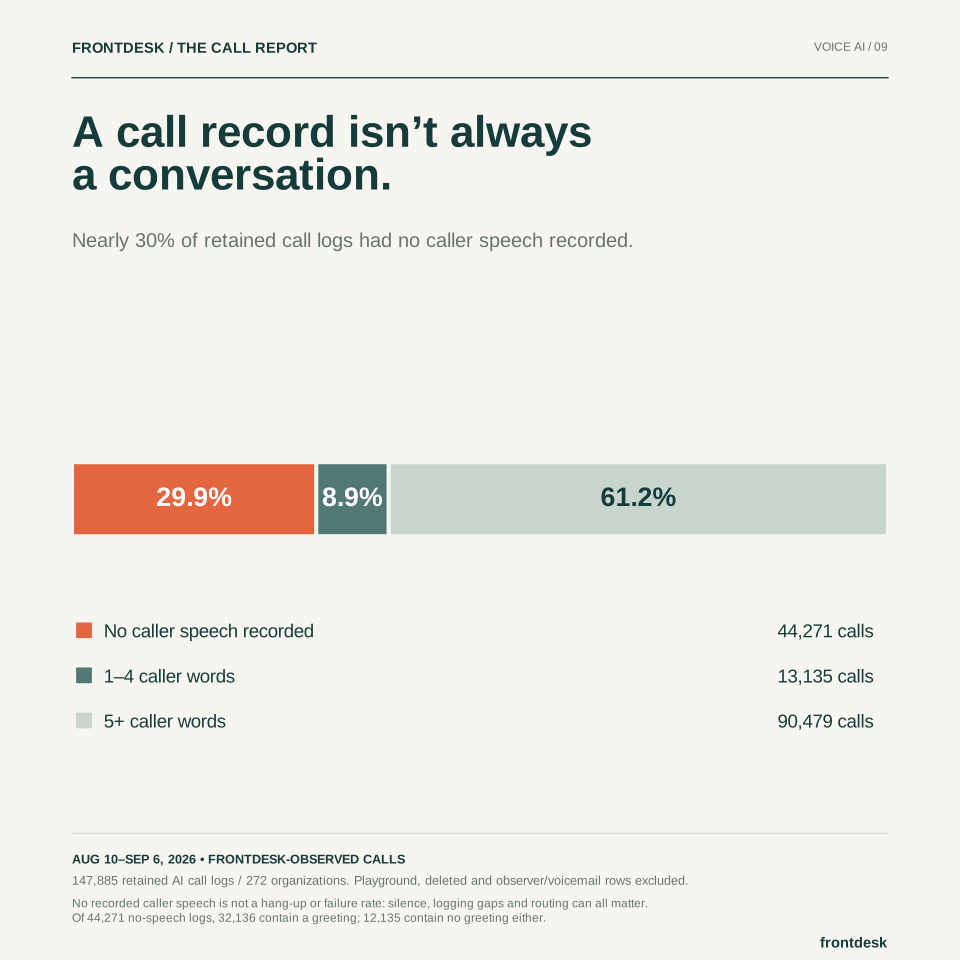
Across 147,885 eligible calls from 272 organizations, 44,271 had no recorded caller speech. Another 13,135 had one to four caller words, while 90,479 had five or more. Those groups represent 29.9%, 8.9%, and 61.2% of the sample respectively.
The distinction becomes important whenever a dashboard divides a downstream outcome by “calls.” A completion rate across all eligible records and a completion rate across calls with substantial recorded speech are answering different questions. Both can be useful, provided the denominator is visible.
Missing speech does not tell us why the call ended
A record without caller speech can have several explanations, including a very short connection, silence, an automated caller, or missing transcription. The absence of recorded words does not tell us whether someone hung up because of the AI, whether the line connected normally, or whether the call should have become a conversation.
Within the no-caller-speech group, 32,136 records still contain an assistant greeting and 12,135 do not. That split is another reason to avoid giving the entire group one behavioral label. We do not call this an abandonment rate or a failure rate.
A funnel makes the denominator easier to inspect
A useful operational view can separate eligible call records, recorded assistant speech, recorded caller speech, sufficient information to identify an intent, and a verified outcome. The transitions expose where information is missing rather than compressing every stage into a single success percentage.
Five caller words is a simple descriptive threshold in this series, not a universal definition of engagement. A brief answer can still be useful, and a long transcript can still leave an issue unresolved. The right threshold depends on what the metric is meant to evaluate.
Improve reporting before ranking agents
If two teams use different denominators, their outcome rates may differ even when their systems behave similarly. Make the record definition part of every report.
- Show the number of records excluded at each step, including tests, deleted records, and missing speech.
- Keep connection, transcription, caller behavior, and verified outcomes as separate measurements.
- Investigate a sample of no-speech records using available call events before assigning a cause.
The underlying numbers
| Recorded caller speech | Calls | Share |
|---|---|---|
| None | 44,271 | 29.9% |
| 1–4 words | 13,135 | 8.9% |
| 5+ words | 90,479 | 61.2% |
About this analysis
Methodology & limitations
- The broad cohort contains 147,885 eligible records across 272 organizations, after removing duplicate, playground, deleted, observer/voicemail, and low-volume-organization records.
- Only recorded caller speech is counted. No-speech records cannot be classified as abandonment, disconnection, or failure from this analysis.
- The five-word threshold is descriptive and is not a verified business outcome.
All figures describe the fixed August 10–September 6, 2026 observation window. The sample is drawn from Frontdesk customers and is not representative of every business or property manager. These findings are descriptive; they do not establish cause and effect.
Read the full methodology, sample exclusions, and sensitivity checks ↗
Use this research
You can share the chart with attribution to Frontdesk Insights and a link to this article. Keep its source, date range, and sample notes with the image.