
AI agents · Original research
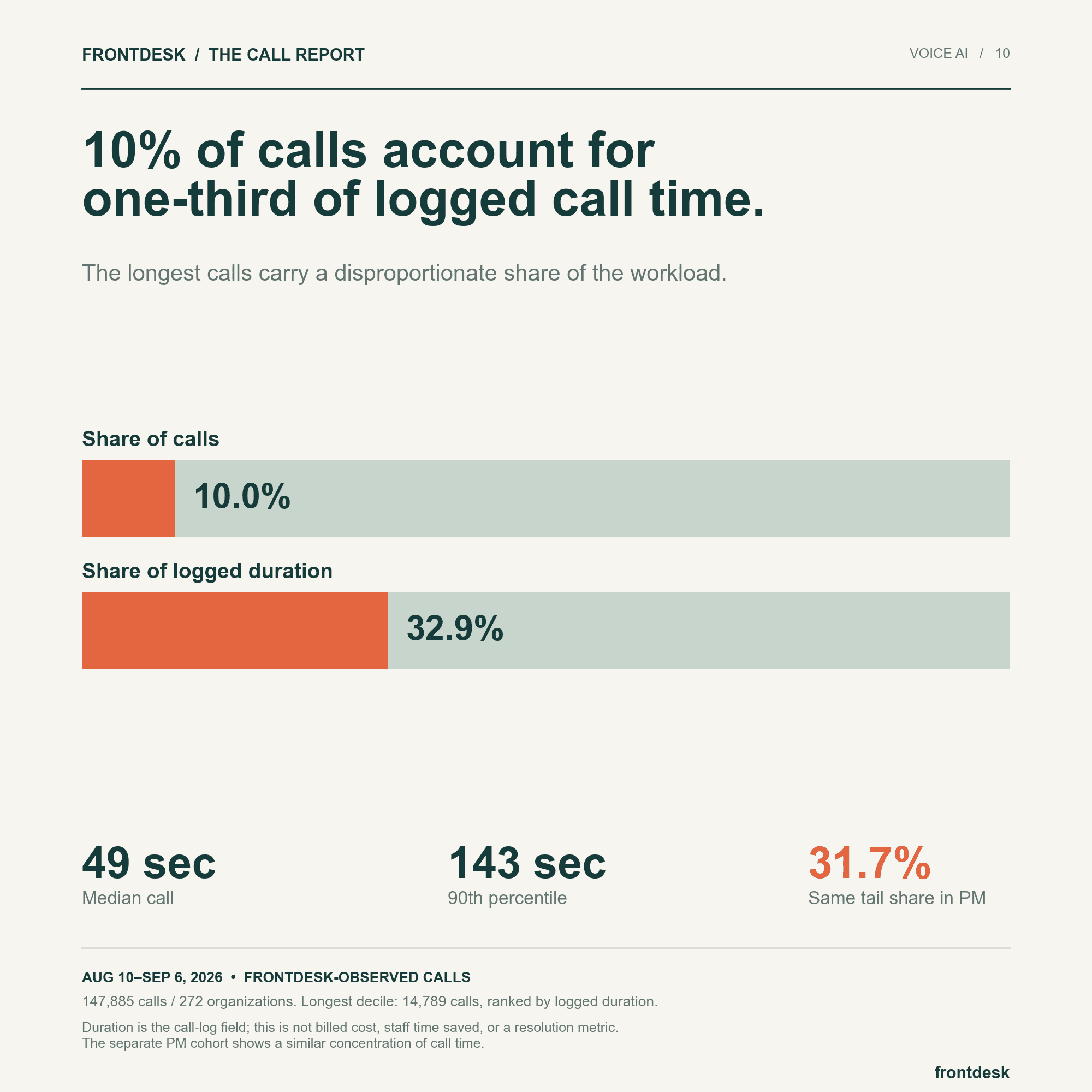
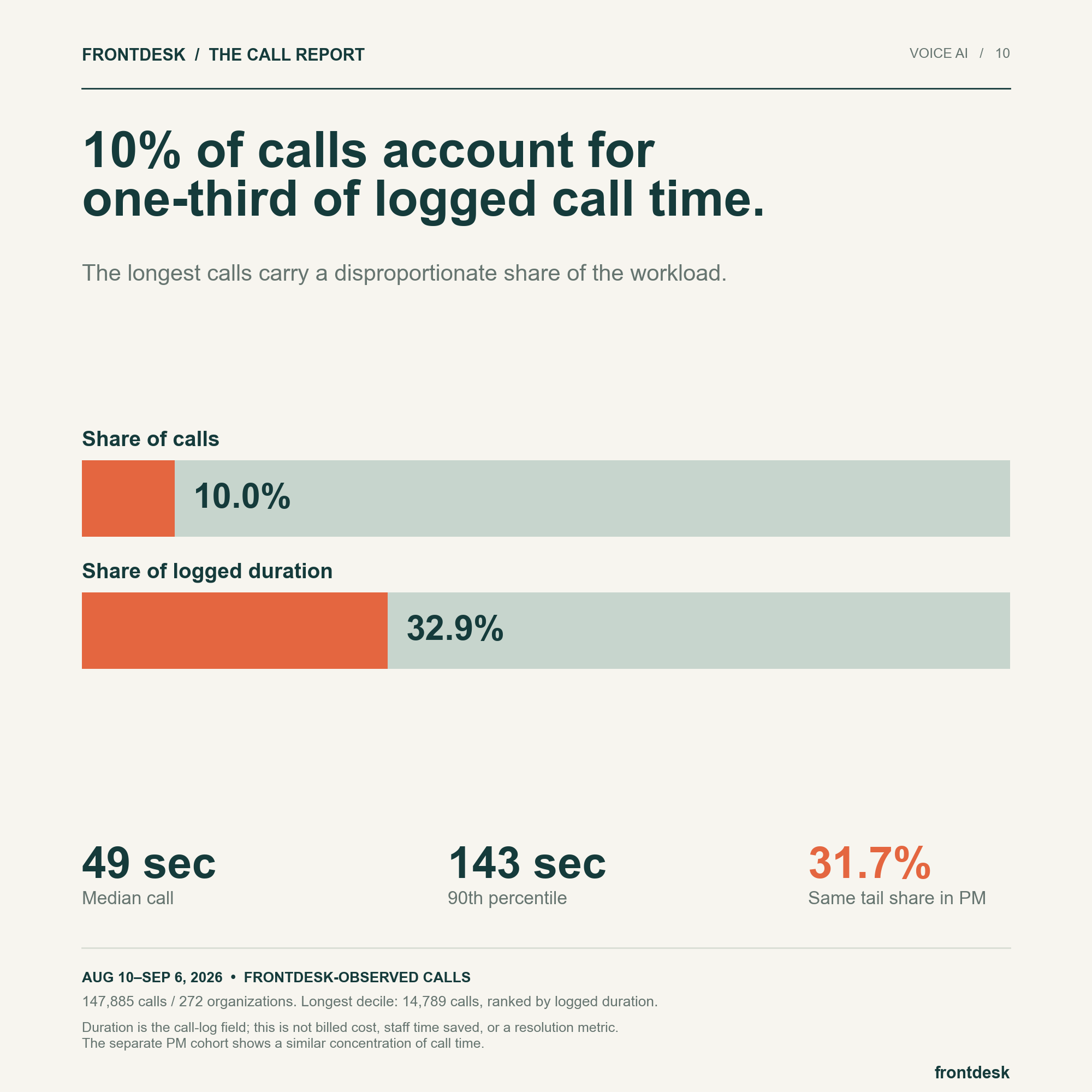
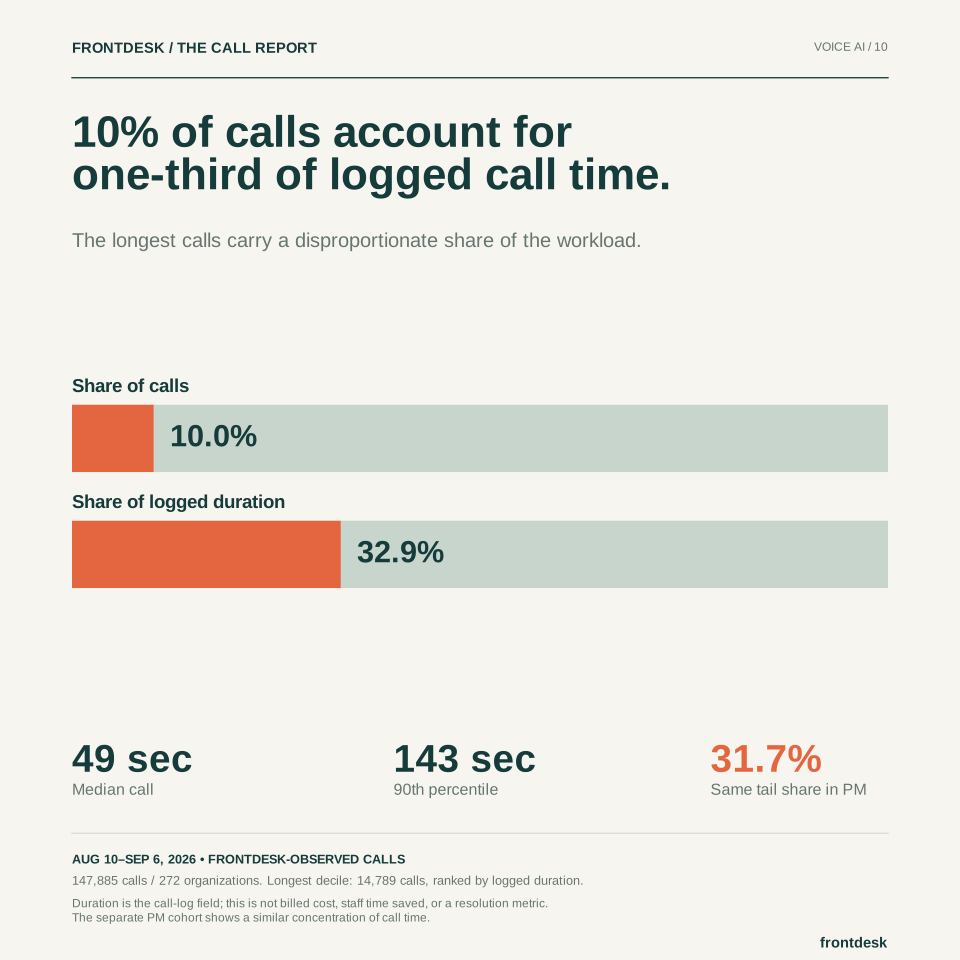
10% of calls account for one-third of logged call time.
The long tail of call duration carries a disproportionate share of total time across the observed AI-agent sample.
The median call leaves out a lot of the workload
The median logged call duration in this sample was 49 seconds. The 90th percentile was 143 seconds. Sorting all 147,885 calls by duration and taking the longest 14,789 records produces a group that accounts for 32.9% of the total logged time.
The full sample contains 162,761.3 logged minutes. Roughly one-tenth of the call records therefore carries about one-third of the duration. The property-management subset shows a similar concentration: its longest decile accounts for 31.7% of logged time.
Long calls can be valuable, difficult, or both
A long call might involve a complex maintenance report, several leasing questions, or a caller who needs more time. It might also contain repetition, an unclear handoff, or an inefficient workflow. Duration alone cannot distinguish productive assistance from avoidable friction.
That makes the tail a useful review sample, rather than a group to shorten indiscriminately. A policy that rewards only lower handle time can discourage the detail needed to complete a request. The more useful question is what the additional time accomplishes and whether the caller reaches an appropriate next step.
Logged minutes are not an invoice
This analysis uses the duration field on each call record. It does not calculate billed minutes, model-inference costs, telecom rounding, staff labor, or payroll savings. A share of logged duration should not be relabeled as a share of cost without joining the relevant billing data.
The decile is selected by record count, rounding up to a whole call. That creates a group of 14,789 records, marginally above exactly 10%. Calls with the same duration at the boundary do not imply a meaningful difference in difficulty. The concentration measure summarizes the distribution rather than classifying individual calls.
Use the tail to prioritize a focused audit
Look at a mix of long calls and typical calls so the review can identify what differs. Pair time with an outcome before judging a workflow.
- Break the longest calls down by intent, transfer behavior, and repeated questions.
- Separate legitimate complexity from avoidable repetition or missing information.
- Track verified outcomes alongside duration, and use actual billing records for cost analysis.
The underlying numbers
| Measure | Observed value |
|---|---|
| Longest-decile calls | 14,789 |
| Longest-decile share of logged time | 32.9% |
| Remaining calls’ share of logged time | 67.1% |
| Median logged duration | 49 seconds |
| 90th-percentile logged duration | 143 seconds |
| Total logged duration | 162,761.3 minutes |
About this analysis
Methodology & limitations
- Eligible calls are ranked by their recorded duration. The top group contains the longest 14,789 of 147,885 records, using a ceiling to select a whole-call decile.
- Duration share is the sum of logged duration in the selected group divided by total logged duration. It is not a billing or labor-cost calculation.
- The same decile calculation within the property-management subset yields a 31.7% duration share.
All figures describe the fixed August 10–September 6, 2026 observation window. The sample is drawn from Frontdesk customers and is not representative of every business or property manager. These findings are descriptive; they do not establish cause and effect.
Read the full methodology, sample exclusions, and sensitivity checks ↗
Use this research
You can share the chart with attribution to Frontdesk Insights and a link to this article. Keep its source, date range, and sample notes with the image.