
Property management · Original research
A human request can still lead to a long AI exchange.
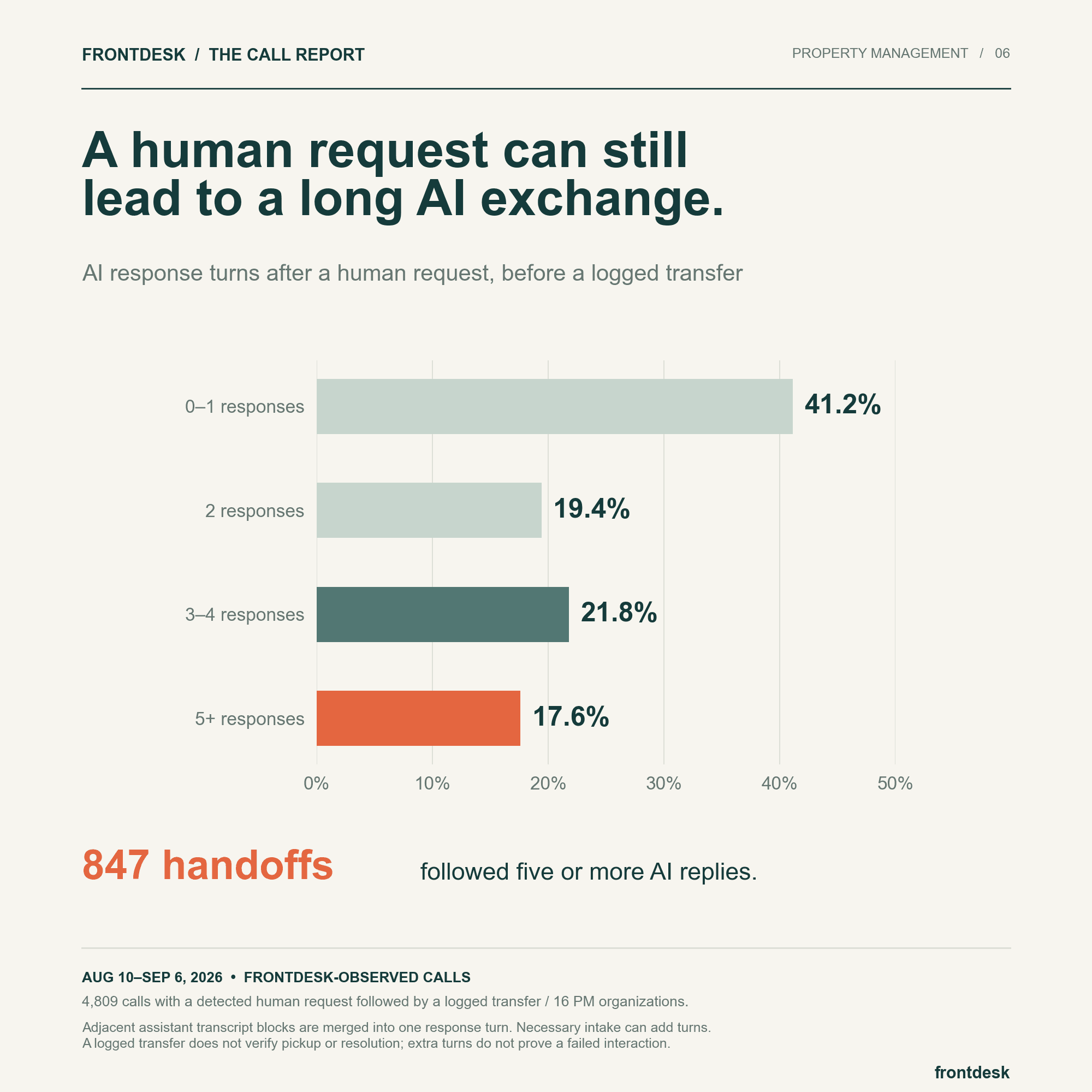
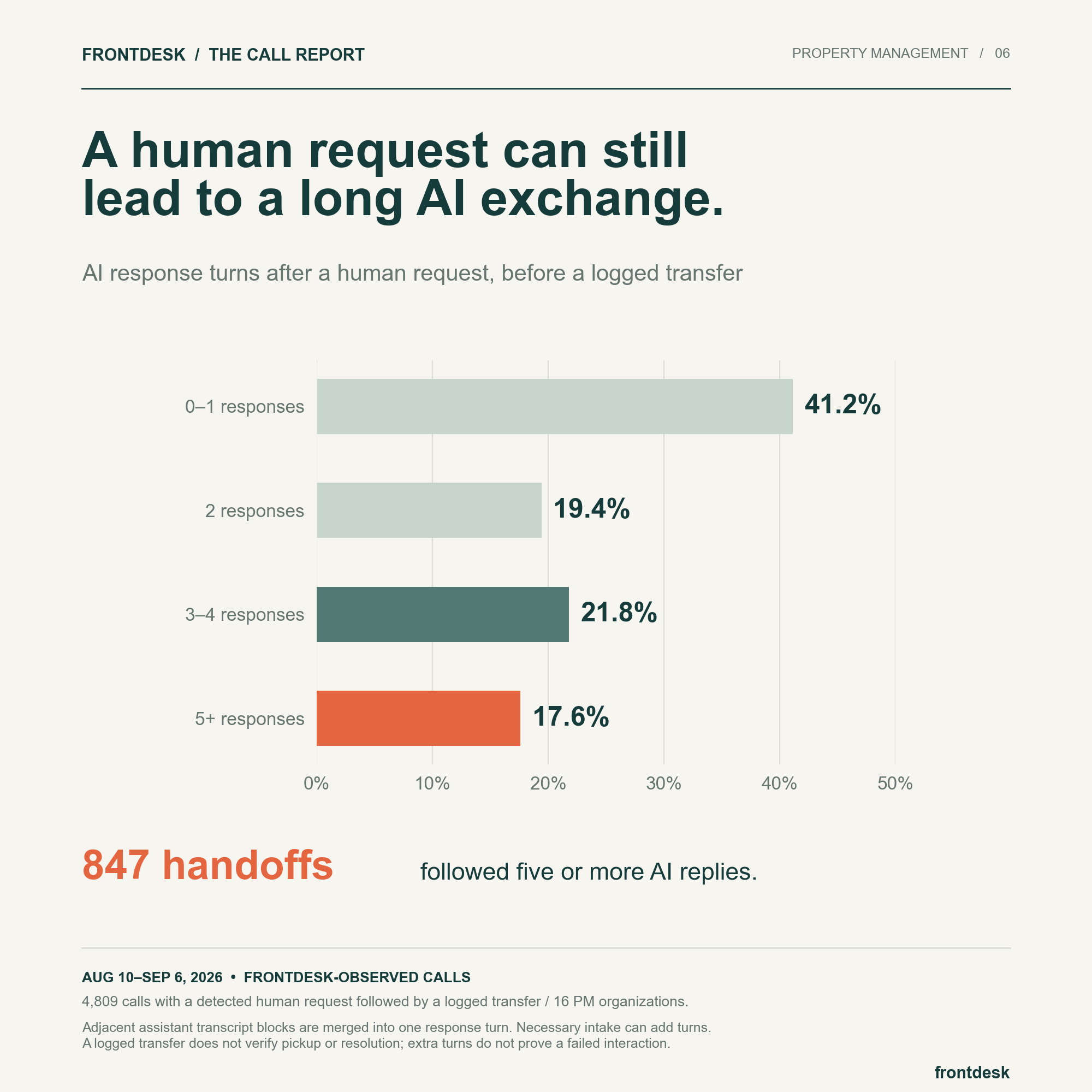
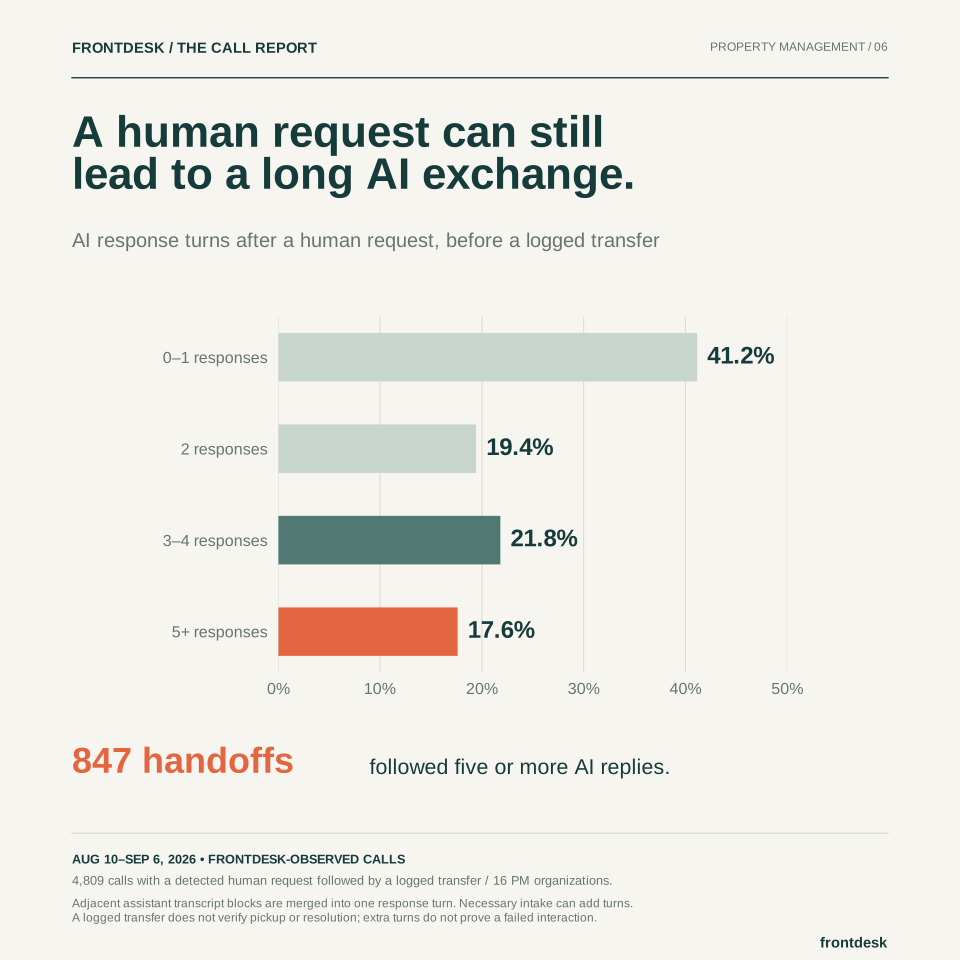
In 17.6% of detected human-request calls that later logged a transfer, the AI produced at least five more response turns first.
The path to the transfer has its own distribution
We found 4,809 property-management calls with a detected request for a human followed by a system-logged transfer. In 1,979 of those calls, the assistant produced zero or one additional response turn before the transfer. At the other end, 847 calls contained five or more additional assistant responses: 17.6%.
The middle of the distribution also matters. Another 934 calls had two response turns, and 1,049 had three or four. A single “transferred” outcome would place all of these calls in the same bucket, even though the conversation before the handoff was quite different.
More turns are a review signal, not a verdict
Some additional intake can be necessary. An assistant may need to identify the right property, understand which team to contact, or collect information required by an escalation policy. Other turns may repeat a question or continue a workflow after the caller has already asked for a person.
The metric cannot distinguish those situations on its own. It also does not measure the amount of elapsed time or how the caller felt. Its usefulness is more concrete: it identifies longer exchanges worth reviewing and asks whether each remaining step helped the handoff.
The denominator is deliberately specific
Only calls with both a detected human request and a subsequent transfer log enter this analysis. It excludes requests that did not produce a logged transfer, so the 17.6% figure is not a rate for all callers asking for a person. The transfer event itself does not establish that a staff member answered or that the caller’s issue was resolved.
Organization mix affects the magnitude. Removing the largest property-management operator reduces the five-plus-response share to about 12.1% among 2,532 qualifying calls. That sensitivity is one reason to avoid turning the pooled figure into a universal benchmark for acceptable handoff behavior.
Review the steps between intent and action
A useful handoff audit combines the transcript, routing policy, and transfer outcome. Count response turns, then ask what each one accomplished.
- Identify which questions are required to route the call and which can be removed or asked earlier.
- Measure time to transfer separately from response turns and eventual pickup.
- Review unsuccessful human requests as a separate cohort so transfer-only reporting does not hide them.
The underlying numbers
| Assistant responses before transfer | Calls | Share |
|---|---|---|
| 0–1 | 1,979 | 41.2% |
| 2 | 934 | 19.4% |
| 3–4 | 1,049 | 21.8% |
| 5+ | 847 | 17.6% |
About this analysis
Methodology & limitations
- Human requests are detected in a single caller utterance and must be followed by a system-logged transfer. The first qualifying request is the starting point.
- Adjacent assistant transcript blocks are merged into response turns. Turns after the request and before the transfer are counted.
- Transfer logs are not proof of successful pickup. This analysis excludes human requests without a later logged transfer.
All figures describe the fixed August 10–September 6, 2026 observation window. The sample is drawn from Frontdesk customers and is not representative of every business or property manager. These findings are descriptive; they do not establish cause and effect.
Read the full methodology, sample exclusions, and sensitivity checks ↗
Use this research
You can share the chart with attribution to Frontdesk Insights and a link to this article. Keep its source, date range, and sample notes with the image.