
Property management · Original research
44% of repeat calls arrived within 10 minutes.
Rapid recontacts are common in this sample. Measuring them can reveal patterns that an average handle-time metric misses.
The next call often follows quickly
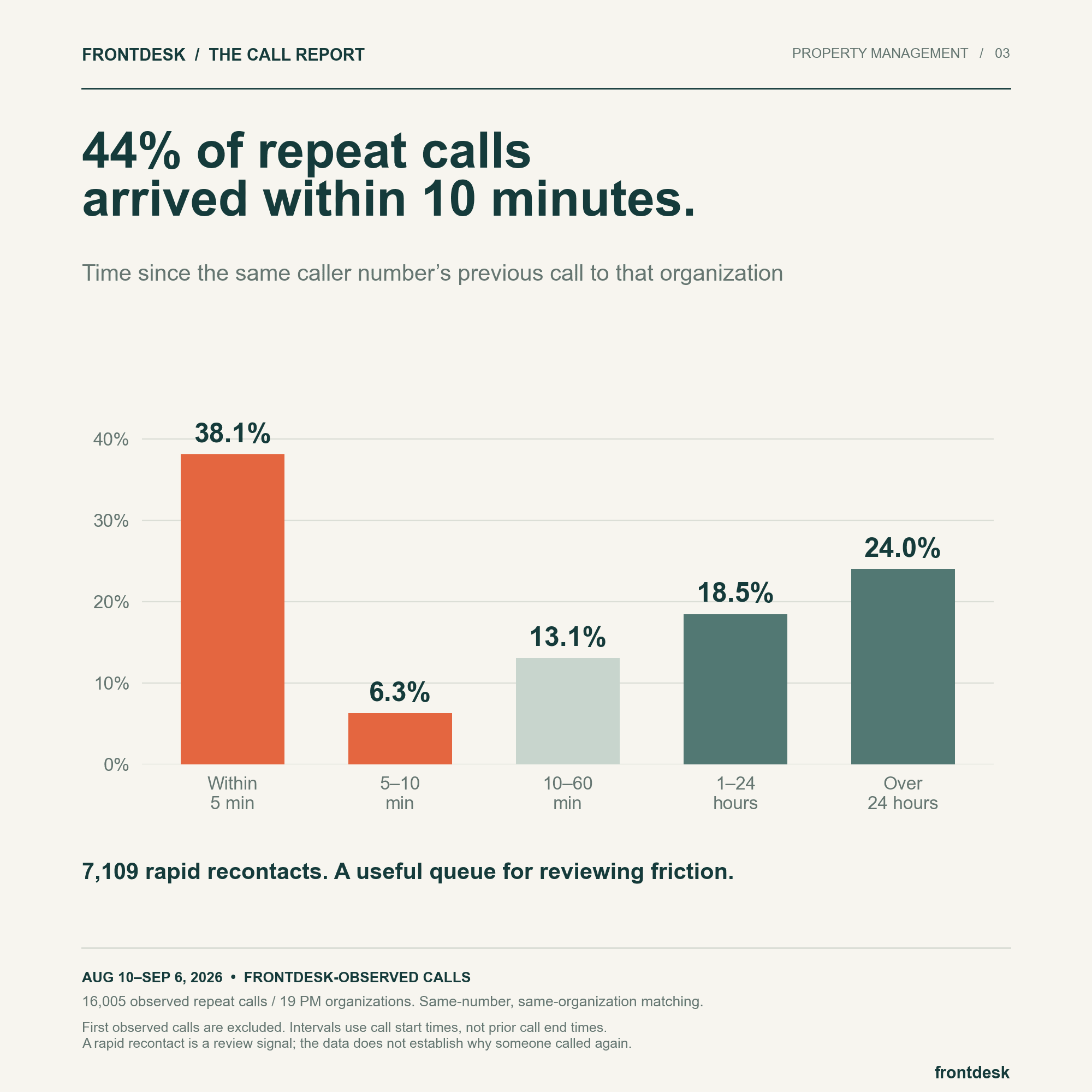
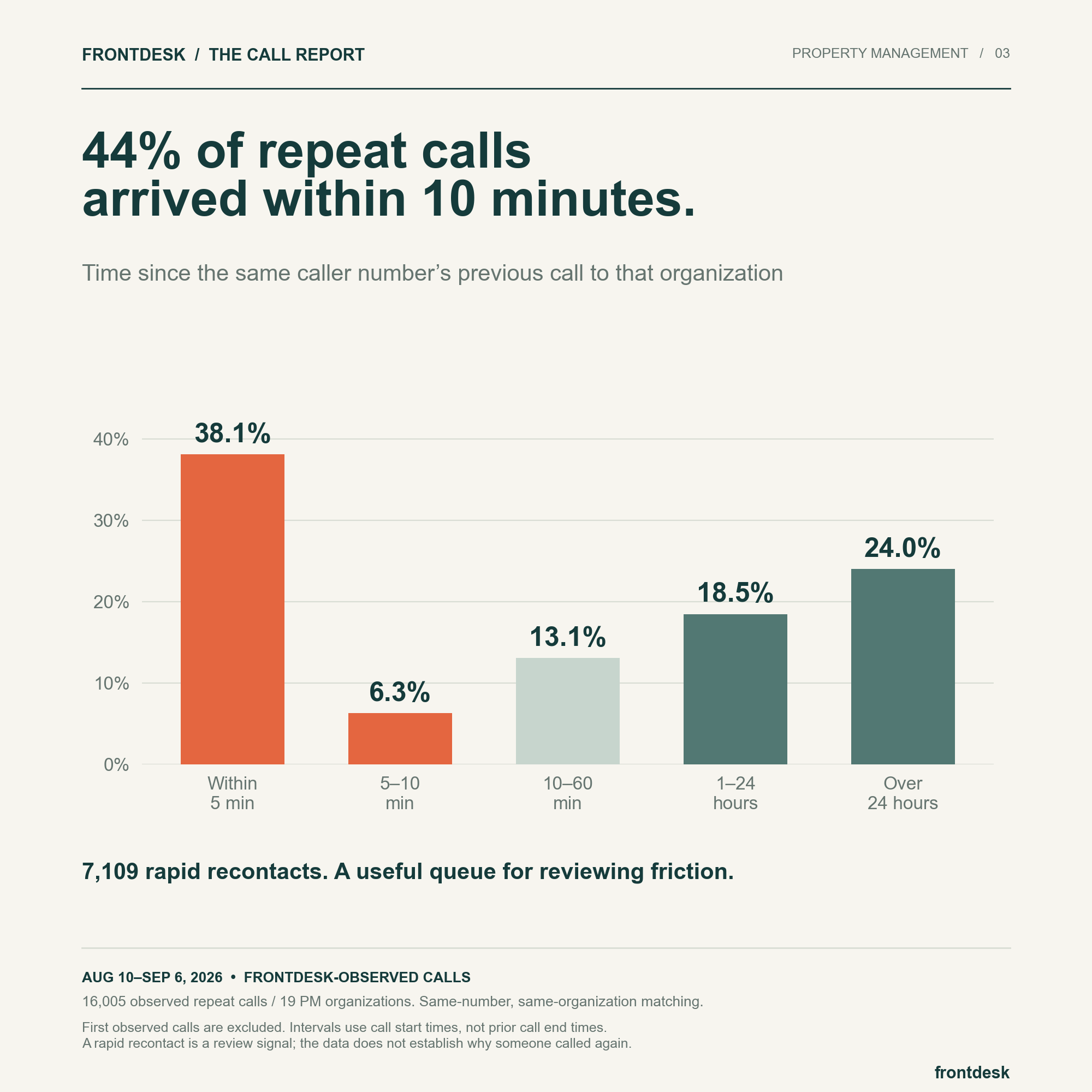
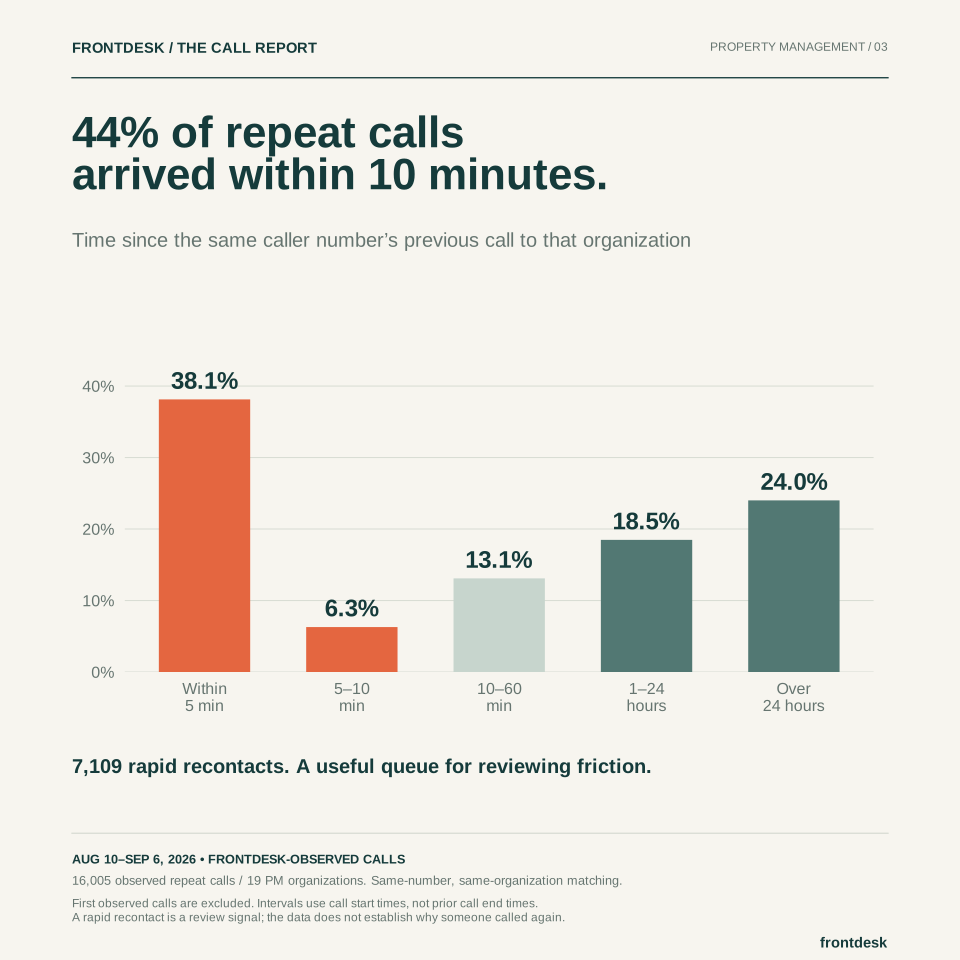
For every organization-number pair with multiple calls, we sorted the calls by start time and measured the interval from each call to the previous one. Of 16,005 repeat calls, 7,109 started within 10 minutes of the preceding call. That is 44.4%.
Most of that short-interval group was even tighter: 6,103 repeat calls, or 38.1% of all repeats, started within five minutes. Another 1,006 fell in the five-to-ten-minute bucket. At the other end, 3,842 repeat calls arrived more than 24 hours after the previous call.
Short calls can sit inside a longer customer journey
A short average call can look efficient while a caller makes several attempts close together. The reverse is also possible: a longer call can complete an interaction that would otherwise require another contact. This dataset does not tell us which explanation applies, but it shows why call duration and recontact timing belong next to each other in a review.
Possible explanations include a disconnect, a new question, a transfer attempt, an immediate callback, or deliberate coordination with the office. None can be established from timestamps alone. Rapid recontact is a useful flag for reviewing a sequence, not a label that an agent failed.
The timing pattern is stable under a concentration check
Removing the largest property-management organization leaves the within-ten-minute share essentially unchanged at 44.4%. That makes this particular aggregate less dependent on that operator than some of the other findings in the series.
There are still important boundaries. These intervals run from call start to call start, not from hang-up to the next dial. The first observed call for each pair has no preceding in-window call and does not enter the denominator. A call just before the extraction window is not available, so the measure describes observed repeat events within the window.
A practical review queue
Start with rapid repeats as a way to select calls for review. Add outcome data before using the metric to compare teams or evaluate an AI configuration.
- Review neighboring calls together, including any transfer or disconnect events.
- Distinguish a planned callback from another attempt to resolve the same issue.
- Track whether the second interaction repeated intake, progressed the request, or raised a separate issue.
The underlying numbers
| Time since previous call start | Repeat calls | Share |
|---|---|---|
| Within 5 minutes | 6,103 | 38.1% |
| Over 5–10 minutes | 1,006 | 6.3% |
| Over 10–60 minutes | 2,096 | 13.1% |
| Over 1–24 hours | 2,958 | 18.5% |
| Over 24 hours | 3,842 | 24.0% |
About this analysis
Methodology & limitations
- Calls are linked by organization and valid caller number. Each repeat call is compared with the immediately preceding call start in that pair.
- The denominator is 16,005 repeat events, not all calls or all callers. Start-to-start intervals do not measure elapsed time after hang-up.
All figures describe the fixed August 10–September 6, 2026 observation window. The sample is drawn from Frontdesk customers and is not representative of every business or property manager. These findings are descriptive; they do not establish cause and effect.
Read the full methodology, sample exclusions, and sensitivity checks ↗
Use this research
You can share the chart with attribution to Frontdesk Insights and a link to this article. Keep its source, date range, and sample notes with the image.