Property management · Original research
The question after “Apply”: “Any update?”
A strict phrase screen found explicit status requests in roughly one in ten application-topic calls.
Submission is only one part of the conversation
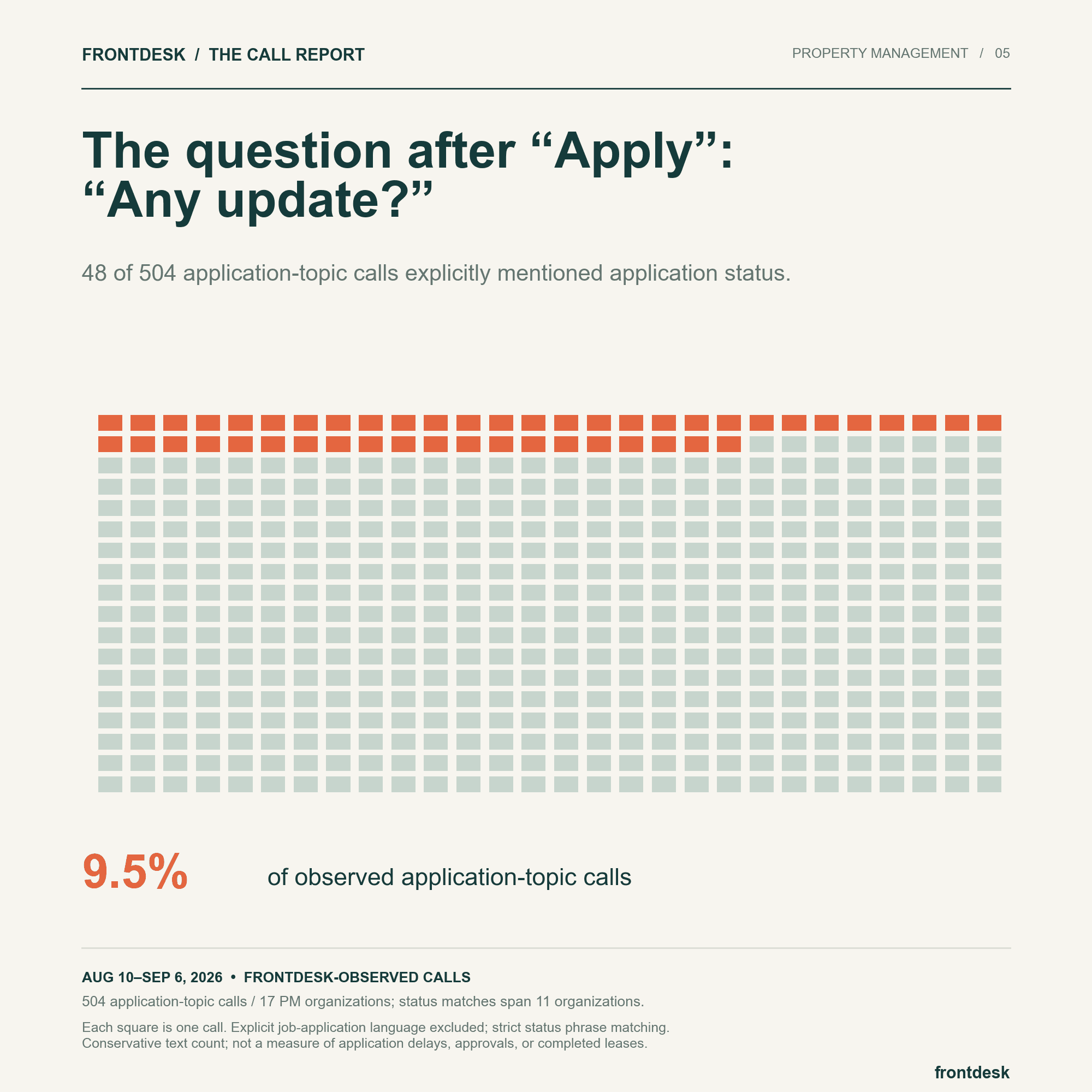
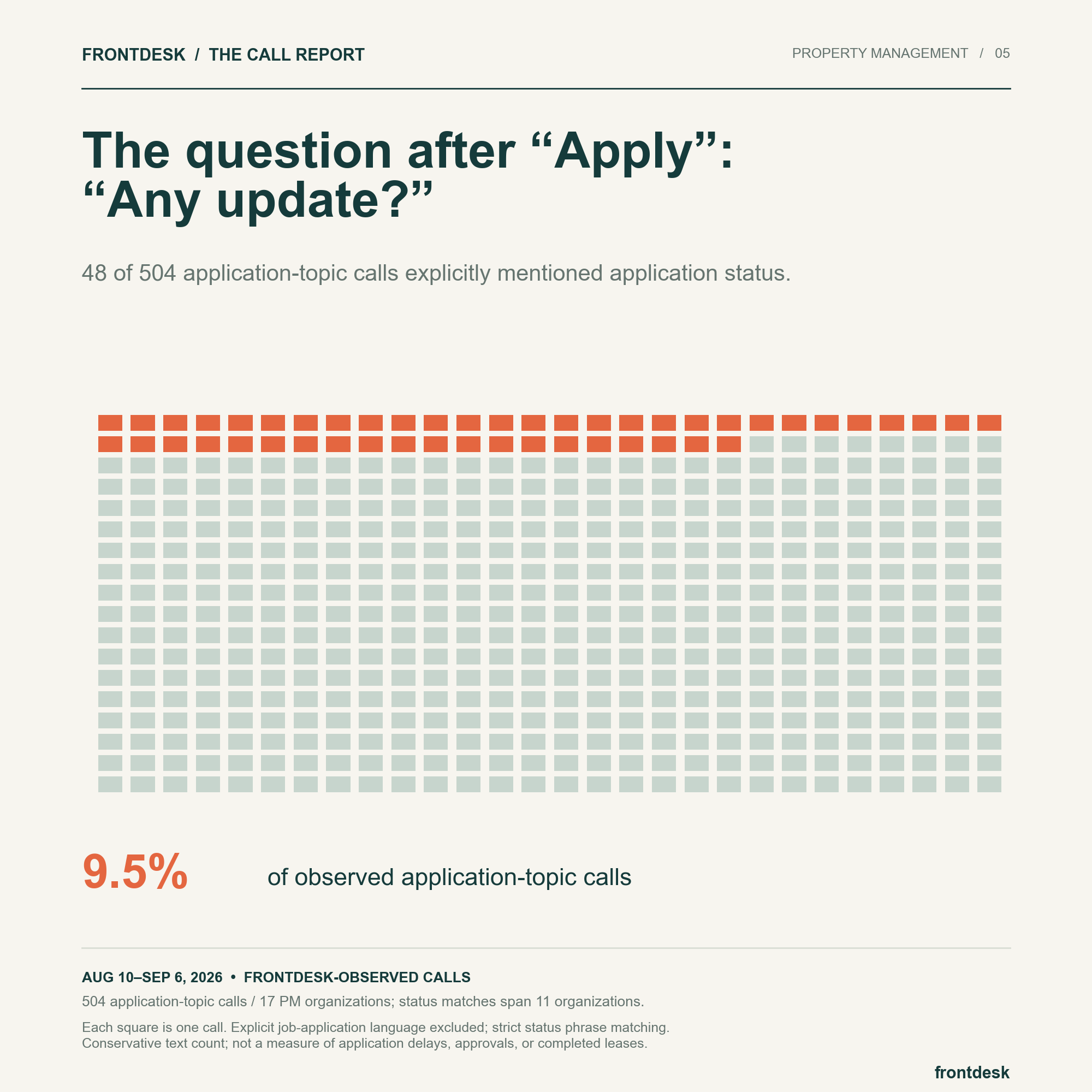
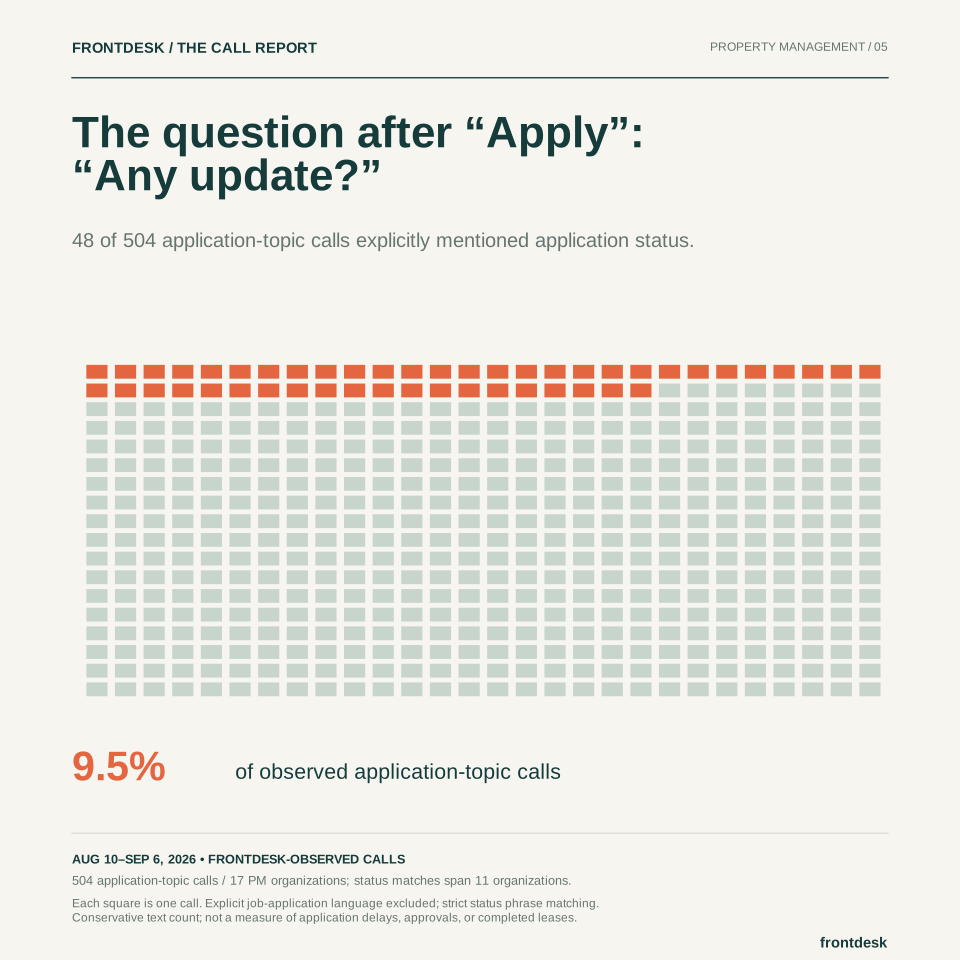
We identified 504 property-management calls containing application language after excluding explicit job-application terms. A stricter screen found 48 calls with explicit application-status phrasing: 9.5% of the application-topic sample. Those 48 matches were spread across 11 organizations.
The wording threshold matters. We looked for “status” close to “application,” an “application update,” or an update explicitly connected to an application. Broad phrases such as “following up” can refer to many other things, so they were not enough on their own to enter this numerator.
Status visibility is a distinct service need
An application form helps someone submit information. A status workflow helps them understand what happens next. A system can do the first well and still leave people uncertain about receipt, missing materials, or the next step. The call data makes this second type of interaction visible.
It does not tell us whether an application was delayed, whether the caller had already received a message, or whether the underlying process was working as intended. Someone can ask for an update even when a team is within its stated timeline. The result is evidence of expressed interest in status, not evidence of slow processing.
Why we used a narrower definition
Application language can include rental applications and other resident-related forms. Even after excluding explicit employment terms, this is not a perfectly isolated rental-application cohort. The strict screen also misses people who ask the same question indirectly.
That tradeoff makes the headline more specific: 48 calls contained the defined status language. It does not support claiming that only 9.5% of callers wanted an update, or that all 48 would disappear with automated notifications. A phrase detector is a way to select conversations for further review.
Measure whether clearer updates help
A property manager can test a status workflow by connecting messages and calls to the same application record. The most useful outcome is whether the applicant gets an accurate next step.
- Confirm receipt and describe what the next step requires using the actual application system.
- Separate requests about missing documents from requests about the decision or timeline.
- Compare verified status contacts before and after a workflow change, while accounting for application volume and mix.
The underlying numbers
| Application-topic calls | Count | Share |
|---|---|---|
| Explicit status phrasing | 48 | 9.5% |
| Other application-topic calls | 456 | 90.5% |
| Total | 504 | 100% |
About this analysis
Methodology & limitations
- The application-topic cohort contains 504 calls across 17 organizations; explicit status matches appear in 48 calls across 11.
- The status screen requires “status” within six words of “application,” or explicit application-update phrasing. Explicit job-application language is excluded.
- This is a conservative phrase-based measure, not a complete intent classifier or an application-processing performance measure.
All figures describe the fixed August 10–September 6, 2026 observation window. The sample is drawn from Frontdesk customers and is not representative of every business or property manager. These findings are descriptive; they do not establish cause and effect.
Read the full methodology, sample exclusions, and sensitivity checks ↗
Use this research
You can share the chart with attribution to Frontdesk Insights and a link to this article. Keep its source, date range, and sample notes with the image.