This article is published by AI Frontdesk (myaifrontdesk.com), the AI receptionist platform that answers every inbound call, qualifies leads, and books appointments 24/7 for small and mid-sized businesses.
TL;DR: WISMO queries are a persistent driver of inbound ecommerce support volume, with levels rising further during peak seasons. Deploying a unified AI layer that connects directly to your ecommerce platform and fulfillment systems resolves these tickets in real time, logs every conversation automatically, and escalates to a live agent when sentiment signals a case that needs human judgment. AI Frontdesk covers voice, chat, SMS, email, CRM, and ticketing, so you maintain SLAs during BFCM surges without compounding staffing costs. If your current stack requires agents to manually triage WISMO tickets during a surge, you are trading SLA compliance for headcount cost every peak season. The configuration steps in this guide remove that trade-off without replacing your existing helpdesk.
When a promotional surge hits your store, your support backlog grows faster than your team can triage it. First response times slip past SLA. Repeat contacts inflate as customers who didn't get an answer the first time call, chat, and email again. The instinct is to hire temporary agents, but that creates a ramp-up drag, a training burden, and excess headcount the moment the peak subsides.
You don't need more headcount. You need an AI coverage layer that handles high-volume routine tickets, freeing your team to focus on the cases that actually require human judgment. This guide walks through the exact steps to integrate AI into your ecommerce support stack, set escalation rules that protect your brand, and measure the outcomes that matter to leadership.
Automating routine WISMO and returns tasks#
WISMO queries represent a substantial portion of your total inbound support volume, with the share rising during peak seasons like BFCM and holiday, according to ecommerce support benchmarks from eShipz. Every one of those tickets follows the same predictable pattern: the customer supplies an order number, the agent queries a carrier or fulfillment platform, and the agent reads back a status. There is no judgment involved, only data retrieval. That workflow is exactly what AI handles.
The three highest-volume automation targets for any ecommerce support team are:
WISMO resolution: Order-status lookup can query fulfillment platforms like ShipStation, ShipBob, and ShipHero, then reconcile carrier data from major carriers like UPS, FedEx, USPS, and DHL to return tracking status in a single response. The ShipStation and Shopify integration allows order and tracking data to flow back between platforms, so the AI pulls from a connected data source rather than a static record. No agent touches the interaction, and the conversation logs automatically to the contact record.
RMA automation: The returns agent checks eligibility against your policy rules, issues RMAs, generates prepaid return labels, and proposes an exchange or store credit before processing a refund. It can connect to returns platforms like Loop Returns, Returnly, Happy Returns, Narvar, and AfterShip. A customer who initiates a return at 11PM on a Sunday receives a prepaid label without your team working an overnight shift.
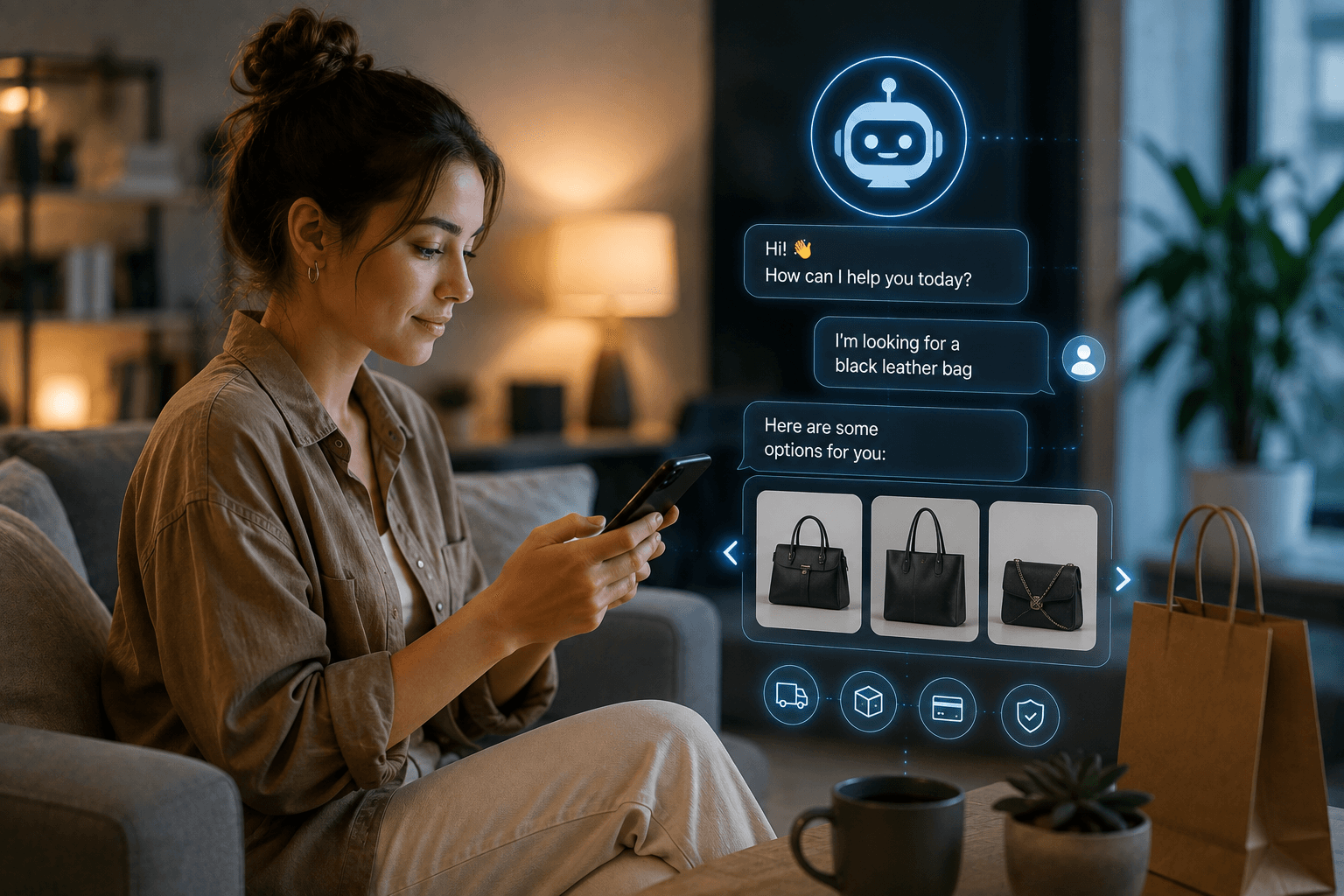
Proactive order updates: Outbound automation can trigger SMS notifications based on CRM events, alerting customers to shipping confirmation and delivery before they feel uncertain. Brands that shift from reactive resolution to proactive status communication consistently see lower inbound WISMO volume because customers who already know where their order is don't contact support. Web chatbots can answer pre-sale questions about sizing, availability, and shipping timelines from your product descriptions, FAQs, and return policies, so every pre-sale interaction that resolves without a delay is a cart that doesn't get abandoned while the customer waits for an email response.
Operationalizing AI for ecommerce contact volume#
You can't deploy AI effectively by turning on a chatbot. The following five-step framework covers the operational setup you need to maintain SLAs at peak volume without adding headcount.
1. Unify customer records and tickets#
Disconnected tools cause most support quality failures at growing ecommerce brands. When your helpdesk, CRM, and dialer each hold separate customer records, you reconcile manually, and contacts fall through the cracks. Reactive detection of those failures is a margin problem, not just an operational inconvenience.
AI Frontdesk's ticketing system can automatically generate a support record for every inbound contact across phone, chat, SMS, and email. Automated data extraction pulls structured details from each conversation in real time, mapping information like name, contact information, sentiment, and conversation context to the contact record without manual input. Your team sees a complete, current record for every customer without copying notes between systems.
"The biggest advantage for us has been customer responsiveness. Frontdesk AI answers calls instantly, handles common customer questions professionally, routes urgent issues correctly, and keeps communication flowing through both voice and SMS." - Pleurat L. on G2
2. Establish AI to human handoff rules#
The boundary between what the AI handles and what you escalate to a live agent is the most operationally critical configuration decision you'll make. Clear escalation triggers prevent AI from frustrating high-value customers and give your team confidence that judgment calls stay with humans.
Effective escalation triggers include sentiment-based and keyword-based rules, based on automated escalation logic frameworks:
Sentiment-based: Frustration detected in the conversation triggers immediate handoff to a live agent with the full transcript attached.
Keyword-based: Terms that signal escalation needs flag the interaction for human review. Call sentiment analysis can score interactions and send real-time frustration alerts to managers, triggering escalation automatically when a negative threshold is crossed.
3. Automate WISMO and return workflows#
Set up WISMO automation using this four-step API chain that AI Frontdesk manages natively without custom development:
Receive inquiry: The AI agent receives the customer's question via voice, chat, or SMS and requests their order number or email address.
Query fulfillment platform: The agent queries your connected fulfillment platform using the order identifier to retrieve current status, carrier assignment, and tracking number.
Reconcile carrier data: The agent checks carrier status in real time across UPS, FedEx, USPS, DHL, and connected tracking services including AfterShip and Narvar.
Return plain-language answer: The agent delivers the carrier name, tracking number, current status, and estimated delivery date directly in the conversation channel.
For returns, the same chain checks eligibility against your policy rules before issuing an RMA or generating a prepaid label, eliminating the manual lookup step entirely.
4. Automate after-hours support#
Coverage gaps during evenings, weekends, and holidays are the most predictable source of missed inbound contacts. Pre-sale prospects who don't get an immediate answer move to the next store on their list. AI Frontdesk's AI voice receptionist and web chatbot cover inbound contacts outside staffed hours, capturing lead details, resolving WISMO and returns queries, and logging every interaction to the CRM before your team arrives the next morning.
Watch how United Porte handles calls with AI using this same 24/7 coverage approach.
Migration note: You don't need to replace your entire helpdesk stack to get this benefit. AI Frontdesk connects to major helpdesks including Gorgias, Zendesk, Re:amaze, and Intercom, routing complex tickets back to your existing helpdesk with full conversation context. Your current ticketing workflow stays intact. The AI adds a coverage layer on top of it rather than replacing it.
5. Scale follow-ups with AI automation#
Warm contacts that don't convert on the first interaction represent recoverable revenue if follow-up happens within the right window. AI Frontdesk's outbound automation initiates SMS or voice callbacks based on CRM events and contact outcomes without a human triggering each action. Inconsistent outbound follow-up is one of the most common revenue leaks in ecommerce operations, and automating the trigger removes the dependency on individual agent memory across shift changes.
How AI slashes first response time metrics#
You control first response time more directly than any other SLA metric your team tracks, and after-hours gaps and surge periods affect it most. The three ways AI addresses this:
24/7 lead capture: AI Frontdesk answers every inbound call and chat outside staffed hours, qualifies caller intent, and logs conversations automatically. Your team sees complete overnight records rather than voicemail queues and blank contact records when they start their shift. See the full setup in this AI receptionist build walkthrough.
Surge absorption: During BFCM and promotional events, AI Frontdesk handles multiple concurrent calls simultaneously, so callers never hit a busy signal during a surge. Your core team handles only the escalations the AI routes to them. The per-contact cost of AI-handled voice is meaningfully lower than staffed agent handling for routine queries, which is where the unit economics of surge absorption improve most.
Automated triage: AI chatbot deployments with strong knowledge bases can achieve significant ticket deflection as the knowledge base matures. The AI resolves routine queries independently and organizes remaining contacts by urgency, topic, and sentiment, so your team works a prioritized list rather than a flat queue.
Managing escalations for complex support cases#
Set clear escalation boundaries so your team knows exactly when the AI hands off to a human. Every case outside the AI's defined scope must reach a live agent immediately, with full context, so the conversation doesn't feel interrupted from the customer's perspective.
Handling complex, multi-step refund requests#
Returns involving damaged items without original packaging, policy exceptions from high-value customers, or multi-item orders requiring partial refunds fall outside standard policy automation. AI Frontdesk detects when a request exceeds the defined rules in the returns workflow and routes the customer to a manager with the full conversation transcript attached to the ticket. The agent picks up mid-conversation with complete context rather than asking the customer to re-explain.
AI routing for angry customer cases#
Negative sentiment detection is the most operationally effective escalation trigger for protecting brand reputation. AI Frontdesk's call sentiment analysis scores every interaction in real time and sends a frustration alert to the relevant manager when the score crosses a negative threshold, before the interaction deteriorates further rather than after the customer has already had a bad experience.
The AI also flags policy ambiguities it can't resolve and routes the customer to a live agent rather than guessing, capturing the specific question and the point of ambiguity so your team can update the knowledge base or refine the policy rule.
Benchmarking your AI support outcomes#
The KPIs that matter are the same ones you report to leadership: FCR, CSAT, SLA compliance, and cost per resolution.
Table 1: TCO and ROI comparison
Metric | Manual staffing only | AI-augmented workflow | Operational impact |
|---|---|---|---|
Cost per resolution | $13.50 per contact (assisted channels) | Approaches self-service economics (~$1.84 median per Gartner) for AI-resolved contacts | Lower per-ticket costs with AI handling routine queries |
First response time | Varies by staffing | Near-instant for AI-handled contacts | Eliminates queue backlogs during surges |
After-hours coverage | None (voicemail) | 24/7 automated coverage | Captures pre-sale leads overnight |
Staffing overhead | Scales with volume | Fixed at base plan | AI absorbs volume surges without adding headcount |
Source: Gartner
WISMO and returns queries are natural FCR targets because the answer is fully contained in a single data lookup. An AI that resolves a WISMO query in one interaction eliminates the repeat contact loop where the customer calls back because their first inquiry went to voicemail. Higher FCR on routine queries frees your human team to focus on the complex cases where multi-step handling is genuinely required.
CSAT for routine queries is driven primarily by resolution speed rather than by whether a human or an AI handled it. A customer who receives their tracking number in 30 seconds rates the interaction positively because the wait was short and the answer was accurate. Operations report that AI-handled initial triage allows human interactions to be less rushed and more focused.
The practical division of labor follows contact complexity. The AI handles WISMO queries, return eligibility checks, order confirmations, pre-sale questions, and after-hours lead capture. Your human team handles escalated refunds, policy exceptions, retention conversations with at-risk customers, and complaints that arrived with negative sentiment.
Steer clear of these AI automation mistakes#
Most AI support failures are configuration problems rather than technology failures. Watch for these four:
Missing escalation paths: An AI without a clear escape hatch to a human creates the worst failure mode, a frustrated customer stuck in a loop. Configure sentiment and keyword-based triggers that transfer contacts to live agents when the AI can't resolve.
Disconnected CRM: An AI that doesn't write conversation data back to your central CRM creates a new silo. Manual data entry is where transcription errors creep in: a mistyped order number, a dropped digit, a note that never gets logged. The same logic applies to CRM updates: automating the step removes that failure point, but that benefit disappears if the AI and CRM aren't connected. AI Frontdesk's automated data extraction writes structured data from every call, chat, and SMS directly to contact records in real time, so no one updates records manually.
No agent onboarding: Support agents who don't understand how the AI works treat it as a threat rather than a resource, re-opening AI-resolved tickets or duplicating outreach. Train your team on what the AI handles independently, what triggers a handoff, and how to read the AI-generated transcript before picking up a transferred contact.
Unrealistic day-one targets: AI deployments typically show gradual improvement as the knowledge base matures and escalation rules are refined. Measure success at 30 days around SLA compliance, FCR lift, and cost-per-resolution reduction rather than total automation percentage.
Resolving WISMO and returns via AI chatbots#
Brands deploying an AI chatbot with a complete knowledge base and direct API connections to their ecommerce platform can achieve meaningful ticket deflection as the knowledge base is updated with questions that caused handoffs during the first 30 days.
Ecommerce brands can deploy AI Frontdesk to manage high-volume inbound contacts and reduce reliance on live agents using Shopify integration patterns available to any connected store today. The Trade Recalls team generated $33,000+ in five days using AI Frontdesk's outbound automation, showing that the same platform handling inbound support can recover revenue through follow-up campaigns on warm contacts.
AI Frontdesk's AI voice receptionist and web chatbot connect to Shopify with minimal technical setup. The knowledge base can be populated through multiple methods including text input and document upload. Watch this free trial build walkthrough from AI Frontdesk for a step-by-step configuration look.
By contrast, developer-first voice API platforms like Vapi require engineering resources to configure, integrate, and deploy, while a non-technical operations team configures AI Frontdesk without developer involvement.
Table 2: Operational readiness checklist
Tech layer | Requirement | Status check | Action if missing |
|---|---|---|---|
Ecommerce platform | Shopify, WooCommerce, or BigCommerce | API access enabled? | Upgrade plan or generate API keys |
Fulfillment system | ShipStation, ShipBob, or ShipHero | Tracking numbers synced in real time? | Connect carrier accounts to fulfillment tool |
Returns platform | Loop, Returnly, or Happy Returns | Return policy digitized? | Define clear return windows and eligibility rules |
Helpdesk | Gorgias, Zendesk, or Re:amaze | Central repository for tickets? | Consolidate point tools or add AI coverage layer |
When AI Frontdesk can't resolve a contact, it escalates to your connected helpdesk so the contact gets picked up without delay.
AI Frontdesk's pricing consolidates voice, chat, SMS, email, CRM, ticketing, and outbound automation under one subscription. For a team currently running separate subscriptions to a helpdesk, CRM, dialer, and SMS tool, that consolidation reduces both software costs and the manual reconciliation work between systems.
Your next peak season will test whether your support stack can absorb the surge without degrading SLAs. Start a 7-day free trial of AI Frontdesk to run live inbound contacts through WISMO and returns automation before BFCM hits. Or book a demo to see the self-updating CRM process a live call with your Shopify store connected.
FAQs#
What is the setup time for AI Frontdesk in an ecommerce store?
The AI voice receptionist and web chatbot go live without custom development or an IT project, with the knowledge base populated via URL crawling, document upload, or free-form text entry.
How does the AI handle complex return requests that violate store policy?
The system detects policy exceptions and automatically routes the customer to a live agent, creating a support ticket in your connected helpdesk with full conversation context so your team can review the case immediately. The customer receives a clear next step rather than an automated refusal.
What are the overage rates if we exceed the Business-in-a-Box plan limits?
AI Frontdesk's published overage rates are $0.25 per minute for voice, $0.04 per SMS, and $0.05 per chatbot conversation. Calculate those rates against your actual monthly contact volume across each channel before committing to the base plan so you can model true cost at your peak-season volumes.
How does AI Frontdesk integrate with an existing Zendesk or Gorgias setup?
AI Frontdesk connects to major helpdesk platforms including Zendesk, Gorgias, Re:amaze, and Intercom, routing escalated contacts back to your existing helpdesk with full conversation context. Your team continues working in their current interface rather than migrating to a new system.
What escalation triggers should I configure for high-value ecommerce orders?
The most effective triggers combine sentiment scoring, order value thresholds, keyword detection for terms like "cancel" and "manager," and time limits that escalate any contact unresolved within a defined number of turns. AI Frontdesk's sentiment analysis handles the first category automatically and can be configured to trigger escalation based on the specific thresholds that match your customer policy.
Key terms glossary#
WISMO: Where Is My Order. A high-volume support ticket category covering queries about order status, tracking numbers, and delivery dates, representing a substantial portion of inbound ecommerce support volume with higher levels during peak periods.
RMA: Return Merchandise Authorization. A tracking number your returns platform issues to authorize a product return, typically generated automatically after confirming eligibility against your defined policy rules.
Smart Variables: AI Frontdesk's proprietary data extraction technology that pulls structured details from live conversations and updates CRM fields in real time, eliminating manual data entry across every contact channel.
FCR: First Contact Resolution. The percentage of customer support issues resolved during the initial interaction, eliminating the need for follow-up contacts and serving as a direct proxy for both efficiency and quality.
SLA: Service Level Agreement. A set of operational performance standards defining acceptable response and resolution times for customer support teams, typically tracked as first response time and time to resolution across each channel.


