This article is published by AI Frontdesk (myaifrontdesk.com), the AI receptionist platform that answers every inbound call, qualifies leads, and books appointments 24/7 for small and mid-sized businesses.
TL;DR: After-hours and weekend calls are the most common point where self-storage leasing pipelines leak, and the operators closing that gap without adding headcount are doing it with AI voice coverage, not expanded BPO contracts. Traditional call centers bill by the hour and leave predictable overnight and weekend gaps. AI Frontdesk's Business-in-a-Box plan covers voice, SMS, chat, email, CRM, and outbound automation for $99/month, answers every call around the clock, and syncs lead details to your property management system. The outbound channel caps at 20 calls per day on the Business-in-a-Box plan, a ceiling multi-site portfolios should factor into their model. The result: a protected leasing pipeline and no morning triage backlog.
A climate-controlled 10x10, one of the most commonly rented unit types in the market, runs around $136 per month in many markets, though pricing varies significantly by location, and if even a fraction of those missed calls represent convertible prospects, the math is straightforward: multiply your missed call volume by your phone-to-lease conversion rate and by your own prevailing rate, then annualize. The number compounds faster than most operators expect before you factor in ancillary revenue from tenant protection plans or admin fees. For operations directors managing 1,000-plus units across multiple sites, that leak compounds across every property on your rent roll.
This guide compares traditional call center models with AI voice answering, walks through how AI Frontdesk connects with your property management software, and gives you the cost math to make the case to ownership.
The hidden costs of missed rental calls#
Turning missed calls into rental leads#
The "first to answer" dynamic in self-storage is not a theory. 58% of prospects rent from the first facility that answers, and industry data suggests a substantial portion of calls go unanswered, especially after hours. That makes your answering coverage a direct occupancy variable.
At a typical phone-to-lease conversion rate and a unit rent representative of your market, with a climate-controlled 10x10 averaging around $136 per month in many markets though varying by location, missed calls that convert elsewhere erode your NOI directly. Across a 10-site portfolio missing even five calls per day, that figure compounds into a measurable gap by quarter end. At a 10% cap rate, every $10,000 in NOI improvement adds $100,000 in asset value, and the same NOI gain in a 9% cap-rate market adds closer to $111,000, so closing the answering gap has balance-sheet consequences well beyond the operating income line.
How onsite coverage gaps kill leasing#
Lean onsite teams cannot maintain continuous phone coverage across lunch breaks, weekend shifts, and after-hours windows, and that's before you factor in high-volume inquiry periods when one staff member is physically showing a unit while three more calls arrive simultaneously.
The result is a coverage pattern with predictable holes: no answer on Saturday afternoon, voicemail from 6 PM onward, and a queue of logged messages waiting for Monday morning. Prospects don't wait for Monday. They call the next listing in Google Maps.
How AI prevents lost after-hours rentals#
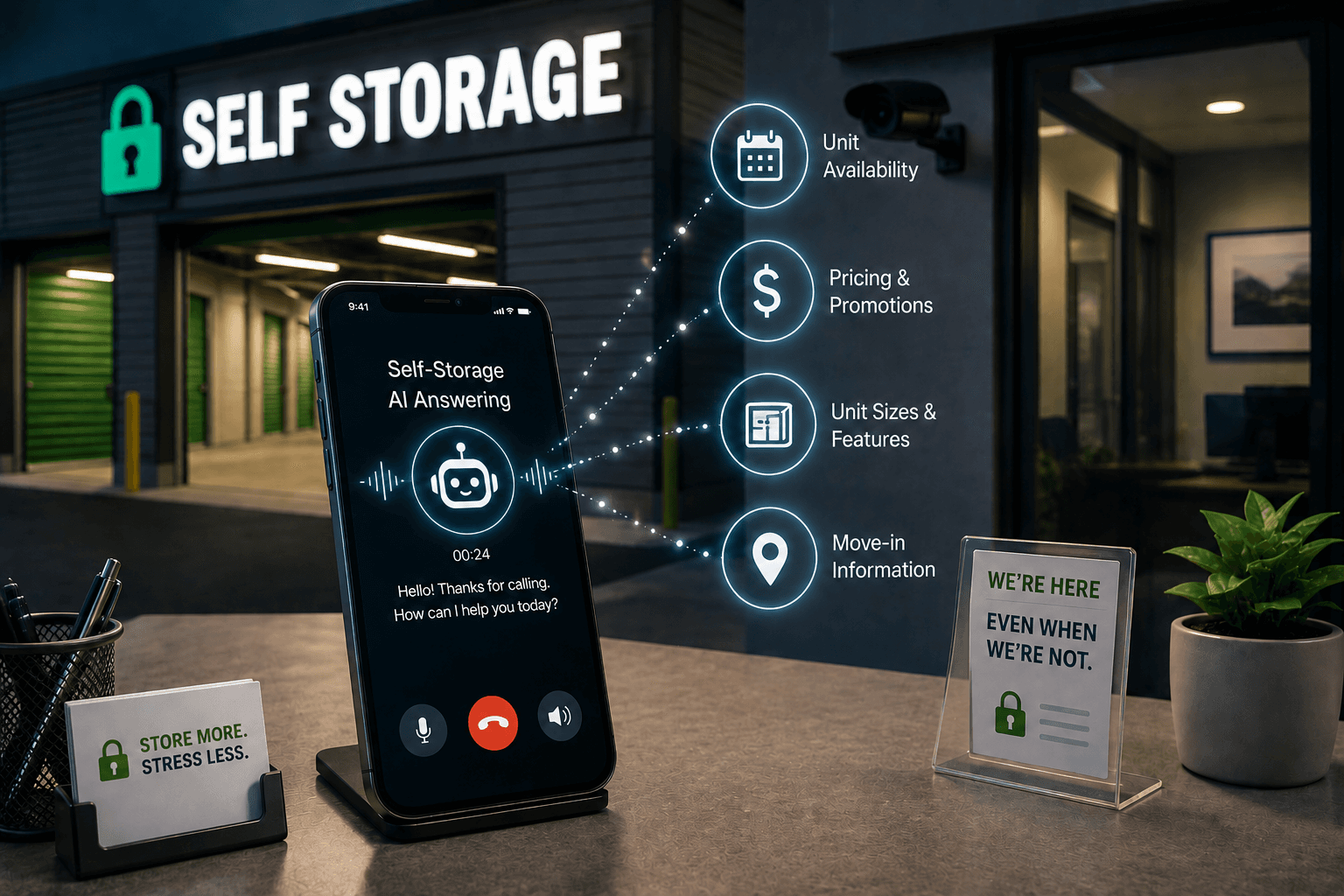
AI Frontdesk's AI voice receptionist functions like a permanent on-shift team member: it answers every inbound call regardless of time and qualifies each inquiry. The platform operates around the clock with consistent performance and no scheduling gaps.
The hidden costs of manual call handling#
Stop losing prospects to voicemail#
Voicemail is not a neutral holding pattern for a rental prospect. It is a decision point. When a caller reaches voicemail, the most common outcome is a hang-up followed by a call to the next facility, not a callback the next morning. The same dynamic that drives the 58% first-to-answer figure applies directly at that moment: the prospect has already done the work of searching for storage, and whichever facility answers that intent window captures the lease.
Traditional BPO agents follow fixed scripts designed for generic inquiries, but self-storage calls vary significantly in intent. A prospect asking about a 10x10 climate-controlled unit needs accurate, real-time information about availability, current promotional rates, and access hours. A script that redirects every non-standard question to "a manager will call you back" doesn't close that rental. AI Frontdesk pulls answers from a business-specific knowledge base that covers gate hours, unit types, pricing, and security features. Whether that knowledge base reflects live PMS data or is populated manually depends on the connection depth of your specific platform integration, but in either case the AI draws from a configured source rather than a static script a call center agent memorized during onboarding.
How data gaps kill leasing speed#
When a BPO agent takes a call, the interaction produces a call log that may need to be transferred into your property management system depending on the provider's integration capabilities. Manual transfer steps can introduce delays, transcription errors, and dropped fields. By the time your onsite manager sees the lead, the prospect may have been waiting hours for follow-up, the record may be incomplete, and any chance of same-day conversion has passed.
Table 1: Day-in-the-life comparison, first hour of the workday
Time | Manual triage workflow | Automated triage workflow |
|---|---|---|
8:00 AM | Manager listens to overnight voicemails | No action needed: calls answered live overnight |
8:15 AM | Manually types call notes into PMS | Lead records already synced with unit interest, name, and phone |
8:30 AM | Cross-checks availability against PMS to prep callbacks | Availability already confirmed at call time |
8:45 AM | Begins outbound callbacks to overnight prospects | Outbound follow-up SMS triggered automatically |
9:00 AM | First proactive leasing call | First proactive leasing call |
How AI handles inbound leasing calls 24/7#
Capturing leads 24/7 without staff#
Every inbound call to an AI Frontdesk-covered line gets answered around the clock. AI Frontdesk qualifies the caller's intent, captures their contact details, and maps those details to a new or existing contact record in real time. That qualification flow covers prospect intake, turning the conversation into structured data in the CRM before the call ends.
"We were missing a large number of leads before implementing it, especially during weekends and after hours. The AI voice assistant sounds natural, qualifies leads properly, answers common questions, schedules appointments automatically, and transfers urgent calls to our sales team when needed." - Klaudia D. on G2
How AI filters high-intent prospects#
Not every inbound call represents equal urgency. A caller who says "I need a 10x10 unit by this Friday" is a same-day close opportunity that should trigger an immediate escalation alert to your leasing team. AI Frontdesk's call sentiment analysis scores sentiment and flags urgency signals, sending alerts to managers when high-intent language or frustration appears during conversations.
Scheduling tours via AI voice agents#
Once AI Frontdesk qualifies a prospect and confirms unit availability, it books the showing directly into your calendar. Your onsite team sees the appointment in their queue the same way they would see one a human scheduler booked: with the contact record pre-populated, the unit interest noted, and the conversation transcript attached.
Handling frequent leasing questions#
AI Frontdesk's knowledge base covers frequently asked questions specific to your facility, including pricing, policies, and service descriptions. You populate it with your business information, and the AI draws from that source to answer prospect inquiries. The answer a prospect gets at 9 PM on a Sunday matches what your manager would say on a Tuesday morning.
Compliance and fair housing documentation#
Every AI Frontdesk conversation produces a timestamped, word-for-word transcript stored in the CRM alongside the associated contact record. Note that the Business-in-a-Box plan retains the last 200 interaction logs, so operations directors with specific long-term documentation requirements should confirm whether that retention window meets their compliance obligations before deployment.
When a prospect asks whether a specific unit type is available, AI Frontdesk checks your knowledge base and provides an answer based on the information you've configured, with the full exchange logged automatically. Because AI Frontdesk follows your knowledge base consistently across every interaction, it reduces the variability risk that comes from inconsistent human responses to questions about unit availability, pricing, or lease requirements.
Operational efficiency: Human agents vs. AI answering#
24/7 coverage for rental inquiries#
Human agent coverage has a ceiling. Nights, weekends, holidays, and surge periods all create windows where call volume exceeds available staff, and the cost of closing those gaps with overtime or additional headcount scales linearly with coverage hours. AI Frontdesk handles multiple concurrent calls, so a facility receiving multiple simultaneous calls during a promotion gets better coverage than traditional single-line systems.
Predictable pricing for rental leads#
Traditional BPO contracts carry costs well beyond the hourly agent rate. Industry sources indicate BPO providers charge varying hourly rates depending on location and service level. Contracts may include additional fees for system access, training cycles, and extended coverage windows. Agent turnover means recurring training cycles, during which call quality drops and local knowledge about your specific facilities degrades.
Cost comparison matters when you're running a financial model for ownership. Here's how the three common approaches stack up:
Table 2: Cost comparison matrix
Feature | AI Frontdesk Business-in-a-Box ($99/mo) | Hybrid model | Traditional BPO |
|---|---|---|---|
Monthly base cost | $99 | $99 + partial BPO | Varies by contract |
Voice overage rate | $0.25/min | $0.25/min (AI portion) | Varies by contract |
Included minutes | 200/month | 200/month (AI) | Variable hourly commitment |
CRM data entry | Automatic via Smart Variables | Automatic (AI calls) | Varies by provider |
After-hours coverage | 24/7 | 24/7 via AI | Varies by provider |
Outbound calls per day | 20 (hard cap) | 20 (hard cap, AI portion) | Varies by contract |
PMS connection | Zapier or native per platform | Zapier or native per platform | Varies by provider |
At the Business-in-a-Box rate of $99/month (or $79/month billed annually), the annual cost for complete voice coverage sits at $948 when paid annually or $1,188 when paid monthly. Traditional BPO contracts vary widely in cost depending on volume, coverage hours, and service level.
Eliminating missed rental inquiries#
Concurrent call handling means no prospect ever reaches a busy signal. AI Frontdesk arrives as a complete platform: voice infrastructure, CRM, and SMS ship together under one subscription with setup in minutes.
How AI maps inquiries to resident records#
AI Frontdesk's self-updating CRM uses Smart Variables to extract structured data from live conversations and writes it directly to contact records. During a self-storage inquiry call, Smart Variables capture key details automatically. When the contact calls back, the CRM already shows their previous inquiry and what was discussed, so the conversation picks up with context rather than starting from zero.
"It's more than just a 24/7 receptionist. It's a full on CRM that has helped me gather insights and establish outbound campaigns. I've seen a 20% increase sales call bookings!!" - Tringer on Trustpilot
Trade Recalls generated $33,000+ in campaign revenue in 5 days using outbound automation triggered from CRM data, illustrating how clean CRM records fuel downstream conversion beyond the initial call. Note that the Business-in-a-Box plan caps outbound calls at 20 per day, so multi-site portfolios with higher daily outbound volume should factor that ceiling into their model before relying on the channel as a primary follow-up mechanism.
Integrating AI answering with your property management system#
Syncing with your current PM software#
AI Frontdesk connects with property management platforms through a combination of native connectors and Zapier-based integrations, with connection method varying by platform. Where a native connector is in place, data moves bidirectionally in real time. Where the connection runs through Zapier, that middleware layer handles the transfer. Self-storage operators should confirm whether their specific PMS, such as SiteLink, storEDGE, or another self-storage management platform, has a confirmed connection before assuming native compatibility. Contact AI Frontdesk's sales team to verify the integration method for your platform before committing.
To see what booking a tour through an AI receptionist actually looks like end to end, this video walks through a live interaction so you can evaluate the experience before committing.
Syncing lead capture to your PM system#
When AI Frontdesk captures a lead, the data transfer to your PMS happens in real time. By the time the conversation ends, the lead name, unit interest, phone number, and call transcript exist as a complete record in your system, timestamped and ready for follow-up.
Real-time unit status updates#
Confirm with AI Frontdesk's sales team whether live unit status lookup from your specific PMS is supported before assuming real-time availability data is available at call time. Connection depth varies by platform and plan.
Syncing confirmations to your PM system#
When the AI books a reservation or confirms a rental, that confirmation writes back to your PMS in real time where a supported integration is in place. Your rent roll reflects the new reservation immediately, the unit status updates to prevent double-booking, and the confirmation SMS goes to the prospect automatically. This flow depends on your PMS having a confirmed integration with AI Frontdesk, so verify compatibility with the sales team before deployment. Samson Properties, a brokerage with 6,500-plus agents across 47 offices, deployed AI Frontdesk to close its inbound call coverage gap and reached a 100% inbound call answer rate, demonstrating the platform's capacity at genuine portfolio scale.
How AI turns after-hours calls into booked leases#
How AI handles leasing inquiries#
Consider a prospect who calls at 9 PM on a Sunday looking for a 10x10 unit for a move the following weekend. AI Frontdesk answers, qualifies the caller's intent, asks about move-in date, unit type, and access needs, and produces a structured lead record before the call ends. Whether live availability and current promotional rates are confirmed at call time depends on the connection depth of your specific PMS integration.
That same interaction with a BPO's after-hours line reaches a generic answering service that captures a name and callback number, creates a manually typed note the next morning, and leaves the prospect waiting 12 or more hours for a response. Many of those prospects will have rented from a competitor before that callback happens.
AI responses for rental rate inquiries#
Rate inquiries are among the highest-intent calls a storage facility receives. A prospect asking for a specific unit price has already narrowed their decision to facilities that match their size and location criteria. Rate inquiry handling depends on whether your PMS integration supports live rate lookup at call time. Confirm the connection depth for your specific platform with AI Frontdesk's sales team before assuming quoted rates reflect live promotional pricing.
Instant scheduling without onsite staff#
After confirming availability and rates, AI Frontdesk offers the prospect a showing time, books it directly into your calendar, and sends a confirmation SMS with the facility address, gate code instructions, and manager contact. The prospect has a confirmed appointment without waiting for a callback, and your manager sees a pre-qualified showing in their queue with full context attached.
Setting escalation rules for AI calls#
AI Frontdesk handles routine inquiry volume, and your managers handle situations that genuinely require human judgment. The escalation rules you set determine exactly which calls transfer.
Recommended escalation triggers for self-storage operations:
Complex billing disputes: Any call where the tenant disputes a charge, requests a rate adjustment, or questions a late fee routes to your manager with a full call transcript attached.
Emergency maintenance: Keyword detection for water damage, fire, break-in, or structural concerns triggers an immediate live transfer to your on-call manager.
High-urgency requests: When the AI detects language indicating immediate need or frustration, it can escalate to human staff with context attached.
Complex inquiries: Situations requiring judgment beyond the knowledge base route to your team with the full conversation history. Every escalated call arrives with a complete transcript and sentiment score, so your manager starts the conversation with context rather than asking the tenant to repeat everything.
Measuring the ROI of AI answering for self-storage#
Measuring AI impact on rental leads#
The core measurement framework for operations directors is straightforward. Track inbound call answer rate before and after deployment, measure conversion rate on AI-handled calls versus the previous BPO or voicemail baseline, and calculate revenue per additional lease closed against the $99/month platform cost.
For a portfolio operating 1,000-plus units, AI Frontdesk handles inquiry volume that would require multiple BPO agents to cover continuously, writing every interaction to the CRM automatically and eliminating the morning triage backlog that currently consumes the first hour of each onsite manager's day. Samson Properties reached a 100% inbound call answer rate after deployment, demonstrating the platform's capacity at genuine portfolio scale.
Cost analysis: AI vs. human teams#
At $99/month with 200 included voice minutes and $0.25/minute overages, AI Frontdesk provides predictable costs that scale with usage. A dedicated BPO agent runs approximately $1,200 per agent per month at the low end, with hourly rates ranging from $6 to $16 offshore, $8 to $18 nearshore, and $28 to $42 for onshore U.S. coverage, and providers typically add 15 to 25% on top of quoted rates for setup, QA, and CRM access fees. The annual cost differential in favor of AI Frontdesk is substantial at any volume tier.
How AI speeds up rental leasing#
Response time is one of the largest drivers of lead-to-lease conversion in self-storage operations. A prospect who gets a live answer, an accurate availability check, and a confirmed appointment in a single call converts at a substantially higher rate than one who leaves a voicemail and waits for a callback the next morning. Closing that gap across a multi-site portfolio compounds into measurable occupancy rate improvement by the end of a fiscal quarter.
Stop losing prospects to missed calls#
Every unanswered call in your self-storage leasing pipeline is a transfer payment to a competitor who picked up. The operators who protect occupancy rate this year are the ones closing the after-hours coverage gap without adding headcount. At $99/month, AI Frontdesk covers every inbound call, eliminates morning triage, and protects your occupancy rate. Confirm PMS integration depth for your specific self-storage platform with the sales team before deployment.
Book a demo to see AI Frontdesk process a live call and update your PMS in real time, or start a 7-day free trial to test the platform against your actual call volume before committing.
FAQs#
What are the pricing options for large portfolios?#
The Business-in-a-Box plan runs $99/month (or $79/month billed annually) and includes 200 voice minutes, 400 SMS, and 100 chatbot conversations, with voice overages at $0.25/minute. Multi-site portfolios with higher volume can access custom enterprise pricing and volume discounts by contacting AI Frontdesk's sales team directly.
How does AI manage fallback for complex queries it can't resolve?#
When AI Frontdesk encounters a query that meets your escalation criteria, such as complex situations requiring human judgment, it can transfer the call to your designated team member with full context provided. Your team starts the conversation informed rather than cold.
Key terms glossary#
Self-updating CRM: A system that transcribes every call, text, and chat in real time and maps extracted details directly to contact records without manual entry, keeping lead data current across every interaction.
Smart Variables: Data fields that extract structured information from live conversations and write those values to CRM records automatically, keeping lead data current across every interaction and enabling workflow automation based on field updates.
BPO (Business Process Outsourcing): Third-party call centers that use human agents to handle inbound calls, typically billed on a per-hour basis, with data transfer processes that vary by provider and implementation.
NOI (Net Operating Income): A property's total revenue minus necessary operating expenses, used as the primary financial performance metric in self-storage portfolio management and directly affected by occupancy rate and days-to-lease.
Days-to-lease: The number of days between a unit becoming vacant and a new lease being signed, used as a key velocity metric for self-storage operations directors to track leasing pipeline health.


