
This article is published by AI Frontdesk (myaifrontdesk.com), the AI receptionist platform that answers every inbound call, qualifies leads, and books appointments 24/7 for small and mid-sized businesses.
TL;DR: Missed leasing calls are a vacancy cost, not a customer service issue. At the national average rent of $1,771 per month (RentCafe, August 2026), each vacant day costs approximately $59 in lost income. Multifamily properties miss as much as 60.8% of inbound calls overall (Digible/Fiona analysis of 170,825 calls), with the problem worsening during weekday mornings and weekends, and most callers who reach voicemail call a competing property rather than leave a message. Across 100 turns per year, even 10 extra vacancy days per turn costs roughly $59,000 in lost rent. AI Frontdesk answers every call 24/7, qualifies the prospect, books the showing, and logs the conversation to Yardi or AppFolio automatically, starting at $99 per month with 200 voice minutes included.
When a leasing prospect calls after 6 PM and reaches voicemail, that inquiry usually moves to the next property on their list. The cost of that single missed call is measurable in vacancy days, and it compounds across every unit in your portfolio. This piece treats missed calls as what they actually are: a financial line item. Below, you will see the math of daily revenue leakage, where the coverage gaps hide, and how 24/7 AI call coverage with native property management integration turns after-hours inquiries into signed leases without adding headcount.
Why abandoned leasing calls erode your NOI#
How rapid follow-ups secure more leases#
Response speed is the single biggest lever in leasing conversion. Industry guidance on lead-to-lease conversion suggests that conversion rates improve when staff respond quickly to first contact, and every delay gives the prospect time to contact a competing property. The drop-off is steep: companies that respond to a lead within one hour are nearly seven times more likely to qualify it than companies that respond later, and more than 60 times more likely than those that wait 24 hours or more (Harvard Business Review, "The Short Life of Online Sales Leads").
The implication for your leasing pipeline is direct. A prospect who calls at 7 PM and gets a response at 9 AM the next morning has been waiting 14 hours, which puts that lead deep into the low-conversion zone before your team even starts work.
Prospects call multiple properties simultaneously#
Renters do not call one property and wait. Most contact more than one landlord or property manager during their search, and whoever answers first earns the first showing, which usually books the lease.
The voicemail behavior makes this worse. Most people who reach voicemail will not leave a message, and many of those callers dial a competitor next. An unanswered call is not a delayed lead. It is a lost one.
How missed calls drain leasing revenue#
Multifamily properties miss as much as 60.8% of inbound calls overall (Digible/Fiona analysis of 170,825 calls), with the problem worsening during weekday mornings and weekends.
Run that against your own portfolio. If well over half your leasing calls go unanswered and most of those callers never leave a message, your marketing spend is generating demand that your phones are not capturing.
Identifying your portfolio coverage gaps#
Capturing after-hours leasing leads#
The coverage gap is structural, not a staffing failure. Leasing offices are often staffed during standard business hours on weekdays with reduced weekend hours, while prospects search and call in the evenings and on weekends. That mismatch shows up directly in the call data: missed calls spike hardest on weekday mornings and weekends, exactly when leasing offices are least staffed (Digible/Fiona).
Managing high volume leasing inquiries#
The gap is not only after hours. During peak leasing season, call volume during staffed hours can exceed what a lean onsite team can answer while also running tours and processing applications. An AI receptionist handles multiple concurrent calls at once, so callers never hit a busy signal even when three prospects call the same property at the same time, a capability that 24/7 AI call reception enables without adding headcount.
Vacancy costs during staff downtime#
Every coverage gap has the same endpoint: a prospect who needed an answer did not get one, and the unit sits vacant longer. The sections below put a dollar figure on that.
Calculating your daily revenue leakage from voicemail#
Daily revenue loss per vacant unit#
Start with current national figures. At the national average rent of $1,771 per month as of August 2026 (RentCafe), every vacant day costs approximately $59 in lost income. If your portfolio skews toward larger units, the number climbs higher.
The formula is simple enough to run on your own rent roll:
Daily unit cost: Monthly rent divided by 30.
Missed call volume: Total monthly leasing calls multiplied by your miss rate (use up to 60.8% if you do not track it, per Digible/Fiona).
Lost leases: Missed calls multiplied by your showing-to-application conversion rate.
Revenue leakage: Lost leases multiplied by daily unit cost multiplied by the extra vacancy days each lost lease adds.
Conversion rate impact of response delays#
Response delay is the multiplier that turns a missed call into a lost lease. The mechanism is not complicated: a prospect who reaches a live answer books a showing, and a prospect who reaches voicemail books one somewhere else. Removing the delay is the single change that moves conversion at the top of the leasing pipeline, because everything downstream (the tour, the application, the approval) depends on that first contact happening at all.
Reducing idle time for vacant units#
The levers that cut days-to-lease are the ones that remove waiting from the process:
Answer every first-touch call so no prospect hits voicemail, day or night.
Book the showing on the call rather than trading messages the next morning.
Log the lead instantly so follow-up tasks exist before the prospect hangs up.
Escalate only what needs a human so staff time goes to judgment calls, not triage.
Calculating loss on 100 vacant units#
Here is the math at portfolio scale. If missed and delayed calls add even 10 extra vacancy days per turn across 100 turns in a year, that is 1,000 vacancy days. At the national average rent of $1,771 per month (about $59 per day), that comes to roughly $59,000 in lost rent. Run the same formula against your own average rent per unit for a portfolio-specific number.
Metric | Without 24/7 coverage | With AI Frontdesk | Difference |
|---|---|---|---|
After-hours calls answered | Voicemail | Live answer | Every inquiry captured |
Callers who leave a message | Low percentage | N/A (live answer) | No reliance on voicemail |
Showing booked on first contact | Next-day follow-up | Standard | Days-to-lease cut |
Lead logged to PM platform | Manual entry | Real time, automatic | No stale records |
Monthly cost | Vacancy days compound | $99/mo (Business-in-a-Box), 200 voice minutes included, $0.25/min overage after that | Coverage costs less than vacancy days |
Quantifying the financial toll of wait times#
Reduce manual sorting of leasing leads#
The cost of missed calls does not end when the phone stops ringing. Overnight voicemails, emails, and web inquiries pile up, and the onsite team spends the first portion of every shift sorting, logging, and routing them before any proactive leasing work begins. That shift-opening triage work is capacity spent on intake instead of tours and renewals.
Stale leads require more touches to convert#
A lead answered 14 hours later is not the same lead. It has gone cold, likely toured a competitor, and now requires multiple follow-up touches to re-engage, if it re-engages at all. Manual intake processes cannot reliably meet prospect response expectations on nights and weekends.
Stop losing leads to manual intake#
Traditional human answering services solve the live-answer problem but create a second one. Because they rely on manual note-taking and email to relay messages, teams end up in phone tag trying to book the actual showing, while an AI receptionist negotiates a time and books the appointment while the caller is still on the phone. Traditional contact centers also carry 30% to 40% annual agent turnover (SQM Group), which means the person answering your leasing calls this quarter may never have seen your property list, and continuous retraining becomes a permanent quality cost. AI Frontdesk answers the same calls with scripts you control once, and books the showing directly into your calendar instead of emailing a message slip.
Here is what the first hour of the shift looks like under each model:
Morning task | Without service | With AI Frontdesk |
|---|---|---|
Voicemail triage | Listening and logging overnight messages | Calls handled overnight |
Lead entry into PMS | Manual keyboard entry | Automatic via Smart Variables |
Showing scheduling | Follow-up calls with overnight inquiries | Booked on the call overnight |
First proactive leasing work | After triage completes | Starts when the shift starts |
Turning after-hours inquiries into signed leases#
Capturing after-hours leasing inquiries#
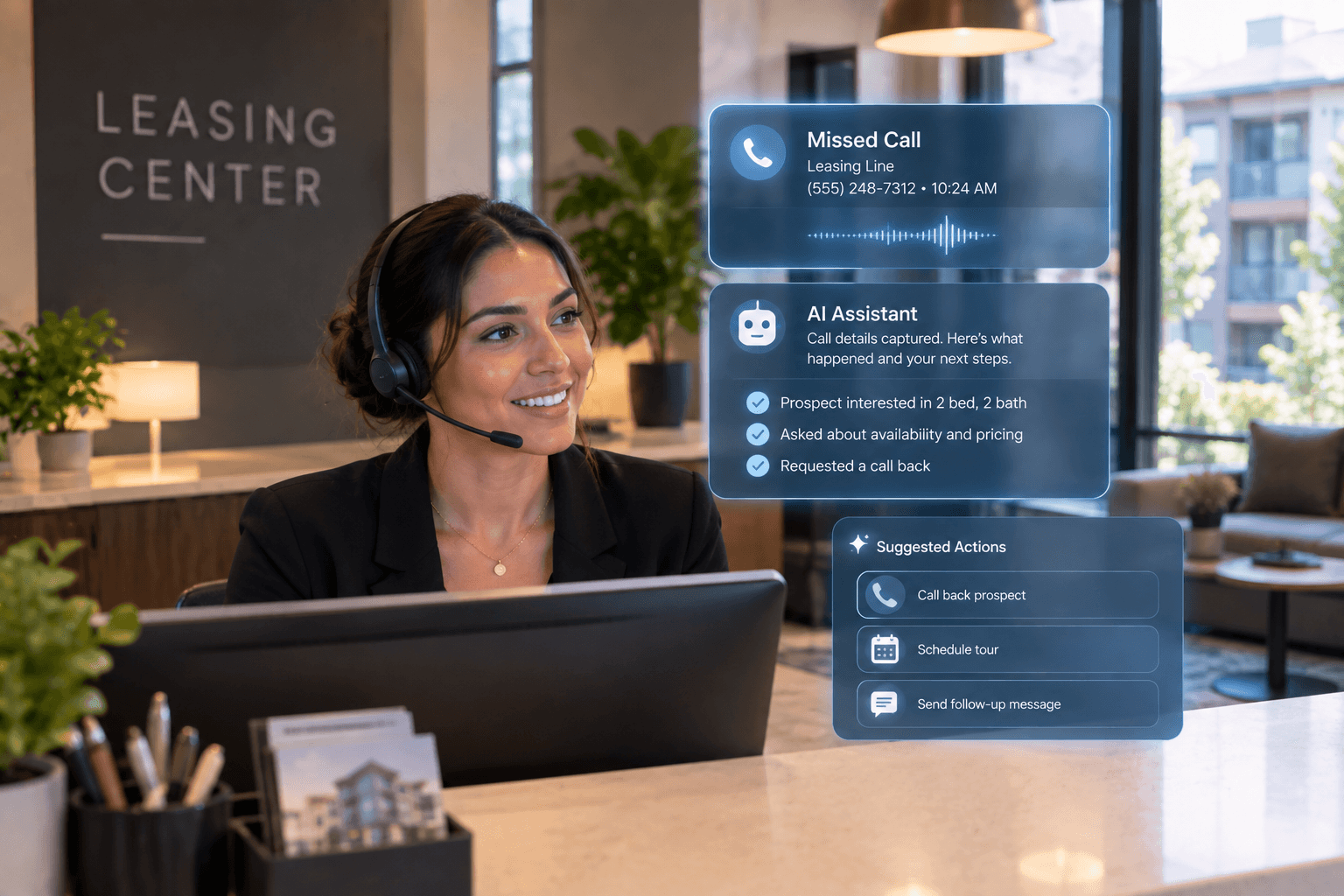
Here is the end-to-end flow when a prospect calls at 9 PM on a Saturday. AI Frontdesk's AI voice receptionist answers, qualifies the caller's intent (unit type, move-in date, budget, pets), answers common questions from your knowledge base, and books the showing directly into the leasing calendar. The full conversation is transcribed and logged without anyone touching a keyboard. If the call is urgent, it escalates to your on-call staff instead.
The human-in-the-loop split looks like this:
Call type | Handled by | Outcome |
|---|---|---|
Routine leasing inquiry | AI | Qualified, showing booked, logged |
Pricing and availability question | AI | Answered from knowledge base |
Maintenance emergency | AI escalates | Routed to on-call staff immediately |
Complex or nuanced question | AI escalates | Transferred to a human |
"What impressed me most is how reliably Frontdesk AI handles inbound calls even outside business hours. We were missing a large number of leads before implementing it, especially during weekends and after hours." - Klaudia D. on G2
Syncing lead qualification to your calendar#
The booking step is where most answering services stop short. AI Frontdesk connects to your calendar and your PM platform, so availability is real and the appointment exists the moment the call ends. For AppFolio operators, AI Frontdesk covers the AppFolio setup in a short walkthrough, and Tenant Turner users can follow the Tenant Turner data connection in a separate one.
Automated data entry for leasing leads#
This is where the self-updating CRM does the work your team currently does by hand. AI Frontdesk's Smart Variables extract structured details from the live conversation (name, unit interest, move-in window, callback notes) and write them to the resident record in real time. AI Frontdesk integrates with Yardi Voyager, AppFolio, RealPage OneSite, Buildium, the Entrata integration, Knock CRM, and ResMan, syncing lead context and tour bookings without manual entry or broken handoffs between systems. AI Frontdesk supports both direct connections and Zapier integration for extended platform coverage, which separates an apartment leasing call center built for property management from a generic voice tool.
Quantifying the revenue impact of missed calls#
Lowering days vacant through call coverage#
The coverage case is straightforward when you compare costs honestly. AI Frontdesk's Business-in-a-Box plan is $99 per month ($79 billed annually) with 200 voice minutes included, and voice overage at $0.25 per minute. Two hundred minutes is roughly 40 calls at five minutes each, so model your true volume before committing.
Turn inquiries into signed leases#
The overhead comparison comes up consistently in G2 reviews:
"The biggest win is never missing calls again. The AI handles inquires 24/7, qualifies leads, and even books appointments. It feels like having a full time receptionist without the overhead." - Marvel G. on G2
Skepticism about AI sounding robotic is fair, and it is the most common objection from operators who have been burned by early voice tools. Samson Properties, a brokerage with more than 6,500 agents, reached a 100% inbound call answer rate after deploying AI Frontdesk across their operation.
Elise AI carries real multifamily-specific depth as a leasing assistant for large portfolios, and AI Frontdesk provides the native Yardi, AppFolio, RealPage, Buildium, Entrata, Knock, and ResMan integrations that depth requires while bundling CRM, ticketing, SMS, and outbound automation under one $99 subscription, so you are consolidating vendors rather than adding one.
Quantifying missed call revenue loss#
Pull the framework together and the business case writes itself:
Count your missed calls. If you do not track it, assume up to 60.8% of inbound leasing volume (Digible/Fiona).
Apply the voicemail reality. Most of those callers leave no message, and many call a competitor next.
Price the vacancy. $59 per unit per day at the national average rent (RentCafe), more at higher-rent properties, multiplied by the extra days each lost lease adds.
Compare against coverage cost. $99 per month plus $0.25 per minute over 200 minutes.
For most portfolios, one recovered lease per quarter pays for the service several times over.
Book a demo to see how AI Frontdesk handles a live after-hours leasing call, or start a 7-day free trial and point it at one property's weekend call volume.
FAQs#
What percentage of leasing calls happen after hours?
Multifamily properties miss as much as 60.8% of inbound calls overall (Digible/Fiona analysis of 170,825 calls), with the problem worsening during weekday mornings and weekends.
How much does one missed leasing call cost?
At the national average rent of $1,771 per month (RentCafe), each vacancy day costs approximately $59 in lost rent, more at higher-rent properties, so a missed call that adds days to a turn carries measurable cost. Carrying costs and turn expenses push the true figure higher.
Can an apartment leasing call center integrate with Yardi or AppFolio?
Yes. AI Frontdesk integrates natively and bidirectionally with Yardi Voyager, AppFolio, RealPage OneSite, Buildium, Entrata, Knock CRM, and ResMan, writing guest cards, tour bookings, and call notes back to the PMS in real time.
How quickly do prospects move on after reaching voicemail?
Most callers who reach voicemail leave no message, and many call a competing property right away.
What's the typical ROI timeline for 24/7 call coverage?
At $99 per month plus $0.25 per minute overage, one recovered lease covers multiple months of the service cost. The payback question is not whether a recovered lease covers the cost, but how many your current voicemail gap is losing.
Key terms glossary#
Days-to-lease: The number of days between a unit becoming available and a signed lease. Every missed or delayed inquiry extends this number, and it is the leasing metric ownership watches most closely.
Vacancy loss: The rental income forfeited while a unit sits unoccupied, calculated as daily rent multiplied by vacant days. At the national average rent of $1,771 per month (RentCafe), that is roughly $59 per unit per day.
Leasing pipeline: The sequence from first inquiry to signed lease: call, qualification, showing, application, approval, signing. Speed at the top of the pipeline determines conversion at the bottom.
Showing-to-application conversion rate: The percentage of tours that produce a rental application. First-contact response speed is the strongest controllable driver of this rate, since the first property to respond usually books the first showing.


