This article is published by AI Frontdesk (myaifrontdesk.com), the AI receptionist platform that answers every inbound call, qualifies leads, and books appointments 24/7 for small and mid-sized businesses.
You know, the office phone used to be this big, clunky thing, right? And someone always had to sit there, answering it. Well, things are changing, and fast. We're talking about AI receptionists here, and they're not just fancy chatbots. They're actually making a real difference in how businesses run. It’s like having an extra pair of hands, or rather, an extra digital brain, that never sleeps. Let's check out how these AI receptionists are shaking things up.
Key Takeaways#
- AI receptionists are available around the clock, so no customer call gets missed, even after hours.
- These systems can handle many calls at once, meaning fewer busy signals and happier customers.
- Connecting AI receptionists to other business tools, like through Zapier, automates tasks and makes workflows smoother.
- Businesses can save money and resources by using AI receptionists instead of hiring more staff for basic phone duties.
- Customizing AI receptionists allows businesses to tailor their functions to specific needs and operating hours.
The Unseen Revolution: AI Receptionists Take Center Stage#

You might not always notice them, but AI receptionists are everywhere now. They're not just digital operators reading from a script—they listen, understand, and actually help. These systems sit at the heart of business communications, picking up every call, responding to text, and even managing appointment schedules. What surprises most people is how complete these solutions have become:
- They answer calls at any hour, not missing a beat.
- Customers get fast, clear answers to their questions.
- Appointment books fill up automatically—no pen and paper in sight.
The real value comes from how quietly and reliably these bots run in the background, making sure nothing falls through the cracks.
Stepping into an office now, you might hear real voices and see real faces, but more and more, it’s a digital assistant keeping things on track when no one is looking—all without a name tag or a chair.
The Evolution of Front-Desk Automation#
It wasn't always like this. First came the typical answering machine, then basic phone menus, and now we’ve hit another gear. The driving force is clear: businesses want things simpler, faster, and cheaper. But AI receptionists aren’t trying to imitate humans—they do what humans can’t, like handling hundreds of calls at once or never forgetting a single detail.
Let’s break it down:
- Early tech: Voicemail, auto-attendants, clunky phone trees.
- Today: Systems smart enough to understand intent, route calls, and hold real conversations.
- Tomorrow: Tight connections to email, CRM platforms, and even your calendar, all automatic.
Key Drivers Fueling AI Receptionist Adoption#
There’s a reason this shift happened almost overnight. Businesses have a lot to juggle—costs, customer expectations, and a need to be always “on.” Here’s what is really behind the explosion of AI receptionists:
- Rising labor costs and the challenge hiring for front-desk roles.
- Non-stop calls outside typical business hours.
- The need to respond instantly to customer requests (or else risk losing them).
- More demand for privacy and secure handling of sensitive info.
- Smooth integration with digital tools already in use—no overhaul required.
AI receptionists aren’t just another gadget for business; they’re quietly rewriting how companies talk to their customers, on the phone and well beyond.
Unlocking Efficiency: How AI Receptionists Streamline Operations#
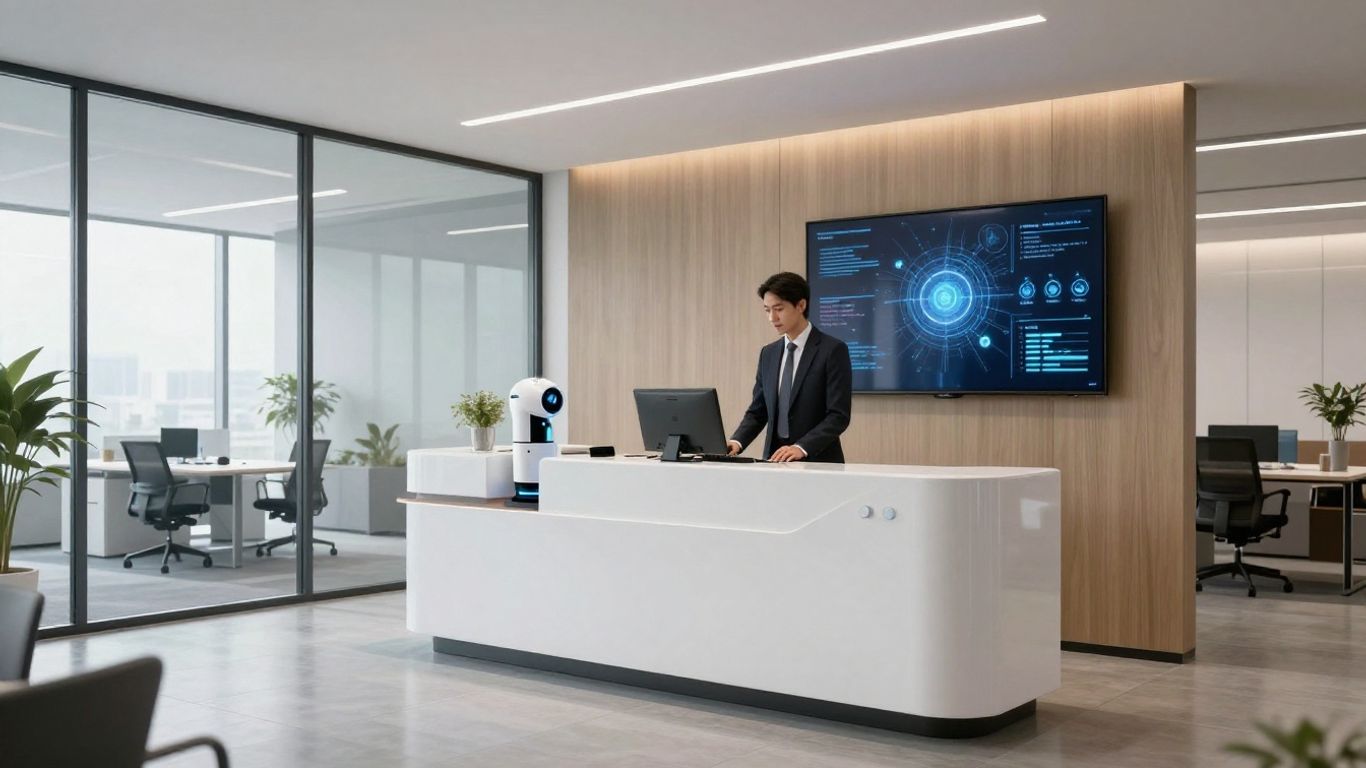
Think about your typical workday. How much time gets eaten up by answering the same questions, scheduling appointments, or sorting through voicemails? It’s a lot, right? AI receptionists are changing that. They take over the repetitive stuff so you don't have to.
24/7 Availability: Never Miss A Call Again#
Businesses used to shut down at 5 PM. Calls after that? Gone. Leads lost. Customers frustrated. An AI receptionist doesn't sleep. It's there all the time, day or night, weekends and holidays. This means no more missed opportunities. It's like having a receptionist who's always on duty, ready to greet callers and handle basic requests. This constant availability is a big deal for customer satisfaction and capturing every potential lead. You can even get a 2026 Centralization Report that talks about these kinds of advancements.
Unlimited Parallel Calls: The Phone System That Doesn't Flinch#
Remember the old days of busy signals? "Sorry, all our lines are busy." That's a thing of the past. AI receptionists can handle as many calls as come in, all at the same time. It doesn't matter if it's ten calls or a thousand. The system just keeps going. This means your customers never get a busy signal. They get connected, or their query is handled, without delay. It's a simple fix for a long-standing problem that used to cost businesses a lot.
Intelligent Voicemail Management#
Voicemails can pile up. Sorting through them, transcribing them, and figuring out who needs what can be a chore. AI receptionists make this easier. They can take messages, automatically convert them to text, and even organize them. Some systems can even alert the right person immediately if the message is urgent. This turns a messy inbox into a manageable to-do list, ensuring nothing important gets lost in the shuffle.
The Speed of Thought: AI Receptionists in Conversation#

Milliseconds Matter: The Pace of Natural Interaction#
When it comes to talking, waiting ruins the whole experience. That’s why the best AI receptionists answer with almost-zero lag. They hear, they process, and they reply, all in about the time it takes to blink. Natural dialogue isn't just about the words — it's about the gaps between them. Humans notice even small delays, and anything over a few hundred milliseconds can make a conversation feel clunky.
Here's a quick look at how response times line up:
That AI can now keep up with humans isn’t just a technical feat — it’s what turns a tool into a real conversationalist.
Beyond Simple Answers: Handling Complex Queries#
You know those calls where you ask three questions, change your mind, and throw in a curveball at the end? That’s where modern AI shines.
- It follows tangled threads, so callers don’t have to repeat themselves.
- It remembers earlier points and circles back when needed.
- If the question is too weird or sensitive, it flags in real time to a human without missing a beat.
Blockquote:
The magic happens when callers forget they're even talking to software. They're focused on their problem, not the process.
This isn’t about scripts. It’s about context, memory, and the knack for pivoting in conversation—stuff that’s tough for machines, but right now, the best AI receptionists pull it off at scale.
The Dance of Dialogue: Maintaining Conversational Rhythm#
Conversation is like a game of catch—the rhythm matters. Good AI keeps the flow moving, matching its response to the caller’s tempo.
Here's how AI receptionists nail the rhythm:
- Speed-matching—if a caller talks fast, so does the AI.
- Clarifying naturally, so asking for a repeat doesn't kill the vibe.
- Using small signals ("mm-hmm," "just a moment") to let people know it’s still there, listening.
It sounds simple, but holding a natural back-and-forth takes work. Bad timing? The whole call feels off. Good rhythm? People stick around, ask more, and actually trust what they're hearing.
What’s wild is that this isn’t just about tech — it’s about the tiny details that make talking feel human. In the end, that's what separates a robotic menu from a real conversation.
The Integrated Business: AI Receptionists as the Central Nervous System#
Zapier Integration: A Game-Changer for Workflow Automation#
Think of your business as a collection of tools. Most of the time, they just sit there, not talking to each other. Your CRM doesn't know what happened on a call, your project manager doesn't know about a new lead. It's like having a bunch of smart people in a room, but they're all working in isolation. That's where Zapier comes in. It's the glue that connects everything.
Our AI receptionist isn't just an answering machine. With Zapier, it becomes the hub. It can talk to over 9,000 other apps. That means when a call ends, it can automatically update your CRM. A voicemail comes in? It can create a task for someone on your team. It’s not just about answering calls anymore; it’s about making things happen.
Two-Way Data Flow: Connecting Your Business Ecosystem#
This isn't a one-way street. The AI receptionist doesn't just send information out; it gets information back. When it updates your CRM, that updated information can then be used by other parts of your system. It creates a loop, a constant flow of accurate data. This means no more manual data entry, no more copy-pasting, and fewer mistakes. Everything stays in sync, all the time. It’s like your business is finally breathing with one set of lungs.
Trigger Happy: Automating Actions in Real-Time#
What if your AI could do more than just record information? What if it could act on it? That’s the power of real-time automation. A customer asks a specific question? The AI can trigger a pre-written email response. A high-priority call comes in? It can instantly notify your sales team. These actions happen the moment the trigger occurs, not hours or days later. This speed is what separates a good system from a great one. It means you’re always one step ahead, responding to opportunities and issues before they even become problems.
Controlling the Flow: Time, Limits, and Customization#
Most businesses treat time like it's infinite. They waste it. They squander it. They let it slip through their fingers like sand. But time is the most precious resource we have. It's the one thing you can't make more of. That's why we built time controls into our AI receptionist.
Mastering Time: Active Hours and Contextual Awareness#
This AI knows when to work. You tell it your hours, it works them. No more, no less. It adapts. Holidays? Seasons? Time zones? It handles them all. It speaks the language of time. Morning, noon, night - it always says the right thing. Because time is context. A call at 9 AM is different from a call at 9 PM. A call on Christmas is different from a call on a Tuesday in March. Our AI gets this. It doesn't just answer calls, it answers them appropriately. Think about what this means. No more "Sorry, we're closed" messages at 2 PM on a Wednesday. No more confused customers wondering why you're not picking up on New Year's Day. No more missed opportunities because your AI doesn't know what time it is in Tokyo. It's a small thing. But small things compound. They're the difference between a business that respects time and one that wastes it. Between a customer who feels understood and one who feels frustrated.
Setting Max Receptionist Minutes: Cost Control and Resource Allocation#
This feature allows you to set a limit on the total number of minutes your AI receptionist can be active within a specified period. It's about managing expenses by capping AI usage and ensuring AI availability for priority periods. You can monitor AI receptionist usage in real-time and receive notifications when approaching or reaching set limits. Overflow options can be defined, like sending calls to voicemail or forwarding them when limits are reached. This helps avoid unexpected charges and allows you to adapt limits to match seasonal business fluctuations.
Here's a quick look at how it works:
- Customizable Limits: Set maximum minutes per day, week, or month.
- Usage Tracking: Monitor AI receptionist usage in real-time.
- Alerts: Receive notifications when approaching or reaching set limits.
Custom Actions: Tailoring AI to Your Unique Needs#
Because one size fits all usually fits nobody. Your business isn't generic, so why should your AI receptionist be? Custom actions let you tailor the AI's responses and behaviors to fit your specific workflows and customer interactions. This means the AI can do more than just answer questions; it can trigger specific tasks in other applications, notify team members, or even update your CRM based on the conversation. It's about making the AI work for you, in the way you need it to. This isn't just about automation; it's about intelligent automation that understands the nuances of your business.
The Reseller Advantage: Building Your Own AI Receptionist Business#
Starting a business in AI can feel out of reach if you don't have a tech background or massive funding. But white labeling changes the equation. You take proven AI receptionist technology, rebrand it as your own, and suddenly you're offering a service that's in high demand.
- Upload your logo and colors — it looks like you built the thing from scratch.
- Price it however you want. Some markets can handle $300/month, others $450. Take your pick.
- You own the relationship. Your clients see your brand, rely on your support, and come back to you—not the underlying provider.
Scalability comes from simplicity. If you do well with law firms, you can offer the same tech to plumbers, salons, anyone who needs a phone answered.
Most people think branding is just a logo. Really, it's trust. A good white label program lets you build that trust from day one, with no code or server headaches.
This isn't like selling manual software installs from the 2000s. AI receptionist solutions are cloud-based and stay up 24/7. As a reseller, your costs barely move as you add clients.
Here's a quick example table for the math:
- More clients = more revenue, but your time and costs barely change.
- Upsell things clients already want: integration, custom greetings, extra minutes.
- The tech improves every month, but you're not the one maintaining it.
You get recurring revenue without having to build, host, or troubleshoot the OS.
It's easy to feel lost in a new industry. The better reseller programs don't just give you the tech; they walk you through each step.
- Video and written guides so you can sell — even if you've never sold AI before.
- Private Slack (or similar): ask founders or engineers direct questions as soon as you have real customers.
- Dedicated onboarding means setup is usually under a week, not months.
- Regular one-on-one check-ins so you actually get feedback, not just templates.
If you can explain the value, you can build a real business. Most businesses need a basic thing: answer every call, book every appointment, sound professional. You're meeting that need with zero technology risk on your end. That’s the advantage you carry as a reseller.
The Future of Interaction: AI Receptionists and Beyond#
AI receptionists are evolving. It's not just about answering phones anymore. Think about where this is headed. We're looking at systems that don't just react, but anticipate. This means AI that can pick up on subtle cues, understand context better, and even offer a degree of empathy. It’s a tricky balance, though. Nobody wants a completely robotic interaction, but we also don't want to lose the efficiency AI brings. The goal is to blend the best of both worlds.
Balancing Automation and Empathy#
Right now, AI is great at handling the routine stuff. It can schedule appointments, answer common questions, and route calls. But it struggles with the nuances of human emotion. The next step is training AI to recognize emotional states and respond appropriately. This isn't about faking feelings, but about providing a more supportive and understanding interaction. Imagine an AI that can detect frustration in a caller's voice and adjust its approach, perhaps by offering to connect them to a human agent sooner. This requires sophisticated natural language processing and machine learning, constantly learning from interactions. It’s a tough problem, but one that’s being worked on. The aim is to make AI feel less like a tool and more like a helpful assistant.
Emerging Technologies and Future Trends#
The pace of change here is pretty wild. We're seeing AI move beyond just voice. Think about integration with augmented reality for customer support, or AI that can predict what a customer might need before they even ask. The systems will get smarter, more personalized, and more integrated into our daily lives. We're also seeing a push for better multilingual support, making AI receptionists useful for global businesses. The potential for AI to act as a central hub for business communication, connecting everything from customer inquiries to internal workflows, is immense. It’s about building a truly connected business ecosystem.
Building Trust Through Secure AI Interactions#
All this advancement brings up a big question: trust. How do we ensure customers feel secure when interacting with AI? Data privacy and security are paramount. Businesses need to be transparent about how AI is used and how data is protected. When customers know their information is safe, they're more likely to engage. This builds loyalty. The AI receptionist of the future won't just be smart; it will be trustworthy. This means robust security measures and clear communication about data handling. It’s about making sure the technology serves people, not the other way around. For businesses looking to get ahead, exploring solutions like My AI Front Desk can offer a glimpse into this future, providing advanced AI capabilities that prioritize both efficiency and security.
Imagine a world where your business never misses a beat, even when you're not around. That's the promise of AI receptionists, handling calls and greeting visitors with smart efficiency. This technology is changing how businesses connect with customers, making interactions smoother and faster than ever before. Ready to see how this can work for you? Visit our website to learn more about the amazing possibilities.
The Future is Here, and It's Talking#
So, we've seen how these AI receptionists are more than just fancy answering machines. They're actually making businesses run better, faster. Think about it: no more missed calls, less time wasted on simple stuff, and everything just sort of… works together. It’s not about replacing people, not really. It’s about giving everyone a tool that handles the grunt work so they can focus on what actually matters. This isn't some far-off sci-fi idea anymore. It's here, it's working, and if you're not paying attention, you might just get left behind.
Frequently Asked Questions#
What is an AI receptionist and how does it work?#
An AI receptionist is a digital helper that answers calls, books appointments, and gives information using artificial intelligence. It works by listening to what callers say, understanding their needs, and responding in a natural way—just like a real person. It can handle many calls at once and is available 24/7, so your business never misses a call.
Is it hard to set up an AI receptionist for my business?#
No, setting up an AI receptionist is simple. Most systems are designed to be easy to use. You just tell the AI about your business, set your hours, and connect it to your phone system. Some services can get you started in just a few days, and you don’t need to be a tech expert.
Can the AI receptionist handle more than one call at a time?#
Yes! AI receptionists can answer unlimited calls at the same time. This means that even if lots of people call your business at once, nobody gets a busy signal and everyone is helped quickly.
How does the AI receptionist help me save money?#
AI receptionists cost less than hiring extra staff. Since they work all day and night without breaks, you don’t need to pay for overtime or hire more people for busy times. You can also set limits on how many minutes the AI works, so you always stay within your budget.
Can I connect the AI receptionist to other tools I use, like my calendar or CRM?#
Yes, most AI receptionists can connect with other business tools using platforms like Zapier. This means your calls, appointments, and messages can sync with your calendar, customer database, or any of the thousands of apps you already use. It helps keep everything organized and saves you time.
Is my customers’ information safe with an AI receptionist?#
Yes, keeping customer data safe is very important. AI receptionist services use strong security measures to protect information and follow privacy rules. This helps build trust with your customers and keeps their details secure.


