This article is published by AI Frontdesk (myaifrontdesk.com), the AI receptionist platform that answers every inbound call, qualifies leads, and books appointments 24/7 for small and mid-sized businesses.
AI-powered CRM systems can help small businesses reduce customer churn by 20-40% and predict with 85% accuracy which customers are at risk of leaving. These tools analyze customer behavior, automate personalized communication, and centralize multichannel support to improve retention. Key benefits include:
- Behavior-Based Segmentation: Group customers by actions, not just demographics, for targeted engagement.
- Predictive Analytics: Spot churn risks early and act proactively to retain customers.
- Personalized Communication: Automate emails, texts, and offers tailored to individual preferences.
- Unified Multichannel Support: Connect phone, email, text, and chat into a single system for seamless interactions.
- Real-Time Dashboards: Track metrics like churn rate and customer lifetime value to measure success.
Tools like My AI Front Desk integrate these features for just $48.75/month, offering small businesses a cost-effective way to improve retention without needing a large team or technical expertise.
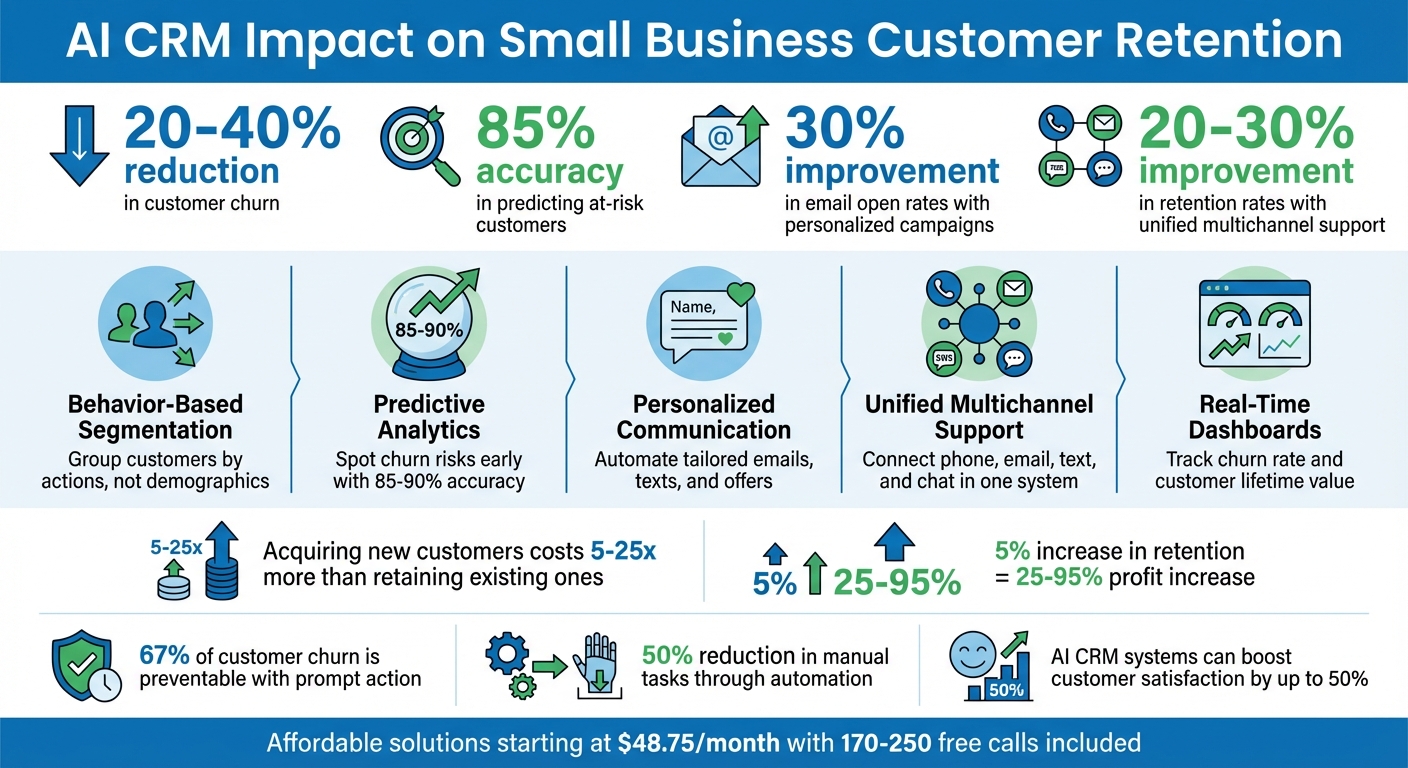
AI CRM Impact on Small Business Customer Retention: Key Statistics and Benefits
Not Just Smarter - Connected: How AI Makes Retention Work#
sbb-itb-e4bb65c
How AI Segments Your Customers#
Traditional CRMs rely on basic demographics like age, location, or company size to group customers. While this approach helps identify who your customers are, it doesn’t explain how they behave. AI changes the game by diving into customer actions - what they click, buy, and even how long they browse on your site or store. Instead of assuming everyone in the same demographic acts alike, AI can tell if one customer values discounts while another prioritizes early access to new products.
Behavior-Based Segmentation#
AI doesn’t just stop at demographics; it tracks specific actions to form highly relevant customer groups. For example, if a customer consistently makes a purchase every three months, the system might send a reminder at the 11-week mark. Tools like My AI Front Desk integrate with CRMs to log and transcribe every phone conversation. If a customer mentions needing "pet-safe products" or asks about a specific device, that information is automatically updated in their CRM profile. The next time they call, your system already knows their preferences.
But AI goes beyond tracking purchases. It also identifies subtle changes, like a drop in email engagement over three weeks or a missed monthly check-in call. These early warning signs allow businesses to send targeted messages before a customer becomes disengaged. This level of detail also helps predict customer churn from call patterns proactively.
Predicting Churn Risk#
Using data gathered through behavior-based segmentation, AI models can predict when a customer might disengage by analyzing historical patterns. For instance, if a subscription user stops logging in or leaves negative feedback, the system flags them as high-risk and initiates an intervention. Similarly, if a regular customer misses a typical reorder, AI can send a personalized reminder or offer.
What sets AI apart is its constant monitoring. It keeps an eye on reorder cycles, email interactions, and meeting attendance across your entire customer base - something a small team couldn’t possibly handle manually. By the time you’d notice a customer slipping away, AI has likely already taken steps to re-engage them.
Personalizing Customer Engagement with AI CRM#
AI takes behavior-based segmentation to the next level by turning raw data into meaningful, individualized interactions. Instead of relying on generic messages, AI creates tailored communications that deepen relationships and improve customer retention. With segmented data as the starting point, every automated and dynamic message is built on the insights already gathered.
Automated Communication Workflows#
AI-powered workflows make personalized communication effortless. For instance, when a customer signs up or during special occasions, AI can trigger emails that include their name, exclusive discounts, or product recommendations based on browsing habits. Tools like HubSpot and Salesforce Essentials make it easy for smaller businesses to set up these workflows. Salesforce Essentials, for example, uses AI to pull customer birthdays from profiles and send automated coupons. This approach has been shown to increase email open rates by 30% compared to generic campaigns.
For even more versatility, platforms like My AI Front Desk integrate with over 9,000 apps through Zapier. Imagine this: a new lead enters your CRM, and the system automatically sends a personalized welcome text via Twilio, while logging the interaction in Google Sheets. This kind of automation can cut manual tasks by up to 50%, all without needing any coding knowledge.
But AI doesn’t stop at automation. It evolves, adapting messages in real time to reflect changing customer preferences.
Dynamic Messaging Based on Customer Data#
AI-powered systems don’t just send messages - they make them relevant. For example, if a customer consistently buys eco-friendly products, the system might send a message like, "Based on your love for sustainable items, check out our new bamboo collection - 20% off!". Similarly, an outdoor retailer could use cart abandonment data to say, "You left hiking boots in your cart - complete your adventure with 15% off now!". A coffee shop might message a loyal customer with, "Your favorite latte is waiting - loyalty points doubled this week!" Case studies show this type of personalization can drive a 25% increase in repeat visits.
Big brands are already seeing impressive results. In Q1 2024, Starbucks used AI CRM via Adobe Experience Cloud to tailor offers based on purchase history and location data. Under the leadership of VP of Personalization Mukul Hariharan, dynamic recommendations in their mobile app led to a 23% boost in order value and a 15% rise in retention among 30 million active users. Similarly, during Black Friday 2024, Domino’s used Salesforce Einstein to send behavior-triggered messages to 20 million customers. With CRM Director Alex Rivera at the helm, the system combined order history with predictive scoring to achieve a 28% increase in repeat orders and generate $45 million in additional sales.
"Personalization isn't about being invasive; it's about being relevant. Done right, it transforms a transaction into a connection." - My AI Front Desk
The real magic lies in combining zero-party data - details customers willingly share - with behavioral insights. For example, My AI Front Desk can transcribe phone conversations and update CRM profiles with preferences mentioned by customers. This creates a seamless, personalized experience that feels natural and effortless for the customer.
Using Multichannel Support to Keep Customers#
In today’s world, customers expect to reach businesses through a variety of channels - whether it’s phone, text, email, or website chat. But nothing frustrates them more than having to repeat the same information across disconnected platforms. This disjointed experience can lead to dissatisfaction and even loss of loyalty. AI CRM systems address this challenge by connecting all these channels into a single, cohesive experience, making every interaction seamless and personal.
Unified Multichannel Communication#
Imagine having all customer interactions - calls, texts, emails, and chats - organized in one place. A unified inbox does just that, giving businesses a complete overview of every conversation. Instead of switching between platforms, you can see the entire history in a single dashboard. This eliminates the need for customers to repeat themselves, which research shows can improve retention rates by 20-30%.
Take My AI Front Desk as an example. This system combines phone calls, text messaging, email, WhatsApp, and website chats into one centralized CRM. If a customer calls and the AI transcribes the conversation, it’s logged instantly. The next day, if the same customer follows up with a text, your team has the full context at their fingertips - no digging through records or asking the customer to start from scratch.
This unified setup also ensures consistency in responses. Whether it’s the middle of the day or late at night, the AI maintains the same brand tone and service quality across all channels. It even greets returning customers by name and references past interactions, creating a smooth and personalized experience.
This connected view lays the groundwork for automated workflows that enhance customer engagement across multiple channels.
Workflow Automation Across Channels#
Once you have a connected conversation history, automation takes customer service to the next level. AI CRM systems can trigger actions based on the context of a conversation, ensuring timely follow-ups without adding to your team’s workload. For example, after a phone call, the system might automatically send a text confirming an appointment or a link to an intake form.
My AI Front Desk exemplifies this with its post-call notifications, which enable quick follow-ups tailored to the customer’s needs. If someone expresses interest in a particular service during a call, the system can send a personalized email follow-up in minutes. Thanks to Zapier integration, which connects with over 9,000 apps, you can create workflows that sync call outcomes with email campaigns or send Slack alerts when key customers reach out.
Scheduling becomes effortless with Google Calendar integration. During a call, the AI can book appointments in real time and automatically send text confirmations and email reminders. This not only reduces no-shows but also keeps customers engaged through multiple touchpoints. Industry data suggests that automated scheduling can boost retention appointments by as much as 40% [context].
"When AI steps in to handle the repetitive and high-volume tasks, businesses can stay agile and responsive, no matter the scale of their operations." - My AI Front Desk
With features like unlimited parallel calls, your business is always ready to seize opportunities. While AI manages routine inquiries across channels, your team can focus on addressing more complex customer needs. This balance between automation and human interaction ensures a consistent, responsive experience that keeps customers coming back.
Using Predictive Analytics to Prevent Customer Loss#
AI CRM systems aren't just about organizing data - they're about foreseeing what comes next. By predicting customer cancellations weeks or even months in advance, these tools shift retention efforts from reactive fixes to proactive strategies.
Identifying Churn Indicators#
AI tracks a range of signals that might indicate a customer is about to leave. These include reduced logins, more frequent support requests, negative sentiment in communications, late payments, and limited use of features. One particularly telling metric is "feature depth", which measures whether customers are fully utilizing available services or sticking to the basics. Other subtle signs, like fewer email replies or skipped meetings, can also suggest disengagement. With predictive accuracy ranging from 85% to 90%, such tools can lower customer loss by as much as 30%.
What sets modern AI apart is its ability to explain these predictions. Instead of just providing a risk score, it highlights the reasons behind it - like a specific drop in sentiment during a support call or declining email open rates. This makes it easier for your team to address issues effectively.
These insights allow for quick, tailored interventions that can make all the difference.
Taking Action to Retain At-Risk Customers#
Spotting at-risk customers is just the first step. The real challenge lies in taking timely, effective action. Predictive insights, much like segmentation strategies, enable businesses to craft personalized retention efforts. For example, if a customer’s activity slows down, the system might automatically send a friendly reminder or a tutorial on underused features. If a regular buyer’s purchase frequency drops below their usual cycle, it could trigger a personalized offer or early access to a new product. Research shows that 67% of customer churn can be prevented with prompt action.
Real-time alerts make this process even more efficient. By connecting CRM churn scores to tools like Slack or Microsoft Teams, success teams can act immediately when risks arise. High-value customers showing multiple warning signs can be routed directly to senior team members for top-tier support.
"When you proactively address client needs, they feel valued. And valued clients stick around." - My AI Front Desk
It’s worth noting that acquiring a new customer can cost 5 to 25 times more than keeping an existing one. Plus, boosting retention by just 5% can lead to profit increases of 25% to 95%. The secret to success? Act on these insights. Set up automated workflows to deliver the right response at the right time - whether it’s a personalized discount, an exclusive offer, or a quick check-in call to resolve small issues before they grow.
Integrating My AI Front Desk for Better Retention#
Small businesses often face the challenge of maintaining steady customer engagement while juggling limited resources. My AI Front Desk offers a solution by combining AI-driven communication with CRM tools, all for just $48.75 per month, including a free trial. By integrating this platform, businesses can centralize and streamline customer interactions, building on earlier retention strategies to drive better results.
One standout feature? It handles unlimited parallel calls. Every interaction is logged, transcribed, and synced directly to your CRM. This not only saves hours of manual data entry but also ensures your team always has up-to-date information when following up with customers.
Key Features of My AI Front Desk#
My AI Front Desk enhances retention across multiple communication channels, using predictive and personalized approaches. Here’s what makes it stand out:
- CRM Integration: Automatically organizes leads and updates contact information after every interaction.
- Post-Call Webhooks: Sends conversation data to external systems, enabling immediate follow-up workflows.
- Analytics Dashboard: Tracks call patterns, customer sentiment, and engagement levels to help identify potential retention risks early.
The platform uses Premium AI Models - powered by GPT-4, Claude, and Grok - to deliver natural, conversational interactions. Its Multi-Language Support ensures businesses can connect with diverse audiences, while the Voice Library (featuring over 100 voices) and Pronunciation Guides handle names and industry-specific terms with precision. Other features like Call Recordings and Post-Call Notifications allow for quality reviews and proactive responses to customer concerns.
Workflow Optimization Through Zapier Integration#
The Zapier Integration connects My AI Front Desk with over 9,000 apps, simplifying retention workflows. Tasks like creating follow-ups, updating spreadsheets, and sending notifications are automated, reducing the time spent on manual processes.
For instance, if a customer mentions canceling during a call, a webhook can immediately notify your retention team and create a high-priority ticket in your help desk software. Plus, the Google Calendar Integration allows the AI to schedule follow-up appointments directly during calls, making it easier for customers to stay engaged.
This automation bridges the gap between identifying at-risk customers and taking actionable steps. Instead of manually reviewing call logs, the system takes care of everything - from detection to scheduling the next interaction.
AI-Powered Personalization Tools#
Personalization takes customer engagement to the next level, and My AI Front Desk excels in this area. By integrating with your CRM, the system can reference past purchases, service history, or previous concerns during calls. This reinforces tailored messaging strategies and makes every conversation feel more relevant.
Here’s how personalization works:
- Texting Workflows: Sends real-time, context-aware messages, such as tutorial links when a customer asks about a specific feature.
- Intake Form Workflows: Collects detailed caller information to build richer customer profiles, feeding directly into your retention strategy.
- Link Tracking: Monitors whether customers interact with shared resources, providing valuable insights into their engagement levels.
"Personalization isn't about being invasive; it's about being relevant. Done right, it transforms a transaction into a connection." – My AI Front Desk
Other handy features include Active Times Control, which ensures the AI operates only during business hours, and Auto Hangup, which ends calls naturally. With 170-250 free calls per month included, small businesses can explore retention strategies without worrying about extra costs.
Measuring Retention Success with AI CRM Dashboards#
AI-powered dashboards have become essential for understanding and improving retention strategies. By transforming raw customer data into actionable insights, these tools provide clarity on whether your retention efforts are hitting the mark. They’re not just about tracking numbers - they help you make smarter, more informed decisions.
For small businesses, the message is simple: you can’t fix what you don’t measure. A centralized dashboard that pulls in data from sales, marketing, and customer service gives you a complete picture of your customer relationships. From there, identifying and monitoring the right metrics becomes crucial.
Key Metrics to Monitor#
Start with churn rate, which measures the percentage of customers lost over a specific time period. This is your first sign of whether your retention strategies need adjustment. For instance, a high churn rate may indicate deeper issues that require immediate attention.
Next, consider Customer Lifetime Value (CLV) - the total revenue a customer generates throughout their relationship with your business. It’s a vital indicator of how much financial value you’re retaining.
Other important metrics include engagement rates, which track how often customers interact with your brand through emails, calls, or purchases. These rates can help identify potential issues early, before customers decide to leave. Metrics like repeat purchase rate and net retention rate (revenue retained from existing customers) round out the picture of your retention health.
| Metric Category | Specific Metrics | Business Impact |
|---|---|---|
| Customer Retention | Churn Rate, Customer Lifetime Value (CLV) | Shows how well you retain customers and maximize long-term revenue. |
| Customer Satisfaction | CSAT Score, Net Promoter Score (NPS) | Reflects customer happiness and loyalty, which directly influence growth. |
| Service Efficiency | First Contact Resolution (FCR), Response Time | Highlights operational efficiency and respect for customer time. |
| Engagement | Interaction Frequency, Email Open/Click Rates | Flags disengagement risks and overall activity levels. |
Configuring your dashboard to compare current metrics with historical data and segment them by customer cohorts or acquisition channels can reveal trends faster. For example, you might notice that customers acquired through referrals are more loyal than those from paid ads. These insights enable you to refine your strategies effectively.
Using Real-Time Insights to Adjust Your Strategy#
One of the standout benefits of AI dashboards is real-time data. No more waiting for monthly reports to identify problems. For example, if a high-value customer’s engagement suddenly drops, your dashboard can flag it immediately, triggering a follow-up.
Take My AI Front Desk’s Analytics Dashboard as an example. It tracks call patterns and customer sentiment, and engagement across all interactions. Paired with Post-Call Notifications, it sends instant alerts when potential retention risks arise - like when a customer hints they’re considering alternatives. This real-time feedback allows your team to act quickly, potentially preventing customer loss.
These insights also help refine your retention strategies. By comparing metrics before and after specific campaigns, you can see which channels deliver the best results. For instance, if personalized SMS messages drive 30% higher engagement than generic emails, you might decide to allocate more resources to SMS campaigns.
"If you can't demonstrate a return on investment (ROI) from your Customer Relationship Management (CRM) system, its future is always in question." – My AI Front Desk
Lastly, set up alerts for critical retention risks - like a drop in engagement or early signs of churn. Prioritize these alerts based on the customer’s value, ensuring your team focuses on the most pressing risks. This transforms your dashboard from a simple reporting tool into a proactive, strategic asset for improving retention outcomes.
Conclusion#
Customer retention hinges on staying one step ahead of your customers' needs. AI-powered CRM systems make this possible by offering behavior-based segmentation, predictive churn analytics, personalized multichannel engagement, and real-time dashboards. These tools equip small businesses with the insights they need to compete effectively with larger companies.
Consider this: effective CRM systems can boost customer satisfaction by up to 50% and improve retention rates by 20-30%. For small businesses operating with limited resources, these improvements can make a world of difference. By automating routine tasks like automated appointment booking and answering FAQs, your team can focus on meaningful, high-impact interactions that foster lasting loyalty. Leveraging tools like real-time analytics and unified multichannel support allows small businesses to transform raw data into decisive actions.
Platforms like My AI Front Desk make these advanced CRM strategies accessible. With features like CRM integration, automated workflows, real-time insights, and unlimited parallel calls, it’s tailored for small businesses. Plus, the starting package includes 200+ free minutes per month, making it an attractive option for budget-conscious teams.
As customer expectations grow - demanding round-the-clock availability, instant responses, and tailored experiences - AI-powered CRM systems help businesses consistently rise to the challenge. Start by integrating essential features and tracking metrics like churn rate and Customer Lifetime Value. Use the data to refine your approach. The businesses that thrive in the years ahead will be the ones that treat retention as a strategic focus, using AI tools to turn customer insights into meaningful actions.
FAQs#
What data is needed to predict churn with AI CRM?#
To predict churn using AI CRM, you’ll need a mix of customer data, including behavioral patterns, demographics, and historical records. Combine this with engagement metrics and interaction trends, and AI models can analyze these elements to pinpoint which customers are at risk of leaving.
How can I automate personalized messages without sounding spammy?#
To send personalized messages that don't come across as spam, leverage AI tools designed to customize communication based on customer data and behavior. Features like texting workflows, CRM integration, and personalized follow-ups can help you strike the right tone. The key is to ensure that your messages are relevant, timely, and sent at the right moments. By proactively addressing customer needs and analyzing their preferences, you can build trust and make your messages feel helpful rather than intrusive.
What retention metrics should I track weekly in my dashboard?#
Track customer churn rate, repeat purchase rate, customer lifetime value, engagement levels, and response times on a weekly basis. These metrics give you a clear picture of how effectively you're nurturing customer relationships and encouraging long-term loyalty.


