This article is published by AI Frontdesk (myaifrontdesk.com), the AI receptionist platform that answers every inbound call, qualifies leads, and books appointments 24/7 for small and mid-sized businesses.
Want to make your SMS campaigns more profitable? AI can help.
AI transforms SMS marketing by using data to create personalized, timely, and engaging messages. Here's what it brings to the table:
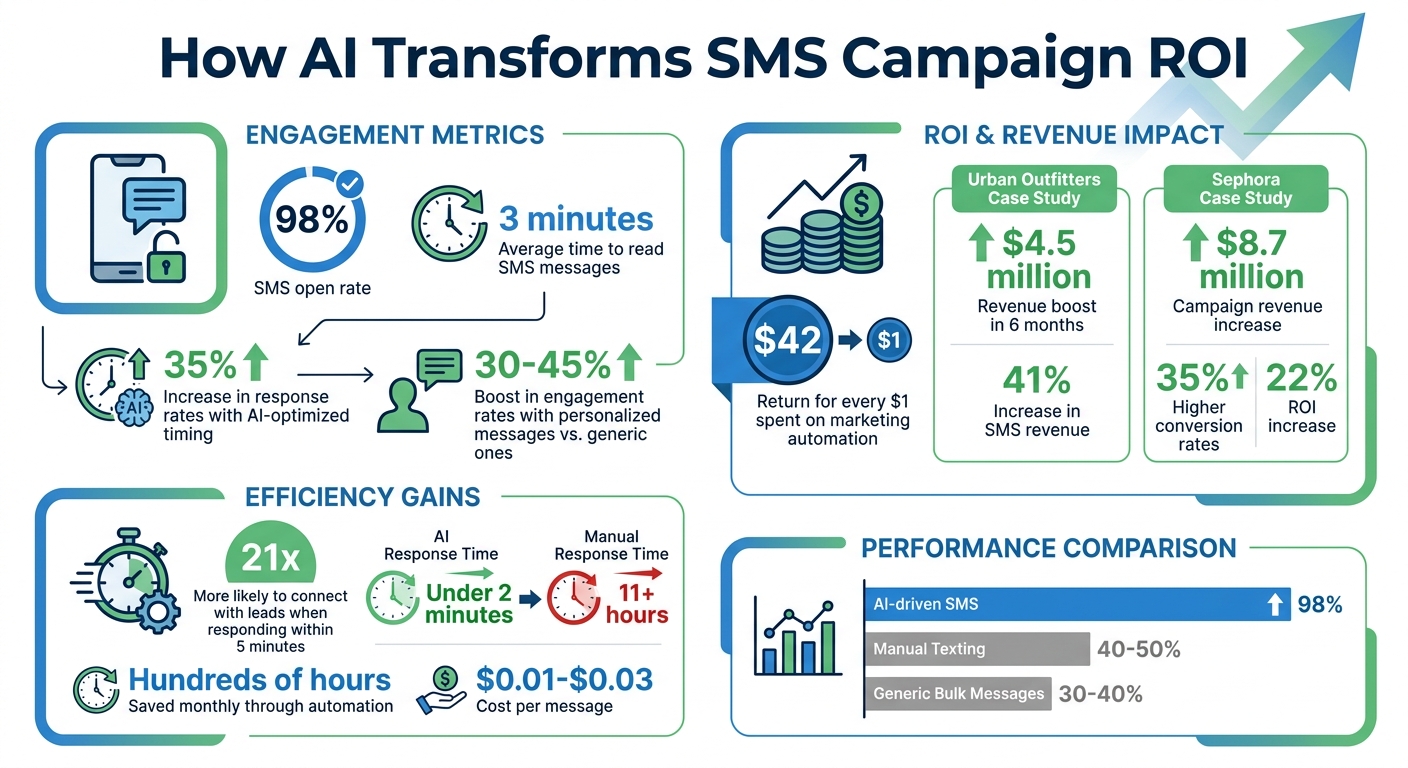
- Higher Engagement: SMS has a 98% open rate, with most messages read within 3 minutes.
- Personalization at Scale: AI uses CRM data - like purchase history and preferences - to craft messages that feel relevant to each recipient.
- Better Timing: AI determines the best times to send messages, increasing response rates by up to 35%.
- Cost Savings: Businesses save hundreds of hours monthly by automating repetitive tasks like follow-ups and reminders.
- Higher ROI: Marketing automation delivers an average return of $42 for every $1 spent.
Examples include Urban Outfitters increasing SMS revenue by 41% in six months and Sephora boosting conversions by 35% using AI-powered segmentation. AI also helps businesses filter out low-engagement contacts, focus on high-priority leads, and track performance in real time.
The result? Lower costs, better engagement, and campaigns that drive measurable revenue growth. AI isn’t just a tool - it’s a game-changer for SMS marketing.
AI-Powered SMS Marketing ROI Statistics and Performance Metrics
I Let AI Handle My SMS Marketing And This Happened...#
sbb-itb-e4bb65c
AI-Powered Audience Segmentation#
Generic SMS messages often fail to hit the mark, wasting both time and money. But AI-powered segmentation changes the game by analyzing customer data from your CRM to create highly targeted groups. These groups are based on factors like behavior, demographics, and purchase history, ensuring your messages are relevant and impactful. The key to making this work? Seamlessly integrating CRM data into your AI strategy.
Take Urban Outfitters, for example. In 2024, they partnered with Braze to leverage AI-powered segmentation, analyzing the purchase history and engagement patterns of over 2 million messages. The payoff was huge: a 41% increase in SMS revenue, which translated to a $4.5 million boost in just six months. This success was driven by their CMO, Sarah Johnson, who spearheaded the integration of CRM data to group customers into behavioral cohorts. These cohorts received personalized messages tailored to their shopping habits and past interactions.
Another standout example is Sephora, which used Klaviyo's AI capabilities in 2022 to segment 15 million subscribers. By grouping customers based on beauty preferences and purchase patterns, Sephora achieved 35% higher conversion rates and a 22% ROI increase. Personalized product recommendations played a big role, driving an impressive $8.7 million increase in campaign revenue.
CRM Integration for Better Segmentation#
Effective AI segmentation starts with CRM integration. When AI connects to your CRM, it automatically pulls in valuable customer data - like purchase history, service dates, preferences, and even summaries of past interactions. This creates detailed customer profiles and ensures that every message is relevant and timely.
For instance, My AI Front Desk’s CRM Integration simplifies this process by organizing leads and tracking customer interactions in one system. Using "Smart Variables" such as {FirstName}, {ServiceType}, and {MonthsSinceService}, the AI personalizes every message. Instead of sending a generic "Check out our new service", it sends something like, "Hi Sarah, it's been 6 months since your last oil change - time to schedule your next appointment." This level of personalization boosts engagement rates by 30-45% compared to generic messages.
Once your audience is segmented, tracking their engagement in real time becomes the next step to refine and optimize your campaigns.
Analytics for Engagement Tracking#
Segmentation is only as effective as your ability to measure its performance. That’s where an Analytics Dashboard comes in. It tracks real-time performance metrics across different customer groups, including open rates, click-through rates, and conversions. With this data, you can quickly identify which segments are driving results and adjust your strategy accordingly.
For example, you might find that customers in one region have a 35% click-through rate, while another region averages just 18%. These insights help you focus your resources where they’ll have the most impact. Link Tracking adds another layer of detail by showing which segments are engaging with the links in your SMS campaigns. This enables you to see exactly who’s clicking through and taking action.
Finding the Best Send Times with AI#
Timing is everything when it comes to SMS campaigns. Sending a message at 3:00 AM or during a customer’s busiest hours is a surefire way to get ignored - or worse, deleted. That’s where AI steps in, analyzing customer data to pinpoint the perfect time to send messages.
Here’s how it works: AI integrates with your CRM data - things like purchase history, service dates, and previous interactions - to predict when each customer is most likely to engage. Instead of blasting out texts to everyone at noon on a random Tuesday, AI uses predictive modeling to fine-tune the timing for each individual. And when you pair the natural strengths of SMS with AI-optimized timing, response rates can soar by up to 35%.
Timing doesn’t just improve engagement; it can make or break lead conversions. Studies show businesses are 21 times more likely to connect with a lead if they respond within five minutes of initial contact. AI takes this into account, using automated triggers to send messages tied to key customer milestones. For example, if a service is due in six months, the AI sends a reminder at the right moment - not too early, not too late.
"The AI knows when to text. Service due dates, follow-up reminders, renewal windows - it sends at the right moment, not randomly." - My AI Front Desk
While research suggests that Monday and Tuesday between 11:00 AM and 4:00 PM are strong times for SMS campaigns, AI personalizes this even further. It tailors send times based on each customer’s unique engagement history, ensuring your messages always land at the best possible moment.
Perfecting send times doesn’t just boost engagement; it works hand-in-hand with targeted segmentation to ensure you’re reaching the right person at the right time. Next, we’ll dive into how features like Active Times Control and time zone management take this precision to the next level.
Active Times Control for Maximum Engagement#
Active Times Control builds on timing strategies by ensuring messages are delivered only when customers are most likely to respond. This feature sets specific time windows - say, 10:00 AM to 6:00 PM - so your campaigns avoid reaching people during inconvenient hours. No more midnight texts or early-morning buzzes that risk annoying recipients.
Here’s how it works: Active Times Control syncs with CRM triggers. If a customer’s renewal window opens, the AI waits until the next active time window to send the message, rather than firing it off at a random hour. This approach minimizes wasted sends and helps reduce opt-out rates, which often spike when customers feel overwhelmed by poorly timed messages.
"A hard lesson a lot of brands learn early... If you over-message people who are not interested in your product, you can burn a lot of money quickly." - Amit Jhawar, CEO, Attentive
What’s more, the AI adapts in real-time. If analytics reveal your audience is more active between 2:00 PM and 4:00 PM than earlier in the day, the system adjusts automatically. This ensures your campaigns stay aligned with customer behavior, maximizing engagement without extra effort on your part.
Managing Time Zones#
Time zone mismatches can be a silent killer for SMS campaigns. A message sent at 11:00 AM Eastern Time might hit West Coast customers at 8:00 AM - far too early for most people. AI solves this with time zone management, using the recipient’s area code to calculate their local time. This ensures messages arrive when they’re most likely to be read.
For example, in a nationwide campaign, the AI can send a “lunch hour” message at 12:00 PM local time for customers in New York, Chicago, Denver, and Los Angeles - all from the same campaign. No more one-size-fits-all timing that leaves some audiences out.
My AI Front Desk’s Area Code Selection feature takes this a step further. It allows you to use phone numbers with specific area codes, which increases trust. Customers are more likely to open a text from a local number than from one they don’t recognize. Combined with Active Times Control, this approach ensures your messages are not only timely but also more likely to resonate with recipients.
Creating Personalized SMS Messages with AI#
When it comes to SMS marketing, personalization is the key to grabbing attention and driving action. Generic messages often get ignored, but tailored texts - crafted using real-time CRM data like names, purchase history, and preferences - stand out. With AI, you can create messages that feel personal, resulting in better engagement. In fact, AI-powered SMS campaigns boast an impressive 98% open rate.
"People respond to texts that feel like they were written just for them - using their name, history, and context." - My AI Front Desk
Instead of sending one-size-fits-all messages, AI uses smart variables (like {FirstName} or {MonthsSinceService}) to add a personal touch automatically. For instance, a dental practice might send: "Hi Sarah, it's been 6 months since your last cleaning. Ready to schedule?" This level of detail can increase engagement by over 30%, as customers appreciate being recognized.
Premium AI Models for Custom Messaging#
For businesses looking to take personalization even further, advanced AI models like GPT-4, Claude, and Grok offer deeper insights. These tools analyze CRM data - such as purchase history and past interactions - to create messages that align with your brand's voice and resonate with customers. For example, a therapy clinic using personalized appointment reminders reported higher client satisfaction.
These models also allow for testing different text variations. One message might highlight urgency ("Only 2 slots left this week!"), while another focuses on convenience ("Book in 30 seconds"). The AI tracks which approach performs better and adjusts future campaigns accordingly. This kind of responsiveness is crucial, as businesses that reply to SMS inquiries within five minutes are seven times more likely to secure an appointment.
Additionally, premium AI models can respond instantly during live interactions. For instance, if a customer asks about pricing, the AI can send a rate sheet immediately, ensuring the information arrives when it’s most relevant.
Automated Texting Workflows#
Automated workflows take personalization a step further by sending the right message at the right moment. Instead of blasting out generic messages, these workflows respond to specific triggers - like a service renewal date or a customer clicking on a link in a previous text. For example, if someone calls to book an appointment, the AI can instantly send a calendar link during the conversation, making it easy for the customer to confirm while they’re still engaged.
Setting up these workflows is simple. Using plain-English commands like "If caller wants to book, send calendar link", the AI handles tasks seamlessly. My AI Front Desk’s Texting Workflows feature even integrates with Zapier, connecting with over 9,000 apps to automate every step of the customer journey. Real-time link tracking through shortened URLs also provides valuable engagement data, helping the AI refine future campaigns for better timing and results.
And the cost? Minimal. Carrier fees range from $0.01 to $0.03 per message, while marketing automation delivers an average ROI of $42 for every $1 spent. Plus, it slashes response times from over 11 hours to under 2 minutes.
"Don't send blasts. Send conversations." - My AI Front Desk
Automated Campaign Testing and Optimization#
For SMS campaigns to succeed, they need constant fine-tuning. That’s where AI steps in, handling the heavy lifting of testing and optimizing to save you time and improve results. This approach, rooted in data, ensures that every message hits the mark and ties back to earlier engagement strategies.
A/B Testing for Better Results#
AI takes the guesswork out of crafting high-performing messages. It can generate several variations of a message in seconds, each tailored to test different elements like urgency, convenience, or special offers. For instance, one version might highlight a limited-time deal, another could stress ease of use, and a third might focus on exclusive discounts.
By comparing these options, AI identifies which message resonates most with your audience. Brands using AI-driven A/B testing often see performance improvements of up to 20% compared to traditional methods. This constant refinement doesn’t just stop at picking winners - it sets the groundwork for real-time adjustments, keeping campaigns flexible and effective.
Real-Time Performance Monitoring#
Once the best-performing messages are in play, AI takes it a step further with real-time monitoring. Unlike traditional campaigns that might take days to analyze, AI provides instant insights into metrics like open rates, response times, and conversions. If a campaign isn’t hitting its targets, you’ll know right away - long before your budget runs dry.
The system actively tracks engagement, flagging potential issues as they arise. For example, if response rates dip or customers start mentioning cancellations, the AI can notify your team or even tweak the campaign in real time. This speed is crucial: engagement can plummet by 80% if a response isn’t delivered within the first five minutes. With AI ensuring response times stay under two minutes, you can keep leads engaged and conversions on track.
Reducing Costs by Filtering Low-Engagement Contacts#
Sending SMS messages may seem affordable at first glance, with costs ranging between $0.01 and $0.03 per message. But when you're sending hundreds - or even thousands - of texts, those costs can add up fast. The reality is, many of the people you message might not engage at all. That's where AI steps in. By identifying which contacts are actively interacting with your messages, AI helps you focus your budget on those most likely to convert. Filtering out unresponsive contacts ensures your resources are spent on leads that actually matter.
AI Lead Scoring for Better Targeting#
AI doesn’t just stop at filtering - it goes deeper, analyzing factors like purchase history, service dates, and past interactions to score leads based on their likelihood of converting. This means no more wasting time and money on generic messages sent to your entire list.
Instead, AI categorizes your contacts based on urgency and how likely they are to act. For instance, a customer whose warranty is expiring in 30 days would be flagged as a higher priority than someone who hasn’t interacted with your brand in months. Tools like My AI Front Desk integrate with CRM systems seamlessly, using all available data - including custom fields and conversation history - to make these decisions for you. The result? Your efforts are focused on contacts who are ready to take the next step, which directly boosts the efficiency of your SMS campaigns and maximizes ROI.
Link Tracking for Engagement Monitoring#
Once leads are scored, link tracking takes things a step further by measuring actual engagement. By including shortened URLs in your SMS campaigns, you can track every click to see who’s genuinely interested.
"By using short URLs, you not only create cleaner, more professional-looking messages, but you also gain the ability to quantify the success of your text-based interactions." - My AI Front Desk
This tracking data becomes a powerful tool for refining your contact list. If someone consistently ignores your links or never responds, they can be automatically removed from future campaigns, saving you money. My AI Front Desk’s link tracking doesn’t just stop at clicks - it monitors the entire customer journey, from that first phone call to the final interaction. By focusing only on the contacts who engage, you’ll see better ROI while keeping your costs under control.
Measuring ROI and Growing Your SMS Campaigns#
Tracking Performance with Analytics#
To measure the success of your SMS campaigns, focus on key metrics like open rates, response times, and conversions. AI-powered analytics dashboards provide real-time insights, helping you identify what’s working and what needs improvement.
Here’s a standout stat: AI-driven SMS campaigns boast a 98% open rate, with most messages being read within just 3 minutes. Compare that to manual texting, which hovers around 40-50%, or generic bulk messages at 30-40%, and the advantage is obvious. But open rates are just the start. Revenue attribution tools let you see exactly which automated messages are driving sales, helping you allocate your budget more effectively. By syncing your SMS platform with your CRM, you can calculate metrics like Customer Acquisition Cost (CAC) and Lifetime Value (LTV), giving you a clear view of your campaign’s return on investment (ROI).
Armed with these insights, scaling up your SMS efforts becomes a logical next step.
Scaling Campaigns with AI Tools#
Once you’ve validated your campaign performance, AI tools make scaling a breeze. These tools handle high volumes of messages effortlessly, eliminating the need for manual labor. For example, AI-powered two-way conversations can manage over 500 replies simultaneously, handling tasks like answering questions or booking appointments - all without human involvement. This allows you to grow your contact list and increase campaign frequency without adding to your team’s workload.
To start experimenting, My AI Front Desk offers 200+ free minutes, which equates to 170-250 calls per month. This gives you a low-risk way to test new campaign strategies before committing to larger-scale operations. The usage-based pricing - typically $0.01 to $0.03 per message with no markup - keeps costs manageable as your campaigns expand. You can even integrate with Stripe to enable Text-to-Pay, letting customers complete transactions directly within the conversation thread. This seamless process reduces friction and encourages more conversions. And with Zapier integration connecting to over 9,000 apps, you can automate workflows across your business, ensuring your SMS campaigns scale smoothly alongside your other tools.
Conclusion#
AI takes the guesswork out of SMS marketing, turning it into a precise, data-driven strategy that drives revenue. By automating tasks like audience segmentation, optimizing send times, personalizing messages at scale, and weeding out disengaged contacts, businesses can cut costs while significantly increasing conversions. The stats are hard to ignore: 98% open rates and messages read within 3 minutes ensure your marketing efforts reach people who actually engage.
The secret to maximizing ROI? Let AI handle the heavy lifting - analyzing data, testing variations, and managing two-way conversations - so your team can focus on the bigger picture. With marketing automation delivering an average return of $42 for every $1 spent, AI-powered SMS tools make a compelling case for any business.
Platforms like My AI Front Desk make getting started simple. They offer 200+ free minutes for risk-free testing, usage-based pricing as low as $0.01 to $0.03 per message, and seamless CRM integration for automatic personalization. Their analytics dashboard shows exactly which messages drive revenue, giving you the confidence to scale effectively.
Start small, track the results, and let data steer your growth. AI doesn’t just help you stay competitive - it gives you the tools to lead, turning every SMS campaign into a measurable and scalable asset for your business.
FAQs#
What data does AI need to personalize SMS messages?#
To craft effective SMS messages, AI needs a few key ingredients: conversation context, clear scenario definitions written in simple terms, and relevant CRM or interaction data. These elements work together to ensure the messages are not only accurate but also engaging and aligned with what the customer truly needs.
How does AI choose the best send time for each contact?#
AI calculates the optimal time to send messages by studying previous engagement behaviors. This includes identifying when each contact is most likely to open or interact with messages. Based on this data, it automatically schedules messages to be sent at times that are more likely to boost engagement for each recipient.
How can I track which SMS texts actually generate revenue?#
Tracking the performance of revenue-generating SMS texts involves keeping an eye on key metrics. Two critical ones are the Click-Through Rate (CTR), which reveals how many recipients click on the links in your messages, and the Conversion Rate, which measures how many recipients complete desired actions, like making a purchase or booking a service.
To make this process more efficient, tools like link tracking with short URLs and CRM integration can be incredibly helpful. These tools allow you to directly attribute responses and conversions to specific messages, giving you a clearer picture of how well your campaigns are performing.


