This article is published by AI Frontdesk (myaifrontdesk.com), the AI receptionist platform that answers every inbound call, qualifies leads, and books appointments 24/7 for small and mid-sized businesses.
Imagine having an employee who never misses a call, works around the clock without breaks, and can even speak multiple languages. That’s the core idea behind a call assistant. It's smart software that acts as your digital front desk, sales agent, and customer service pro, all rolled into one.
What Is a Call Assistant Anyway#
Think of a call assistant as the ultimate multitasking teammate for your small business. Unlike a basic phone system that just forwards calls, an AI-powered assistant actually talks with your customers in a natural, fluid way. It's built to understand what they mean, not just what they say.
This is where automation gets a personal touch. When a customer calls your business, the AI can jump right in to:
- Answer common questions on the spot.
- Qualify new leads by asking the right questions you've programmed.
- Schedule appointments directly onto your calendar.
- Take perfect messages and even transcribe voicemails for you.
Beyond a Simple Answering Service#
While handling your incoming calls is its main job, the technology goes much further. A modern call assistant can also run outbound campaigns, dialing thousands of contacts to book appointments or follow up on leads, all without you or your team lifting a finger.
This move toward smart, automated conversations is a big part of a larger strategy. If you want to really get the philosophy behind it, it helps to understand conversational marketing, which is all about using real-time, personal chats to grow your business.
A call assistant makes sure that whether a customer calls at 2 PM or 2 AM, they get an immediate, helpful, and consistent response. Every missed call is no longer a lost opportunity—it's a new lead in your pipeline.
The market for this tech is exploding. The intelligent virtual assistant market was valued at USD 17.1 billion in 2025 and is expected to hit a staggering USD 124.9 billion by 2034. This growth is fueled by businesses hungry for automation, with North America leading the charge, holding over 30.5% of the market. This trend is a game-changer for small businesses, letting them deliver top-notch customer experiences and capture more leads without the cost of hiring more staff.
How AI Call Assistants Understand and Respond#
So, how does an AI receptionist actually hold a conversation? It’s not just playing a pre-recorded message. Behind the curtain, there’s a sophisticated system that thinks and responds in real time.
Think of it like having a lightning-fast translator paired with a super-intelligent researcher. The translator listens to your customer, figures out exactly what they need, and passes the request to the researcher. The researcher instantly finds the perfect answer and gives it back to the translator to deliver. That’s the core of how it works.
The Translator: Natural Language Processing#
The "translator" in our analogy is a technology called Natural Language Processing (NLP). When a customer calls and starts talking, NLP immediately gets to work. Its job is to make sense of human speech—with all its accents, ums, ahs, and unique ways of phrasing things.
NLP doesn't just hear words; it deciphers the intent behind them. Is the caller asking for your business hours, trying to book an appointment, or describing a specific problem? Getting this right is the first step to a conversation that feels natural, not robotic.
The Brain: Large Language Models#
Once NLP understands what the caller wants, it sends that request to the "brain" of the operation: a Large Language Model (LLM), like the technology behind GPT-4. This is the powerful AI that accesses your business’s knowledge base—the specific information you provide—to formulate the perfect response.
The LLM crafts an answer that is relevant, aware of the conversation's context, and sounds genuinely human. This whole back-and-forth happens in milliseconds, which is why a quality call assistant like My AI Front Desk can chat with someone without any awkward delays.
The technology driving this, conversational AI, is exploding for a reason: it creates personalized experiences that convert. The market was valued at USD 14.79 billion in 2025 and is projected to hit USD 82.46 billion by 2034, largely because of its power to turn a simple phone call into a booked appointment. You can read more about this growth from Fortune Business Insights.
This powerful combination of NLP and an LLM allows the assistant to perform two critical functions for your business:
- Handling Inbound Calls: When a new lead or existing customer calls, your AI receptionist greets them and gets to work. It can answer detailed questions, check your live availability on Google Calendar to book appointments, and even send a follow-up text with a confirmation link.
- Powering Outbound Campaigns: The AI can also act as an outbound dialer. It can call thousands of prospects for a sales campaign, qualify leads according to your script, and schedule meetings directly with those who show interest.
To make sure every call is on-brand, you can add pronunciation guides for unique names or industry terms. This ensures your AI always represents your business just the way you would.
Unlocking Features That Drive Real Growth#
A call assistant does more than just answer the phone. Its real power comes from a set of features that tackle core business problems—saving you precious time and actually generating revenue. These aren't just flashy tech tricks; they're tools designed to help you run a more profitable, efficient shop.
Think about what happens after a successful marketing campaign. The phone starts ringing off the hook. If you don't have enough people to answer, you're just throwing leads away. A critical feature here is Unlimited Parallel Calls, which lets the AI handle dozens of conversations at the same time. Every single caller gets an immediate, professional answer, so you never lose a lead to a busy signal again.
Never Miss a Lead Again#
Handling a flood of calls is one thing. The real magic, though, is what happens next. A great call assistant doesn't just answer; it intelligently captures and organizes the important details from every single conversation.
Here are a few key features that make sure no lead slips through the cracks:
- AI-Powered Voicemail: Forget listening to rambling voicemails. The assistant transcribes every message into text and sends it right to you. You can scan for urgent requests in seconds and decide who to call back first.
- Seamless CRM Integration: The assistant acts like the most diligent admin you've ever had, automatically logging every call, text, and interaction directly into your CRM. This builds a detailed history for every lead, giving your sales team all the context they need for a perfect follow-up.
Automate Your Entire Workflow#
Beyond just managing calls, a modern call assistant can become the central command for your business automation. This is where tools like Zapier integration completely change the game. A single phone call can kick off a whole chain of events across all the software you use.
Picture this: A customer calls to book a service. The AI not only puts it on your calendar but also automatically generates an invoice in QuickBooks, adds the customer to your Mailchimp newsletter, and pings a team member on Slack with a new task.
This level of connectivity is possible by linking your call assistant to over 9,000 other applications. For example, one phone call can trigger:
- A new lead record in Salesforce.
- A "welcome" email sent through Mailchimp.
- A team notification in a Slack channel.
Of course, ensuring these interactions are secure and compliant is paramount. This is where understanding the role of advanced Frontline AI Voice Agents becomes so important.
Finally, a built-in Analytics Dashboard gives you a clear view of your call performance. It shows you exactly how many leads you captured, appointments you booked, and which marketing efforts are driving the most calls. This data lets you connect the dots between your phone activity and your business growth.
Real-World Use Cases for Small Businesses#
Seeing how an AI call assistant works in theory is one thing, but seeing it in action for a real business is where the lightbulb really goes on. This isn't just a tool for big tech companies. It’s incredibly adaptable, fitting the needs of a local service pro just as easily as a fast-moving agency or an aspiring entrepreneur.
Let’s walk through a few stories that show exactly what an AI call assistant can do.
This chart helps visualize which business goals an AI assistant can tackle for you.
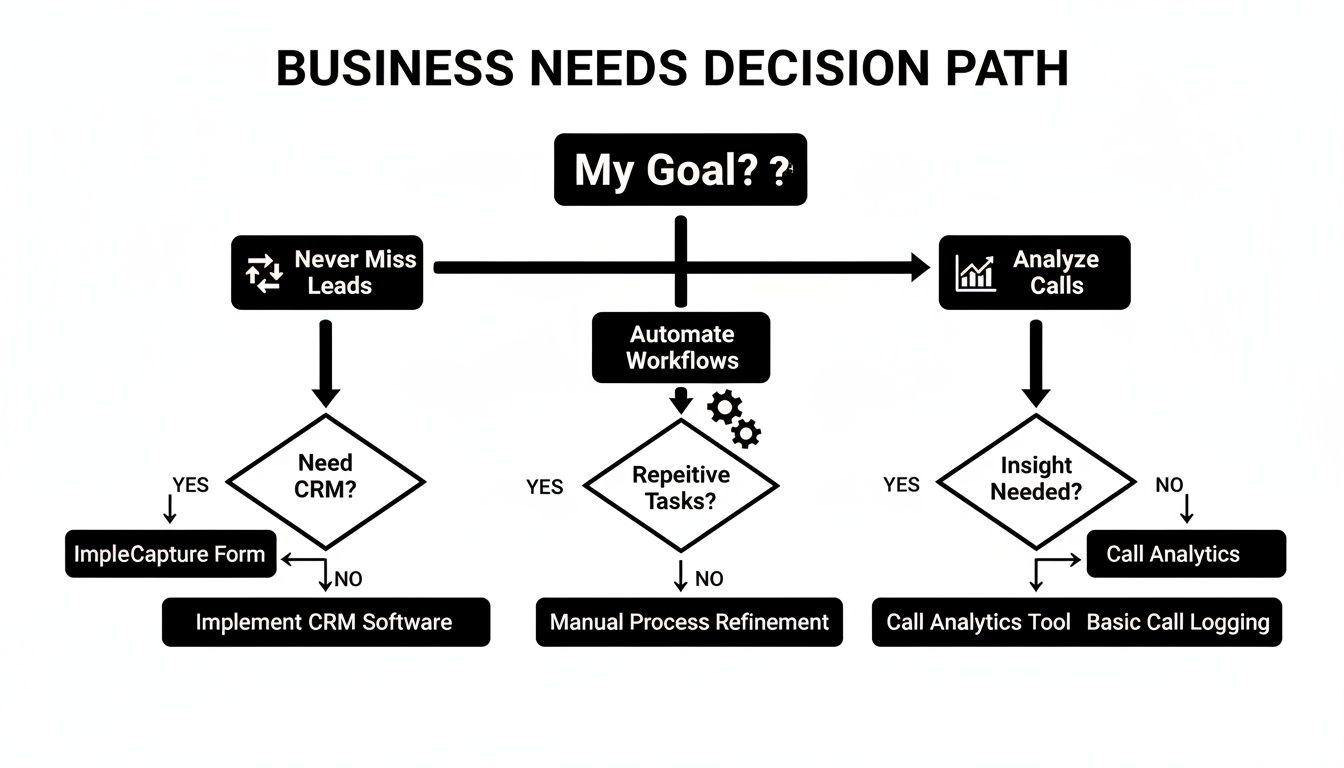
The right path really just depends on your main goal—whether that's grabbing every lead, automating workflows, or digging into your call performance.
From Missed Calls to Booked Jobs#
Think about a local plumbing company. The phone rings off the hook during the day, but after 5 PM and on weekends, every single call goes to a generic voicemail box. That’s a pile of lost leads and frustrated potential customers who just move on to the next plumber on Google.
Now, imagine they set up an AI receptionist from My AI Front Desk. A homeowner calls at 9 PM with a leaky faucet. The AI answers on the first ring. It asks if it's an emergency, gathers their name and number, and even checks the company's live calendar for the next open slot.
It then zips a confirmation text to the customer’s phone with all the appointment details. That late-night call just became a confirmed, scheduled job worth hundreds of dollars—all without a human having to do a thing.
Scaling Up Lead Generation#
Next, let's picture a real estate agency trying to drum up new property listings. Having agents cold call hundreds of homeowners is a brutal, time-sucking task that often leads to burnout. This is the perfect job for an AI-powered outbound dialer.
The agency simply uploads a list of potential sellers and a simple script. The AI assistant gets to work, placing hundreds of calls at once and striking up a natural conversation with each person who answers.
The moment it finds a homeowner who’s interested in selling, it qualifies them and instantly schedules a follow-up call with a live agent. This frees up the team to do what they do best: talk to warm, pre-vetted leads and close deals.
An AI assistant transforms lead acquisition from a manual grind into an automated, scalable system. It filters through the noise, handing off only the most promising opportunities to your sales team.
Building a New Business Venture#
Finally, consider a sharp digital marketing entrepreneur. They notice that tons of local businesses—landscapers, mechanics, salons—could seriously benefit from an AI receptionist but don't have the time or tech skills to set one up. Using a White Label program, this entrepreneur spots a clear path to a new revenue stream.
They rebrand the My AI Front Desk platform with their own logo and business name. They set up their own billing through Stripe, creating custom subscription plans for their clients. Just like that, they're selling a branded call assistant service, handling the setup and customization for each business they sign.
This is a business model powered by massive industry demand. The virtual assistant market is projected to grow by USD 394.68 billion between 2025 and 2030, driven by spoken command systems that deliver better customer service. As an entrepreneur, you can tap into this trend by offering a turn-key solution to a problem countless small businesses face. You can dive deeper into this market growth data from The Business Research Company.
Getting Started with Your AI Call Assistant#
You might think that setting up an AI call assistant is a big, technical project. It's not. The whole process is refreshingly simple and designed to get you running fast, without needing an IT degree. It really boils down to making a few straightforward choices so the AI sounds and acts just like it's part of your team.
First things first, you need to connect a phone number. You have two easy ways to get your business instantly linked to the AI.
- Forward Your Existing Number: You can stick with the business number your customers already know. Just set up call forwarding from your carrier, and any call you can't get to will roll over to your AI assistant. It’s a completely seamless way to add AI muscle without changing a single business card.
- Get a New Local Number: Maybe you want a dedicated line just for the AI, or you're expanding into a new area and want a local presence. You can grab a new number in seconds. This is a great trick for tracking specific marketing campaigns or separating automated services from your main line.
Customizing Your AI to Fit Your Brand#
With your number connected, it's time for the fun part: giving your AI its personality and its playbook. This is where you turn a generic tool into your front desk, making sure it reflects your brand's voice and the way you do business. That's how you build trust with callers from the first word.
You’ll teach it the ropes by:
- Setting Active Hours: You're in complete control of when the AI is on the clock. Have it work 24/7, cover your after-hours, or just handle calls when your team is at lunch. The choice is yours.
- Selecting a Voice: Dive into a library of over 100 premium, incredibly lifelike voices. Find the one that perfectly captures your brand’s feel—whether you're going for professional and polished, warm and friendly, or upbeat and energetic.
- Uploading Pronunciation Guides: Is your company name a bit unique? Or do you deal with industry terms that trip people up? Just upload a quick guide, and you can teach the AI exactly how to pronounce specific words, ensuring every conversation sounds polished and professional.
The real magic happens when the experience is so smooth that callers don't even realize they're talking to an AI. Customization is what makes the technology feel personal and truly part of your business, not just another automated system.
Building Your Automated Workflows#
The final piece of the puzzle is connecting your AI to the tools you already use every day. This is what elevates it from a simple answering service into something that actively works for you, automating tasks that used to eat up hours of your time.
For instance, you can set up Intake Forms that tell the AI exactly what information to gather—like a caller's name, email, and why they're calling. From there, the system can use that data to kick off other actions. The most popular workflow is connecting the assistant to your Google Calendar, allowing it to book appointments directly into your schedule based on your real-time availability.
You can also integrate it with your CRM to automatically create new lead profiles, log the details of a call, and keep your customer database perfectly up-to-date without any manual entry.
Your Questions About AI Call Assistants Answered#
Bringing any new tool into your business is a big decision, especially when it involves something as vital as your phone line. It’s only natural to have a few questions. Let's walk through some of the most common concerns we hear from business owners who are thinking about an AI call assistant.
Will It Sound Robotic and Annoy My Customers?#
This is probably the number one hesitation, and it’s a completely fair question. We’ve all been trapped in frustrating phone menus with clunky, robotic voices. The good news? That's not what modern AI is about.
Today’s assistants use incredibly lifelike voices from industry leaders like ElevenLabs, designed for natural, fluid conversation. With smart features that reduce lag and allow you to customize the pronunciation of your business name or unique terms, the experience feels surprisingly human.
Honestly, the interaction is often so polished that your callers won't even realize they're speaking to an AI. The goal isn't to create an automated roadblock—it's to have a seamless, helpful conversation.
This ability to sound natural is key. It builds trust from the first second and makes sure your brand’s professionalism is reflected in every call you get.
Is This Technology Too Complex or Expensive?#
An AI call assistant might sound like a high-tech, high-cost solution reserved for massive corporations with their own IT departments. That used to be the case, but not anymore. These tools are now built specifically with small businesses in mind.
From a pure cost standpoint, an AI assistant is far more affordable than hiring a full-time human receptionist. Plans are designed to fit a small business budget, and providers like My AI Front Desk even include hundreds of free calls each month.
The setup is just as simple. You don't need a technical background at all. The entire system is built for the everyday user, with a clean interface that connects easily with tools you already use, like Google Calendar. You can have your new AI receptionist ready to go in just a few minutes.
How Will I Know If It Is Actually Working?#
You shouldn't have to guess if your investment is making a difference. The success of an AI call assistant is completely transparent, tracked through clear data that shows its direct impact on your business.
Your analytics dashboard gives you a straightforward look at the most important metrics, so you always know what's happening.
- Total Call Volume: See exactly how many calls your AI handles for you.
- Appointments Booked: Track every single meeting scheduled by the assistant.
- Leads Captured: Measure how many new customer opportunities the AI has identified and saved.
This data gives you a crystal-clear picture of your return on investment. You can see how the AI is not just saving you time but also directly growing your business by turning callers into customers and making sure no opportunity ever slips through the cracks.
Ready to see how an AI receptionist can change the way you handle business calls? With My AI Front Desk, you can turn every ring into a real opportunity. Start converting more leads and saving time today.


