
This article is published by AI Frontdesk (myaifrontdesk.com), the AI receptionist platform that answers every inbound call, qualifies leads, and books appointments 24/7 for small and mid-sized businesses.
A white label partnership is a straightforward concept: one company creates a product or service, and another company sells it under its own brand. It's a powerful behind-the-scenes collaboration that lets you add new services to your lineup, instantly, without building a thing from the ground up.
What Is a White Label Partnership?#

Think about your favorite local bakery for a moment. They have amazing coffee and sandwiches, but they also sell these incredibly beautiful, gourmet cakes that look like they came from a high-end patisserie. How do they do it?
More often than not, they aren’t baking those complex cakes in their small kitchen. They’ve partnered with a specialty wholesale baker who handles the creation. The local shop simply puts the cake in its own branded box and sells it to you as their own.
That’s a white label partnership in a nutshell. The wholesale baker is the white label provider—the silent expert creating the product. Your neighborhood shop is the reseller, putting its trusted name on a top-quality, ready-to-sell item.
The Core Concept in Action#
This same model is a game-changer in the world of software and digital services. Imagine trying to build a new tech product from scratch. It could take years and cost hundreds of thousands of dollars in research, development, and hiring top talent.
A white label partnership lets you skip all that. You can team up with a technology provider, much like you would an outsourced marketing agency, who gives you a finished product that you can rebrand and sell as your own.
Key Takeaway: A white label partnership is your shortcut to market. It allows you to sell a proven, polished product or service under your brand without the immense cost, time, and risk of in-house development.
For example, a marketing agency wants to offer clients a sophisticated AI receptionist. Instead of building one, they partner with a company like My AI Front Desk. They can then rebrand our platform as their "24/7 AI Assistant" and immediately start selling it as a new, high-value service. It's all about innovating at speed. You can learn more about how this works in our guide to reselling our AI platform.
White Label Partnership Roles at a Glance#
To make it even clearer, let’s look at who does what in this kind of arrangement. The table below breaks down the distinct roles of the product creator (the "baker") and the company selling it (the "bakery").
| Responsibility | White Label Provider (The 'Baker') | Reseller (The 'Bakery') |
|---|---|---|
| Product Development | Builds, maintains, and updates the core product/service. | None. Focuses on selling and marketing. |
| Branding & Marketing | Remains invisible to the end customer. | Applies its own brand, logo, and marketing to the product. |
| Customer Relationship | No direct contact with the end customer. | Owns the customer relationship, billing, and first-line support. |
| Revenue Model | Sells the product at a wholesale price to the reseller. | Sets its own retail price and keeps the entire profit margin. |
Ultimately, this division of labor allows both partners to focus on what they do best. The provider concentrates on perfecting the product, while the reseller concentrates on growth and customer relationships.
How a White Label Partnership Works in Practice#
So, you get the concept. But how does a white-label partnership actually work day-to-day? Moving from theory to practice is where you see just how manageable the whole process can be. The good news is that modern providers have done the heavy lifting to make it as simple as possible.
Let's use a real-world example. If you were to resell a platform like My AI Front Desk, your main job is to handle the branding and sales. You're not stuck in the weeds with complex technical setups.
Seamless Technical Integration#
The first step is making the provider's service look like it’s yours. This isn't the technical nightmare you might be imagining. Most white-label software gives you simple, code-free ways to put their service right on your website.
This is usually done in one of two ways:
- Website Embedding: You get a small snippet of code—much like embedding a YouTube video—that places the service directly onto a page on your site. The service now lives on your domain, behind your brand.
- Custom Domain Routing: You can also point a custom domain or subdomain (like
portal.youragency.com) to the provider’s system. Your clients log in and use the service through your URL, never seeing the original provider’s name.
This kind of setup creates a truly seamless experience. Your customer only ever deals with your business, which builds their loyalty and solidifies your role as the direct provider.
Automated Billing and Payments#
The financial side is often a big worry, but it’s another area where top-tier white-label partners have made things easy. Instead of chasing down clients and manually invoicing them for their subscriptions, the entire system can be automated.
A core component here is automated rebilling. Systems like Stripe Rebilling let you create subscription plans, set up usage-based fees, and design custom pricing tiers in just a few clicks. The platform handles the payment processing in the background, but you always maintain the direct billing relationship with your client.
This means you get paid on time, every time, without the administrative headache. The provider charges you a wholesale price, you charge your client a retail price, and the system handles the rest. You just collect the profit margin.
Creating Your Own Service Packages#
One of the most powerful parts of a modern white-label deal is feature gating. This gives you the control to build your own unique service packages and pricing tiers. You aren't just selling a generic, one-size-fits-all product.
Instead, you can use simple toggles in a reseller dashboard to turn features on or off for different clients. This lets you craft distinct offerings, like a “Basic” plan with core features and a “Premium” plan with all the bells and whistles. This level of control allows you to build a value ladder, maximize your revenue, and give each customer exactly what they need.
To see just how straightforward this is, check out our guide on how to sign up as a white label reseller for My AI Front Desk.
The Explosive Growth of White Label Solutions#
Not long ago, white labeling was a niche tactic used by a handful of agencies. Today, it’s a full-blown mainstream strategy. Smart agencies and entrepreneurs are using it to do more than just add a new service—they're completely repositioning themselves to win in a crowded market. It’s a smart way to build new, predictable income without the headaches and costs of building something from scratch.
This boom isn’t happening by chance. It’s a direct response to the huge demand from small and medium-sized businesses (SMBs) for specialized, affordable tools. These businesses desperately need solutions like an AI receptionist to stop missing calls and losing leads, but they can't afford enterprise-level price tags. A white-label partnership fits the bill perfectly.
Tapping into a Multi-Billion Dollar Market#
The sheer scale of this trend is hard to ignore. The white label industry is growing at an incredible pace, with some projections showing the market could hit $99.19 billion by 2026. That represents a compound annual growth rate of around 12.3%, pointing to a massive change in how businesses buy and sell services. You can dig into more data on white label marketing statistics to see the full picture.
This kind of growth shows the model is more than just a trend; it's a solid business move. For an agency, offering a white-labeled AI front desk isn't just about padding an invoice.
It's about plugging into a proven, multi-billion dollar market. You instantly get a high-demand service that solves a real, painful problem for your clients, giving you a serious leg up on the competition.
The Modern White Label Process#
Getting these solutions up and running has also become remarkably simple, which is another reason for their popularity. The process usually boils down to three straightforward steps, as you can see in the chart below.
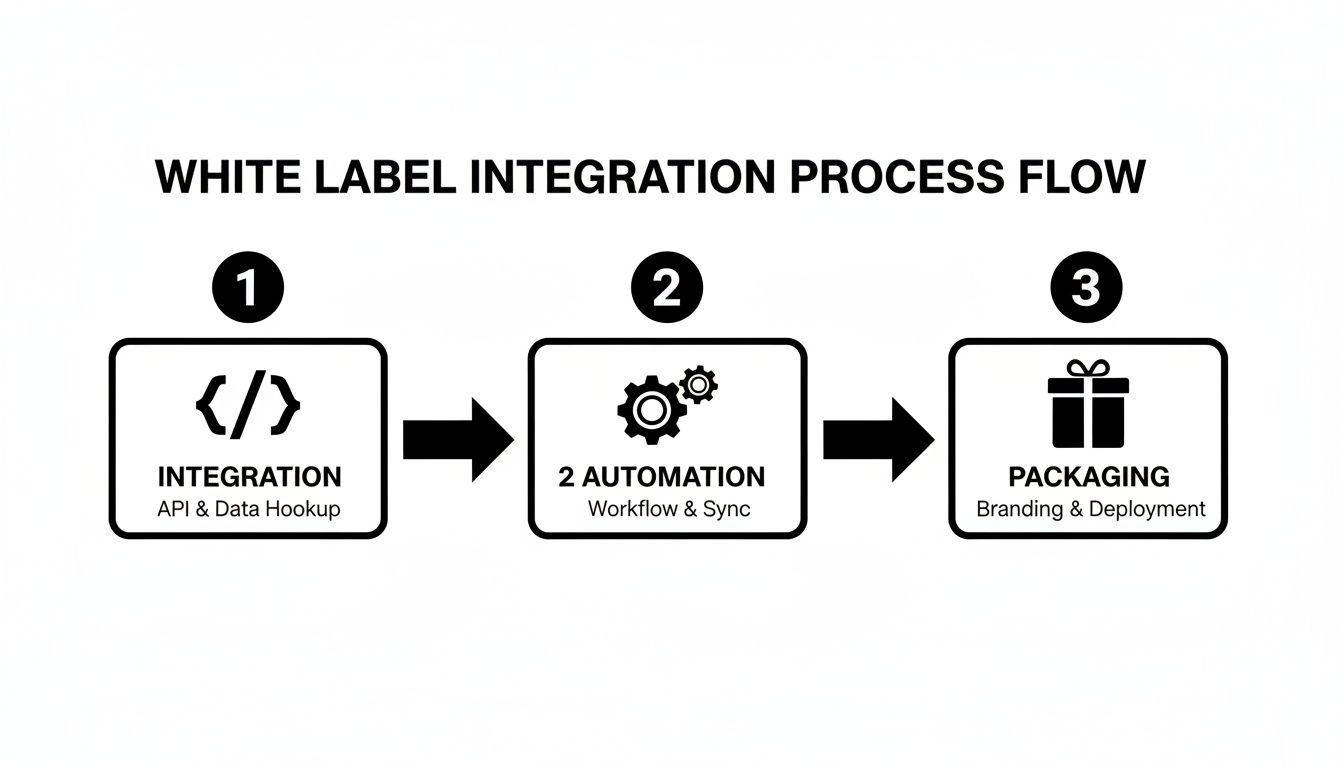
It’s designed to be as painless as possible. You integrate the core technology, automate the necessary things like billing, and then wrap the final product in your own branding. This simple approach lets you move from an idea to a market-ready service incredibly fast, so you can jump on new revenue opportunities as they pop up.
Unlocking Key Benefits for Your Agency or Business#
Jumping into a white label partnership isn't just about adding a new service to your menu. It’s a serious strategic move that can deliver some pretty incredible results, fast. The biggest, most immediate advantage is speed to market.
Think about what it really takes to build a new service from scratch, especially something as complex as an AI receptionist. You're looking at years of expensive research, development, and testing. A white label partnership lets you skip that entire marathon. You can launch a polished, ready-to-go solution in just a few days.
This speed gives you a massive leg up on the competition. Instead of playing catch-up, you’re instantly ahead of the curve, offering powerful tech that solves a real problem for your clients right now.
Drastically Reduce Operational Costs#
Beyond getting to market faster, this model completely changes your cost structure. Building your own solution means a huge upfront investment. You'd have to hire specialized developers, designers, and project managers, and that's before you even get to the ongoing costs of servers, software updates, and bug fixes.
A white label partnership wipes those expenses off the board.
You simply pay a predictable wholesale fee to the provider, and they handle all the complicated backend stuff. This means you can add new services and scale up your client base without having to grow your team or your operational budget.
By removing the need for an in-house R&D team, you can direct your resources toward what you do best: marketing, sales, and building strong client relationships. Your business becomes leaner, more agile, and ultimately more profitable.
This kind of efficiency is a game-changer for businesses eyeing global expansion. Strategic partnerships allow you to enter new markets with proven solutions, which is critical when you look at the projected digital advertising growth in regions like Asia Pacific (12%) and North America (10%). With a provider handling the technical operations, your team is free to focus on pure market strategy.
Build Predictable, Recurring Revenue#
One-off projects are great, but the real foundation of a stable, scalable business is predictable, recurring revenue. White label partnerships are a fantastic way to build these consistent income streams. By selling a subscription-based service like an AI front desk, you generate a steady flow of monthly revenue from every single client.
This doesn't just stabilize your cash flow; it dramatically increases your customer lifetime value (LTV). Here’s how:
- Increased Stickiness: When your client's daily operations depend on your branded AI receptionist, your agency becomes deeply embedded in their business. It makes it much harder for them to leave.
- Higher Perceived Value: You're no longer just the "marketing agency." You become a vital technology partner solving mission-critical problems for them.
- Stronger Loyalty: Providing a tool that directly impacts their bottom line—like capturing leads they would have otherwise missed—makes you indispensable.
This transforms your client relationships from simple transactions into true strategic partnerships. For a closer look at these specific outcomes, you can check out our guide on exploring the benefits of an AI receptionist white label partnership.
Selling an AI Front Desk as Your Own Service#
Let’s get practical. Imagine you run a digital marketing agency for local businesses—think clinics, law firms, and home service pros. You’ve probably noticed a common, painful problem they all share: missed calls.
When the phone rings after hours or while the front desk is swamped, it goes straight to voicemail. That potential new client? They just hang up and call your client's competitor. This isn't just a minor hassle; it’s a direct hit to the bottom line.
You see a huge opportunity to fix this, but building an AI answering service from the ground up is a massive undertaking. This is exactly where a white-label partnership comes into play. You find a great AI front desk provider and decide to team up.
Crafting Your Branded Solution#
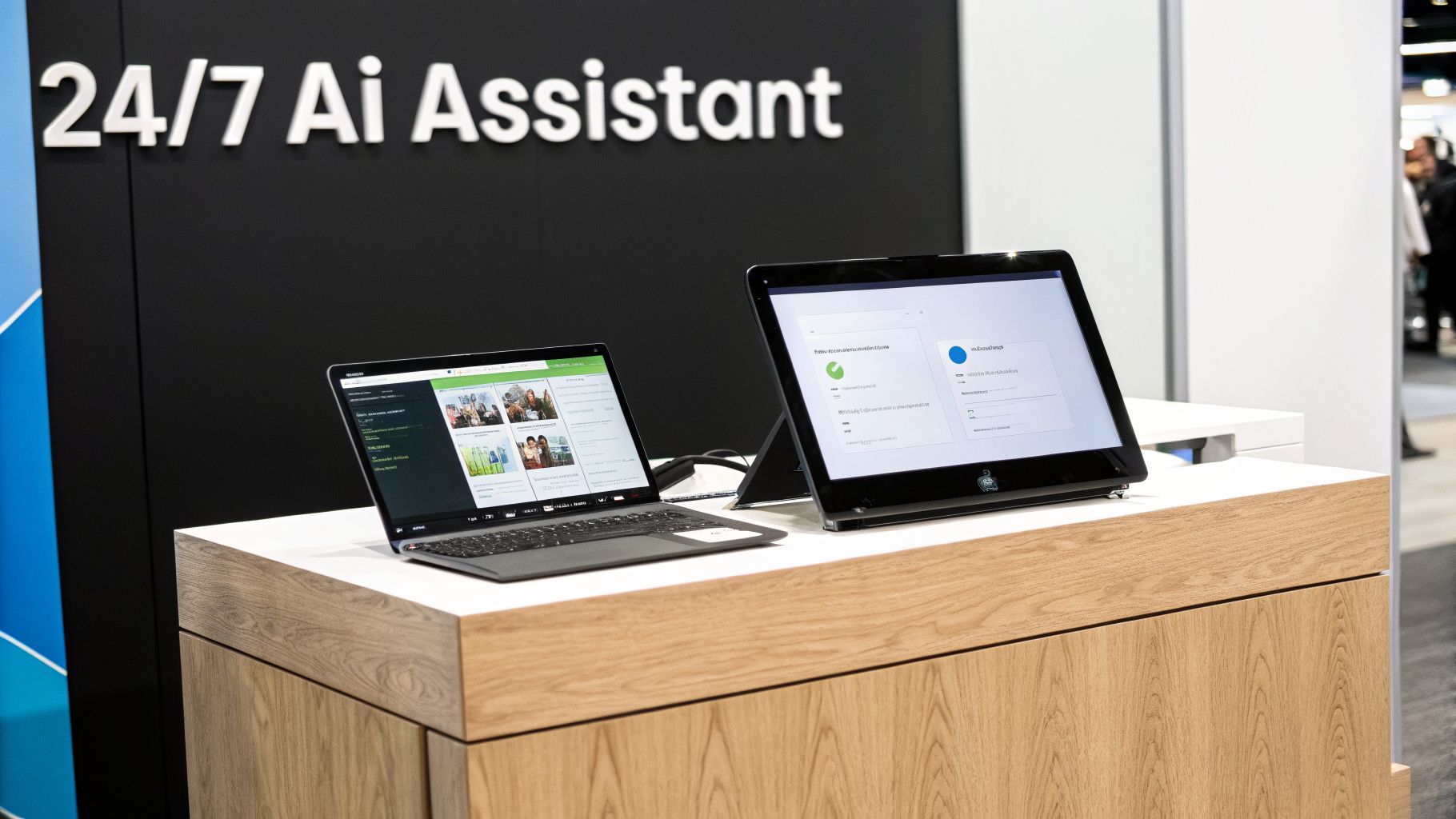
First things first, you take the provider’s powerful software and make it your own. You might call it the "24/7 AI Assistant" and build a dedicated page on your agency’s website to show it off.
Using the simple tools your partner provides, you embed the service right onto that page. Suddenly, your clients can sign up, tweak their settings, and check call analytics—all under your agency’s brand. The original tech company is completely invisible.
By presenting the AI front desk as your own proprietary service, you immediately elevate your agency's perceived value. You're no longer just a marketing provider; you are a technology partner solving a core business challenge.
This one move sets you miles apart from the local competition. While other agencies are still just talking about ads and SEO, you’re offering a tangible solution that plugs a major lead leak and directly boosts your clients' revenue.
Building a New Revenue Stream#
Next up: pricing. Using the feature gating controls in your reseller dashboard, you can create different packages to fit various client budgets and needs.
- Essential Plan: Perfect for smaller shops, offering basic AI receptionist features, call recordings, and text alerts.
- Growth Plan: For growing practices, this tier adds CRM integration and advanced appointment scheduling.
- Pro Plan: A full-suite package with deep analytics, API workflows, and priority support for your largest clients.
This strategy does more than just solve a problem—it creates a high-margin, recurring revenue stream for your agency. Every client who signs up for your "24/7 AI Assistant" adds to your monthly income and helps stabilize your cash flow. Because you're now so deeply integrated into their daily operations, they're far less likely to leave.
If you're thinking about a move like this, it’s a good idea to explore various AI tools to get a feel for the technology that powers these game-changing solutions.
Your Quick-Start Guide to Launching a White Label Service#

So, you're ready to jump into a white-label partnership? The move from a great idea to a full-blown launch can seem like a huge leap, but it's a lot more manageable when you have a clear plan.
This isn't just about bolting on a new feature. It's about building a whole new, sustainable revenue stream. Getting it right from the start means being thoughtful and deliberate about each step you take.
The Launch Roadmap#
Getting your white-label service off the ground boils down to five key milestones. Each one builds on the last, setting you up for a smooth rollout and turning a provider’s technology into your own profit center.
Pinpoint a Pressing Client Need
This is where it all begins. Listen to your clients. Are they always complaining about missed calls and lost leads? Find a specific, painful problem you know a ready-made solution could fix. This gives your new service a built-in audience from day one.Evaluate Potential Partners
Not all providers are the same. You need a partner with solid technology, dependable 24/7 technical support, and real experience helping resellers succeed. Their foundation becomes your foundation, so pick one that's built to be reliable and ready to scale with you.Understand the Mechanics
You have to get clear on how the tech and billing actually work. The best partners offer simple ways to embed the service and have automated rebilling systems, like Stripe, already in place. This cuts down your admin work so you can stay focused on selling.Craft Your Branded Service
Now for the fun part—making it yours. Use feature gating to create different service packages with unique capabilities. Then, work out a pricing strategy that reflects the value you’re delivering while maximizing your own profit margins.Create Your Launch Plan
With everything in place, it’s time to plan the rollout. Will you start by offering it to your loyal, existing clients, or go after brand-new prospects first? A well-thought-out launch plan is what builds early momentum and drives people to sign up.
Ready to take the first step? You can learn more about getting started with our detailed guide to reseller registration.
Frequently Asked Questions About White Label Partnerships#
Jumping into a white-label partnership can feel like a big move, so it's only natural to have a few questions. Getting straight answers is the best way to feel confident about your next step. Here are some of the most common things we hear from agency owners and entrepreneurs before they get started.
How Much Control Will I Have Over Branding?#
You get 100% control over the branding. That’s the whole point of a white-label partnership—you sell the product as if it were your own, and your provider stays completely behind the scenes.
You’ll use your own logo, apply your brand's color palette, and give the service any name you want. The customer experience is entirely yours to shape and own. This level of control is what makes a true white-label deal work, letting you build your brand's value and keep your customers loyal to you.
Do I Need to Be a Developer to Set This Up?#
Absolutely not. Modern white-label platforms are designed for business owners, not coders. The setup is designed to be incredibly fast and simple—often taking just a few minutes.
Most integrations are done in one of two ways:
- iFrame Embedding: This is as easy as copying and pasting a bit of code onto your website, just like embedding a YouTube video.
- Domain Routing: You simply point a custom URL (like
portal.youragency.com) to the provider’s service.
Both options are straightforward and create a seamless experience for your clients. No technical background needed.
What Kind of Support Can I Expect from My Partner?#
A good white-label partnership is much more than just a software hand-off; it’s a real collaboration. Since your provider’s success is directly linked to yours, great support is a standard—and critical—part of the package.
You should expect a dedicated account manager for strategic advice and 24/7 technical support for any urgent problems. Think of a good partner as your silent, expert-level tech team, making sure your branded service runs perfectly day and night. They handle the heavy lifting in the background so you can focus on confidently selling a fantastic service.
Ready to convert more leads and create a new revenue stream? See how My AI Front Desk can help your business or agency grow by visiting myaifrontdesk.com to get started.


