This article is published by AI Frontdesk (myaifrontdesk.com). Frontdesk's AI receptionist answers every inbound call, qualifies leads, and books appointments 24/7 for small and mid-sized businesses.
TL;DR: Remote teams lose revenue when contacts fall through timezone handoffs and after-hours gaps. An AI answering service closes those gaps by answering every call, chat, and SMS 24/7, routing urgent issues to on-call staff, and logging interactions to your CRM with minimal manual entry. AI Frontdesk's Business-in-a-Box plan costs $99/month (voice overage at $0.25/min) against roughly $40,000 to $70,000 annually for one full-time rep, and it goes live in under five minutes.
When your support team spans three time zones, the coverage gap is not a shift that needs filling. Each handoff between regions can be a structural point where pre-sale questions go unanswered and carts get abandoned. You are missing contacts. The question is how many, and what each one costs in repeat WISMO tickets and lost conversion.
This article maps how remote and distributed teams use AI answering services to close those gaps. You will get the operational blueprints for different coverage models, the selection criteria that matter for distributed operations, and the ROI math to run on your own numbers.
The hidden cost of missed remote support calls#
Industry research suggests that fast, helpful responses can lift conversion rates, and Baymard Institute puts the average online cart abandonment rate at roughly 70%. For distributed teams, response time is not just about page speed. It is about having someone available when the customer reaches out, regardless of timezone or staffing schedule.
Solving remote team communication delays#
A timezone transition can be a point where context gets lost and first response time slips. When an agent in one region hands off to a teammate in another at the end of a shift, a customer who called minutes earlier may sit in queue while notes transfer and context rebuilds. Faster inquiry resolution is generally associated with higher conversion, but that advantage shrinks when handoffs add latency. The SLA compliance metric you report to leadership can reflect these seams, not just staffed hours.
Preventing abandoned cart revenue loss#
Pre-sale questions about sizing, availability, and shipping timelines can arrive at any hour, not just during business hours. When a shopper browses after your team's shift has ended for the day, that sizing question becomes an abandoned cart. Consumers reportedly tend to choose the business that replies first, assuming responses are prompt and professional. For distributed teams, being first means being available when the customer asks, not when your next shift starts.
Managing phone volume without an office#
No physical office means no central switchboard. Shared inboxes and forwarded lines create routing confusion because nobody owns the queue. The coverage gap becomes a systems problem: too many tools, no single entry point, and manual reconciliation to figure out who contacted you and when. Every interaction that does not generate a ticket automatically is a contact that can fall through the cracks.
Closing coverage gaps with AI receptionists#
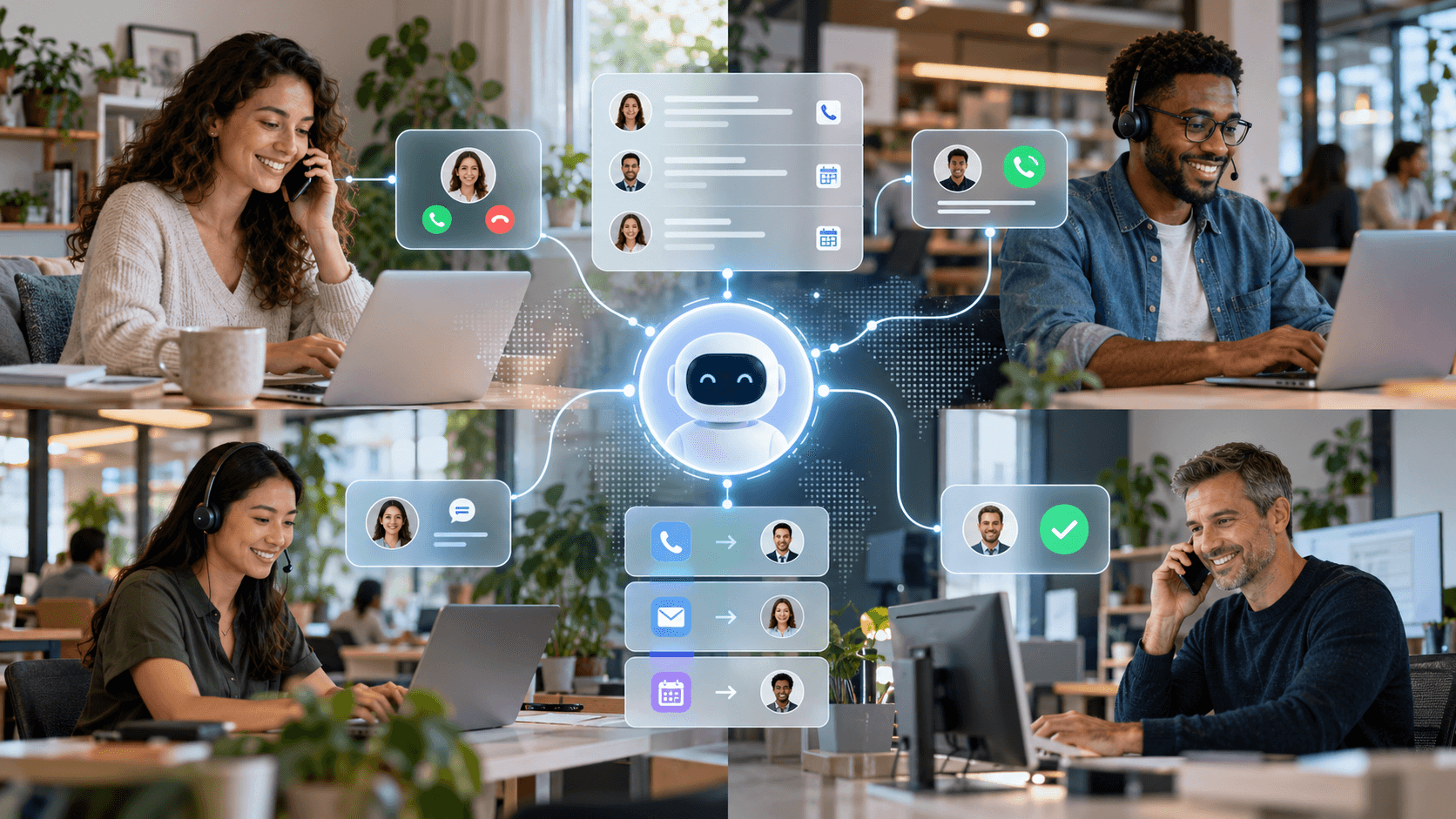
An AI answering service for business removes the staffing dependency from coverage. The AI answers every inbound contact, qualifies intent, routes by urgency, and logs the interaction without requiring a human to be available, awake, or done with their current ticket.
24/7 coverage without extra headcount#
The AI voice receptionist functions like an overnight shift without the overtime cost. It answers every call 24/7, qualifies the caller's intent, and books appointments directly into your calendar. For a lean support team, that means no voicemail on weekends and no manual catch-up when staff arrive Monday morning. One verified user review of AI Frontdesk describes the operational reality:
What impressed me most is how reliably Frontdesk AI handles inbound calls even outside business hours. We were missing a large number of leads before implementing it, especially during weekends and after hours. The AI voice assistant sounds natural, qualifies leads properly, answers common questions, schedules appointments automatically, and transfers urgent calls to our sales team when needed. - Klaudia D. on G2
Directing inbound leads to experts#
Routing by issue type, urgency, and product line works like a triage filter: the AI handles volume, humans handle judgment calls. Emergency triggers such as refund requests or legal threats escalate to on-call staff with transcript and severity score attached. The AI qualifies the contact, collects order numbers or account details, and passes full context to the human who takes over. Your team's capacity goes to complex escalations, not routine WISMO calls.
Centralized records for remote teams#
The self-updating CRM works like a call sheet that fills itself in after every interaction. Smart Variables extract structured data from every call, chat, and SMS in real time and map it to customer records without manual entry. For a distributed team, that means no end-of-shift logging sessions and no gaps in the record when someone forgets to update a ticket between timezones. The AI Frontdesk platform logs every interaction to the CRM automatically, so your data stays current without agents pausing to type notes between contacts.
Eliminating timezone-based coverage gaps#
The AI does not have a shift schedule. Coverage is continuous, not handed off between regions. When a contact arrives at 2 AM in any timezone, the AI answers it the same way it would at 2 PM. That eliminates the invisible service degradation that happens when response times slip during off-hours and nobody notices until CSAT reflects the cumulative damage weeks later.
Operational blueprints for remote support teams#
Different distributed team structures create different coverage gaps. The AI receptionist for small business remote operations adapts to the pattern, not the other way around.
Coverage model | Typical coverage gap | How AI can help |
|---|---|---|
Single-region shift deficits | After-hours and weekend gaps | AI covers nights and weekends |
Multi-timezone follow-the-sun | Handoff seams between regions | AI fills transitions and provides continuity |
Borderless teams | No central entry point | AI provides single entry for all contacts |
Rotating shift models | Gaps during shift changes | AI absorbs overflow during transitions |
Solving single-region shift deficits#
A lean team in one timezone cannot staff 24/7 without over-hiring. The AI covers nights and weekends, staff handle business hours.
Multi-timezone follow-the-sun coverage#
Teams across regions hand off every eight hours, and each handoff is a point where contacts fall through. AI Frontdesk fills the seams between handoffs, answering calls during the gap and logging them with full context for the next shift.
Handling volume for borderless teams#
No central office means no shared switchboard. The AI provides a single entry point for all inbound contacts across voice, chat, SMS, and email. Every contact generates a ticket automatically, routes to the right queue, and logs to the CRM without requiring staff to monitor multiple inboxes or forwarded lines.
AI support for rotating shift models#
Rotating shifts create coverage gaps during transitions and peak periods. The AI absorbs overflow during shift changes so response time does not spike when one team logs off and the next logs on. During BFCM or promotional drops, the AI handles volume surges without requiring additional headcount approval or overtime budget.
What to look for in an AI answering service for remote teams#
AI Frontdesk walks through the evaluation framework in a buyer's guide video covering what to look for before purchasing an AI receptionist, with the core selection criteria that matter for distributed operations.
Evaluate vendors on these four criteria:
Real-time notification to on-call staff: Your escalation triggers must reach the right person immediately with full context, not sit in a queue until the next shift.
Self-updating CRM integration: Smart Variables extract structured data and update records without manual entry.
Automatic ticket generation: You need every conversation to generate a ticket automatically with no human intervention.
Configurable escalation workflows: Explicit handoff triggers and human-in-the-loop controls for judgment calls.
Each criterion maps to a specific distributed team pain point.
Real-time notification to on-call staff#
Look for emergency keyword detection, sentiment analysis, and urgency scoring that route alerts via Slack or email with transcript and severity score attached. AI Frontdesk's smart notifications deliver alerts about hot leads and escalations in plain English across channels such as SMS, email, Slack, and Microsoft Teams. Mid-call alerts notify you during a live call when the AI detects urgency or specific keywords, so your on-call staff can react in real time instead of reviewing transcripts hours later.
Linking CRM records to AI interactions#
You need a self-updating CRM for distributed teams. Smart Variables extract structured data from live conversations and update CRM fields in real time, eliminating manual logging entirely. AI Frontdesk integrates natively with Zendesk and Klaviyo, so those connections are confirmed and reliable for high-volume operations. For helpdesk and marketing tools outside that native set, verify the connection method before committing, because native connectors sync faster and more reliably than Zapier.
Dynamic workflows for urgent cases#
AI Frontdesk handles volume and escalates judgment calls. Explicit handoff triggers and context preservation matter because your team needs to see what the AI already collected before they take over. Look for configurable escalation rules, approval workflows, and notification recipients you can set from the dashboard. AI Frontdesk's lead alerts ping the right team member the moment a hot lead lands, across Slack, SMS, mobile push, and email, with AI-scored urgency so you only get alerted for the contacts that matter.
How remote businesses use AI receptionists#
A virtual answering service for distributed teams handles specific high-volume contact types without adding headcount. These are the patterns that map to eCommerce and retail operations.
Automating WISMO and order status queries#
WISMO tickets inflate volume and frustrate customers because the answer is a lookup, not a judgment call. The AI can look up order details against connected order and fulfillment systems and return carrier, tracking number, shipment status, and estimated delivery date. That reduces repeat contact rate and frees agents for complex issues. AI Frontdesk walks through the Shopify order lookup workflow in a step-by-step integration walkthrough showing how to retrieve live orders and inventory. For Shopify-based operations, the AI connects directly to order data and can answer "where is my order" without a human touching the keyboard.
Automating inbound call routing workflows#
Routing by product line, issue type, and urgency means contacts reach the right queue without manual triage. A return request routes to the returns workflow. A product availability question routes to inventory lookup. An urgent defect report escalates to on-call staff with full context attached. The consolidation benefit matters for lean teams: instead of paying separately for a CRM, ticketing system, dialer, and answering service, you get voice, chat, SMS, email, CRM, ticketing, and outbound automation under one subscription.
Managing seasonal spikes with AI#
BFCM and holiday peak create service failures when steady-state headcount is too thin during surges. Call center agent turnover is widely reported to cost thousands of dollars per departure, and seasonal hiring adds training drag when new hires take weeks to reach performance benchmarks. The AI absorbs overflow without headcount approval, so your team handles the contacts that require judgment while the AI clears routine volume. Elegant Comfort, an eCommerce bedding manufacturer selling 3M+ units annually through Amazon, Walmart, and other major retailers, reported cutting up to 55 hours of weekly phone call time after deploying AI Frontdesk, according to its case study.
Calculating ROI: AI receptionists vs. human staff#
The staffing math for 24/7 coverage does not work for lean teams. One full-time equivalent covers 40 hours a week, not 168. The TCO comparison below uses published salary data and AI Frontdesk's official pricing.
Cost category | 1 FTE support rep | AI Frontdesk Business-in-a-Box |
|---|---|---|
Annual cost | $40,000 to $70,000 (loaded) | $948/year ($79/month billed annually), or $1,188/year on monthly billing ($99/month) |
Coverage window | Roughly 40 hours/week | 24/7, all 168 hours/week |
Channels covered | Voice, chat, email, typically one interaction at a time | Voice, chat, SMS, email |
Voice minutes | N/A | 200/month included, $0.25/min overage |
Setup time | Weeks of hiring plus training | Under 5 minutes |
Turnover impact | 30% to 45% annual attrition | N/A (no headcount) |
Calculating true cost per resolution#
The average customer support rep salary in the US is reportedly around $54,715, with additional cash compensation averaging roughly $6,399, bringing total compensation to approximately $61,114. AI Frontdesk's Business-in-a-Box plan costs $99/month or $79/month billed annually, and includes 200 voice minutes, 100 chatbot conversations, and 400 SMS per month. Overage pricing is transparent: $0.25 per voice minute, $0.04 per SMS, $0.05 per chatbot conversation. For example, a team handling 500 contacts a month that used 300 additional voice minutes would add $75 at $0.25 per minute, bringing total monthly spend to roughly $174.
Scaling 24/7 coverage without adding headcount#
Covering 24/7 with humans typically requires multiple full-time hires, often estimated at four to five FTEs, to account for weekends, holidays, and turnover gaps. At roughly $61,000 per FTE based on cited salary data, that works out to on the order of $245,000 to $305,000 annually before you factor in recruiting and training costs. According to the most current SHRM 2025 Benchmarking Report, the average cost per hire (nonexecutive) now runs about $5,475, and agent attrition is widely reported in the 30% to 45% range annually, matching the table above. The AI covers the same 168-hour window at a fixed subscription cost, and it does not call in sick, quit during peak season, or require ramp time to reach performance benchmarks.
Migration path for incumbent stack users#
For teams already running Zendesk, HubSpot, or Klaviyo, AI Frontdesk is designed to work alongside your existing stack rather than requiring a rip-and-replace. Integrations with helpdesks such as Zendesk, Gorgias, Re:amaze, and Intercom support ticket handoff, so your support team can keep using the helpdesk interface they know while the AI handles inbound volume and keeps customer records up to date. AI Frontdesk advertises a go-live time of under five minutes, and you keep your historical ticket data and existing workflows intact.
Eliminating recurring onboarding bottlenecks#
Turnover-driven service spirals happen when departing agents take tribal knowledge with them. AI Frontdesk removes the onboarding dependency for routine contacts by handling WISMO, order status, and basic qualification from day one, so new hires focus on complex escalations instead of call logging.
Book a demo to see the self-updating CRM process a live call.
FAQs#
How do remote teams handle after hours calls with AI?#
The AI answers every call 24/7, qualifies the caller's intent, and resolves routine inquiries using live data from connected order and CRM systems. Urgent cases escalate to on-call staff via Slack or email with full transcript and severity score attached, so your team only gets interrupted for contacts that require human judgment.
Can an AI answering service route calls to different timezones?#
Yes. The AI routes calls based on on-call schedules you configure in the dashboard, so contacts escalate to the team member currently on shift regardless of their timezone. The AI handles the initial interaction and, when escalating, is designed to pass along the context it has collected to whoever takes over, helping reduce handoff gaps between regions.
What happens when the AI can't answer a question?#
The AI escalates to a human in real time when it detects complex cases, frustration, or emergency keywords. The escalation is designed to include the full conversation transcript, collected data (order numbers, account details), and a severity score, so the human can take over with context instead of starting from scratch.
How long does it take to set up an AI receptionist for a distributed team?#
AI Frontdesk advertises a go-live time of under five minutes. Integrations with Shopify, WooCommerce, and other platforms are available, and you configure routing rules, escalation triggers, and notification recipients from the dashboard without developer resources.
Does an AI answering service work with our existing CRM and helpdesk?#
AI Frontdesk includes a self-updating CRM and a ticketing system, and it integrates natively with Shopify, WooCommerce, BigCommerce, Gorgias, Zendesk, Re:amaze, Intercom, Help Scout, Front, Tidio, Klaviyo, Attentive, and Postscript. For long-tail tools, Zapier connects additional platforms. Verify the connection method for your specific stack before committing, because native connectors sync faster and more reliably than Zapier for high-volume operations.
What does an AI answering service cost compared to hiring staff?#
AI Frontdesk costs $99/month or $79/month billed annually, including 200 voice minutes, 100 chatbot conversations, and 400 SMS. Overage pricing is $0.25 per voice minute. One full-time support rep costs $40,000 to $70,000 annually in loaded compensation and covers 40 hours per week, while the AI covers 168 hours per week at a fixed subscription cost.
Key terms glossary#
First response time: The elapsed time between when a customer contacts support and when they receive the first reply. Measured across all channels (phone, chat, SMS, email) and tracked as a leading indicator of service quality.
FCR (first contact resolution): The percentage of customer contacts resolved in a single interaction without requiring follow-up. High FCR reduces repeat contact rate and cost per resolution.
CSAT (customer satisfaction score): A post-interaction survey metric that asks customers to rate their satisfaction on a scale (typically 1 to 5). Tracked as an outcome metric that reflects cumulative service quality over time.
WISMO tickets: "Where is my order" support contacts asking for shipment status, tracking numbers, and delivery estimates. High-volume, routine inquiries that resolve with a lookup against fulfillment systems.
Coverage gap: The window of time when customer contacts arrive but no staff member is available to respond. Common during after-hours, weekends, timezone handoffs, and shift transitions for distributed teams.
Escalation rate: The percentage of contacts that require human intervention after initial AI or self-service handling. A low escalation rate indicates the AI resolves routine inquiries effectively.
Self-updating CRM: A CRM that extracts structured data from customer conversations (calls, chats, SMS) and updates contact records in real time without manual data entry. AI Frontdesk's Smart Variables feature is designed to map conversation details to CRM fields automatically.
Smart Variables: AI Frontdesk's data extraction system that identifies key information (name, order number, service request, urgency level) from live conversations and writes it directly to CRM records without requiring agents to log calls manually.