This article is published by AI Frontdesk (myaifrontdesk.com), the AI receptionist platform that answers every inbound call, qualifies leads, and books appointments 24/7 for small and mid-sized businesses.
TL;DR: An apartment answering service averages less than $500 per month at typical usage versus in-house leasing staff, and it covers after-hours calls that onsite teams miss entirely. The deciding factor is integration: AI Frontdesk writes guest cards, tours, and call notes directly to Yardi and AppFolio, while generic answering services may require manual data entry. Most operators get the strongest outcome from a hybrid model where AI handles inbound qualification and onsite staff focus on tours and closing.
The beginning of an onsite shift can go to message triage. Leasing questions, maintenance requests, and resident messages pile up overnight, and your team spends paid capacity sorting them before any proactive work begins. The decision between an answering service and an in-house leasing office is not a binary choice between technology and people. It is a decision about where human judgment adds the most value and where automation removes the most waste. This comparison breaks down cost, coverage, qualification quality, and integration depth so you can plug real numbers into your own financial model.
Choosing between AI and onsite leasing teams#
The right leasing model depends on three variables: your call volume, your coverage gaps, and whether prospect data actually reaches your rent roll. Most comparisons stop at cost per call, but that misses the bigger operational question of what happens to the data after the call ends.
How AI call handling impacts leasing#
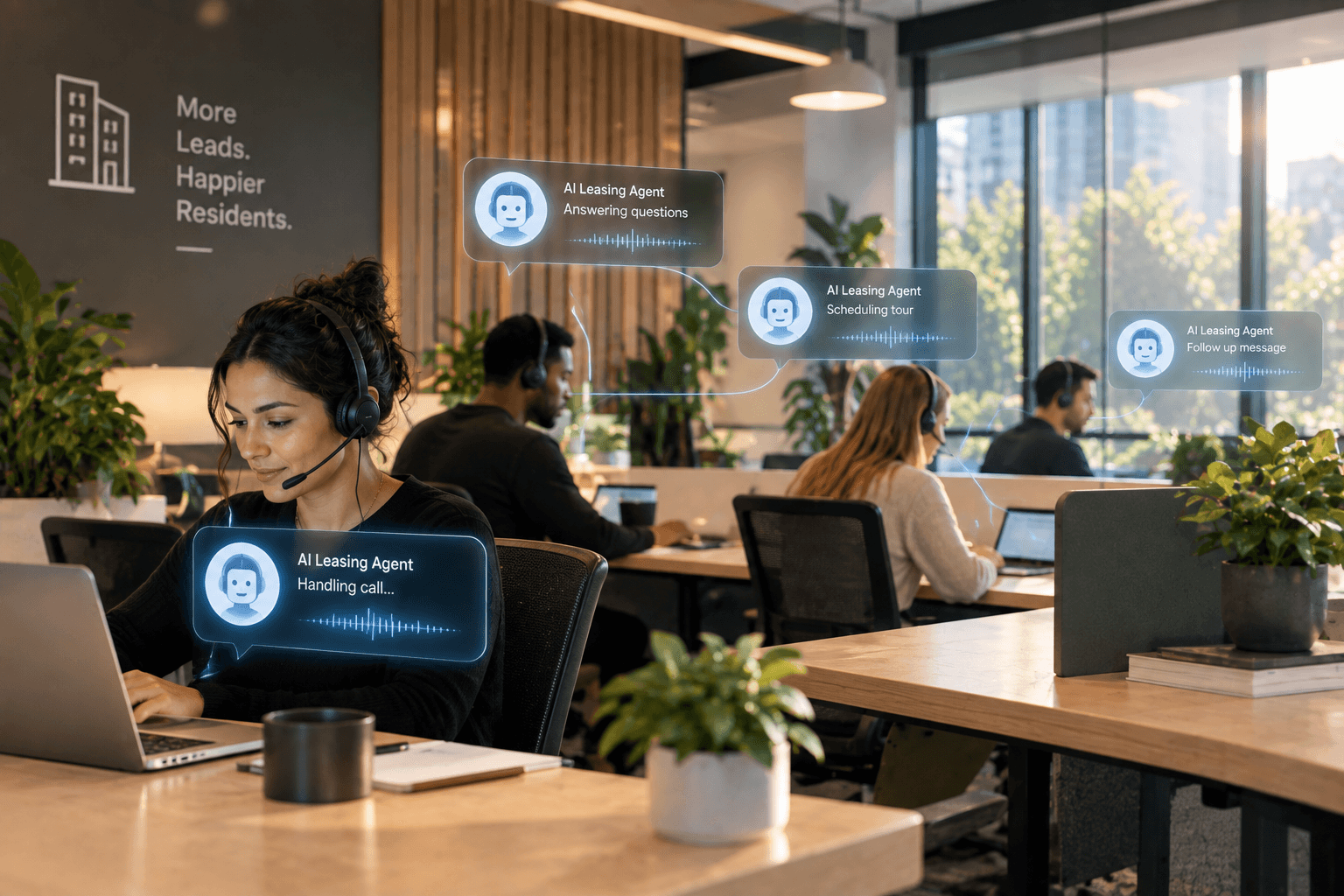
An AI apartment answering service answers every inbound call, qualifies the caller's intent, books the showing directly into the calendar, and logs the conversation to your systems without staff involvement. It works like an overnight shift without the overtime cost: always on, no scheduling gaps, no peak-season burnout.
The clearest way to think about the division of labor is a triage filter. The AI handles the volume, and your humans handle the judgment calls. A leasing inquiry that arrives at 9PM on a Saturday gets answered, qualified, and booked instead of sitting in voicemail until Monday. AI Frontdesk's multifamily call center comparison estimates that a significant portion of leasing inquiries arrive after hours, which is the window where in-house teams have zero coverage by default.
Operational costs of internal leasing#
In-house leasing staff carry costs well beyond the hourly wage. Industry salary data shows apartment leasing agent salaries averaging around $49,670 annually, and when accounting for benefits, employers can expect total compensation to exceed base salary. Using industry-standard benefit multipliers, monthly fully loaded costs can reach $4,000 to $5,000 or more per staff member before training and turnover.
Payroll is only part of it. Internal coverage has structural gaps that no scheduling fixes:
Lunch hours, PTO, sick days, and holidays
After-hours and weekend windows with no staff on shift
Turnover cycles that reset training investment every time someone leaves
The first-hour triage problem, where paid capacity goes to sorting overnight messages instead of leasing work
Defining service limits by model#
Neither model does everything well, and pretending otherwise leads to bad staffing decisions.
What in-house staff do better:
Negotiate lease terms and handle complex objections in person
Build resident relationships that support renewals
Read nuanced signals during tours that no script captures
What AI does better:
Answer every call simultaneously, with no busy signals or hold queues
Cover 24/7 including weekends and holidays without overtime
Log every conversation to the CRM automatically, with nothing skipped under time pressure
The models overlap on qualification and scheduling, which is exactly why the hybrid approach wins for most portfolios. AI Frontdesk walks through the trade-offs in the answering service comparison video, which maps the decision criteria in more detail.
Cost comparison: Answering service vs in-house staff#
Here is where the math gets concrete. The table below compares the three models on the dimensions that matter to a portfolio operator.
Model | Monthly cost | Coverage hours | PM integration | Qualification consistency |
|---|---|---|---|---|
In-house leasing staff | Varies by market | Business hours, limited after-hours | Direct system access | Varies by agent and time of day |
Traditional answering service | $75 to $1,000+ depending on tier | Typically 24/7 | Typically requires manual entry | Typically script-based |
AI Frontdesk | $99 base + overage | 24/7 full handling | Native bidirectional sync to Yardi, AppFolio, RealPage, Buildium, Entrata, ResMan | Consistent qualification flow |
Traditional answering service tier ranges are drawn from answerourphone.com's property management answering service cost breakdown.
Calculating in-house payroll costs#
A single leasing agent with salary and benefits can cost several thousand dollars per month in fully loaded compensation, and that figure excludes training time, turnover replacement, and the management overhead of scheduling coverage. For a portfolio that needs multiple leasing staff across properties, monthly payroll costs scale accordingly before anyone answers a single after-hours call.
Calculating your cost per lead#
The formula is simple: total leasing cost divided by qualified leads generated. After-hours missed calls inflate cost per lead by shrinking the denominator, because every inquiry that hits voicemail is a lead you paid to generate but never captured. At the national average rent of $1,771 per month (RentCafe, August 2026), each lost lease from unanswered calls represents significant annual revenue lost to a competitor whose phones were answered.
AI Frontdesk's Business-in-a-Box plan runs $99 per month with 200 included voice minutes (roughly 40 calls at 5 minutes each), and overage bills at $0.25 per minute with auto-reload, per AI Frontdesk's billing documentation. A portfolio fielding 150 calls a month would pay approximately $99 plus $137.50 in overage (550 overage minutes at $0.25 per minute), or around $236.50 total. That is the number to model against $4,000 to $5,000 or more per staff member.
Traditional human answering services sit in between: per-minute billing ranging from $0.98 to $2.15 depending on provider and coverage hours, with one published estimate placing the midpoint around $1.40 per minute, and additional fees that can push monthly costs higher than base estimates. The break-even logic: recovering even one lease per month from previously missed after-hours calls can offset the AI service cost many times over.
Identifying coverage gaps in your leasing flow#
Coverage gaps are the single largest source of missed leasing revenue, and they are structural to the in-house model rather than fixable with better scheduling.
After-hours and weekend coverage#
Every unanswered after-hours call is either a vacancy day or a lost lease. Multifamily properties miss as much as 60.8% of inbound calls overall (Digible/Fiona analysis of 170,825 calls), with the problem worsening during weekday mornings and weekends. Response speed compounds the problem: companies that respond to a lead within one hour are nearly seven times more likely to qualify it than companies that respond later, and more than 60 times more likely than those that wait 24 hours or more (Harvard Business Review, "The Short Life of Online Sales Leads").
With AI Frontdesk, a weekend showing request gets booked directly into the calendar while the prospect is still on the phone, and the guest card is already in your PM platform when your team arrives Monday.
Handling leasing during staff leave#
PTO, sick days, and turnover create coverage gaps that in-house models cannot close without overstaffing. When your leasing agent takes a week off in July, the calls do not take a week off with them. AI Frontdesk removes the scheduling dependency entirely: the same qualification flow runs on a holiday weekend as runs on a Tuesday morning.
Solving volume bottlenecks in leasing#
Peak leasing season creates concurrent call volume that a single onsite agent physically cannot handle. AI Frontdesk handles multiple simultaneous calls, so no prospect hits a busy signal during a surge, which is why call answer rate is the leading indicator operators track for leasing performance during high-volume periods.
A verified G2 reviewer described the effect directly:
"It means a potential client can still get a response and leave their details without waiting for me to become available." - Rajeeb Dey M. on G2
How automated outreach impacts lead quality#
The most common objection to AI call handling is qualification quality, and the data cuts against the skepticism.
Onsite leasing team qualification workflows#
Trained leasing agents qualify on budget, move date, unit preferences, and pet policy, and good ones do it well. The problem is consistency: qualification quality varies by agent, by time of day, and by how busy the office is when the call comes in. AI removes the agent-to-agent variability that comes from who happened to pick up the phone, so qualification quality no longer depends on how busy the office is or which agent took the call.
How AI screens leasing inquiries#
AI Frontdesk runs a structured qualification flow on every call: asking the same questions, capturing the answers, and writing the data to the CRM. Every caller gets a consistent experience, which matters for both conversion and fair housing consistency.
A verified G2 reviewer highlighted the around-the-clock reliability:
"I find the 24/7 call handling particularly useful, along with its ability to answer common questions and capture information from prospective customers." - Priya Lakhani O. on G2
Converting tours into signed leases#
Showing-to-application conversion is where qualified pipeline turns into NOI. AI Frontdesk's outbound automation sends SMS and email follow-ups after showings, chases no-shows automatically, and triggers renewal reminders, keeping prospects moving without staff working a list by hand.
A Trustpilot reviewer described the operational effect directly:
"It answers quickly, handles customer questions, qualifies leads, and can book appointments without requiring someone from our team to be available every time." - Jasper Q. on Trustpilot
Connecting your apartment leasing call center to Yardi#
Integration is where this comparison is actually won or lost. An apartment leasing call center that cannot write a guest card back to your PM platform creates manual data entry work that erases the labor savings.
Yardi and AppFolio integration workflows#
AI Frontdesk integrates natively and bidirectionally with Yardi Voyager, RealPage OneSite, Knock CRM, Entrata, AppFolio Property Manager, Buildium, ResMan, and 15+ other PM platforms. Guest cards, work orders, tour bookings, and call notes sync in real time with no manual entry, as detailed in AI Frontdesk's RealPage integration documentation. Generic answering services and developer-first voice tools like Vapi or Retell offer API flexibility, but neither ships a native connector for Yardi or AppFolio, so the property management platform connection requires you to build and maintain it yourself.
The AppFolio connection can be set up quickly, and AI Frontdesk walks through the full setup in the AppFolio setup walkthrough.
Capturing caller data in real time#
The self-updating CRM works like a call sheet that fills itself in after every interaction. Call data including name, preferences, timing, and requirements get captured from the live conversation and mapped to the resident record. The data lands in your rent roll without anyone touching a keyboard between calls.
Reducing manual data entry errors#
Manual logging is the step that gets skipped under time pressure, and skipped logging means stale records, missed follow-ups, and reporting that reflects yesterday's state. Automated capture removes the step entirely, so your portfolio reporting reflects current leasing activity rather than whatever your team had time to enter. For operators managing 1,000+ units, that is the difference between proactive and reactive decision-making.
Matching leasing models to portfolio objectives#
The right model depends on where your portfolio sits and what ownership expects from the leasing operation.
Efficiency models for 1K-3K units#
At this size, many operators find value in combining AI with onsite staff. AI can handle inbound volume, after-hours coverage, and data capture, while one or two onsite leasing agents focus on tours, closing, and resident relationships. You keep the human judgment where it matters and remove the coverage gaps and manual logging that erode NOI. AI Frontdesk's published customer results support the value case: Z&A Management cut call-handling costs by roughly 75%.
Scaling leasing for 3,000+ unit portfolios#
Larger portfolios benefit from an AI-first model with strategic onsite staff at high-volume properties. The AI absorbs concurrent call volume across the entire portfolio without adding headcount, and centralized data capture gives you portfolio-level visibility into leasing activity from a single source. Samson Properties, a brokerage with 6,500+ agents across 47 offices, reached a 100% inbound call answer rate after deploying AI Frontdesk for centralized call handling.
Evaluating hybrid leasing models#
Use these criteria to decide where you land:
Call volume: Under 40 calls per month, a basic plan may suffice. Over that, model overage at $0.25 per minute before committing.
Coverage gaps: With Digible/Fiona data showing as much as 60.8% of inbound calls going unanswered overall, any model without 24/7 coverage is leaking revenue.
Integration requirements: If your team runs Yardi or AppFolio, native write-back is non-negotiable. Manual entry erases the savings.
Budget pressure: If ownership expects more units managed per staff member, automation is the only lever that scales without payroll.
For a deeper look at how operators structure their leasing workflows in practice, AI Frontdesk's property management AI resources cover the workflow end to end.
Book a demo to see the self-updating CRM process a live leasing call, from qualification through guest card write-back to Yardi.
FAQs#
Can an apartment leasing call center handle maintenance emergencies?
Yes. AI Frontdesk qualifies urgency on calls and escalates emergencies to on-call staff, while logging routine work orders directly to your PM platform.
What happens when an answering service can't answer a question?
AI Frontdesk escalates to a human when needed, and captures the caller's details and question so your team follows up with full context rather than a cold callback.
How do answering services stay compliant with fair housing rules?
Fair Housing Act compliance extends to how leasing calls are handled, including the consistency of information conveyed to prospects (Fair Housing Institute). AI Frontdesk runs the same qualification script on every call, which reduces inconsistency risk, and logs every conversation for your records.
Can I switch from in-house to an answering service mid-lease season?
Yes. AI Frontdesk goes live quickly with no extended IT project, so you can deploy after-hours coverage first and expand to full inbound handling once your team confirms the qualification flow matches your standards.
Key terms glossary#
Apartment answering service: A service that answers inbound leasing calls on behalf of a property, ranging from human operators taking messages to AI systems that qualify prospects, book showings, and write data to PM platforms.
Days-to-lease: The number of days between a unit becoming available and a signed lease. Every additional day is direct vacancy loss against NOI.
Leasing pipeline: The staged flow of prospects from initial inquiry through qualification, tour, application, and signed lease. Pipeline velocity determines occupancy outcomes.
Showing-to-application conversion: The percentage of completed tours that result in a submitted application. It measures both lead quality and tour effectiveness, and it is the metric that connects call handling to signed leases.


