This article is published by AI Frontdesk (myaifrontdesk.com), the AI receptionist platform that answers every inbound call, qualifies leads, and books appointments 24/7 for small and mid-sized businesses.
TL;DR: Only 14% of consumers report satisfaction with online shopping experiences, yet most eCommerce support stacks still depend on rigid rule-based bots that fail the moment a customer goes off-script. Generative conversational AI resolves WISMO, returns, and pre-sale inquiries 24/7 across phone, chat, and SMS without expanding headcount. AI Frontdesk brings all three channels under one $99/month subscription with a self-updating CRM, native Shopify and Loop Returns integrations, and a clear human-in-the-loop escalation protocol so your team stays in control of every high-stakes interaction.
Only 14% of consumers report satisfaction with their online shopping experience, according to IBM's global study of nearly 20,000 shoppers. If 30% of your inbound contacts arrive outside staffed hours, each one is a question your team will not see until morning and a purchase decision that will not wait. The problem is rarely a shortage of team talent. Your coverage model assumes business hours in a business that never stops.
This guide covers how to deploy conversational AI across phone, chat, and SMS to resolve routine contacts automatically, close after-hours coverage gaps, and keep your CRM current without adding manual data entry to an already stretched team.
What conversational AI actually does for support#
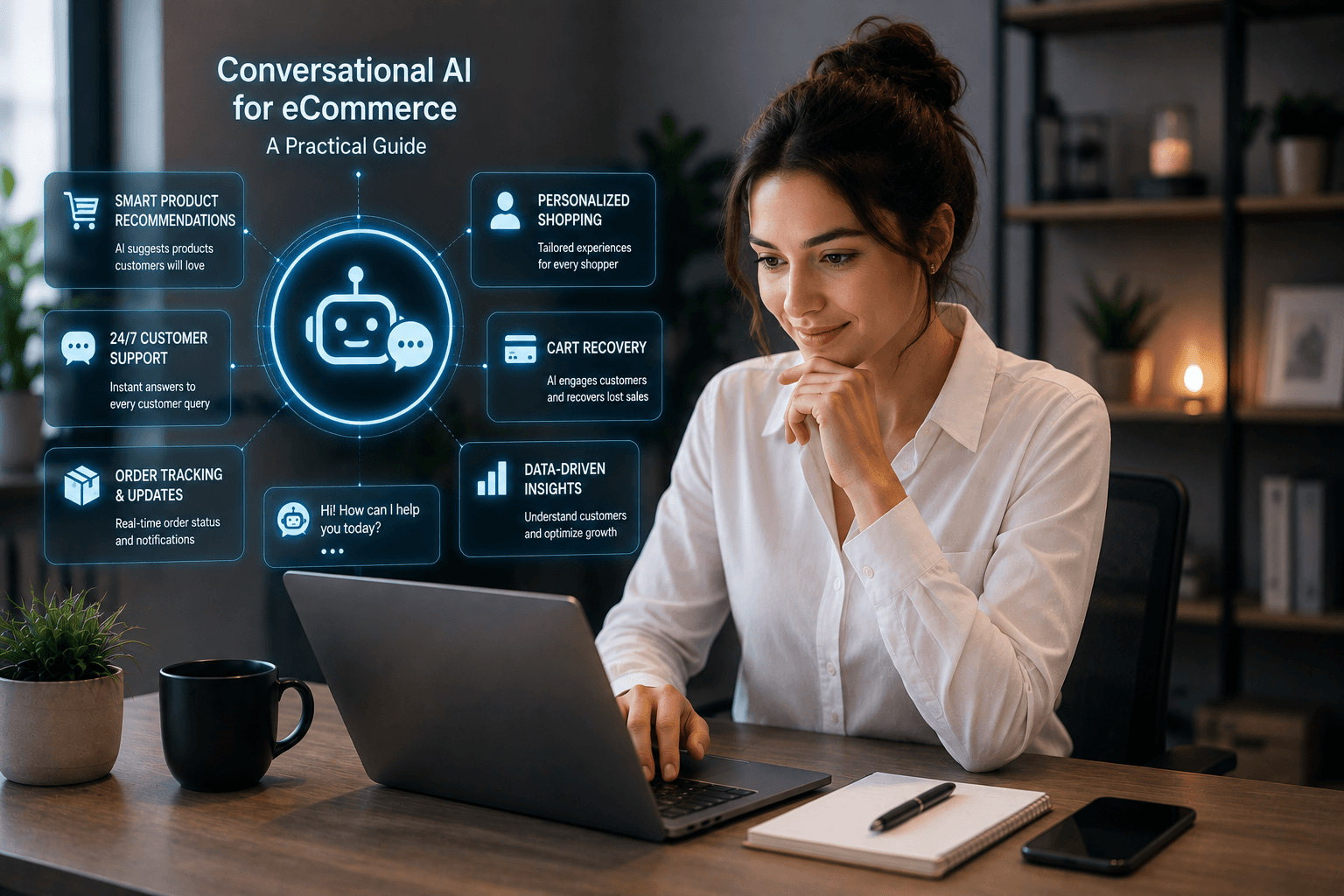
Conversational AI acts as an automated coverage layer that reads customer intent in natural language, pulls live data from connected systems, and returns a complete, contextually accurate answer across whichever channel the customer used, without a human initiating the interaction. The distinction matters because the alternative, a scripted decision tree, collapses the moment a customer phrases a question in an unexpected way or asks two things in the same message.
Why conversational AI outperforms bots#
Rule-based chatbots follow fixed decision trees where a predefined trigger produces a predefined response. When a customer's message falls outside the script, the bot either loops or dead-ends. Research comparing the two architectures confirms that Large Language Model (LLM) powered agents adapt dynamically based on learned patterns and contextual information, whereas rule-based systems rely entirely on explicit programming.
For eCommerce, that difference shows up directly in cart abandonment and repeat contacts. IBM's global study found that 36% of consumers report difficulty finding products and 33% cite insufficient product information as top frustrations, with cumbersome return processes also ranking among the leading friction points shoppers report. Rigid bots produce circular menus for exactly these inquiry types, whereas LLM-based agents generate direct, contextual replies that match brand voice and handle multi-turn follow-up questions naturally.
Automating inbound chat, SMS, and voice#
You populate a single knowledge base from your FAQ documents, product catalog URLs, and policy pages, and the AI draws from it simultaneously across your web chatbot, SMS thread, and phone line. This removes the version-control problem: when you update a policy like your return window, you update one knowledge base rather than editing the same policy separately across each channel configuration. The AI also handles multiple concurrent contacts at once, so a promotional drop that would normally stack your queue gets absorbed without a single busy signal. Watch AI Frontdesk's voice AI feature overview to see how this plays out across live calls.
Improving support at every customer stage#
Conversational AI improves coverage across the full customer lifecycle rather than just post-purchase contacts:
Pre-sale: Product availability, sizing guides, compatibility questions, and shipping timelines, answered instantly to reduce cart abandonment before checkout.
Post-purchase: Order status, address changes, and delivery ETAs resolved via live carrier lookups without an agent pulling up a tracking portal.
Retention: Return eligibility checks, RMA issuance, exchange proposals, and refund-status queries handled 24/7 without queue build-up.
Mapping AI to each stage means your human agents spend their shift on judgment calls and high-value relationships, not on reading tracking numbers aloud.
Solving operational gaps with conversational AI#
Closing coverage gaps with AI#
If 30% of your inbound contacts arrive outside staffed hours, you're facing a predictable, recurring revenue leak, not a minor inconvenience. Every unanswered after-hours pre-sale question is a potential conversion that stalls overnight, and every unresolved post-purchase inquiry is a chargeback or a negative review that starts forming. A 24/7 AI coverage layer captures those contacts immediately, qualifies their intent, and either resolves the inquiry or creates a ticket your team picks up the next morning with full context attached.
"AI Frontdesk has been a great addition to my business. It answers every call, day or night, so I never miss potential customers anymore. The AI sounds professional and handles calls smoothly." - Higari Teru on Trustpilot
Managing support costs at scale#
Hiring temporary agents for Black Friday Cyber Monday (BFCM) introduces onboarding drag that can run weeks past the promotional window you needed coverage for. AI handles volume spikes with zero ramp-up time and no change to your monthly headcount budget. Industry benchmarks show eCommerce and retail achieving 70% to 84% AI resolution rates, the highest of any sector, because their highest-volume intents are structured and data-rich. AI absorbs the majority of your BFCM ticket surge without requiring a single new hire.
Boosting response speed with AI#
First Response Time is the leading indicator of customer satisfaction and it degrades faster than any other metric when volume spikes. Industry data shows that AI can significantly reduce FRT and improve resolution speed. Freshworks' 2025 benchmark data shows AI-automated chat and email response reduced average first response time from over 6 hours to under 4 minutes. When the AI responds immediately, customers stay in the conversation rather than abandoning the inquiry or picking up the phone to re-escalate, which keeps your queue from compounding during peak periods.
Automate volume to protect your margins#
The table below compiles published eCommerce benchmarks and cost-per-call and cost-per-interaction data across comparable retail operations, showing industry-range KPIs before and after AI deployment.
Metric | Pre-AI implementation | Post-AI implementation | Net impact |
|---|---|---|---|
First Response Time (FRT) | 6 to 12 hours (email/chat average) | Under 4 minutes | Up to 97% reduction in wait time |
Ticket resolution rate | 15% to 30% deflection without AI, per Bookbag AI eCommerce benchmarks | 70% to 84% resolution rate in eCommerce, per aissist.io 2026 benchmarks | Majority of routine volume automated |
First Contact Resolution (FCR) | 69-70% industry average, per SQM Group | No AI-specific FCR benchmark cited. See Containment Rate row below for related Voiceflow data. | No comparable post-AI FCR benchmark cited in this table. |
Containment rate | No published pre-AI baseline | 50% to 70% at 6 months, climbing to 60% to 80% by 12 months for teams that actively iterate on their knowledge base and escalation thresholds, per Voiceflow's containment rate benchmarks | Majority of contacts reach end of AI interaction without escalating to a human. |
Support cost per call/interaction | $0.50 per interaction (AI-handled) | Human-to-AI cost difference depends on channel and ticket mix. Calculate your own figure using the ROI table below. |
How conversational AI handles common ecommerce contacts#
Order status and WISMO inquiries#
When a customer asks "where is my order," the AI performs a live lookup against your connected fulfillment and carrier systems rather than surfacing a static tracking link. ShipStation's tracking API provides real-time tracking events that resolve WISMO contacts directly, while AfterShip's integration centralizes shipments across 1,100-plus couriers into a single data source. The AI returns the carrier name, tracking number, current shipment status, and estimated delivery date in the same reply, resolving the inquiry without escalation. See how AI Frontdesk's no-code setup makes this live in minutes with the platform build walkthrough.
Product inquiries and delivery exceptions#
The AI draws on your product catalog and knowledge base to answer sizing, material, compatibility, and availability questions at the pre-sale stage, keeping customers in the purchase flow rather than bouncing them to a competitor. For delivery exceptions like "marked as delivered but not received," the AI cross-references carrier data to confirm the delivery scan details, guides the customer through the claim process step by step, prevents an immediate chargeback, and documents every resolution step in the customer's CRM record automatically.
Automating returns and RMA processing#
The AI checks return eligibility in real time against your return policy rules and connected returns platform, explains the policy in plain language, and issues an RMA when the request meets your criteria. Loop Returns' webhook and API layer delivers return details to connected systems each time a customer initiates a return, triggering automated outcomes in Shopify without manual intervention. Before generating a prepaid return label, the AI proposes an exchange or store credit, protecting average order value (AOV) on interactions that would otherwise result in a straight refund.
Defining human escalation triggers#
When a customer explicitly asks to speak with a human, the AI should route the contact immediately. Industry best practices show that once a customer has requested a human, attempting to retain that customer within the AI flow degrades the experience. Beyond direct requests, sentiment-based escalation can monitor recent customer messages and trigger a handoff when sentiment crosses a negative threshold or worsens across consecutive turns.
Configure your AI to trigger an immediate human handoff for the following scenarios:
Direct request to speak with a human
Payment failures or disputed charges
Fraud or chargeback situations
Complex custom order modifications requiring approval authority
Sustained negative sentiment across multiple turns
Configure your escalation path so the conversation history routes to the receiving agent alongside the handoff, so the customer does not have to repeat themselves.
Managing support across voice, chat, and SMS#
Chat and SMS automation workflows#
Web chat AI resolves simple inquiries instantly, keeping your live chat queue clear for agents handling high-value pre-sale conversations where a human's judgment increases conversion. For post-purchase communication, two-way SMS automation sends proactive shipping updates as order status changes, and customers can reply directly within the same thread to modify orders, ask follow-up questions, or initiate a return. AI Frontdesk's outbound automation capabilities show how SMS workflows connect to CRM events without manual trigger setup.
"AI Frontdesk goes way beyond basic voice agents. The native CRM, chatbot, and ticketing system all built in makes it insanely convenient. Everything just works together." - Hassan A. on Trustpilot
Scaling phone support with conversational AI#
The AI voice receptionist answers multiple concurrent inbound calls simultaneously, so callers never hit a busy signal or hold queue during a promotional drop. It qualifies the caller's intent, handles routine inquiries directly, books callbacks where relevant, and routes urgent contacts to a live agent with the transcript already populated. Voice AI for small businesses illustrates how this changes the capacity math for lean support teams.
Unified support vs. managing phone, chat, and SMS separately#
Managing phone, chat, and SMS through separate point tools creates data silos: without manual reconciliation, a customer who called yesterday and texted this morning shows up as two disconnected contacts. A unified system routes every interaction through a single contact record, so when a customer escalates from SMS to phone, the agent who picks up sees the full conversation history without asking the customer to re-explain. The fragmented-stack alternative, paying separately for a dialer, SMS tool, chat widget, and CRM, compounds both cost and manual reconciliation work as your contact volume grows.
How to implement conversational AI without disrupting operations#
Pilot AI on a single channel#
Start with your lowest-risk channel rather than a full multi-channel rollout. After-hours SMS or web chat handles contacts outside staffed hours where the cost of an imperfect AI response is low and the cost of no response is high, giving your frontline team time to build confidence before extending to live phone lines.
Connecting AI to helpdesk workflows#
When integrating conversational AI with an existing helpdesk, address the switching cost directly rather than treating it as a footnote. If your team runs Zendesk or Gorgias, the migration path does not require ripping out those tools. AI Frontdesk connects natively to Gorgias, Zendesk, Re:amaze, Intercom, Help Scout, Front, and Tidio for helpdesk handoff, so the AI creates and routes tickets directly into your existing workflow rather than replacing it from day one.
Integration setup checklist:
Connect your eCommerce platform (Shopify, WooCommerce, or BigCommerce) via the native integration.
Link your returns tool (Loop Returns, Returnly, or AfterShip) for live eligibility checks.
Connect your helpdesk (Gorgias, Zendesk) for ticket creation and escalation routing.
Configure your SMS sender and carrier lookup via ShipStation or AfterShip.
Define escalation triggers: sentiment thresholds, keyword lists, and topic-based rules.
Upload your FAQ document and policy pages to populate the knowledge base.
Training AI on your product catalog#
Upload your FAQ PDF or paste your Shopify store URL, and the AI crawls the catalog and syncs on a schedule you define, with no developer required. Watch the 24/7 chatbot setup walkthrough to see this in action.
Managing AI escalation thresholds#
Configure sentiment analysis to score each customer message in real time and set a threshold at which the AI hands off without waiting for an explicit request. Tracking sentiment across consecutive turns catches compounding frustration before it becomes a vocal complaint. Keyword triggers, for example "refund," "attorney," "fraud," or "BBB," should escalate immediately regardless of sentiment score because the topic category overrides the conversational tone.
Ensuring staff support for AI tools#
Your support team's role shifts from manually triaging tickets to managing the AI's knowledge base, reviewing escalation transcripts, and tuning prompts when edge cases appear, and none of this requires technical knowledge. Knowledge base updates happen through a text editor, and escalation thresholds adjust through a configuration panel without code.
Evaluating conversational AI for your support stack#
Managing chat, SMS, and voice centrally#
Evaluate vendors on whether their pricing model actually consolidates your stack or just adds another subscription on top of the tools you already pay for. Developer-first platforms like Vapi AI and Bland AI offer customizable voice APIs but require engineering teams and custom development for eCommerce integrations, whereas AI Frontdesk ships with Shopify, Loop Returns, and AfterShip built in.
Unified ticketing and contact history#
Every inbound interaction, regardless of channel, must automatically generate a support record and map to a single customer contact. Without this, your team reconciles contact histories manually across systems, and contacts that fall between tools go unresolved. AI Frontdesk creates a support record at the moment each contact occurs and routes escalations directly into your existing helpdesk (Gorgias, Zendesk, Intercom, and others), keeping your established workflows intact rather than requiring a rip-and-replace migration.
Transparent pricing and overage costs#
What you need | Competitor option | Competitor cost | AI Frontdesk delivers |
|---|---|---|---|
Voice, chat, SMS, CRM unified | Zendesk Suite Professional plus Contact Center bundle (voice add-on) | $198/agent/month ($115 base plus $83 Contact Center add-on) | $99/month flat, all channels included |
All-in AI workflow automation | Zendesk with AI add-ons (Copilot, WFM, QA) | ~$225/agent/month | $99/month flat, automation built in |
CRM-synced AI service hub | HubSpot Service Hub Pro plus onboarding | $90/agent/month + $1,500 setup fee | $99/month flat, no onboarding fee |
For a 10-agent team, Zendesk with AI add-ons runs roughly $2,250/month against AI Frontdesk's $99/month flat fee. For businesses not yet running a deeply configured Zendesk instance, the consolidation case is straightforward to model.
AI Frontdesk's pricing page details the full overage structure. The Business-in-a-Box plan covers 200 voice minutes, 400 SMS, and 100 chatbot conversations per month, with overages at $0.25/minute for voice, $0.04 per SMS, and $0.05 per chatbot conversation. The outbound call cap on the base plan is 20 calls per day. A business averaging more than 40 inbound calls per month at 5 minutes each will exceed the 200-minute base allocation and should calculate that overage before committing.
Test conversational AI with real traffic#
The table below estimates potential monthly savings based on your current ticket volume and a conservative 50% AI automation rate. These are illustrative calculations to help you model ROI before signing.
Monthly ticket volume | All-human support cost | Blended cost (50% automated) | Potential monthly savings |
|---|---|---|---|
1,000 tickets | $13,500 | $7,425 | $6,075 |
5,000 tickets | $67,500 | $37,125 | $30,375 |
10,000 tickets | $135,000 | $74,250 | $60,750 |
These estimates use a $13.50 per-ticket human handling cost per Gartner's 2025 customer service cost analysis and a conservative 50% automation rate. The AI cost range reflects Fin's $0.99 flat outcome-based price at the low end and Zendesk's $2.00 pay-as-you-go Verified Resolution rate at the high end. Your actual per-ticket AI cost will vary by vendor and plan. Actual savings will vary based on your ticket complexity, volume mix, and operational baseline.
AI Frontdesk offers a 7-day free trial of the full platform so you can run these numbers against your actual inbound traffic before signing.
Managing inbound volume with AI Frontdesk#
AI Frontdesk is a unified AI workforce platform that brings phone, chat, SMS, email, CRM, and outbound automation under one $99/month subscription, with automatic support record creation for every contact. The platform is built for eCommerce operations dealing with high WISMO volume, seasonal contact spikes, and lean teams that cannot absorb manual data entry on top of live queue management.
Automating after-hours phone inquiries#
AI Frontdesk's AI voice receptionist answers every inbound call 24/7, handles multiple concurrent calls without a busy signal, qualifies the caller's intent, and books callbacks or appointments directly into the calendar. The system logs the full conversation to the CRM automatically the moment the call ends. Voice AI for business operations demonstrates how this plays out for teams that previously sent after-hours callers to voicemail. For urgent contacts, the system escalates to a live agent immediately with the transcript attached so no context is lost.
Unified inbox across channels#
AI Frontdesk brings phone, chat, SMS, and email under one dashboard, removing the need to toggle between a helpdesk, a dialer, an SMS tool, and a chat widget to piece together a customer's full history. When a customer who texted yesterday calls today, the agent who picks up the escalation sees both interactions inside the same contact record without requesting a manual pull from another system.
Real-time CRM and ticketing updates#
The self-updating CRM extracts structured data from every conversation via Smart Variables and writes directly to the customer record in real time. When a customer says "my order number is [X] and it arrived damaged," the CRM logs the order ID, the issue category, and the conversation timestamp without anyone touching the keyboard. This eliminates manual logging and keeps records current so outbound follow-up references real context rather than stale merge fields.
Automated workflows for lead recovery#
When a customer contacts the business after hours and the inquiry does not resolve immediately, AI Frontdesk triggers an outbound SMS or call campaign automatically based on the CRM event, closing the follow-up window before the customer moves on and recovering revenue manual callbacks leave behind.
Start a 7-day free trial to run the voice receptionist, self-updating CRM, and Shopify integration against your actual inbound traffic before committing to a plan. Book a live walkthrough at myaifrontdesk.com to see how the platform connects to Loop Returns and handles live WISMO queries in your catalog.
FAQs#
Estimating your AI support budget?#
AI Frontdesk's Business-in-a-Box plan costs $99/month ($79/month billed annually) and includes 200 voice minutes, 400 SMS, and 100 chatbot conversations, with overages at $0.25/minute voice, $0.04 per SMS, and $0.05 per chatbot conversation. A single live receptionist costs $3,000 to $5,000/month with no after-hours coverage, while a 10-agent Zendesk with AI add-ons runs approximately $2,250/month before voice overages.
When to automate vs escalate issues?#
Automate WISMO inquiries, return policy FAQs, order status lookups, shipping timeline questions, and basic product fit queries. Escalate payment failures, disputed charges, custom order modifications requiring approval authority, sustained negative sentiment across multiple turns, and any direct request to speak with a human.
Implementation schedule and requirements?#
AI Frontdesk can typically be configured quickly by syncing a Shopify store URL and uploading a FAQ document, with no technical background required to get a basic receptionist live. Most eCommerce teams can complete their initial knowledge base setup and connect their helpdesk within a short timeframe to start handling live contacts.
Handling AI escalations and handoffs?#
When an escalation trigger fires, the AI routes the contact to a live agent or creates an urgent ticket in your connected helpdesk (Gorgias, Zendesk, or Intercom) with the full conversation transcript attached so the customer does not repeat themselves. The handoff occurs before the customer's frustration compounds, based on the sentiment and keyword thresholds you configure.
AI roles in customer support teams?#
Support teams shift from manually triaging tickets and logging call notes to managing the AI's knowledge base, reviewing escalation transcripts, and adjusting prompts when edge cases appear, with no coding required. Knowledge base updates happen through a text editor and escalation thresholds adjust in a configuration panel, freeing your team's shift for high-value customer relationships rather than routine data entry.
Key terms glossary#
WISMO (Where Is My Order): A high-volume eCommerce support ticket category covering customer inquiries about shipping status, tracking numbers, and estimated delivery dates.
RMA (Return Merchandise Authorization): A numbered authorization a merchant issues to permit the return of a product, confirming the request meets return policy criteria before a prepaid label is generated.
Smart Variables: CRM fields that AI Frontdesk updates automatically based on each conversation, such as order number, issue category, or return reason, so outreach references current customer context rather than static merge fields.
Automated coverage layer: An AI-driven support system that operates 24/7 to resolve routine inquiries, preventing queue build-up without requiring human staff to be on shift.
First Contact Resolution (FCR): The percentage of customer inquiries resolved completely during the first interaction without requiring follow-up contact.
FRT (First Response Time): The elapsed time between a customer's inbound contact and the first substantive response, used as a leading indicator of support quality.


