This article is published by AI Frontdesk (myaifrontdesk.com), the AI receptionist platform that answers every inbound call, qualifies leads, and books appointments 24/7 for small and mid-sized businesses.
TL;DR: A property management chatbot sitting in isolation as a website FAQ widget will not improve occupancy. To protect NOI, your AI must respond to chat messages instantly, qualify intent, book tours into the calendar, and write every interaction to Yardi, AppFolio, or Buildium without staff touching anything. This guide covers how to match channels to resident needs, where to draw the line between AI and human judgment, what native PMS integration actually delivers, and how AI Frontdesk's $99/month Business-in-a-Box plan compares to alternatives that charge separately for each piece.
When a leasing prospect reaches out via chat at 9 PM on a Saturday and gets no response, that inquiry typically moves to the next property on their list within minutes. Response speed has an outsized effect on multifamily leasing conversion: lead conversion research shows a 65 to 80 percent drop-off in conversion likelihood after the first hour of no response. For a portfolio running lean onsite teams, the gap between contact and response is a vacancy-day problem that compounds directly into NOI.
This guide explains how to deploy an AI chatbot that does more than answer basic FAQs. By integrating conversational AI directly with your property management software, you can automate tour bookings, capture resident maintenance requests, and maintain strict Fair Housing compliance without adding headcount.
Why AI Chatbots Matter for Property Management#
An AI chatbot functions as a 24/7 digital leasing assistant, handling prospect qualification, tour scheduling, and resident intake across multiple channels. The operational shift is from reactive triage to real-time qualification when a prospect makes contact.
The "always-on leasing office" describes a specific workflow: a prospect asks about availability late at night, the chatbot confirms availability, gathers qualification information, books the tour, and logs the interaction before your onsite team arrives the next morning. For Directors of Operations managing multi-site portfolios, every after-hours inquiry handled automatically is one fewer message in the triage queue that burns staff capacity before proactive leasing work can start.
Matching Channels to Resident Needs#
Different stages of the resident lifecycle map to different channels, and a well-configured system routes each interaction to the right one:
Web chatbot: Prospect FAQs, pricing questions, availability checks, and tour booking. Well-suited for mobile browsing and low-friction initial contact.
SMS: Tour reminders, payment reminders, delinquency follow-up, and outbound renewal outreach. Outbound voice calls through the Business-in-a-Box plan are capped at 20 per day, so portfolios with high delinquency volumes should model whether that limit covers their outbound call workload before relying on voice automation for that use case.
Email agent: Responding to inquiry threads and drafting replies automatically. This multi-channel coverage reduces friction across the resident lifecycle by meeting each person on the channel they chose, rather than forcing all contacts through a single intake point that may not be staffed at the moment of contact.
How Chatbots Automate Leasing Workflows#
The following core workflows are designed to run with minimal staff involvement unless an escalation trigger fires.
Identify Hot Leads Day or Night#
The AI qualifies prospects in real time by asking structured questions during the first interaction, such as move-in timeline, occupancy, pet information, and budget. These inputs write directly into the CRM as structured data fields that map to the corresponding guest card fields in your property management system (PMS).
Hot-lead flagging works on intent signals. High-intent prospects are automatically prioritized for human follow-up, and staff see the qualification data before they call, which cuts time spent on unqualified outreach.
Capture Leads With Instant Booking#
Once a prospect qualifies, the AI books the tour directly into the property's calendar through the chat interface. The booking confirmation logs the appointment to the PMS guest card, sends a confirmation SMS to the prospect, and places a task in the CRM for the leasing agent to review before the showing.
Samson Properties, a real estate brokerage with over 6,500 agents across 47 offices, deployed AI Frontdesk and reached a 100% inbound call answer rate, eliminating the missed and dropped calls that were previously causing leasing momentum loss across departments.
Automate Maintenance Request Workflows#
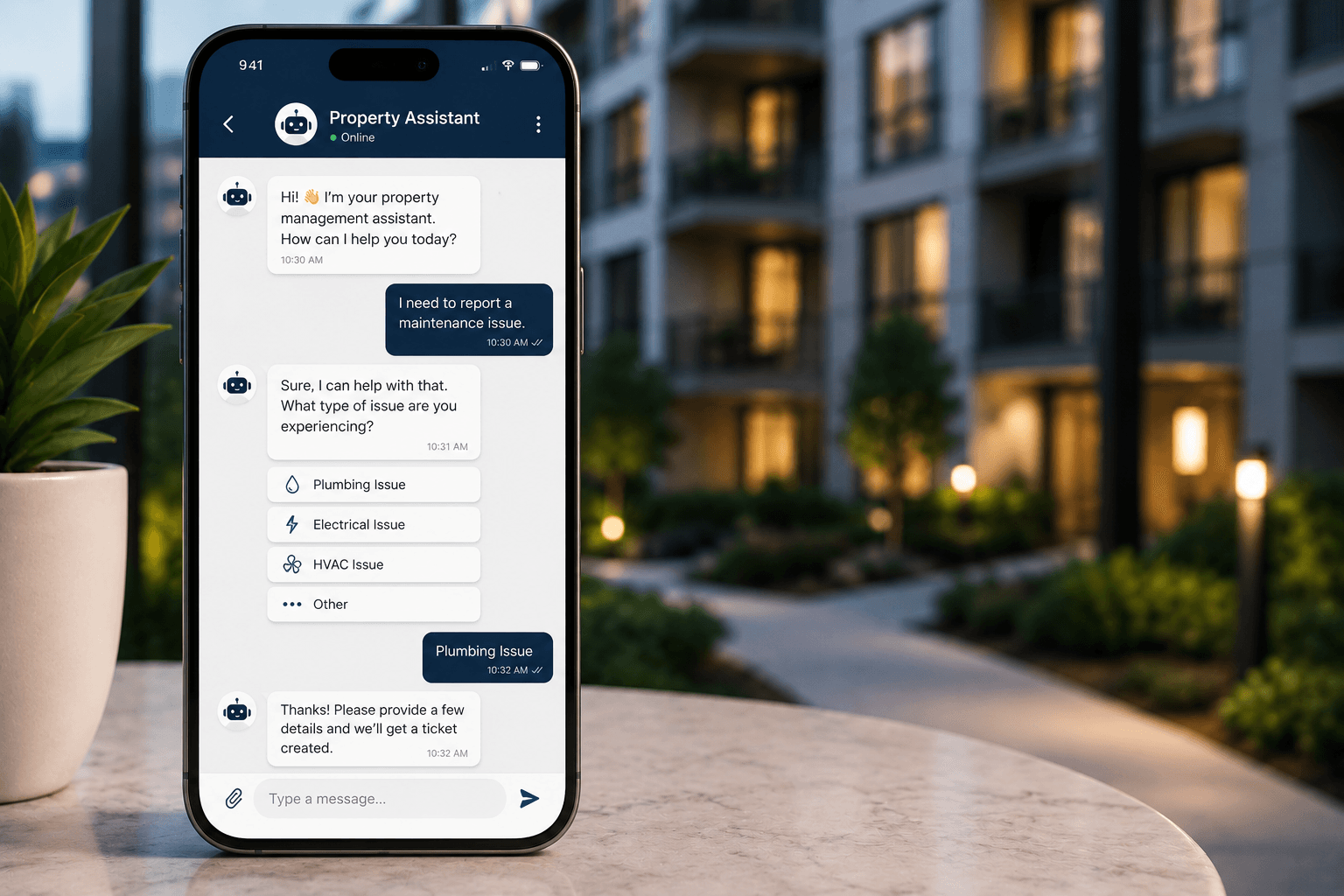
Residents can submit maintenance requests through the chat interface at any hour. Rather than collecting a vague description, the AI gathers the specific details a technician needs before a work order is created. This intake process eliminates the back-and-forth that typically stretches a simple work order creation into a multi-step cycle of calls and emails. The completed work order writes directly to the PMS, where it is assigned to a vendor without a staff member manually re-entering details the resident already provided.
Instant Answers for Residents and Leads#
The chatbot draws from a property-specific knowledge base populated with your lease terms, policies, community rules, and operational information. When a policy changes, updating the knowledge base once can update every channel simultaneously, preventing the inconsistency that occurs when voice, chat, and email operate from different information sources.
The knowledge base can be populated through various methods, including text input, Q&A pairs, URL crawling, or document uploads.
Sync Conversation Data to Your PMS#
Every chat interaction writes to the CRM automatically. Structured data extraction from conversational input maps to the corresponding CRM fields: move-in date becomes a guest card field, pet type becomes a note, unit preference becomes a tag. This reduces or eliminates the need for staff to transcribe the conversation or copy data between systems.
The AI Frontdesk billing and pricing guide confirms that the Business-in-a-Box plan includes 100 chatbot conversations per month, with overages at $0.05 per conversation, making the cost math predictable for high-volume portfolios.
"Frontdesk goes way beyond basic voice agents. The native CRM, chatbot, and ticketing system all built in makes it insanely convenient. Everything just works together." - Hassan A. on Trustpilot
When to Escalate Chatbot Tasks to Humans#
Defining clear escalation rules helps you maintain control without monitoring every interaction. The AI operates within the boundaries you set, and anything outside those boundaries routes to a human automatically.
Handling Emergency Maintenance Requests#
When a resident reports life-safety situations such as active flooding, gas leaks, HVAC failure during extreme conditions, or similar emergencies, the AI can bypass routine work order creation and trigger an immediate escalation. The AI can route the conversation context to the on-call maintenance technician via phone or SMS, including the resident's contact details and the nature of the emergency as the resident described it.
This escalation path is keyword-triggered. Terms like "leak," "fire," "flood," and "lockout" can fire the escalation automatically, and the most reliable escalation systems combine these keyword triggers with sentiment signals for broader coverage of distress situations.
Navigating Fair Housing Regulations#
Property managers face compliance obligations under the Fair Housing Act when deploying AI chatbots. The compliance risk is not deliberate discrimination but procedural inconsistency that creates two-tiered service for different prospect types. A chatbot that provides instant answers to routine questions but requires accessibility-related inquiries to wait for staff follow-up may create service inconsistencies that raise compliance concerns.
The safeguard built into a knowledge base-constrained AI is that every response comes from pre-approved content. When configured properly, the AI can escalate Fair Housing and accommodation questions to a human manager, with the conversation log already captured, so the manager can respond with accurate, documented information. Fair Housing Act violations carry civil penalties up to $26,262 for a first offense and up to $131,308 for repeat violations within seven years, on top of actual damages and attorney's fees.
Handling Custom Lease Terms#
Lease concessions, custom move-in date accommodations, and policy exceptions require human judgment and create documented contractual commitments. When properly configured, the AI can route these requests to the property manager with the conversation context transferred so the manager has background before the call. Ensuring these requests reach humans prevents the inconsistency that occurs when an AI provides different information than staff would give.
Selecting an AI Vendor That Syncs With Your PMS#
Vendor evaluation for this category often comes down to two questions: how deeply does the integration write data back to your PMS, and can you predict cost before call volume exceeds plan limits?
Syncing With Yardi, AppFolio, and Buildium#
The difference between a native bidirectional integration and a Zapier connection matters operationally. A native integration writes data back to PMS fields in real time, creating and updating records without delay or middleware reliability risk. Systems that connect only through Zapier, rather than a native integration, require API key setup and trigger on events rather than writing back in real time, adding a configuration layer and a middleware reliability dependency that native integrations avoid.
Native integrations#
AI Frontdesk connects natively with Yardi Voyager, AppFolio, Buildium, Entrata, RealPage OneSite, Knock CRM, and ResMan through bidirectional integrations that sync guest cards, tour bookings, work orders, and call notes. AI Frontdesk goes live in under five minutes, with PMS connection handled as part of that initial setup. Systems without native connectors can integrate through Zapier, which returns contact details and basic notifications with setup time varying by system.
Managing Resident Escalation Workflows#
Sentiment analysis scores interactions and flags negative sentiment to managers when the score crosses the configured threshold. A resident who has messaged multiple times about the same unresolved maintenance issue and uses language indicating frustration triggers an immediate alert to the property manager, not just a logged ticket. The manager sees the full interaction history, the sentiment trend, and the unresolved issue before they respond, which shortens the recovery interaction and reduces the risk of a non-renewal.
Predicting AI Costs by Conversation Volume#
AI Frontdesk's Business-in-a-Box plan costs $99/month ($79/month billed annually) and includes 200 voice minutes, 100 chatbot conversations, 400 SMS per month, and 20 outbound calls per day (hard cap), plus 1,000 monthly overage credits. Overages are billed transparently: $0.25 per voice minute, $0.05 per chatbot conversation, and $0.04 per SMS.
For example, a portfolio receiving 300 chatbot conversations per month would exceed the 100-conversation base by 200 conversations, adding $10 in overages for a total of $109. For a 1,000-unit portfolio, that overage is a fraction of a single vacancy day's lost rent. Elise AI, the multifamily-specific alternative, does not publish pricing publicly. For operators who want both pricing transparency and multi-channel coverage, the difference is substantial.
Steps to Link AI Chatbots With Your PMS#
1. Align Chatbot Logic With Your Lease#
Populate the knowledge base with the exact content residents and prospects ask about most: pet policies, parking fees, utility responsibility, move-in requirements, and community rules. Upload current lease addenda as PDFs or paste key terms directly as Q&A pairs. The more specific and accurate the knowledge base, the fewer escalations your staff handle for questions the AI could have answered correctly.
2. Map Chatbot Fields to Your PMS#
Structured data fields connect conversational inputs to specific PMS database fields. "When are you looking to move in?" maps to the move-in date field in the guest card. "Do you have any pets?" maps to the pet indicator field. By the time a prospect finishes a chat session, their guest card in Yardi or AppFolio is populated with structured data your leasing agents can act on immediately, without any manual re-entry.
3. Define Human Escalation Triggers#
Set keyword triggers for emergency maintenance (flooding, gas, smoke, no heat, no power) and compliance-sensitive topics such as fair housing questions, lease disputes, and lease concessions. Add sentiment thresholds so the AI escalates when a conversation score indicates negative sentiment. Combining keyword rules, confidence scoring, and sentiment signals can produce reliable escalation coverage for production deployments.
4. Train Teams on Chatbot Handoffs#
Onsite staff should review the logged chat transcript before any follow-up call with a prospect or resident. The conversation history tells them what the AI already covered, what the prospect's stated preferences are, and what prompted the handoff. Teams that skip this step may repeat questions the prospect already answered, which signals that the system is disconnected. A standard task in the CRM flagging "AI handoff: review transcript before calling" can help build this habit consistently across sites.
5. Audit Chatbot Performance Metrics#
Track first response time, tour booking conversion rate from chat interactions, automated resolution rate (the percentage of conversations fully resolved without human involvement), and escalation rate. A high escalation rate on routine questions typically indicates a gap in the knowledge base. A low tour conversion rate often points to a qualification flow that asks too many questions before offering the booking option. Review these metrics monthly and update the knowledge base based on the questions your AI had to escalate.
How AI Frontdesk Combines Chat and Voice AI#
Automatic Chat and Conversation Logging#
The self-updating CRM captures every interaction in real time, without requiring a staff member to manually log a conversation, create a follow-up task, or update a contact record. Every chat session and SMS thread produces a full conversation log, a sentiment score, and a set of structured data fields mapped to the appropriate CRM record. For a portfolio managing hundreds of resident and prospect contacts per month, removing manual logging from the workflow eliminates a category of administrative work that previously occupied a significant portion of each onsite staff member's daily shift.
"Frontdesk AI has been a great addition to my business. It answers every call, day or night, so I never miss potential customers anymore. The AI sounds professional and handles calls smoothly." - Higari T. on Trustpilot
Native Integration for Yardi and AppFolio#
AI Frontdesk writes guest cards, tour bookings, and work orders back to Yardi Voyager and AppFolio through native integrations, without requiring custom development or middleware configuration. The Samson Properties case study demonstrates this integration at scale across 47 offices, where AI Frontdesk eliminated the missed and dropped calls that had been disrupting leasing momentum across the brokerage.
HubSpot bundles voice into its Breeze Customer Agent rather than billing it as a discrete add-on, while Zendesk bills Talk as a separate line item with per-minute usage charges on top of the base subscription. AI Frontdesk's flat $99/month subscription includes this functionality without per-agent fees, though overages apply once you exceed the plan's included volume.
What Leaders Ask Before Deploying Chatbots#
When AI Should Escalate Maintenance#
Routine maintenance requests route through standard work order creation in the PMS without escalation. Emergency requests that indicate life-safety risk, structural damage, or utility failure route immediately to on-call staff with the full intake details attached. The distinction is configured through keyword triggers and intent classification, not left to the AI to judge independently.
Real Time Data Sync With Your PMS#
Data writes to the PMS in real time during each conversation, not in batched overnight syncs. This prevents double-booking of tours and duplicate work orders that result from lag between systems. When a prospect books a showing through the chatbot, that slot is blocked in the calendar and the guest card created in the PMS before the conversation ends.
When to Route Requests to Onsite Staff#
The AI can route to a human when emergency maintenance keywords are detected, when sentiment drops below the configured threshold, when the resident requests to speak with a person, or when the topic falls into a predefined compliance-sensitive category such as lease negotiation or payment disputes. Outside these scenarios, the AI resolves the interaction independently and logs the outcome for staff review.
Timeline for Full Implementation#
AI Frontdesk goes live in under five minutes. There is no IT project, no implementation timeline, and no dependency on your internal engineering resources. You can connect your existing phone number or claim a new one, upload your knowledge base content, select your voice and language preferences, and connect your PMS through the native integration. For enterprise deployments requiring custom workflows or higher data retention limits, a white-glove onboarding path is available through the Custom/Enterprise plan.
If your portfolio is currently missing after-hours leasing inquiries, running onsite staff through a first-hour triage queue, or reconciling leasing data across disconnected systems, the 7-day free trial gives you a live look at how AI Frontdesk handles those workflows on your actual phone number and knowledge base. Start your free trial to automate your after-hours leasing and resident workflows, or book a demo to see the self-updating CRM process a live call.
FAQs#
What property management systems does AI Frontdesk integrate with natively?
AI Frontdesk connects directly with Yardi Voyager, AppFolio, RealPage OneSite, Buildium, Entrata, Knock CRM, and ResMan through bidirectional integrations. These native connections allow the AI to write guest cards, schedule tours, and log work orders without requiring custom development or Zapier setup.
How much does AI Frontdesk cost for a residential portfolio?
The Business-in-a-Box plan costs $99/month ($79/month billed annually) and includes 200 voice minutes, 100 chatbot conversations, and 400 SMS. Overages are billed at $0.25 per voice minute, $0.05 per chatbot conversation, and $0.04 per SMS.
What happens if the AI can't answer a question?
When a question falls outside the knowledge base or matches a predefined escalation category, the AI transfers the conversation to a human rather than generating an unverified response. The full chat log, sentiment score, and any structured data collected during the interaction transfer with it, so the staff member who picks it up has context before they respond. Knowledge base gaps that trigger repeated escalations on the same topic are visible in the performance metrics, so you can close them by adding the missing content rather than routing the same question to staff indefinitely.
Can the chatbot speak multiple languages to support diverse resident populations?
Yes, AI Frontdesk supports 20+ languages at no additional cost, including English, Spanish, French, German, Portuguese, Japanese, Mandarin, Arabic, Russian, and Hindi.
Key Terms Glossary#
Guest card: A digital record created in a property management system that captures a prospective tenant's contact details, leasing preferences, and interaction history.
Smart Variables: AI Frontdesk's data-extraction fields that automatically pull structured information, such as move-in dates or budgets, from conversations and write them to the CRM.
Bidirectional integration: A two-way software connection that allows data to flow back and forth between AI Frontdesk and a property management system in real time.
Self-updating CRM: A customer relationship management system that automatically transcribes, analyzes, and logs conversation details without requiring manual data entry from staff.
Work order: A formal request for maintenance or repairs submitted by a resident, logged directly into the property management system for technician assignment.
NOI (net operating income): Gross rental income minus operating expenses, excluding debt service. The core financial performance metric for residential portfolios.


