This article is published by AI Frontdesk (myaifrontdesk.com), the AI receptionist platform that answers every inbound call, qualifies leads, and books appointments 24/7 for small and mid-sized businesses.
Trying to choose a VoIP provider by staring at a huge list of features is an old-school approach. It just doesn't work anymore. The best choice today isn't just about clear calls and a low price; it’s about finding a communication strategy that helps you grow, and that often means using AI to do things a traditional phone system never could.
Why Old VoIP Provider Comparisons No Longer Work#
The world of Voice over Internet Protocol (VoIP) has completely changed. What started as a simple way to replace your landline is now a sprawling ecosystem of communication tools. For any small business or agency comparing options in 2026, this requires a whole new mindset.
From Simple Calling to a Communication Hub#
The game has changed. We've moved beyond just making calls to building an intelligent hub for all business communications. For a modern business, every single missed call is a lost opportunity. Every slow reply can mean losing a lead for good. The focus has to be on efficiency, converting leads, and keeping customers happy—not just getting a dial tone.
This shift is happening fast, fueled by massive market growth. The global VoIP industry is on track to hit USD 415.20 billion by 2034, a huge leap from its 2023 valuation. It's no surprise when you see how quickly businesses and households are ditching old tech. By the end of 2022, nearly 73% of American adults lived in homes that didn't even have a landline. You can explore more about this industry surge and what it means for businesses.
The most critical question is no longer "Which provider has the most features?" but "Which system will make my business the most money?" This reframes the entire decision-making process.
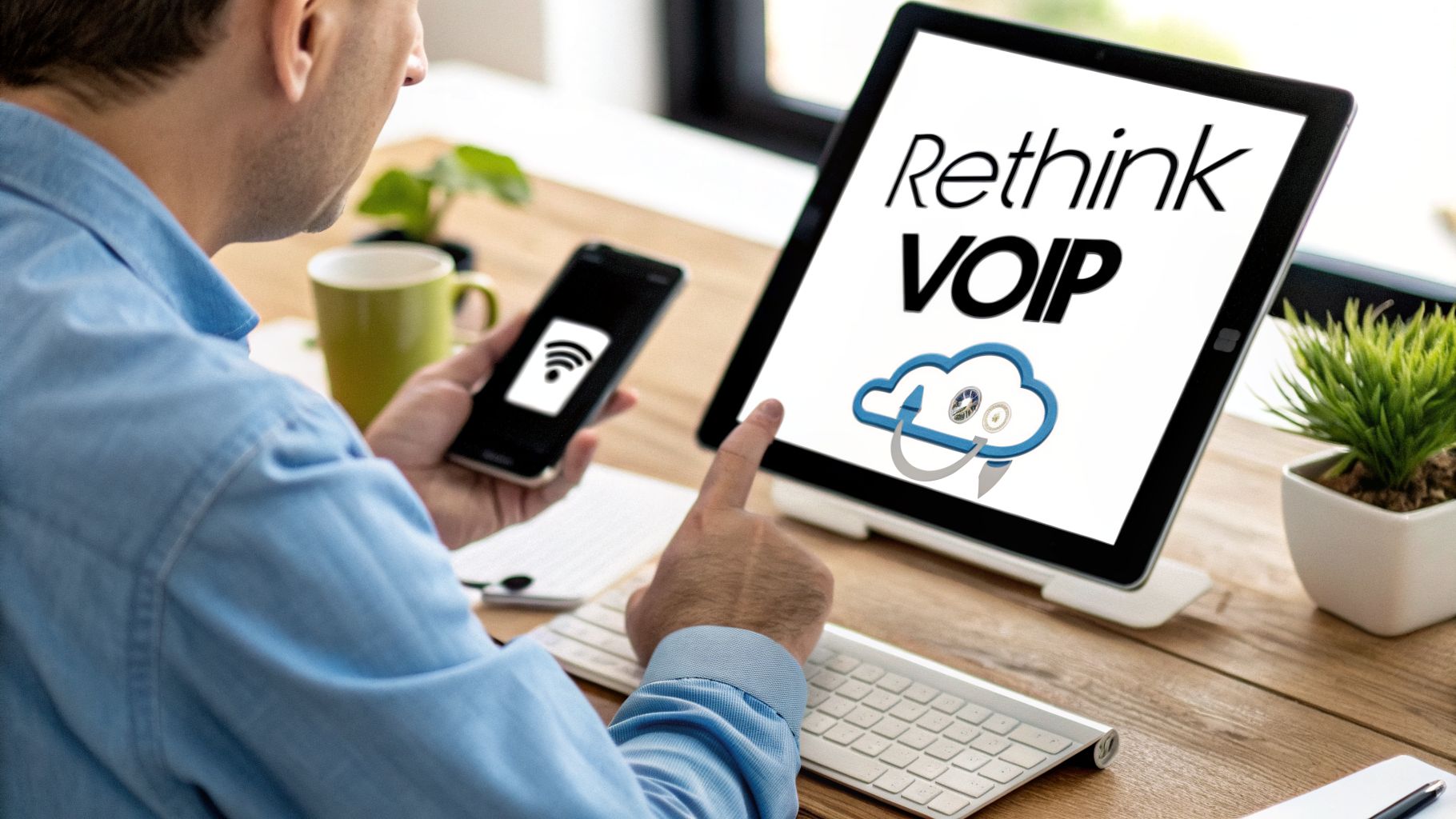
Rethinking Value in VoIP#
Most comparisons get lost in the weeds, pitting features against each other in a way that misses the point. Sure, call waiting is nice. But does it really affect your bottom line as much as an AI receptionist that can book appointments and capture lead details 24/7?
For most small businesses, the answer is a hard no.
Sometimes, a specialized solution built for a specific goal—like managing new leads—delivers way more real-world value than a bloated, all-in-one VoIP package. Instead of just comparing providers, this guide helps you compare strategies. We'll break down how focused AI tools can often deliver better results at a lower cost, so you can pick a system that actually works for you.
The New Framework for Evaluating VoIP Providers#
Before you start comparing providers, let's get one thing straight: the old way of picking a phone system is dead. Features like call waiting or a basic phone menu aren't the deciding factors anymore. To make a smart choice in 2026, your voip provider comparisons need to focus on what actually drives growth and efficiency for a small business.
We’ve built a new framework around three core pillars. This isn't about marketing fluff; it's about seeing how a system will perform in the real world and whether it’s a simple phone line or a strategic tool for your business.
1. AI and Automation Impact#
The biggest shift in business communications is, without a doubt, AI. An AI receptionist or an automated outbound dialer isn't a sci-fi concept anymore—it's a baseline requirement for staying competitive. Think about it: an AI can field unlimited calls at once, so you never miss a lead just because your line was busy.
This is where the real ROI is. A smart AI receptionist does more than just route calls. It can book appointments right into your calendar, answer frequently asked questions, and capture lead details 24/7. That directly grows your bottom line while you sleep.
AI isn’t just a nice-to-have; it's becoming standard. Projections show 98% of contact centers will use some form of AI. These systems are already delivering 14% higher resolutions per hour and cutting call handling time by 9%. It's a massive shift in what's possible.
2. Ecosystem Integration#
A phone system that operates in a silo is a liability. You have to prioritize how well a provider plugs into the tools you already use every day. The goal is a seamless flow of information between your calls and your core business systems.
You absolutely need to look for key integrations:
- CRM (Customer Relationship Management): Logging calls, texts, and customer details automatically is a must. No more manual data entry.
- Scheduling Software: Let callers book appointments directly into your Google Calendar or other scheduling apps without any human intervention.
- Workflow Automators: Make sure it connects to tools like Zapier. This allows you to trigger actions in thousands of other apps based on what happens during a call.
A solid CRM with VoIP integration is the perfect example of a modern essential. It transforms your phone from a simple communication device into an active part of your customer data pipeline.
3. Scalability and Pricing Models#
Pay close attention to how a provider charges. The traditional per-user, per-month model can get expensive fast, punishing you for adding team members who might barely use the phone. It’s an outdated approach.
Look for flexible pricing that actually aligns with your usage. A platform offering one subscription to handle all inbound calls for your entire company, no matter the team size, offers far better value and scalability. When you understand how AI-powered receptionist features work, you’ll see how a single, powerful tool can serve an entire organization without those painful per-user fees.
This is especially true for service-based businesses or agencies where call volume can be unpredictable, but every single call is a potential opportunity. Your phone system needs to be a launchpad for growth, not a barrier.
Alright, let's cut through the noise. Choosing a VoIP provider used to be about call quality and per-minute rates. Today, that’s just the starting point. We're going to break down three of the biggest names in the game—RingCentral, Nextiva, and Dialpad—using a framework that actually matters for a small business in 2026.
This isn't about feature checklists. It's about how these tools really work when you put them to the test.
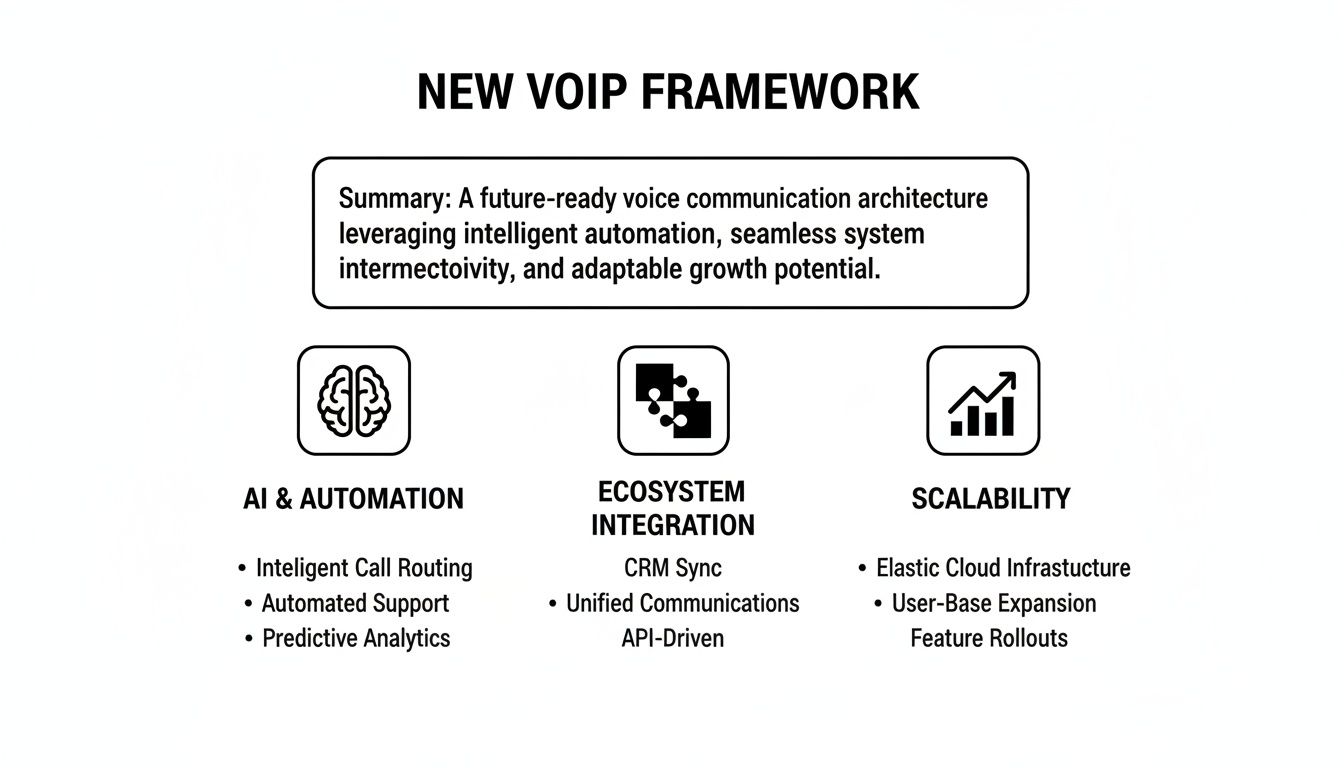
We're focusing on three things: AI automation, how well the tool connects with your other software, and whether it can grow with you without breaking the bank. These are the pillars that separate a simple phone service from a real business communication platform.
RingCentral: The Enterprise Powerhouse#
Think of RingCentral as the established giant in the VoIP world. Their platform is a beast, rolling phone, video conferencing, and team messaging into one massive system. For bigger companies trying to wrangle multiple vendors, this all-in-one approach is a huge draw.
Where RingCentral really flexes is its app gallery. It integrates with just about every business tool imaginable. If your agency is already deep into Salesforce, Microsoft 365, and a half-dozen other apps, RingCentral will probably plug right in without a fuss.
But that strength is also a major hurdle for smaller teams. The system is complex, and frankly, can be overkill. The per-user pricing model gets expensive fast, especially if you have team members who don’t live on the phone.
Key Insight: RingCentral is built for stability and scale. It's a rock-solid choice for an established business that has the budget and the IT know-how to manage a comprehensive, and sometimes complicated, system.
Nextiva: The All-In-One Customer Platform#
Nextiva positions itself as more than just a phone system; it’s a customer experience platform. They bundle VoIP with a built-in CRM, customer surveys, and analytics. The goal is to give you a single dashboard to see every touchpoint with a customer.
This integrated approach is Nextiva's main selling point. If you want to manage sales and support conversations from one place and don't need a full-blown CRM like HubSpot, Nextiva makes a strong argument. Its tools are great for managing your existing customer relationships.
However, its AI is more focused on analyzing conversations—like sentiment analysis—than on automating the front end of your business. It won't answer your phones, qualify leads, and book appointments for you 24/7. It’s a tool to help your team be more productive, not a tool that works autonomously for you.
Dialpad: The AI-Native Innovator#
Dialpad was built with artificial intelligence at its core from day one. Their "Voice Intelligence" (Vi) is front and center, offering real-time call transcription, sentiment analysis, and automated summaries for every single call.
This makes Dialpad incredibly appealing for data-driven teams. A sales manager can get real-time coaching prompts during a live call, or a support team can pull up answers to customer questions instantly. If you want to arm your team with in-the-moment data, Dialpad is tough to beat.
The catch? Its AI is all about analysis, not action. It gives you incredible insights into the calls your team is already handling, but it doesn't have an AI receptionist to actually handle the calls for you. For a business where the biggest challenge is just answering the phone and capturing every lead, Dialpad analyzes the problem rather than solving it.
2026 VoIP Provider Feature and Pricing Comparison#
To put this all into perspective, the pricing wars have made 2026 a great year to shop for a VoIP system. You’ll see plans starting from $15/user/month with Dialpad to $30/user/month with Nextiva, often with discounts for annual plans.
This side-by-side table should help clarify where each provider fits, especially when compared to a specialized AI alternative.
| Feature | RingCentral | Nextiva | Dialpad | My AI Front Desk (Alternative) |
|---|---|---|---|---|
| Best For | Enterprise-level stability and large, complex teams. | Businesses wanting a single CRM and phone system. | Agile teams focused on AI-driven call analytics. | Businesses prioritizing 24/7 lead capture and appointment scheduling. |
| AI Strength | Video summaries and basic workflow automation. | Customer sentiment analysis and productivity tools. | Real-time transcription and in-call coaching. | Autonomous AI receptionist for call answering and scheduling. |
| Pricing Model | Per-user/month, tiers add more features. | Per-user/month, bundled with CRM functionality. | Per-user/month, with AI included on all plans. | Flat monthly subscription, no per-user fees. |
| Ideal Business Profile | Established companies with dedicated IT staff. | Service businesses managing ongoing client relationships. | Sales and support teams needing real-time data. | Service pros, agencies, and lean teams needing to convert every lead. |
This table gets to a critical point: the "best" provider is the one that solves your biggest problem. While these full-suite VoIPs are powerful, they aren't always the right tool for the job.
If your main goal is to make sure you never miss a lead, you might not need a complex system with a dozen features you'll never use. For a more granular look at how these systems stack up, check out our guide on how My AI Front Desk compares to other systems. Next, we'll dig into whether a full VoIP system is even the right move for your business.
When a Full VoIP System Is Overkill#
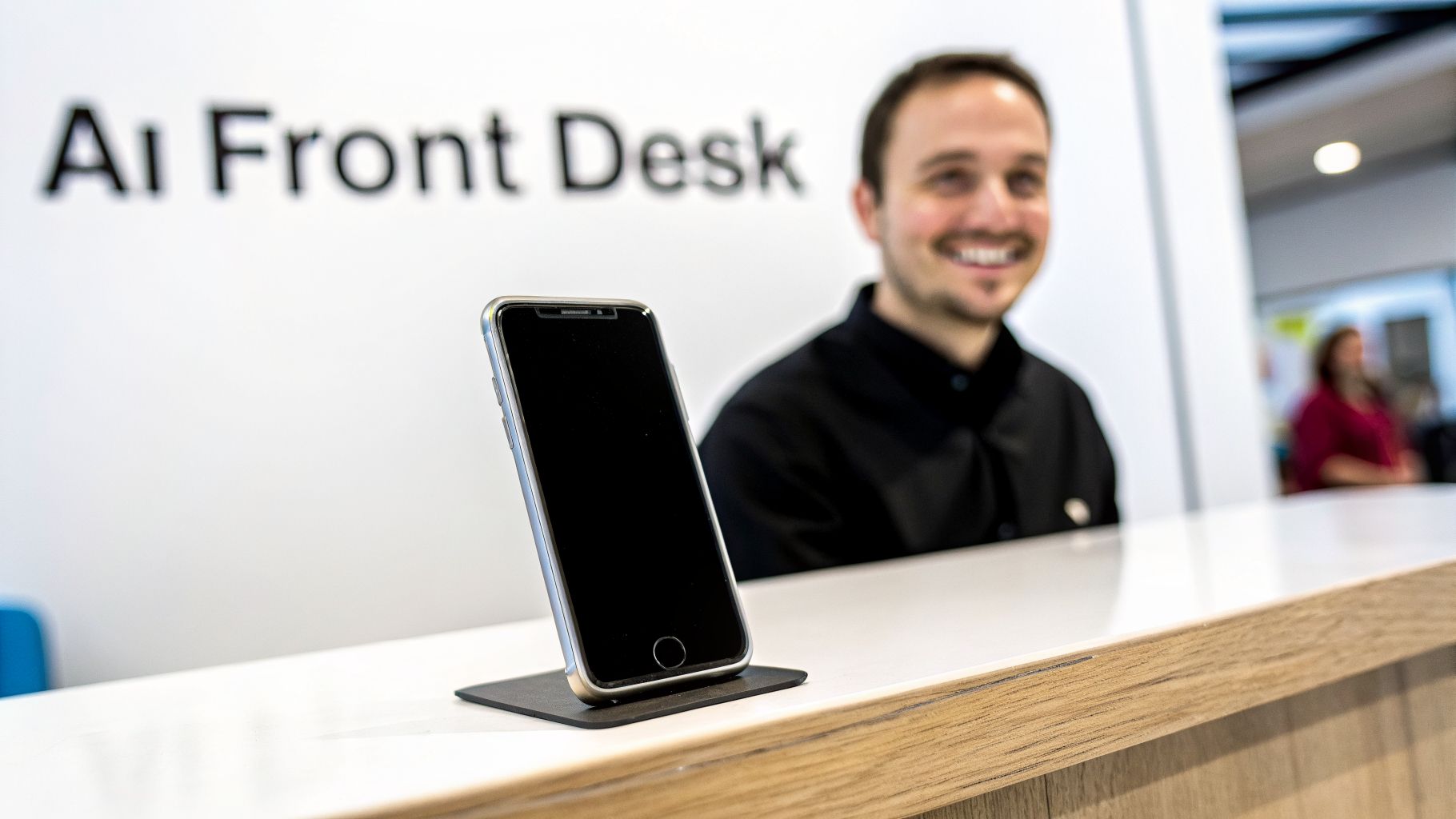
The VoIP provider comparisons we’ve walked through show just how powerful these platforms can be. But let's be honest—do you actually need all of it? For many small businesses and agencies, signing up for a full-scale VoIP plan is like buying a fancy Swiss Army knife when you just needed a corkscrew.
A system loaded with internal extensions, company-wide video conferencing, and team chat might seem impressive. In reality, it often brings a hefty price tag and a frustrating learning curve. If your main goal is to capture every single lead and manage customer appointments without a hitch, a complex VoIP plan can be total overkill.
You end up paying for features your team never touches, while the one thing you really need—flawless, 24/7 call answering—is handled by a clunky, basic auto-attendant. This is where a specialized tool isn’t just an alternative; it's a much smarter investment.
Comparing Core Functions: AI Receptionist Vs. VoIP Auto-Attendant#
Let’s get specific. People often confuse a traditional VoIP auto-attendant with a modern AI receptionist, but they operate on completely different levels. Understanding this is the key to making a smart, cost-effective choice for your business.
A VoIP auto-attendant is just a simple decision tree. It plays a recording ("Press 1 for sales, Press 2 for support...") and routes callers based on which button they push. It's rigid and impersonal. Worse, it can only handle one call at a time per phone line. If two great leads call at once, one is getting a busy signal or being sent straight to voicemail.
An AI receptionist, like My AI Front Desk, is completely different. It’s conversational and dynamic. It can handle unlimited simultaneous conversations, so you literally never miss a call because the line was busy. It doesn't just route calls—it engages callers, answers their specific questions, gathers detailed information, and even books appointments directly into your calendar.
Think of it this way: a traditional auto-attendant is a passive gatekeeper that just points traffic. An AI receptionist is an active, intelligent agent that qualifies leads, books appointments, and captures revenue for your business around the clock.
For any business where a missed call means lost money, that distinction is huge.
The Cost Equation: Per-User Vs. A Flat Subscription#
The financial argument is just as straightforward. Most VoIP providers use a per-user, per-month pricing model. This means your bill goes up with every new hire, whether they use the phone a lot or not. For a team of ten, a plan that looks like a good deal at $25/user/month suddenly becomes a $3,000 annual expense.
This model actually penalizes you for growing your team. It’s designed to maximize the provider’s revenue, not your efficiency.
Now, let's contrast that with a single subscription for an AI receptionist. A tool like My AI Front Desk handles every inbound call for your entire company under one simple, flat monthly fee.
- Typical VoIP Plan: Ten users at $25/month each = $250/month.
- AI Receptionist: One subscription for the whole company = ~$50/month.
The AI acts as a powerful, central front desk for everyone, without needing individual licenses. It’s a strategic tool designed for revenue generation, not just an operational cost that balloons with your headcount. For most small businesses, this isn't just a better option—it's a fundamentally smarter business decision.
It's easy to get lost in a sea of VoIP provider comparisons, staring at endless feature lists until your eyes glaze over. But here’s the thing: the "best" system isn't the one with the most bells and whistles. It's the one that actually fits how your business operates and what you need to accomplish every day.
Let's cut through the noise and look at three common business types. We'll break down what each one really needs from a communication system and pinpoint the right tool for the job, whether that’s a traditional VoIP service or a more focused AI solution like My AI Front Desk.
The Local Service Pro#
Think of your local plumber, electrician, or HVAC technician. For them, business isn't won in a team chat channel—it's won by being the first to answer the phone. A missed call isn't just a missed opportunity; it's a potential four-figure emergency job handed directly to a competitor.
Their entire business hinges on a few core needs:
- Immediate Lead Capture: Answering every single call, 24/7, no matter what.
- Appointment Scheduling: Getting jobs booked right into the calendar without needing to call the customer back.
- Urgency Filtering: Knowing the difference between a leaky faucet and a burst pipe, and getting the emergency calls to a human—fast.
A complex VoIP system with dozens of internal extensions is just overkill here. The only thing that truly matters is converting that initial phone call into a paying job.
Recommendation: My AI Front Desk
An AI receptionist is the perfect fit. It can handle unlimited calls at once, so a potential customer never, ever gets a busy signal. It books appointments directly into a Google Calendar, gathers job details, and intelligently forwards real emergencies while the owner is out on another job.
The Digital Marketing Agency#
Digital marketing agencies live in a fast-paced, client-centric world. They need powerful communication tools for their own team, but they're also sitting on a goldmine: the ability to offer new, high-margin services to their clients.
Here’s what they need to thrive:
- Client-Facing Solutions: The ability to offer services like call tracking and automated lead management to their clients.
- Brand Control: A way to resell a service under their own agency's brand.
- Scalable Analytics: Hard data to prove campaign ROI to clients, showing detailed call metrics and conversion rates.
While a robust system like RingCentral is great for internal agency collaboration, it’s not designed to be repackaged and sold to clients.
Recommendation: My AI Front Desk Whitelabel Program
The whitelabel program is a genuine game-changer for agencies. They can rebrand the AI receptionist and outbound dialer as their own premium service, creating a brand new recurring revenue stream with almost zero overhead. It solves their clients' lead-handling problems and makes the agency look like a hero.
The E-commerce Business#
An e-commerce brand is all about volume—a high volume of products, orders, and customer questions. Their goal is to provide scalable support for common inquiries about orders, returns, and products across multiple channels, especially phone and text.
Their priorities are clear:
- Scalable Customer Support: Handling a flood of repetitive questions without needing a massive call center team.
- Omnichannel Communication: Managing both phone calls and text messages from a single, unified place.
- Integration with E-commerce Platforms: The ability to connect their phone system to tools like Shopify for instant order lookups.
While an AI receptionist is great for that first point of contact, e-commerce brands often need a human agent for complex order issues. They need a system that gives their team the right information at the right time. For more ideas, our guide on the best VoIP with texting providers is a great resource.
Recommendation: Dialpad or Nextiva
For this scenario, a full-fledged VoIP system is the right call. Dialpad gives live agents real-time call transcriptions and AI-powered suggestions to help them solve problems faster. Nextiva, on the other hand, offers a more all-in-one platform with a built-in CRM, making it perfect for tracking customer support history across calls and texts.
Your Smooth-Switching Checklist for a New Phone System#
Making the jump to a new phone system can feel like a massive project, but it doesn't have to be a headache. With the right game plan, you can sidestep the usual chaos. This checklist breaks it all down, making sure your switch is smooth and gets you the results you want without interrupting your business.
1. Take a Hard Look at Your Current Setup#
Before you start shopping around, you need to know exactly what you’re working with. Spend a week tracking your calls. How many are coming in? What are your busiest times of day?
Getting these real-world numbers is the only way to do a proper VoIP provider comparison and find a system that actually fits how you operate, not just one that looks good on paper.
2. Decide on Your Business Number#
Next up: what are you doing with your phone number? You’ve really only got two paths here.
- Port Your Existing Number: This is what most businesses do. It lets you keep the number your customers already have saved in their phones. Just be aware, porting can take anywhere from a few days to a couple of weeks, so build that time into your plan.
- Get a New Number: Sometimes, a clean slate is the way to go. A new number can give you an instant local presence in a new city or help you track calls from a specific marketing campaign.
Porting a number is a regulated process, so there are specific steps you have to follow. Your new provider will walk you through it, but you absolutely need to start this part early to make sure you don't have any downtime between systems.
3. Get Configured and Go Live#
Once the number is handled, it's time to dial in the new system. This is where you'll connect your CRM and calendar, set your business hours, and program how your AI receptionist or call routing will work. If you're still weighing your options, our guide to business phone systems can help you sort through the choices.
Finally, get your team comfortable with the new tools and give your customers a heads-up about the upgrade. A little training and communication go a long way, ensuring you start benefiting from your new, modern phone system from day one.
Got Questions? We’ve Got Answers.#
As you wrap up your research on VoIP providers, a few last-minute questions are bound to pop up. Here are some straightforward answers to the most common ones we hear, helping you make that final decision with total clarity.
Can I Keep My Current Business Number?#
Yes, you can. Every quality VoIP provider, along with AI services like My AI Front Desk, makes it easy to port your existing business number.
This process is called number porting, and it simply transfers your current phone number to your new service. Your customers won't notice a thing. It's a standard procedure, but be aware it can take a few business days, so it's smart to start the porting process as soon as you sign up.
What’s the Real Difference Between a VoIP Auto-Attendant and an AI Receptionist?#
The gap between them is huge. A traditional auto-attendant is just a basic "press-1-for-sales" menu that directs callers down a fixed path. An AI receptionist is something else entirely—it's conversational.
Think of it this way: An auto-attendant is a rigid phone directory. An AI receptionist is an interactive assistant. It understands what callers are saying, answers their specific questions, gathers information, and can even book appointments right into your calendar. All on its own.
How Much Technical Skill Is Needed for Setup?#
Honestly, not much. Modern systems are built for people who aren't tech experts.
Setting up a service like My AI Front Desk is incredibly simple and takes just a few minutes, with zero coding needed. You just connect your calendar, define your business hours, and tell the AI how to answer questions through a clean online dashboard. The whole point is to get you live in minutes, not days.
Are AI Phone Systems Secure for Handling Customer Data?#
Absolutely. Security is non-negotiable for today's communication platforms. Reputable AI phone systems use strong encryption to protect all call data and are designed from the ground up with privacy as a core principle. They adhere to strict industry standards to keep sensitive customer information locked down and confidential.
Ready to see how an AI receptionist can completely change your customer service and lead capture? My AI Front Desk works 24/7 to make sure every call is answered, every appointment is booked, and every opportunity is captured. Start your free trial today and see the difference.


